
Sep 15, 2017 | News, Publications, Reports, Thematic reports
Failure to assert the rule of law in the transfer of suspects across borders perpetuates violations of human rights in cases where national security is invoked, a new ICJ report finds.
Released today, the ICJ report Transnational Injustices – National Security Transfers and International Law documents laws and practices in the OSCE region involving transfer of national security suspects by all possible means without regard to national law or States’ international legal obligations.
“This report demonstrates that, under different guises, some States still continue to abuse extradition and expulsion procedures and sometimes even to resort to abductions and renditions in cases related to counter-terrorism or national security,” said Róisín Pillay, Director of the ICJ Europe and CIS Programme.
“This has pernicious consequences for the respect of human rights and the rule of law,” she added.
“In some states, such as in Russia and Central Asia, existing national legal procedures to protect against abusive transfers have been bypassed or ineffective,” Pillay said.
She added: “We need to put judges and human rights law at the heart of extradition procedures to ensure their effectiveness and to prevent arbitrary and extra-legal transfers of suspects.”
Lack of accountability in cases where suspects’ human rights have been violated fuels further abuses, the report finds.
“With the closure of the US programmes, renditions were thought to be over,” said Massimo Frigo, Legal Adviser at the ICJ.
“The almost complete lack of accountability for US renditions has provided a blank check of legitimacy to any countries trying to bend or break the rules at the expenses of the basic safeguards of one’s human rights,” he added.
Background
Practices in a number of States in recent years have highlighted the serious implications for human rights and the rule of law of transfers of people based on national security and criminal cooperation grounds in the Russian Federation, Central Asia and beyond.
Extraditions, expulsions and, sometimes, transfers occurring outside of the legal framework have triggered international reactions and rulings of international courts and quasi-judicial bodies.
The ICJ report Transnational Injustices – National Security Transfers and International Law is based on research of these practices, documenting illustrative cases, and the applicable legal framework.
The report analyses extradition, expulsion and informal transfers in the Russian Federation, Central Asian countries and EU Member States, as well as the rendition practices in the United States and assesses the situation against international human rights law.
The report offers concrete recommendations for change based on the comparative experiences of selected EU member States.
Contact:
Róisín Pillay, ICJ Europe Programme Director, t: +32 2 734 84 46 ; e: roisin.pillay(a)icj.org
Massimo Frigo, ICJ Legal Adviser, t: +41 22 979 3805 ; e: massimo.frigo(a)icj.org
Europe-Transnational Injustices-Publications-Reports-Thematic reports-2017-ENG (Full report in English, PDF)
Europe-Transnational Injustices-Publications-Reports-Thematic reports-2017-RUS (Full report in Russian, PDF)
Europe-Transnational Injustices-ExecSummary-Publications-Reports-Thematic reports-2017-ENG (Executive Summary in English, PDF)
Europe-Translational Injustices-ExecSummary-Publications-Reports-Thematic reports-2017-RUS (Executive Summary in Russian, PDF)

Sep 14, 2017 | Advocacy, Cases, Legal submissions, News
On 13 September, the European Committee of Social Rights decided on the admissibility of the collective complaint submitted by the ICJ and Forum for Human Rights, against the Czech Republic.
The Committee assessed the admissibility conditions set out in the Protocol and the Committee’s Rules and the Government’s objections on admissibility and declared the complaint admissible. The Czech Government has now two months to make written submissions on the merits of the complaint.
The complaint argues that the Czech Republic fails to ensure equal legal protection and participation of children below the age of criminal responsibility in the pre-trial stage of juvenile justice procedures.
The ICJ and FORUM submit that serious systemic flaws in the Czech juvenile justice system deprive a specific group of particularly vulnerable individuals – children below the age of criminal responsibility – of an adequate level of social protection and leave them at risk of inappropriate or unfair procedures leading to arbitrary punitive measures, in violation of Article 17 of the European Social Charter, both alone and read in conjunction with the principle of equality in the preamble to the Charter.
Europe-ECSR-ICJvCzechRepublic-ChildrenJustice-AdmissibilityDecision-2017 (download the Committee’s decision)
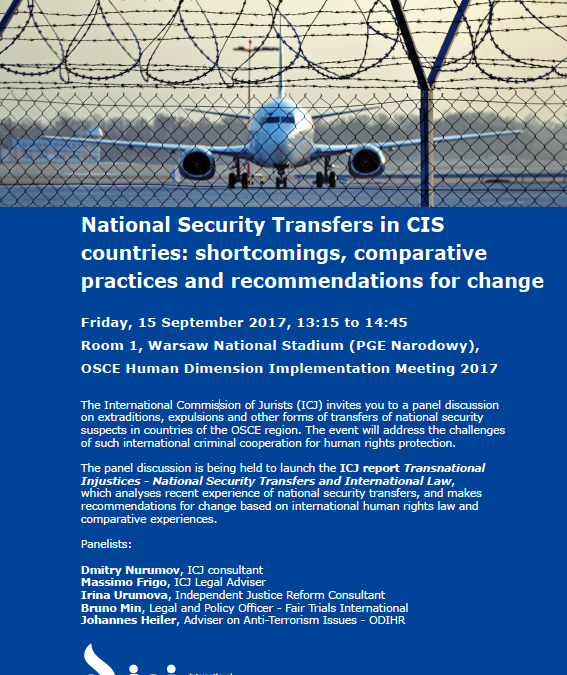
Sep 14, 2017 | Events
At a side event to the OSCE Human Dimension Implementation Meeting 2017, the ICJ will review the latest developments on extraditions, expulsions and other forms of transfers of national security suspects in countries of the OSCE region.
The event will address the challenges of such international criminal cooperation for human rights protection.
The panel discussion is being held to launch a new ICJ report which analyses recent experience of national security transfers, and makes recommendations for change based on international human rights law and comparative experiences.
The event will take place in Warsaw Friday 15 September at 13:15 – 14:45 at Room no. 1 at the OSCE HDIM 2017.
Panelists:
- Dmitry Nurumov, ICJ consultant
- Massimo Frigo, ICJ Legal Adviser
- Irina Urumova, Independent Justice Reform Consultant
- Bruno Min, Legal and Policy Officer – Fair Trials International
- Johannes Heiler, Adviser on Anti-Terrorism Issues – ODIHR
Working language: English and Russian (simultaneous translation provided)
A flyer for this event is available in PDF format by clicking here.
For more information, contact massimo.frigo(a)icj.org and/or dina.iskaliyeva(a)icj.org

Sep 13, 2017 | Advocacy
The ICJ joined 17 other organizations in calling for robust and human rights compliant international standards to regulate the use of “Unmanned Aerial Vehicles” , developed through fully inclusive and consultative processes.
Universal-DroneStandards-Advocacy-2017-ENG (full PDF)

Sep 13, 2017 | Advocacy, News
As proceedings resume in India v. Pakistan (Jadhav case) before the International Court of Justice (ICJ), the ICJ has published a briefing paper to clarify the key issues and relevant laws raised in the case in a Question and Answer format.
The case concerns Pakistan’s failure to allow for consular access to an Indian national detained on charges of serious crimes.
India has alleged “egregious violations of the Vienna Convention on Consular Relations (VCCR)” by Pakistan in connection with the detention, trial and conviction of Indian national Kulbhushan Sudhir Jadhav.
Pakistani authorities arrested Jadhav on 3 March 2016.
India was informed of the arrest on 25 March 2016. On 10 April 2017, Pakistan’s military announced Jadhav had been convicted and sentenced to death by a military court for “espionage and sabotage activities against Pakistan.”
India’s requests for consular access, made at least sixteen times starting from 25 March 2016, were either denied by Pakistan or made conditional upon India’s assistance in the investigation against Jadhav.
India alleges that denial of consular access breaches Pakistan’s obligations under Article 36(1) of the VCCR, to which both States are parties.
In May 2017, the ICJ accepted India’s request for provisional measures and directed Pakistan to “take all measures at its disposal” to ensure Jadhav is not executed pending the final decision of the Court.
India is due to file its written memorial with supporting documents today, 13 September.
Pakistan will have three months to file a counter-memorial.
The ICJ will then decide on dates for oral hearing of arguments.
Following the hearings, the Court will deliberate and issue a judgment.
While the case at issue is limited to denial of consular access under the VCCR, it engages other critical fair trial concerns that arise in military trials in Pakistan.
The International Commission of Jurists has documented how Pakistani military courts are not independent and the proceedings before them fall far short of national and international fair trial standards.
Judges of military courts are part of the executive branch of the State and continue to be subjected to military command; the right to appeal to civilian courts is not available; the right to a public hearing is not guaranteed; and a duly reasoned, written judgment, including the essential findings, evidence and legal reasoning, is denied.
The case also underscores one of inherent problems of the death penalty: that fair trial violations that lead to the execution of a person are inherently irreparable.
The International Commission of Jurists considers the death penalty a violation of the right to life and cruel, inhuman or degrading punishment and notes that a large majority of States, in repeated UN resolutions, have called on retentionist states to declare a moratorium on the practice with a view to abolition.
Contact:
Frederick Rawski (Bangkok), ICJ Asia Pacific Regional Director, e: frederick.rawski@icj.org
Reema Omer (London), ICJ International Legal Adviser, South Asia t: +447889565691; e: reema.omer(a)icj.org
Download the Q&A:
India-ICJ Q&A Jadhav case-Advocacy-2017-ENG (in PDF)