Dec 4, 2014 | Events, News
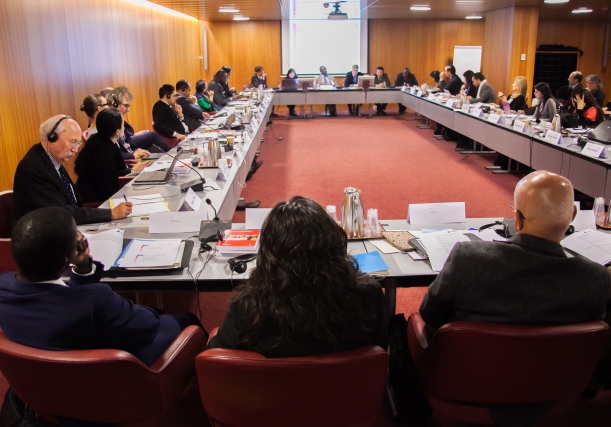
Today and tomorrow, the ICJ welcomes judges and lawyers from all regions of the world to discuss the “Judicial Enforcement of Economic, Social and Cultural Rights”.
The 2014 Geneva Forum of Judges and Lawyers is a joint initiative of the ICJ Center for the Independence of Judges and Lawyers (CIJL) and the ICJ Programme on Economic, Social and Cultural Rights.
Participants are exchanging views on the progress made over the past two decades, including the entry into force of the Optional Protocol to the International Covenant on Economic, Social and Cultural Rights in May 2013.
The Protocol allows individuals to bring complaints of violations of such rights to an independent international body of experts for adjudication.
Discussions are held also in relation to challenges to the justiciability of these rights, including as regards the principle of separation of powers between the judicial, executive and legislative branches of government.
Managing potential implications for public human and financial resources of judicial orders for enforcement of ESCR, and the conflicts that may arise between state development plans, public interest and the interests and rights of the individuals, will also be topics of discussion.
Participants are invited to ground the discussion of conceptual issues in examples from their own actual experience and practice in their national jurisdictions.
Alejandra Ancheita, recent winner of the Martin Ennals Award 2014 – The Nobel Prize of Human Rights – is among the guest speakers.
A report of the discussions will be published in 2015.
The draft agenda for the 2014 Geneva Forum is available here:
Universal-Programme GVA Forum 2014-Events-2014-ENG (English)
Universal-Programme GVA Forum 2014-Events-2014-ESP (Español)
The 2014 Geneva Forum has been made possible with the support of the République et Canton de Genève, the Permanent Mission of Germany to the United Nations in Geneva, and the Taipei Bar Association.
The Geneva Forum has been convened annually by the CIJL since 2010.
Information on, and reports of, the previous Geneva Forums can be found here:
Geneva Forum 2013 (photo)
Geneva Forum Series no. 1: Women and the Judiciary
Geneva Forum 2012
Third Geneva Forum for Judges and Lawyers: the report is published
Geneva Forum 2011
2nd ICJ Geneva Forum of Judges and Lawyers: final report
Geneva Forum 2010
1st ICJ Geneva Forum of Judges and Lawyers: accountable national security policies – the role of judges and legal practitioners
Dec 1, 2014 | News
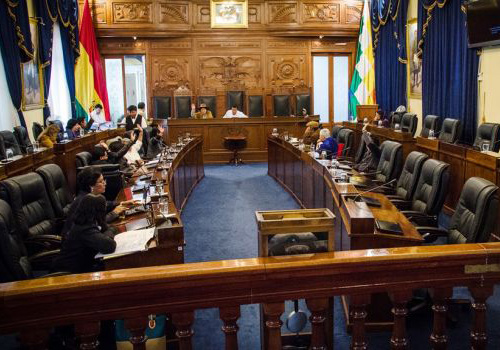
The ICJ expresses deep concern that the Legislative Assembly of Bolivia continues to threaten three Constitutional Court judges with removal, and possibly criminal punishment, based solely on legislators’ disagreement with a legal opinion and ruling issued by the judges.
A “trial” of the three judges conducted by the Senate is scheduled to begin on 4 December 2014.
The ICJ has previously condemned the proceedings as fundamentally flawed and in violation of international standards for the independence of judges.
The legislature and government now appear to accept some of the ICJ’s criticisms.
Last-minute legislative amendments would apparently specify that the legislative assembly process is disciplinary in character and that the only sanction the assembly can directly impose is permanently to remove judges from office; if a disciplinary violation is found, the case would be referred onward for criminal prosecution before the ordinary courts. (Legislators were previously reported to be seeking for the Senate itself to impose a sentence of 10 years’ imprisonment.)
The ICJ reaffirms, however, that the case against these three judges remains inherently flawed because the allegations on which the proceedings are based cannot be a valid basis for any removal from office or criminal punishment.
“It is fundamental to the independence of the judiciary, and the rule of law, that judges must be able to decide cases without fear of punishment for their legal opinions and rulings, including those that the government or legislature may not like,” said Matt Pollard, Head of the Centre for Independence of Judges and Lawyers at the ICJ.
“The procedural amendments under consideration could be an improvement for other kinds of cases in the future,” said Pollard. “However, the stated reason for pursuing these three judges – disagreement with the content of their legal opinion and ruling – cannot form a valid basis for their removal from office or criminal punishment under any procedure.”
“The case against these three judges cannot be cured by legislative ‘quick fixes’ and must simply be dropped immediately,” Pollard added.
The ICJ is also concerned that the legislature has said it will press ahead immediately with the “trial” on 4 December, a few days from now, while fundamental changes to the procedure are still underway.
Further, the media has reported that Chamber of Deputies President Marcelo Elío has stated that the judges could avoid trial by “voluntarily” resigning before 4 December.
It would be unacceptable to use the threat of unjust or unclear procedures to pressure a judge to resign.
The ICJ welcomes the decision by the legislature to review and potentially reform judicial accountability procedures in Bolivia.
At the same time, reform of procedures that are of such fundamental importance to the rule of law and democracy should be based on a process of broader consultation with all concerned stakeholders, and more considered, comprehensive and detailed assessment and analysis in relation to international standards.
For instance, under the new amendments, it would appear that the Senate (photo) has no option in any case to impose a disciplinary penalty less than permanent removal from office, even if this would be disproportionate.
Placing all responsibility for disciplinary proceedings with an independent Judicial Council should also be considered.
In October, the ICJ sent an open letter and analysis brief to members of the Legislative Assembly, explaining why the proceedings violate international law and standards, urging that proceedings against the three judges immediately be ended, and recommending a process of longer-term reform of judicial accountability processes in Bolivia.
Contact:
English: Matt Pollard, Head of the Centre for Independence of Judges and Lawyers at the ICJ, t: +41 79 246 54 75; e: matt.pollard(a)icj.org
Spanish: Carlos Ayala, ICJ Commissioner, t: +58 212 952 8448; e: carlos.ayala(a)icj.org
Bolivia-Procedimento magistrados-News-Press Release-2014-SPA (full text in PDF)
(Update: the proceedings were suspended on 4 December, and are to continue on 9 December)

Nov 19, 2014 | Events, News
On 18 November, the ICJ presented and discussed, in a meeting at the European Parliament in Brussels, its two reports on special economic regimes and their impact on social rights in Peru and Morocco.
MEP Richard Howitt, Member of the Subcommittee on Human Rights at the Parliament, and ICJ Commissioner Olivier De Schutter led the discussions.
The reports highlight the impact on rights, including labour and social security, land and water rights, of special economic regimes that aim at facilitating exports and investment in areas such as agriculture and textile.
The meeting enabled discussion of the role that the EU and its member states can and should play in its general dialogue and cooperation with the two countries, particularly in regard to trade relationships and agreements and also the regulation of the EU based business enterprises benefiting from these special regimes.
The presentation of the ICJ research and reports comes at an important moment in the relationships of the EU with both Peru and Morocco.
As to the latter, the ICJ report will feed into the Human Rights dialogue between the Subcommittee on Human Rights of the European Parliament and Morocco that is taking place today in Brussels.
Reports:
Peru-Social Rights for Export Promotion-Publications-thematic report-2014-ENG (Full report in English – PDF)
Peru-Regimenes especiales exportacion-Publications-thematic report-2014-SPA (Full report in Spanish – PDF)
Morocco-Droits sociaux et regimes speciaux-Publications-thematic report-2014-FRE (Full Report in French – PDF)
Contacts:
Carlos Lopez, Senior Legal Advisor, Business and Human Rights Programme, t +41 22 979 3816, carlos.lopez(a)icj.org
Sandra Ratjen, Senior Legal Advisor, Economic, Social and cultural Rights Programme, t +41 22 979 3835, sandra.ratjen(a)icj.org
Nov 15, 2014 | News
La Comisión Internacional de Juristas, a través de su representante para Suramérica, Federico Andreu-Guzmán, intervino como perito en el procedimiento interamericano, a solicitud de los representantes de las víctimas.
Oct 16, 2014 | Advocacy, Analysis briefs, News, Open letters
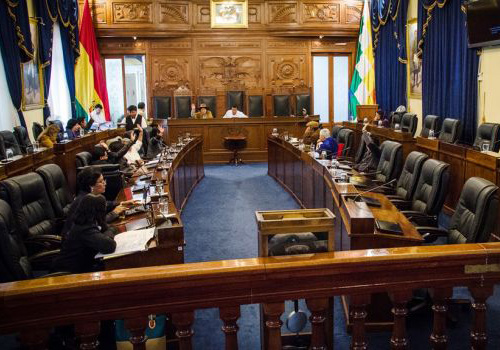
The ICJ condemns the imminent “trial” of Constitutional Court judges by Bolivia’s Senate, in proceedings that could see the judges sent to prison over politicians’ disagreement with a legal ruling.
The proceedings “violate the independence of the judiciary and the right to fair trial,” the Geneva-based organization wrote today in an open letter to all Senators and Deputies of the legislative assembly.
The charges in the trial, scheduled to begin on 21 October, are based entirely on a precautionary ruling by the judges that parts of a new law regulating notaries should not be implemented until the Court has an opportunity to hear a constitutional challenge to the law.
“The spectacle of dozens of politicians pretending to act as an independent and impartial criminal court, threatening to throw constitutional court judges in jail over a difference of opinion as to interpretation of the law, is incompatible with respect for human rights, the separation of powers, and the rule of law,” said Matt Pollard, Head of the Centre for Independence of Judges and Lawyers at the ICJ.
Constitutional Court Judges Soraida Rosario Chanez Chire and Ligia Mónica Velásquez Castaños are to be tried on 21 October, while proceedings against Judge Gualberto Cusi Mamani have reportedly been temporarily suspended for reasons of health. The judges were suspended from duty on 28 July.
An analysis brief published by the ICJ and sent to the legislative members concludes that the proceedings violate Bolivia’s international legal obligations under the American Convention on Human Rights and the International Covenant on Civil and Political Rights.
The brief also cites judgments of the Inter-American Court of Human Rights that found violations of the American Convention as a result of defective parliamentary proceedings for removal of judges in other countries. The proceedings in Bolivia are poised to be even more egregious than the proceedings at issue in the earlier judgments, given the possibility for the Bolivian Senate (photo) to impose a criminal conviction and imprisonment.
“The ICJ urges the Senators and Deputies immediately to cancel the proceedings, to end the judges’ suspension from duty, to refrain from any other form of interference with judicial independence, and to reform judicial discipline and removal procedures to bring them into line with international standards,” said Pollard.
(update as of 21 October: the proceedings were postponed to 4 November after one of the judges collapsed on arrival at the Legislative Assembly and was taken to hospital).
Contacts:
English: Matt Pollard, Head of the Centre for Independence of Judges and Lawyers at the ICJ, t: +41 79 246 54 75; e: matt.pollard(a)icj.org
Spanish: Carlos Ayala, ICJ Commissioner, t: +58 212 952 8448; e: carlos.ayala(a)icj.org
BOLIVIA-Unfair trial of judges-News-Press release-2014-SPA (full text in PDF)
BOLIVIA-unfair trial of judges-Advocacy-Open letter-2014-ENG (full text in PDF)
BOLIVIA-unfair trial of judges-Advocacy-Open letter-2014-SPA (full text in PDF)
BOLIVIA-unfair trial of judges-Advocay-Analysis brief-2014-ENG (full text in PDF)
BOLIVIA-unfair trial of judges-Advocacy-Analysis brief-2014-SPA (full text in PDF)