Tunisia: ICJ workshop highlights need  for Specialized  Criminal Chambers to deliver justice for victims of gross human rights violations

Tunisia: ICJ workshop highlights need for Specialized Criminal Chambers to deliver justice for victims of gross human rights violations

The credibility of the criminal trials currently ongoing before Tunisia’s Specialised Criminal Chambers depends on their capacity to deliver justice and reparation to victims and their families in a manner consistent with international law, said more than 25 Tunisian lawyers and human rights defenders at a workshop organized with the ICJ and international experts.

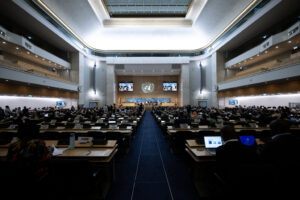
The workshop, which was held in Tunis on 25 and 26 March, aimed at enhancing the capacity of participants to use international law in the preparation and litigation of cases before the Specialized Criminal Chambers (SCC) effectively.

The participants discussed the application of international law and standards relating to the notions of victims and persons entitled to reparation before the SCC. Participants also considered the various forms of reparation, including restitution, compensation, rehabilitation and satisfaction, and guarantees of nonrepetition.

The workshop was attended by international and Tunisian experts, along with ICJ representatives.

The Director of ICJ’s Middle East and North Africa Programme, Said Benarbia, emphasized the importance of guaranteeing the right of victims to effective remedies and reparations, especially in transitional justice contexts.

Mondher Cherni, the SecretaryGeneral of the Tunisian Organization Against Torture (OCTT), underlined that reparations must be comprehensive. Tunisian courts should ensure the adoption of a comprehensive notion of harm, while addressing the violations suffered by victims in Tunisia,” he said.

Rachel Towers, Legal Advisor at Dignity (The Danish Institute Against Torture)highlighted that there is no justice without remedies and reparations; accordingly, Tunisia should ensure that victims of gross human rights violations may enjoy these rights effectively.

Clive Baldwin, Senior Legal Advisor at Human Rights Watch, said that “Tunisia is not only bound to punish and sanction gross human rights violations, but also to prevent them from occurring in the future.” Baldwin also emphasized the importance of providing a comprehensive set of guarantees of nonrepetition, including legislative and institutional reforms aiming to ensure effective civilian control of military and security forces and the independence of the judiciary.

Participants also addressed the lack of compliance in law and practice of the Tunisian transitional justice framework with international law and standards.

The functioning and delivery of transitional justice in Tunisia has been enduring numerous and complex challenges over the last years,”said Benarbia.The Tunisian authorities should immediately respond to these challenges with a holistic action plan, based on concrete reforms and solutions” Benarbia added.

Contact

Valentina Cadelo, Legal Adviser, ICJ Middle East and North Africa Programme, e: valentina.cadelo(a)icj.org

Asser Khattab, Research and Communications’ Officer, ICJ Middle East and North Africa Programme, e: asser.khattab(a)icj.org

Tunisia:  Joint communication to UN Special Procedures calls for immediate action to counter attacks against the transitional justice process

Tunisia:  Joint communication to UN Special Procedures calls for immediate action to counter attacks against the transitional justice process

In a joint communication to five United Nations Special Procedures, the ICJ and its partners urged the mandate holders to call on the Tunisian authorities to immediately stop hampering the transitional justice process.

The organizations expressed their concern at the ongoing attempts to undermine the transitional justice process and accountability efforts for past gross human rights violations.

“The Tunisian transitional justice process has been under serious attack since its inception in 2013. Today, the ICJ and its partners are urging the United Nations Special Procedures to take urgent action to deter such attacks, demand justice for the victims and secure accountability for the perpetrators,” said the Director of ICJ’s Middle East and North Africa Programme, Said Benarbia.

The joint communication highlights the following areas of concern:

  • The recent political initiatives to dismantle the transitional justice process;
  • The incessant attacks against the Truth and Dignity Commission (Instance Verité et Dignité, IVD) and its 2018 final report’s findings;
  • The lack of support to the Specialized Criminal Chambers (SCC) and the numerous obstacles that risk to severely impair access to justice and effective remedies for victims of gross human rights violations.

The communication is addressed to the following United Nations Special Procedures:

  • The Special Rapporteur on the promotion of truth, justice, reparation and guarantees of non-recurrence;
  • The Special Rapporteur on torture and other cruel, inhuman or degrading treatment or punishment;
  • The Special Rapporteur on the independence of judges and lawyers;
  • The Working Group on Arbitrary Detention; and
  • The Working Group on Enforced or Involuntary Disappearances.

The communication was submitted jointly by the ICJ along with:

  • The World Organisation Against Torture (OMCT)
  • The Ligue tunisienne des droits de l’homme (LTDH)
  • The Forum Tunisien pour les Droits Economiques et Sociaux (FTDES)
  • Avocats Sans Frontières (ASF)
  • The Association of Tunisian Magistrates (AMT)
  • Al Bawsla
  • International Alert
  • The Association KARAMA
  • The Association INSAF pour les anciens militaires
  • No Peace Without Justice
  • The Organisation Contre la Torture en Tunisie (OCTT)
  • The Organisation Dhekra we Wafa, pour le martyr de la liberté Nabil Barakati
  • The Coalition Tunisienne pour la Dignité et la Réhabilitation
  • The Association Tunisienne pour la Défense des Libertés Individuelles
  • The Association des Femmes Tunisiennes pour la Recherche sur le Développement
  • The Association Internationale pour le Soutien aux Prisonniers Politiques
  • The Réseau tunisien de la justice transitionnelle

Contact

Valentina Cadelo, Legal Adviser, ICJ Middle East and North Africa Programme, e: valentina.cadelo(a)icj.org

Asser Khattab, Research and Communications’ Officer, ICJ Middle East and North Africa Programme, e: asser.khattab(a)icj.org

Download

Tunisia-Special-Procedures-Joint-Submission-2021 (PDF, in French)

Turkey : Immediately free lawyer and human rights defender Öztürk Türkdoğan

Turkey : Immediately free lawyer and human rights defender Öztürk Türkdoğan

The ICJ called today on the Turkish authorities to immediately release human rights defender and lawyer Öztürk Türkdoğan, who was arrested this morning after an unlawful search of his home.  The charges against him, if any, are unkown and he is currently being held without access to his lawyer.

Öztürk Türkdoğan is the chair of the Human Rights Association and a lawyer and member of the Ankara Bar Association.

“The arrest and search of Öztürk Türkdoğan’s continues a systematic pattern of misuse of the criminal law to harass and persecute human rights defenders and lawyers in Turkey in recent years,” said Roisin Pillay, ICJ’s Europe and Central Asia Programme Director. “Öztürk Türkdoğan must be released immediately. If he remains in detention then he must be ensured immediate and confidential access to a lawyer, and be informed of the nature of any charges against him and brought promptly before a court.”

The arrest occurred during a search of Öztürk Türkdoğan’s home without the presence of a lawyer, which is in direct contravention of Turkish criminal procedural law.

While no information has been made available on the charges against Öztürk Türkdoğan, he is currently being detained without access to a lawyer for 24 hours, which indicates that the charges are likely related to terrorism or to offences against the State. These offences, contrary to obligations under international human rights law, are vaguely and broadly defined and have been long used and abused by prosecutors in Turkey to suppress human rights defenders, lawyers and political opponents.

Under international human rights law, anyone arrested has a right to prompt and confidential access to a lawyer, and to information on the charges against them.  Arrests and searches of homes must not be arbitrary and must be carried out in compliance with international standards and national laws and procedures.

“Hundreds of lawyers, judges and prosecutors have been improperly arrested, harassed and detained in the past few years by Turkish authorities  ” said Roisin Pillay.  “Using the criminal justice system in this way is contrary to the most fundamental principles of the rule of law.”

Background

Systematic violations of human rights in investigation and prosecution of counter-terrorism offences in Turkey have also been documented by the UN Special Rapporteur on the promotion and protection of human rights while countering terrorism, the UN Special Rapporteur on the situation of human rights defenders, the UN Special Rapporteur on the independence of judges and lawyers, theWorking Group on Arbitrary Detention, the Special Rapporteur on the rights to freedom of peaceful assembly and of association and the Special Rapporteur on the promotion and protection of the right to freedom of opinion and expression, and the Commissioner for Human Rights of the Council of Europe.

The ICJ has extensively documented these violations:


Translate »