Dec 20, 2016 | Multimedia items, News, Video clips
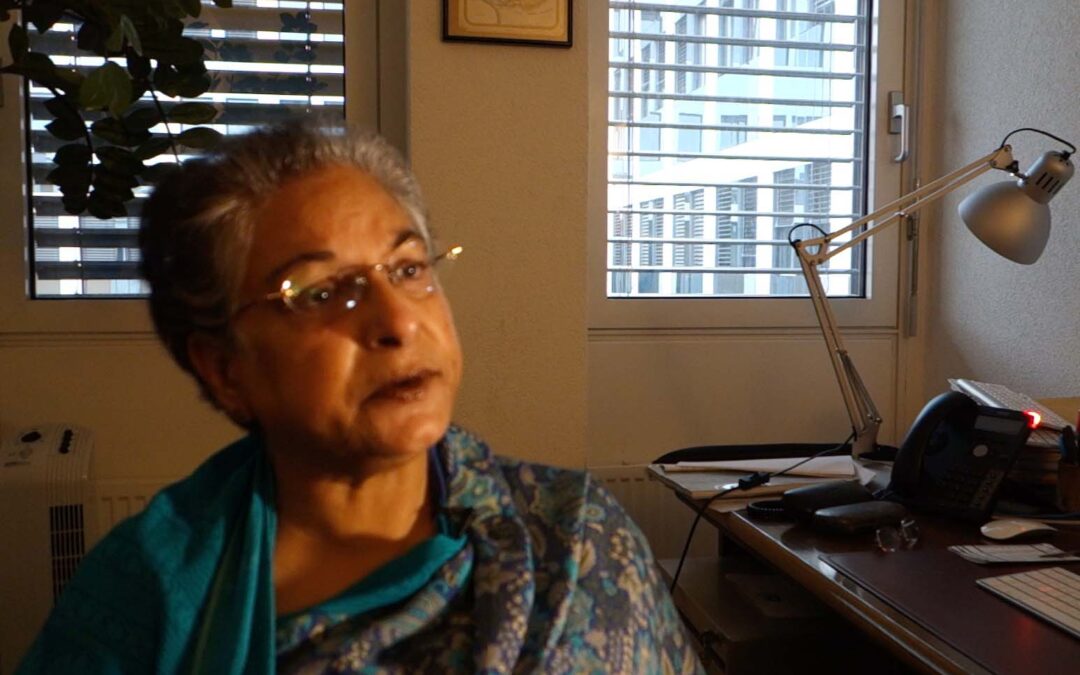
The ICJ continues its profile series of women’s rights defenders with ICJ Commissioner Hina Jilani.
Hina Jilani is a human rights activist and an advocate of the Supreme Court of Pakistan, she has served as the first UN Special Representative on Human Rights Defenders to the Secretary-General and has been an ICJ Commissioner since 2013. In 1980, Hina co-founded Pakistan’s first all-female legal aid practice, AGHS Legal Aid Cell (ALAC).
Hina started her legal career at a time of an oppressive military government takeover in Pakistan. The government sought to legitimize their authority on the basis of Islam, which they interpreted as meaning lesser rights for women who were reduced to second-class citizens and denied the same rights as men. This sparked Hina’s passionate commitment to women’s rights work.
The women’s rights movement in Pakistan has declared itself a secular movement, having decided that it is better to separate the question of religion and universal rights. Hina said that Islam doesn’t deny rights to anyone but that when it is used by those in positions of authority they can interpret religion in ways that suit their own political needs and this results in inequality.
Domestic violence is a major problem in Pakistan and Hina said that most women will have experienced this in one form or another at some point in their lives.
Hina identified a lack of social mobility and social prejudices as key challenges that women in Pakistan face in accessing justice.
In a society where women are encouraged to stay at home many women are unable to access the legal and other services they may need if their rights are being abused. Many women do not even have an awareness of what their rights are, nor do they have access to information about their rights or the kinds of people that could provide them with this information.
In addition, where women do seek justice through the legal system they often encounter social prejudices from those administering that system.
However, although the Pakistani judiciary has traditionally been very conservative there has been a lot of progress in this area. Ms Jilani thinks this is a results of women’s rights advocates taking cases to courts and presenting these in a way that makes the social inequalities and injustices apparent and makes it easier for judges to make better decision that challenge these prejudices.
Ms Jilani recommends three steps for eradicating violence against women:
Firstly, it is essential to have strong legislation; having something anchored in the law makes it incumbent for authorities and institutions to provide women with protection and justice.
Secondly, there must be mechanisms on the ground that make it possible for women to assert their rights under any such legislation; this goes beyond legal support and will include cross-sectoral services such as women’s shelters.
Thirdly, there must be independent judges administering the legislation; judges must be independent not only of the executive but also of their own social prejudices.
Defending women’s rights in the courts of law has seen some significant victories in terms of clarifying the whole meaning of equality and equal opportunity. However, Hina said that the most difficult rights protection work women can do is defending women’s rights.
Women’s rights defenders “are seen as change-makers who are not necessarily liked so they are targeted”. They are often vulnerable to exclusion, social isolation and being discredited, both within their wider communities and also, often, within their own families.
Hina Jilani recommends that women who engage in rights defence work develop strong support networks that also makes link with other rights movements. The more it is apparent they are not acting in isolation, the better protected they will be.
Watch the interview:
The series of profiles introducing the work of ICJ Commissioners and Honorary Members on women’s rights was launched on 25 November 2016 to coincide with the International Day to Eliminate Violence against Women and the first day of the 16 Days of Activism Against Gender-Based Violence Campaign.
Dec 15, 2016 | News
The Pakistani Government must not extend legal provisions that empower military courts to try civilians for terrorism-related offences, the ICJ said today.
The 21st Amendment and corresponding amendments to the Army Act, 1952, are scheduled to lapse on 6 January 2017, when their respective two-year sunset clauses expire.
“These military trials of civilians has been a disaster for human rights in Pakistan,” said Sam Zarifi, ICJ’s Asia Director.
“The conduct of these tribunals over the last two years has demonstrated that military trials are secret, opaque, violate even basic fair trials rights —and don’t do anything to protect people from acts of terrorism,” he added.
In a question-and-answer briefing paper released today, the ICJ provides answers to key questions regarding the conduct of military courts and the issues that have arisen in their operation.
The military has acknowledged the convictions of at least 144 people by military courts for their “involvement” in terrorism-related offences, 140 of whom have been sentenced to death.
Twelve out of the 140 people sentenced to death by military courts have been hanged.
The military has announced that least four people have been given life imprisonment sentences, but the actual number could be much higher.
Some 135 out of 144 people (94 per cent) convicted by military courts had allegedly “confessed” to the charges, raising serious questions about the possibility of torture or other coercive measures being used to secure these convictions.
The ICJ has documented how proceedings before Pakistani military courts fall short of national and international standards requiring fair trials before independent and impartial courts:
- Judges are part of the executive branch of the State and continue to be subjected to military command;
- The right to appeal to civilian courts is not available;
- The right to a public hearing is not guaranteed;
- A duly reasoned, written judgment, including the essential findings, evidence and legal reasoning, is denied;
- The procedures of military courts, the selection of cases to be referred to them, the location and timing of trial, and details about the alleged offences are kept secret; and
- The death penalty is implemented after unfair trials.
In addition to these concerns, the ICJ has also received reports that suspects tried by military courts have been subjected to torture and ill-treatment in detention and their family members have been harassed and intimidated by military authorities.
Allegations of torture and ill-treatment are not effectively investigated and information alleged to have been obtained by means of torture or other ill-treatment is not excluded as evidence in trial, the ICJ says.
In at least two cases, the petitioners have also alleged that the convicts were children under the age of 18 at the time they were arrested by law enforcement agencies.
Military courts were empowered to try civilians pursuant to the National Action Plan against terrorism, in contravention of international standards.
The National Action Plan envisioned military courts to be a short-term “solution” to try “terrorists”, to be operational only for a two-year period during which the Government would bring about necessary “reforms in criminal courts system to strengthen the anti-terrorism institutions”.
With less than one month left before military courts cease to be in effect, there is little sign of the promised reforms to strengthen the ordinary criminal justice system to effectively handle terrorism-related cases, the ICJ adds.
“Pakistan has not used the period of using military courts to reform and strengthen the criminal justice system,” said Zarifi.
“On the contrary, military courts have only further undermined the legitimacy of the ordinary courts and weakened the rule of law in Pakistan.”
The ICJ urges the Pakistan Government to not extend the 21st Amendment and ensure that all counter-terrorism laws and procedures are in accordance with Pakistan’s human rights obligations.
Contact
Sam Zarifi, ICJ Asia Pacific Regional Director (Bangkok), t: +66 807819002; e: sam.zarifi(a)icj.org
Reema Omer, ICJ International Legal Adviser for Pakistan (Lahore), t: +923214968434; e: reema.omer(a)icj.org
pakistan-military-courts-qa-advocacy-2016-eng (full Q& A on Military Courts, in PDF)
pakistan-list-of-convicted-advocacy-2016-eng (full list of convicted people, in PDF)

Dec 13, 2016 | News
The ICJ and Human Rights Commission of Pakistan (HRCP) urge the Pakistani authorities to fully engage with the UN human rights body by answering its questions comprehensively.
The call follows the recent adoption by the United Nations Human Rights Committee of a document raising a multiplicity of concerns about Pakistan’s human rights record.
“It is encouraging to see Pakistan’s increased engagement with United Nations human rights mechanisms in recent years”, said Sam Zarifi, ICJ’s Asia Director.
“But it is important that the Government does not stop here and now takes the additional constructive step of answering all the Committee’s questions truthfully and honestly,” he added.
In November 2016, during its 118th session, the Human Rights Committee adopted a document known as a List of issues in relation to Pakistan’s compliance with the International Covenant on Civil and Political Rights (ICCPR), in which the Committee asked multiple questions about the country’s human rights record, including:
- Fair trial concerns as a result of the expanded jurisdiction of military courts following the introduction/adoption of the 21st Amendment to the Constitution, including the criteria for and the process of selecting cases to be tried by military courts, the qualifications of judges presiding over those courts and their proceedings;
- Reintroduction of the death penalty and the wide scope of its application, including the mandatory death sentence for “blasphemy”;
- Broad and vaguely defined “blasphemy offences”, their disproportionate use against individuals belonging to religious minorities; the large number of “blasphemy” cases instituted on the basis of false accusations; and the lack of mechanisms to protect judges who hear “blasphemy” cases and those accused of blasphemy from intimidation and threats;
- Rights of Ahmadis, including their “right to profess, practice and propagate” their religion without interference;
- Repatriation of Afghan refugees, including information on the adoption of a draft national refugee law and a comprehensive policy on the voluntary repatriation and management of Afghan nationals;
- Rights of women, including steps taken by the Government to prevent and punish persistent violence (sexual and otherwise) against women, including so-called honour killings;
- Torture and other ill-treatment, extrajudicial killings, and enforced disappearances, including steps taken by the Government to implement the Supreme Court’s judgment in the Muhabbat Shah case, which held military authorities responsible for the enforced disappearance of at least 28 people from a Malakand internment centre.
This is the first time Pakistan’s human rights record is being reviewed by the Human Rights Committee, the treaty body that monitors implementation of the International Covenant on Civil and Political Rights by its State parties, since Pakistan ratified the Covenant in 2010.
The next step in the review process is for Pakistan to respond to the questions framed in the List of Issues.
The Human Rights Committee will undertake a comprehensive review Pakistan’s compliance with and implementation of the ICCPR and adopt concluding observations in July 2017.
“It is of the utmost importance to Pakistan to derive greater benefit from its engagement with the UN human rights mechanisms by making a sincere effort to answer the concerns of the Committee,” said I A Rehman, Secretary General of HRCP.
Background
Pakistan ratified the International Covenant on Civil and Political Rights (ICCPR) in June 2010. Following ratification/accession, every state party to the ICCPR is required to submit an initial “state report” containing information on the implementation of each provision of the treaty.
Pakistan submitted its initial state report to the Human Rights Committee in October 2015.
In light of the information provided in the State report, as well as information received from civil society, the Human Rights Committee then prepares a List of Issues containing particular issues of concern to the Committee, and asking whatever questions it sees fit in light of those concerns.
The answers provided by the State party to those questions, as well as other information submitted by civil society and others form the basis of the “review” of the State’s compliance with the treaty.
The State is not obligated to reply to the List of Issues in advance of the review session, but in practice most do.
The State replies are presented to the Committee at the beginning of the review and are the starting point for the interactive dialogue between the Committee and the State under review.
During the review, the Committee meets with State representatives who present answers to the List of Issues and respond to the Committee’s questions.
At the end of the session, the Committee adopts Concluding Observations, which highlight the Committee’s concerns and make recommendations to the State on improving the implementation of the ICCPR.
Pakistan’s ICCPR review is scheduled to take place in July 2017.
Contact
Sam Zarifi, ICJ Asia Pacific Regional Director (Bangkok), t: +66 807819002; email: sam.zarifi(a)icj.org
Pakistan-list-of-issues-advocacy-2016-eng (in PDF)

Dec 6, 2016 | News
Hosted on 3-4 December, the event was attended by a total of 40 participants which includes representatives of CSOs, lawyers, MPs and village track administrators.
The workshop aimed to raise awareness of international standards and best practice of resettlement and development-based eviction and displacement among local community in order to mitigate potential adverse impact associated with the development of the Kyauk Phyu Special Economic Zone.
In the opening, Dr Daniel Aguirre, ICJ International Legal Adviser, outlined the essential role of lawyers and community members in safeguarding human rights and holding the State and investors accountable.
The discussion was led by international experts and experienced and committed leaders of Civil Society Organization.
Susanna Price from Australian National University highlighted key principles of the ADB’s Involuntary Resettlement Policy along with experiences from China, Cambodia and Indonesia.
U Hayman Oo, ICJ Legal Researcher, explained how the UN principles on Development-based Eviction and Displacement are applicable in the context of Myanmar and urged the participants to use these standards for their advocacy work.
U Myo Mrat Hein, the Director and lawyer of the Thazin Legal Aid Group, discussed important issues surrounding the national land acquisition legislation whilst Sean Bain, legal consultant at the ICJ give a brief overview of important provisions of the Myanmar SEZ Law (2014).
The other two guest local speakers shared their first-hand experiences of advocacy work and resettlement issues which occurred during the development of Dawai and Thilawa SEZ respectively.
Participants exchanged strategies and ideas to take preparatory steps to mitigate potential impacts of the KPSEZ in terms of protecting their economic, social and cultural rights, learning from Dawei and Thilawa, as well as from international standards which Myanmar recognizes.
The new Kyauk Phyu SEZ Management Committee, along with Dawai and Thilawa, was formed last month with over 30 members including international and local social and environmental experts.
In a meeting held in Nay Pyi Taw following the establishment of the SEZ Management Committee, Daw Aung San Su Kyi emphasized that the current three SEZs of the country are leading projects for Myanmar’s economic growth.
She also expressed concerns over the potential negative effect of these zones if not properly implemented.

Dec 5, 2016 | News
A joint statement calls on members of the House of Representatives of the Philippines to stop further attempts to reintroduce the death penalty and to block any legislation that subverts human rights.
On 29 November 2016, the Sub-Committee on Judicial Reforms of the House Committee of Justice approved a bill restoring the death penalty in the Philippines by railroading the proceedings in the committee and ignoring important questions from other lawmakers questioning the need for the legislation or its urgent passage.
The full statement can be downloaded here:
philippines-joint-statement-death-penalty-news-web-story-2016-eng (PDF)

Nov 29, 2016 | News
The Philippines House of Representatives must immediately cease efforts to rush through legislation restoring the death penalty, the International Commission of Jurists (ICJ) said today.
On 29 November 2016, the Sub-Committee on Judicial Reform, which is chaired by Congressman Marcelino “Ching” Veloso, hastened the passage of a bill restoring the death penalty in the Philippines.
According to reports received by the ICJ, ex-officio members of the Sub-Committee on Judicial Reform railroaded the proceedings and ignored important questions from other lawmakers questioning the need for the legislation or its urgent passage. The Sub-Committee did not present any report, as is the normal practice, on the discussions and information presented in the previous hearings.
“Filipino lawmakers seem intent on embracing the barbaric practice of executions purely as a political measure, without any understanding or even proper discussion of the death penalty’s impact or what their actions would mean to the international obligations of the Philippines,” said Emerlynne Gil, ICJ’s Senior International Legal Adviser for Southeast Asia.
A representative of the ICJ spoke at the hearing of the Sub-Committee on 22 November 2016, and brought to the lawmakers’ attention the country’s obligations under the 2nd Optional Protocol to the International Covenant on Civil and Political Rights (ICCPR) and the general prohibition on reintroduction of capital punishment once abolished, which commit the country not to execute anyone within its jurisdiction.
“There are already thousands of alleged cases of extrajudicial killings in the country. This bill, if it becomes law, will unquestionably usher the Philippines into a dark period where respect for the right to life is comprehensively degraded,” Gil emphasized.
The ICJ has previously written to President Rodrigo Duterte underscoring that the evidence shows that death penalty is not effective at deterring crime at a greater rate than alternative forms of punishment. Investing in improved detection and investigation techniques and capacity, and improving the effectiveness and efficiency of the justice system, is more likely to achieve real results in reducing crime.
The ICJ categorically opposes the death penalty and considers its use to be a violation of the right to life and freedom from cruel, inhuman, or degrading punishment.
The UN General Assembly has repeatedly adopted resolutions by overwhelming majorities, calling on all retentionist States to impose a moratorium with a view to abolition.
Contact:
Ms. Emerlynne Gil, ICJ’s Senior International Legal Adviser
Telephone: +66 840923575
Email: emerlynne.gil(a)icj.org