Feb 23, 2018 | News
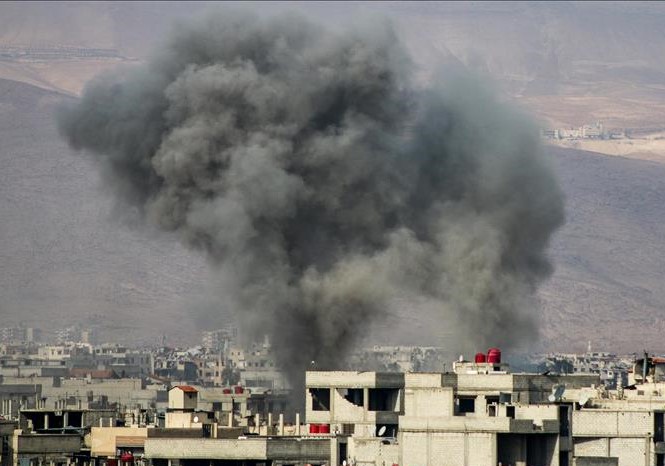
The ICJ today called on the governments of Syria and Russia to cease all attacks on the civilian population in Eastern Ghouta.
Intentionally directing attacks against the civilian population and civilian objects, including hospitals, constitutes a war crime.
All those responsible for such crimes must be held accountable.
“The UN Security Council is blatantly failing to discharge its primary responsibility for maintaining international peace and security. It’s so paralyzed by division that it cannot even enforce its own resolutions on protecting the civilian population in Syria and ensuring unimpeded humanitarian access,” said Said Benarbia, Director of the ICJ Middle East and North Africa Programme.
“After 7 years of shielding the Syrian regime from accountability for its egregious crimes, including the use of chemical weapons, Russia is joining forces with this regime’s cynical enterprise to murder and starve its own people,” he added.
The air and artillery bombing campaign conducted by the Syrian government, with the backing of Russia, have caused hundreds of victims since Sunday.
The destruction of hospitals and the lack of basic supplies and medicines are making the living conditions of the civilian population extremely dire.
Under international humanitarian law, the Syrian government and its ally Russia have obligations to protect the civilian population and to grant rapid and unimpeded passage to humanitarian relief for the residents of Eastern Ghouta.
The UN Security Council imposed a disarmament plan concerning the Syrian chemical arsenal, yet credible reports of government use of chemical weapons against civilians continued to emerge as late as January and February 2018, in particular in Eastern Ghouta and Saraqeb.
In its last report in October 2017, the OPCW-UN Joint Investigative Mechanism established the responsibility of the Syrian government for the use of chemical weapons.
In the same month, Russia vetoed a resolution to renew the Mechanism’s mandate.
“States must act individually and collectively to stop the escalation of horrors we are witnessing in Eastern Ghouta. They must also ensure, including through any means available in their national legal systems, as well as at the regional and international level, that all those responsible for the war crimes, crimes against humanity and other international crimes committed in Syria, irrespective of their nationality, rank or status, are brought to justice,” Benarbia added.
Contact
Said Benarbia, Director of the ICJ Middle East and North Africa Programme, tel: +41 798783546, e-mail: said.benarbia(a)icj.org
Syria – Ghouta Bombing – News – Webstory – 2018 – ARB (Arabic translation in PDF)
Feb 14, 2018 | News
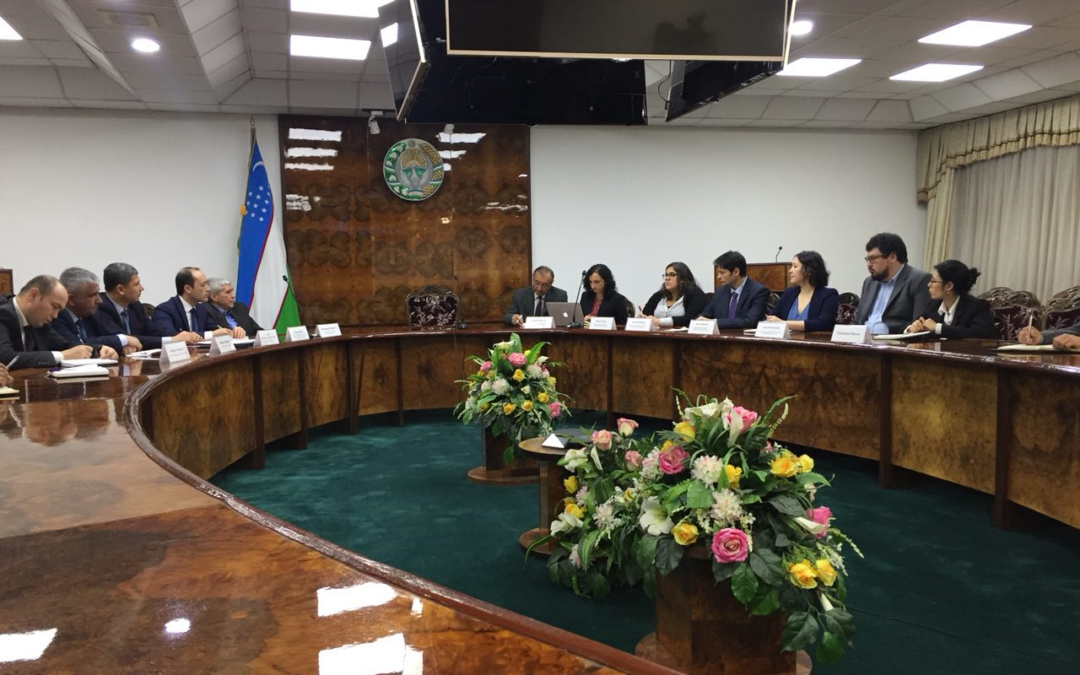
From 12 to 14 February, representatives the ICJ visited Uzbekistan as the first step in a new programme of work on access to justice in the area of economic, social and cultural rights.
During the visit, ICJ representatives met with a number of State institutions relevant to this topic, including the Supreme Court, the High Judicial Council, the Ministry of Justice, the Bar Association of Uzbekistan as well as the Commission of the European Union Technical Assistance Programme National Coordination Unit (NCU).
The ICJ also met with the Delegation of the European Union to Uzbekistan.
The visit allowed the ICJ to provide information and begin plans for its work to advance access to justice for the protection of economic, social and cultural rights in Uzbekistan in the framework of the ACCESS project (“Advancing Civil Society in promoting ESCR Standards”), supported by the Delegation of the European Union to Uzbekistan.
During this visit, the ICJ signed a Memorandum of Understanding with the Research Centre for the Study of Justice under the Supreme Judicial Council of the Republic of Uzbekistan, with which it held an international seminar on Comparative Approaches to Selection, Appointment and Evaluation of Judges in September 2017.
The memorandum will serve as a platform for furthering ICJ’s work with the judiciary in Uzbekistan within the ACCESS project and other initiatives.
The ICJ is grateful to all those who met with the ICJ representatives in Tashkent.
Feb 13, 2018 | Advocacy
The ICJ, together with other NGOs, has expressed serious concerns about the current wording of the draft Copenhagen Declaration on the future of the European Convention on Human Rights (ECHR) system, which has been proposed by the Danish government.
In a joint response to the first draft of the Copenhagen Declaration, the group of NGOs welcomed the willingness of the Danish government to engage with civil society in developing the Declaration, which is to be finalised at an intergovernmental conference in Copenhagen in April 2018.
However the NGOs expressed concerns that some of the language of the Declaration appears to diminish the role of the European Court of Human Rights, and risks fragmenting the European human rights protection system as well as undermining the independence of the Court. The NGOs emphasised that:
- The Declaration should affirm the need to respect and preserve the independence of the European Court of Human Rights, and should omit any language or proposals that put the independence of the Court at risk;
- Effective human rights protection at the national level must be subject to the supervision of the European Court of Human Rights;
- Greater emphasis should be given to the role of civil society in implementing the ECHR at the national level, and this should be taken into account in developing proposals for more effective implementation;
- The universality of human rights protection should be respected, and the text should be worded to highlight the importance of all human rights in all situations across all of the Council of Europe states;
- The Declaration must not call into question the Court’s authority to review human rights cases concerning asylum and immigration, or those arising from international conflicts;
- Governments should not be given further opportunities to influence the Court, nor should the Declaration provide a pretext for states to exert political pressure on the Court;
- Council of Europe States should not only implement the European Convention on Human Rights, but also act promptly to execute judgments of the European Court;
- National processes for the selection and election of European Court judges should be further strengthened.
Europe-JointNGO-Response-Copenhagen-Declaration-Advocacy-2018-ENG (Full document in PDF)
Feb 3, 2018 | Agendas, Events, News
Today begins in Ankara (Turkey) a two-day training for lawyers and CSO practitioners representing and working with migrants, refugees and asylum-seekers.
This event is organized by ICJ, in cooperation with its partners Refugee Rights Turkey, the European Council on Refugees and Exiles (ECRE), Mülteci-Der (MD) and ICJ-EI, as part of the EU co-financed project Fostering Access to Rights for Migrants, Refugees and Asylum-Seekers in Turkey.
30 lawyers and civil society practitioners – representing nine different bar associations and relevant organisations from the Ankara area and other nearby key migration and asylum locations – are taking part in the training on 3 and 4 February.
The training aims to update lawyers and CSOs on the international and national law on the rights of refugees, migrants and asylum-seekers in order to be effective in their work at both the national and international levels. It aims at an effective implementation of the Turkish legal framework on asylum and migration.
The main thematic areas to be discussed will be the principle of non-refoulement, international protection, detention and access to economic, social and cultural rights.
The training will use as a basis the draft training materials prepared by the ICJ and its partners (to be published an the end of 2019) and, among other sources, the ICJ Practitioners Guide no. 6: Migration and International Human Rights Law.
The project “Fostering Access to Rights for Migrants, Refugees and Asylum-Seekers in Turkey” is funded by the European Instrument for Democracy and Human Rights (EIDHR) of the European Union.
Turkey-Training-Ankara-MigrationAsylum-Agenda-2018-tur-eng (download the agenda in Turkish and English)
Jan 30, 2018 | Agendas, Events
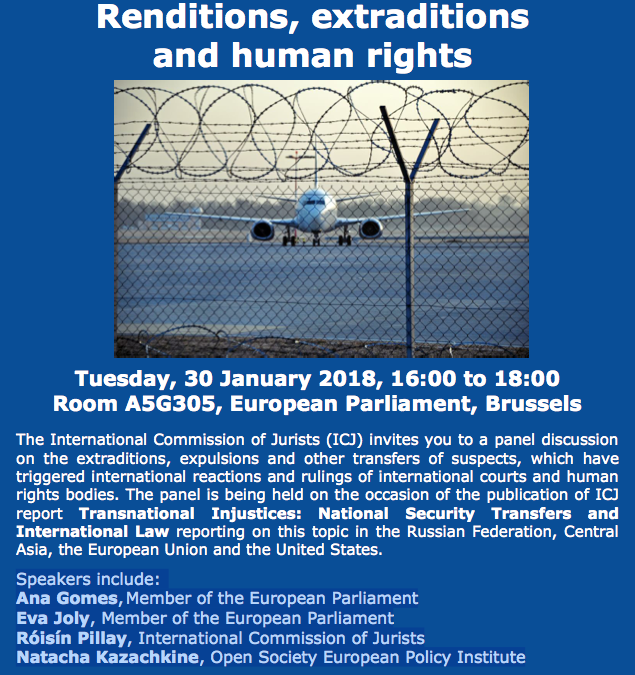
The ICJ invites you to an event to discuss challenges in prevention of, and accountability for, violations of human rights in renditions and other transfers of suspects, including through past European complicity in US-led renditions, and in ongoing transfers of suspects in the CIS region.
Join us for a discussion marking the EU launch of the International Commission of Jurists’ report, Transnational Injustices: National Security Transfers and International Law. The event is kindly hosted by Ana Gomez and Eva Joly, MEPs.
Panelists will discuss the ongoing practice of states unlawfully rendering people accused of terrorism, accountability for violations of human rights in past renditions, and how the EU institutions and EU Member States should address these.
When: Tuesday 30 January 16.00 – 18.00
Where: Room A5G305, European Parliament, Brussels
RSVP to: anamaria.gomes@europarl.europa.eu
Speakers include:
- Ana Gomes, Member of the European Parliament
- Eva Joly, Member of the European Parliament
- Róisín Pillay, International Commission of Jurists
- Natacha Kazachkine, Open Society European Policy Institute
A flyer for this event is available in PDF format by clicking here.