Sep 21, 2017 | Events, News
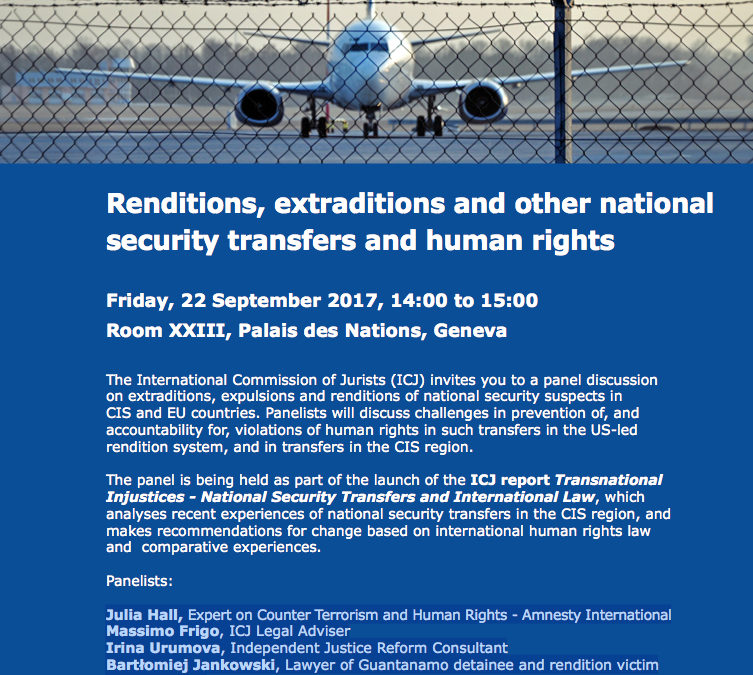
At a side event to the UN Human Rights Council on 22 September, the ICJ will discuss challenges in prevention of, and accountability for, violations of human rights in the US-led rendition system, and in the CIS region.
The event will address as well the challenges of extraditions, expulsions and renditions of national security suspects in CIS and EU countries.
The panel discussion is being held as part of the launch of the ICJ report Transnational Injustices – National Security Transfers and International Law, which analyses recent experiences of national security transfers in the CIS region, and makes recommendations for change based on international human rights law and comparative experiences.
The event will take place at the UN Human Rights Council in Geneva on Friday 22 September at 14:00 – 15:00 at Room no. XXIII.
Panelists:
- Julia Hall, Expert on Counter Terrorism and Human Rights – Amnesty International
- Bartłomiej Jankowski, Lawyer of Guantanamo detainee and rendition victim Abu Zubaydah
- Massimo Frigo, ICJ Legal Adviser
- Irina Urumova, Independent Justice Reform Consultant
Copies of the report in English will be available for the persons attending the meeting.
A flyer for this event is available in PDF format by clicking here.
For more information, contact massimo.frigo(a)icj.org and/or un(a)icj.org

Sep 15, 2017 | News, Publications, Reports, Thematic reports
Failure to assert the rule of law in the transfer of suspects across borders perpetuates violations of human rights in cases where national security is invoked, a new ICJ report finds.
Released today, the ICJ report Transnational Injustices – National Security Transfers and International Law documents laws and practices in the OSCE region involving transfer of national security suspects by all possible means without regard to national law or States’ international legal obligations.
“This report demonstrates that, under different guises, some States still continue to abuse extradition and expulsion procedures and sometimes even to resort to abductions and renditions in cases related to counter-terrorism or national security,” said Róisín Pillay, Director of the ICJ Europe and CIS Programme.
“This has pernicious consequences for the respect of human rights and the rule of law,” she added.
“In some states, such as in Russia and Central Asia, existing national legal procedures to protect against abusive transfers have been bypassed or ineffective,” Pillay said.
She added: “We need to put judges and human rights law at the heart of extradition procedures to ensure their effectiveness and to prevent arbitrary and extra-legal transfers of suspects.”
Lack of accountability in cases where suspects’ human rights have been violated fuels further abuses, the report finds.
“With the closure of the US programmes, renditions were thought to be over,” said Massimo Frigo, Legal Adviser at the ICJ.
“The almost complete lack of accountability for US renditions has provided a blank check of legitimacy to any countries trying to bend or break the rules at the expenses of the basic safeguards of one’s human rights,” he added.
Background
Practices in a number of States in recent years have highlighted the serious implications for human rights and the rule of law of transfers of people based on national security and criminal cooperation grounds in the Russian Federation, Central Asia and beyond.
Extraditions, expulsions and, sometimes, transfers occurring outside of the legal framework have triggered international reactions and rulings of international courts and quasi-judicial bodies.
The ICJ report Transnational Injustices – National Security Transfers and International Law is based on research of these practices, documenting illustrative cases, and the applicable legal framework.
The report analyses extradition, expulsion and informal transfers in the Russian Federation, Central Asian countries and EU Member States, as well as the rendition practices in the United States and assesses the situation against international human rights law.
The report offers concrete recommendations for change based on the comparative experiences of selected EU member States.
Contact:
Róisín Pillay, ICJ Europe Programme Director, t: +32 2 734 84 46 ; e: roisin.pillay(a)icj.org
Massimo Frigo, ICJ Legal Adviser, t: +41 22 979 3805 ; e: massimo.frigo(a)icj.org
Europe-Transnational Injustices-Publications-Reports-Thematic reports-2017-ENG (Full report in English, PDF)
Europe-Transnational Injustices-Publications-Reports-Thematic reports-2017-RUS (Full report in Russian, PDF)
Europe-Transnational Injustices-ExecSummary-Publications-Reports-Thematic reports-2017-ENG (Executive Summary in English, PDF)
Europe-Translational Injustices-ExecSummary-Publications-Reports-Thematic reports-2017-RUS (Executive Summary in Russian, PDF)

Sep 14, 2017 | Advocacy, Cases, Legal submissions, News
On 13 September, the European Committee of Social Rights decided on the admissibility of the collective complaint submitted by the ICJ and Forum for Human Rights, against the Czech Republic.
The Committee assessed the admissibility conditions set out in the Protocol and the Committee’s Rules and the Government’s objections on admissibility and declared the complaint admissible. The Czech Government has now two months to make written submissions on the merits of the complaint.
The complaint argues that the Czech Republic fails to ensure equal legal protection and participation of children below the age of criminal responsibility in the pre-trial stage of juvenile justice procedures.
The ICJ and FORUM submit that serious systemic flaws in the Czech juvenile justice system deprive a specific group of particularly vulnerable individuals – children below the age of criminal responsibility – of an adequate level of social protection and leave them at risk of inappropriate or unfair procedures leading to arbitrary punitive measures, in violation of Article 17 of the European Social Charter, both alone and read in conjunction with the principle of equality in the preamble to the Charter.
Europe-ECSR-ICJvCzechRepublic-ChildrenJustice-AdmissibilityDecision-2017 (download the Committee’s decision)
Sep 14, 2017 | Events
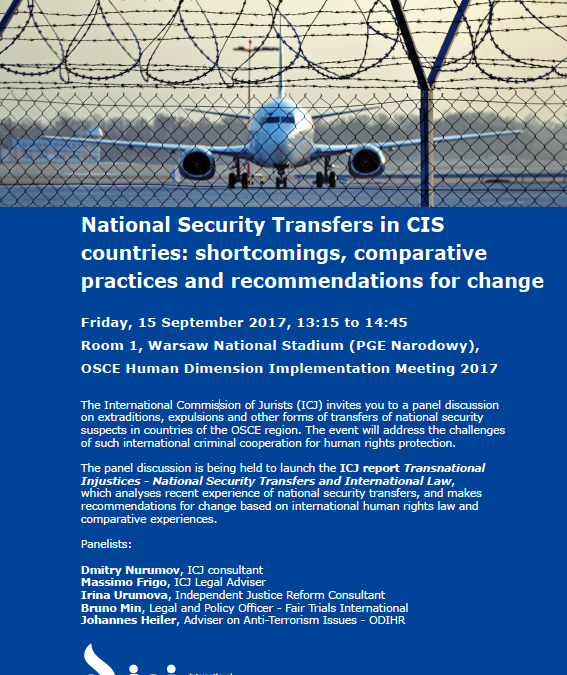
At a side event to the OSCE Human Dimension Implementation Meeting 2017, the ICJ will review the latest developments on extraditions, expulsions and other forms of transfers of national security suspects in countries of the OSCE region.
The event will address the challenges of such international criminal cooperation for human rights protection.
The panel discussion is being held to launch a new ICJ report which analyses recent experience of national security transfers, and makes recommendations for change based on international human rights law and comparative experiences.
The event will take place in Warsaw Friday 15 September at 13:15 – 14:45 at Room no. 1 at the OSCE HDIM 2017.
Panelists:
- Dmitry Nurumov, ICJ consultant
- Massimo Frigo, ICJ Legal Adviser
- Irina Urumova, Independent Justice Reform Consultant
- Bruno Min, Legal and Policy Officer – Fair Trials International
- Johannes Heiler, Adviser on Anti-Terrorism Issues – ODIHR
Working language: English and Russian (simultaneous translation provided)
A flyer for this event is available in PDF format by clicking here.
For more information, contact massimo.frigo(a)icj.org and/or dina.iskaliyeva(a)icj.org
Jul 28, 2017 | Multimedia items, News, Video clips
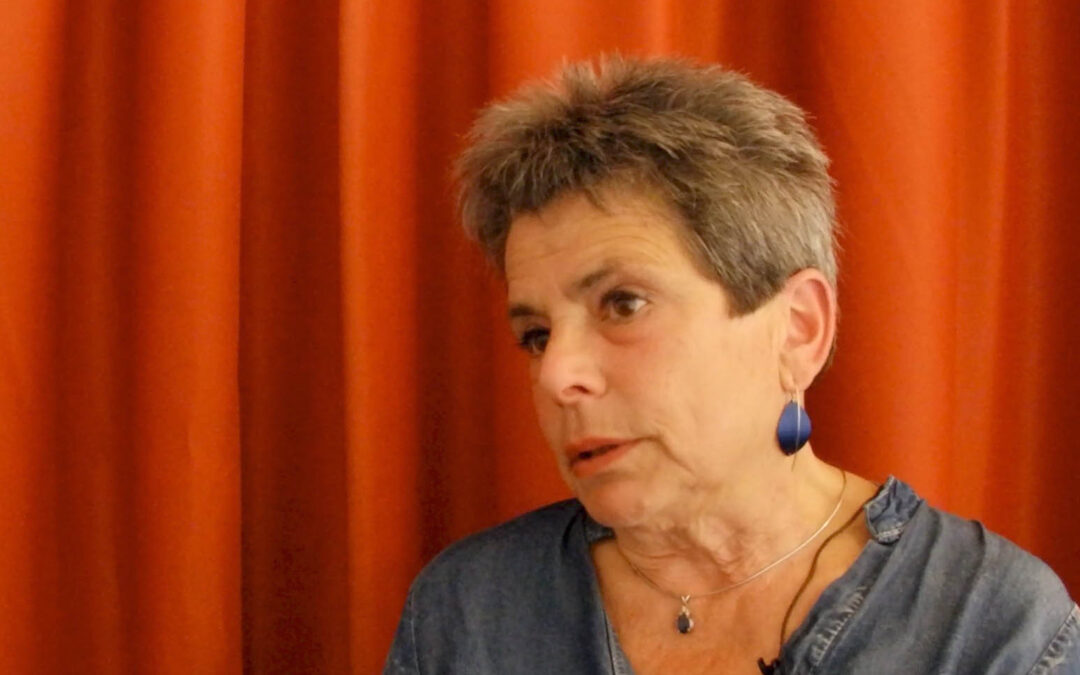
The ICJ continues its series of profiles of its women Commissioners with an interview with Prof. Jenny E. Goldschmidt, who is currently serving her third term as an ICJ Commissioner.
She was first elected to the Commission in 2003 and re-elected in 2008 and 2013.
She is a Member of the Advisory Board of Nederlands Juristen Comité voor de Mensenrechten (NJCM), and NJCM Public Interest Litigation Group. The NJCM is the ICJ’s National Section in the Netherlands.
In this wide-ranging interview, Jenny describes how she started out her career as a lawyer by studying Constitutional law; how her interests began to focus on the haves and the have nots and from there her interest in human rights developed.
She explains how she has always combined academic research and teaching with practical work, particularly during her years as the President of the Equal Treatment Commission in the Netherlands. She also stresses the importance of working in an inter-disciplinarian manner.
For example, she explained that after academics had developed concepts of direct discrimination, indirect discrimination, and systemic discrimination, these concepts were taken on board by lawyers and have been incorporated into case law.
She gave the example of how the European Court of Human Rights and the European Court of Justice are now incorporating this type of stereotyping into their equality concept.
She emphasized human rights law must protect women and that this protection must be embodied in law.
She considered that it is vital to take cases to the Treaty Bodies and courts everywhere to establish severe measures against discrimination and domestic violence.
But human rights lawyers also need sociologists to help find the arguments that convince people and how we can influence their behavior.
“Sometimes soft law and mediation can be effective and you need other disciplines to show in which cases which instruments are most effective,” she said.
She explained that because women are not a homogenous group and because of migration and all the divisions in society, inter-sectionality has become one of the crucial challenges for women’s rights.
She believes in combining a focus on the general problems which all women face as well as taking into account that some women are even less equal than others – that women who belong to minorities, that women who are disabled, that girls are more vulnerable than the majority of women.
“I think one of the things that the disability convention tries to do by giving a specific provision for women and girls rights is that it forces the authorities, the Treaty Bodies, the national and international institutions to be aware of the fact that we are talking about women and disabled people and that we have to take two perspectives at the same time into account,” she added.
When asked what advice she would give a woman who wants to pursue a career in human rights she said: “Don’t give up! And don’t think it will be easy. Human rights world still is a man’s world.”
Jenny Goldsmith is currently Emeritus Professor of Human Rights Law, and was from 2007-2014 Director of the Netherland Institute of Human Rights at the University of Utrecht.
From 1994-2003 she was President of the Equal Treatment Commission of the Netherlands.
She is on the board of Disability Studies in the Netherlands and involved in several NGOs of disability rights, democracy, and human rights.
Watch the interview:
The series of profiles introducing the work of ICJ Commissioners and Honorary Members on women’s rights was launched on 25 November 2016 to coincide with the International Day to Eliminate Violence against Women and the first day of the 16 Days of Activism Against Gender-Based Violence Campaign.