Jan 12, 2024 | Advocacy, Joint Statement
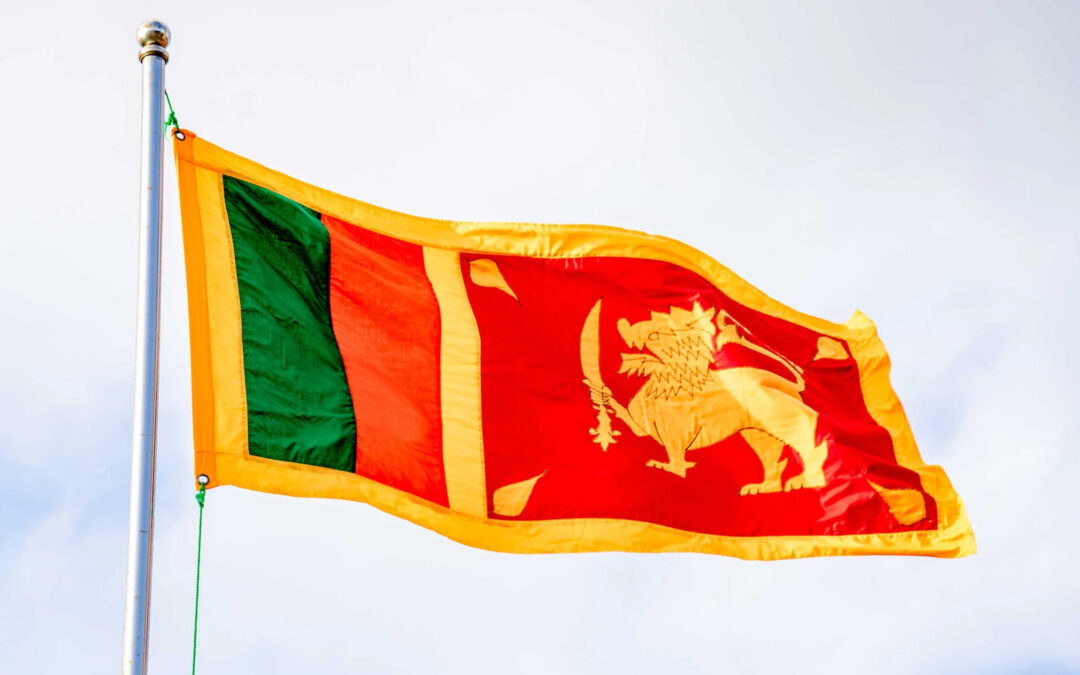
The International Commission of Jurists (ICJ) has joined 29 other organizations urge Sri Lanka to halt the anti-drug operations that has intensely escalated to human rights violations.
[JOINT STATEMENT] Sri Lanka: Stop Abusive Anti-Drug Operation and Release Those Arbitrarily Detained
We, the undersigned organisations, are deeply concerned about the drastic intensification of anti-drug operations in Sri Lanka leading to significant human rights violations.
On 17 December 2023 the Acting Inspector General of Police Deshabandu Tennekoon, with the endorsement of Minister of Public Security Tiran Alles, spearheaded an operation titled “Yukthiya”, with the stated aim of controlling “the drug menace”. The operation is ongoing as of 10 January 2024, with at least one thousand persons arrested daily.
This operation is unfolding in a context of already severe repression against persons who use or are suspected of using drugs, who suffer discrimination and stigma within the Sri Lankan criminal justice system and society.
Alongside the Sri Lankan police, members of the armed forces have been supporting this operation, during which several human rights violations have been reported. These violations include alleged arbitrary arrests, primarily against individuals from marginalised socio-economic communities; searches conducted without warrants or reasonable suspicion; and degrading treatment including strip searches in public as well as cavity searches. The searches and arrests have been televised, in violation not only of the right to privacy (and of basic human dignity) but also of a person’s right to be presumed innocent. According to lawyers, persons are being arrested even when no drugs are found in their possession, simply for having been arrested for drug offences or having been sent to compulsory rehabilitation in the past. The arrests of main livelihood earners and mothers have adversely impacted the ability of families to meet their basic needs during a time of economic crisis in Sri Lanka, and the wellbeing of children.
Persons are being arrested primarily under Section 54A of the Poisons, Opium and Dangerous Drugs Ordinance, an offence which is non-bailable. As a result, those arrested are bound to spend time (sometimes months) in pretrial detention, thereby exacerbating already poor conditions of imprisonment in an overburdened prison system. The Human Rights Commission of Sri Lanka has previously stated that the existing prison conditions and treatment of incarcerated persons are “inhumane and degrading.” At present, as per statistics issued by the Department of Prisons, the level of overcrowding of the prison system is at nearly 200% – with punitive drug policies playing a significant role: as of 2022, 63% of convicted persons were sentenced for drug-related offences.
The total reported number of arrests pursuant to operation Yukthiya has exceeded 29,000 as of 9 January 2024, while nearly 1,500 people are in administrative detention in police custody for further investigation. At least 1,600 more persons have been sent for compulsory drug rehabilitation, in violation of several fundamental rights; including the right to the highest attainable standard of health, which includes the right to consent to and withdraw from medical treatment. “Drug treatment” in these centres is abstinence-based, essential harm reduction services are not available, and persons undergo severe withdrawal symptoms without any medical assistance while in detention. The use of violence to discipline and punish has been reported in at least two compulsory drug rehabilitation centres which are within the purview of the Bureau of the Commissioner General for Rehabilitation and are operated by the military, which is in itself a violation of international standards.
The UN Working Group on Arbitrary Detention in its statement at the conclusion of its visit to Sri Lanka in 2017 expressed concern regarding the involvement of military personnel in drug treatment and rehabilitation, the fact that strenuous physical exercise was the core component of compulsory drug treatment, and at the lack of trained professionals to monitor the health of people in detention. Furthermore, the statement highlighted the irregularities in the judicial process by which persons were sent to drug rehabilitation centres without a medical assessment.
More broadly, the UN Special Rapporteur on Torture has highlighted that by denying persons access to substitution therapies, states are subjecting “a large group of people to severe physical pain, suffering and humiliation, effectively punishing them for using drugs and trying to coerce them into abstinence.” The Special Rapporteur has further stated “forcible testing of people who use drugs without respecting their autonomy and their right to informed consent may constitute degrading treatment, especially in detention settings. States are obliged to respect the enjoyment of the right to health, including by refraining from using coercive medical treatment. The requirement of informed consent, including the right to refuse treatment, should be observed in administering any treatment for drug dependence.”
Since the 2016 UN General Assembly Special Session on drugs, there is international consensus on pursuing a holistic and health and human rights-based approach to drugs, which encompasses supply and demand reduction as well as harm reduction. The 2019 Ministerial Declaration on drugs – the current global drug policy document – as well as multiple resolutions of the UN General Assembly, the UN Commission on Narcotic Drugs, and the UN Human Rights Council reiterate and recommend a similar approach.
A punitive and militarised approach to drug control contravenes recognised international human rights standards and guidelines, is ineffective to protect individual and public health, and ultimately fails to make communities safer.
We thus call upon the government to:
- Immediately cease operation “Yukthiya” and release persons who have been arrested without evidence or reasonable suspicion. The government should ensure that those arrested who do not have access to legal representation are provided legal aid.
- Immediately release persons arrested or sent to compulsory drug rehabilitation for using drugs/having a drug dependence.
- Cease involving the armed forces in drug control and treatment activities as consistent with human rights law.
- Repeal laws that allow compulsory drug rehabilitation, close compulsory treatment centres and release persons presently held at the centres within the purview of the Bureau of Commissioner General for Rehabilitation.
- Allocate adequate financial resources to provide voluntary, comm unity and evidence-based drug treatment and care, under the leadership of the Ministry of Health.
- Meaningfully engage civil society, communities, human rights experts and UN agencies, such as the World Health Organisation and the Office of the High Commissioner for Human Rights in reforming national drug laws and policy.
- Ensure that any law enforcement operation to address the supply side is conducted respecting due process standards and constitutionally protected fundamental rights.
Download
The joint statement and full list of signatories is available here
Sep 29, 2023 | News
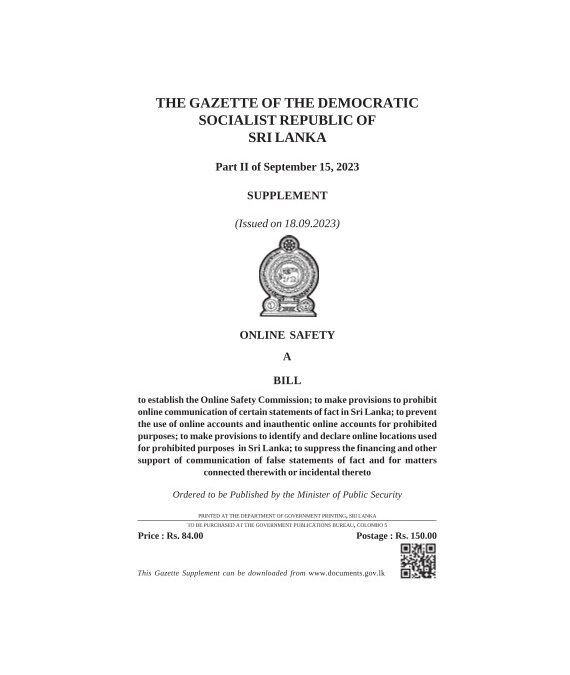
The ICJ is concerned that the newly proposed Online Safety legislation, if adopted in its present form, would serve to crush free expression and further contract an already shrinking civic space in Sri Lanka.
On 18 September 2023, the Ministry of Public Security gazetted a bill titled “Online Safety” intended to dramatically regulate the content of online communication, including by the general public.
The ICJ considers that several provisions of the bill would serve to undermine the exercise of human rights and fundamental freedoms in the country, including freedom of information and expression. Of particular concern are provisions related to the setting up, appointment and functions of an Online Safety Commission and other experts, the vague and overbroad wording of conduct designated as punishable offences and unnecessary and disproportionate punitive sanctions.
“While the spread of online hate-speech and disinformation need to be tackled, this bill is deeply flawed in its design and would be open to abuse by the Sri Lankan government, which has persistenty failed to uphold freedom of expression,” said Ian Seiderman, ICJ’s Legal and Policy Director. “It risks being used to suppress important public debate regarding the conduct of the government and matters of public policy,” he added.
The Bill would establish an “Online Safety Commission” that would act to: “prohibit online communication of certain statements of fact; prevent the use of online accounts and inauthentic online accounts for prohibited purposes; make provisions to identify and declare online locations used for prohibited purposes in Sri Lanka and to suppress the financing and other support of communication of false statements,” as well as other unspecified matters.
The Bar Association of Sri Lanka has called for the immediate withdrawal of the bill and for the adoption of a process of meaningful consultations with all relevant stakeholders prior to gazetting bills which ‘have a serious impact on the community at large.’
“The current draft fails to adhere to the principles of legitimacy, necessity and proportionality required for any State activity that restrict rights. It must be withdrawn or amended to be brought in line with Sri Lanka’s international human rights obligations guaranteeing freedom of expression, opinion, and information.” Seiderman added.
The ICJ considers that the Bill should not be evaluated in a vacuum, but instead must be read in conjunction with existing and proposed legislation that threaten human rights. Such laws include the extremely misused ICCPR Act of 2005, the Prevention of Terorrism Act (PTA), the Bureau of Rehabilitation Act, and the proposed Anti-Terrorism law which seeks to replace the PTA. This body of legislation, taken together, fosters a chilling effect on the exercise of fundamental freedoms restricting civil society while unduly expanding the reach of the security state.
Article 14 (1) (a) of the Sri Lankan Constitution gurantees the freedom of speech and expression. Article 19 of the International Covernant on Civil and Political Rights, to which Sri Lanka is a party, affirms the right to freedom of expression and opinion.
In July 2018, the UN Human Rights Council adopted by consensus a resolution affirming that “the same rights that people have offline must also be protected online, in particular freedom of expression, which is applicable regardless of frontiers and through any media of one’s choice, in accordance with articles 19 of the Universal Declaration of Human Rights and the International Covenant on Civil and Political Rights.”
Contact: Ian Seiderman, Legal & Policy Director, e: ian.seiderman@icj.org
See annexed below a summary analysis of some problematic aspects of the Online Safety Bill.
Sri Lanka: Selected flaws in the Online Safety Bill
- Wide ranging and overly broad powers of the Online Safety Commission and appointed Experts
The bill provides for the establishment of a five-member ‘Online Safety Commission’ that is to be appointed on the sole discretion of the President (clause 5). This is in contrast to other notionally independent commissions in Sri Lanka, the appointments to which require the consent of the Constitutional Council by way of nomination or ratification. This bill would give the president unfettered discretion where both appointment and removal is concerned.
The Commission would also be vested with a wide range of powers, some of which encroach into the functions of the judiciary. It essentially acts as sole arbiter of matter of fact and is entitled to issue notices or directives against any person, internet service provider (ISP) or internet intermediaries who/which is alleged to have communicated a prohibited or false statement. The bill does not specify the process through which the Commission would arrive at this decision.
Moreover, the Commission is granted authority to block websites and instruct ISPs to restrict access to specific online locations. This may result in undue government overreach and censorship and impermissible limitations on the exercise of the right to information protected by Article 14A of the Constitution and international law.
Further clause 37 allows for the Minister to appoint ‘Experts’ to assist police officers in investigations. The experts are private individuals who can accompany police officers during search procedures, but are also given the power upon authority granted by a police officer above the rank of a sub-inspector to require a person to hand over any documents or device, provide traffic data or be orally examined (clause 37 (6)). Such excessive powers in the hands of unaccountable private individuals provide avenues for abuse.
The bill does not provide provide for judicial review of the Commission’s decisions or procedures. Instead clause 49 seeks to protect the Commission, its staff, or any expert appointed under clause 37 from being brought to court for any act or omission done in good faith.
- Vague and overbroad offences
A particularly problematic aspect of the bill are provisions of vague and overbroad definitions of offences.
Article 19(3) of the ICCPR provides that the right to freedom of expression and opinion may be subject to certain restrictions, but that these restrictions must be provided by law and necessary for one of a limited numbers of legitimate purposes, namely to protect the rights and reputations of others, national security, public order or public health or morals. The measure of limitation must be proportionate, using the least restrictive means possible to achieve the purpose. The requirement that any restrictive measure be provided by law means that they must comply with the principle of legality, by which the law must be stated with precision as to allow persons to be able to conform their conduct in compliance.
Similarly, Article 15 (2) of the Sri Lankan Constitution provides for possibility of restriction of the right “as may be prescribed by law in the interests of racial and religious harmony or in relation to parliamentary privilege, contempt of court, defamation or incitement to an offence.”
The prohibitions listed in this draft legislation go beyond the restrictions allowed for under the ICCPR and the Sri Lankan Constitution, as clause 12 states that “any person who poses a threat to national security, public health or public order or promotes feelings of ill-will and hostility between different classes of people, by communicating a false statement, commits an offence.”
In addition, several acts that would constitute offence are only vaguely defined, if at all. This includes communicating a false statement “with the deliberate intention of wounding the religious feelings of any other person” (clause 16) or “outraging the religious feelings of any class of persons, insults or attempts to insult the religion or the religious beliefs of that class” (clause 17). These clauses are overbroad in that they would encompass expression that is protected under human rights law. Clause 14 makes it an offence to ‘wantonly giving provocation by false statement to cause riot’. This language is open to abuse by the authorities, as evidenced by practices arising from other legislation, including the ICCPR Act and the PTA.
Repeated mention of ‘religion’ in these provisions is a cause for concern as they come in a context where there is ongoing strife relating to contested religious sites between majority and minority religious communities, thus creating risk of selected application to silence expression by persons from minority religious communities.
- Disproportionate Punishment
The draft bill prescribes unjustifiably hefty punishments of fines and a period of imprisonment ranging from one, two, three or five years for overbroad and ill-defined offences. It also states that “in the event of a second or subsequent conviction, such term of imprisonment or fine or both such imprisonment and fine may be doubled.”
Clause 25 of the bill, which refers to ‘failure to comply with the directives of the Commission’ would make it an offence to fails to comply with such directive within a period of 24 hours and makes the person liable to imprisonment for a term not exceeding five years or to a fine not exceeding one million rupees.
Sep 25, 2023 | News
The ICJ considers that revisions made to the draft of proposed anti-terrorism legislation, while positive, fail to sufficiently correct the deficiencies of the earlier draft and, if adopted, would risk serious human rights violations.
The revised bill, in its clause 3 continues to define acts of terrorism in a vague and overbroad matter and undercuts the inherent authority of the judiciary, as people may be detained for two months solely on order of the secretary of the Defence Ministry.
“The overbroad definition coupled with the restriction on the authority of magistrates to review initial Detention Orders is in contravention of fundamental rule of law principles and must be further revised if Sri Lanka is to deliver on its promise to protect the human rights of all of its inhabitants,” said Ian Seiderman, ICJ’s Legal and Policy Director.
The ICJ stresses that these provisions contravene article 13 of Sri Lanka’s Constitution, as well as article 9 of the International Covenant on Civil and Political rights, to which Sri Lanka is a party.
On 15 September 2023, the Ministry of Justice of Sri Lanka published the revised version of the Anti- Terrorism Bill (ATA), which would repeal and replace the Prevention of Terrorism (Temporary Provisions) Act No.48 of 1979 (PTA). A first draft of the Bill was published in March 2023 and according to government ministers the current revision was aimed at removing certain problematic provisions from the earlier draft. The ICJ had previously expressed concerns about that draft.
“Sri Lanka should dispense with special regimes like the ATA and instead address terrorism offences through criminal procedures that comply with the rule of law,” said Ian Seiderman. “At the very least, the Ministry of Justice must revise the present draft in line with international human rights law and standards before parliament takes action on it.”
Among the vague and overbroad provisions of the draft bill are the “encouragement of terrorism” (clause 10) and “dissemination of terrorist publications” (clause 11), under which persons can be detained for sharing or causing to be published statements which are interpreted by the authorities to be in support of terrorism or terrorism activities. The burden of proof for such offences would be unacceptably reversed under the bill, as the accused would be required to prove before the high court that they had not consented to or approved the utterance or publication of such statements.
The prescribed punishment for these offences is imprisonment up to 15 years and/or a fine up to one million rupees. Property owned by the accused may also be forfeited to the State.
The bill would provide the President with excessive powers to restrict the exercise of human rights, including to impose restriction orders on individual persons, proclaim curfews, designate prohibited places, and make regulations to implement “rehabilitation programmes” for persons regarding whom the Attorney-General has recommended a deferment or suspension of criminal action. Rehabilitation programmes in the past have served a punitive function, as accused persons have often been effectively coerced into accepting rehabilitation particularly in cases where the prosecutor has lacked evidence of criminal conduct.
The ICJ notes the several positive changes in the revised draft, including the removal of the death penalty as a possible punishment and removal of the power of the Deputy Inspector Generals (DIGs) of Police to issue Detention Orders (DO). The new draft would also allow the Magistrate to discharge suspects, in the absence of a DO, where the Magistrate determines that there is no justification for the arrest. DOs, which may only be issued by the Secretary to the Ministry of Defence would now allow for detention of two months without charge, as opposed to three months contemplated by the earlier draft of the bill. Finally, the revised bill removes mention of the Board of Review, which would have been empowered to hear appeals against DOs in the previous draft, and provides time limits for declarations of prohibited places by the President.
The revised draft also retains the improvements made to the PTA in the first draft including the removal of a provision which accepts “confessions” made before a police officer while in detention as evidence in courts; the issuance of a document by the arresting officer notifying arrest to a family member of the arrested person; employing women police to question or conduct searches of women detainees; access to translations in a language of the accused’s choice; and production before a magistrate every 14 days when a person is detained under a Detention Order (DO).
However, among its many flaws, the draft law is silent on compensation and redress mechanisms for those affected by abuse and misuse of the law. This is a significant shortcoming, as detainees have languished in custody for years under the PTA and have had the cases against them dismissed decades later.
Background
Past experience with the PTA has shown that provisions relating to ‘encouragement of terrorism’ or ‘dissemination of terrorist publications’ are open to abuse particularly against persons from minority communities including journalists. For instance, Ahnaf Jazeem ,whose book of poetry was spuriously identified as promoting “extremism”, was subjected to human rights violations, including arbitrary detention under the PTA. In May 2022, the UN Working Group on Arbitrary Detention stated that Sri Lanka had violated international human rights law by detaining Ahnaf Jazeem.
The ICJ has repeatedly called for the repeal of the Prevention of Terrorism Act, which has been used to arbitrarily detain suspects for months and often years without charge or trial, facilitating torture and other abuse. United Nations human rights bodies have also called on Sri Lanka to enforce a moratorium on the use of the Prevention of Terrorism Act and to repeal the Act.
Sep 11, 2023 | Advocacy, News
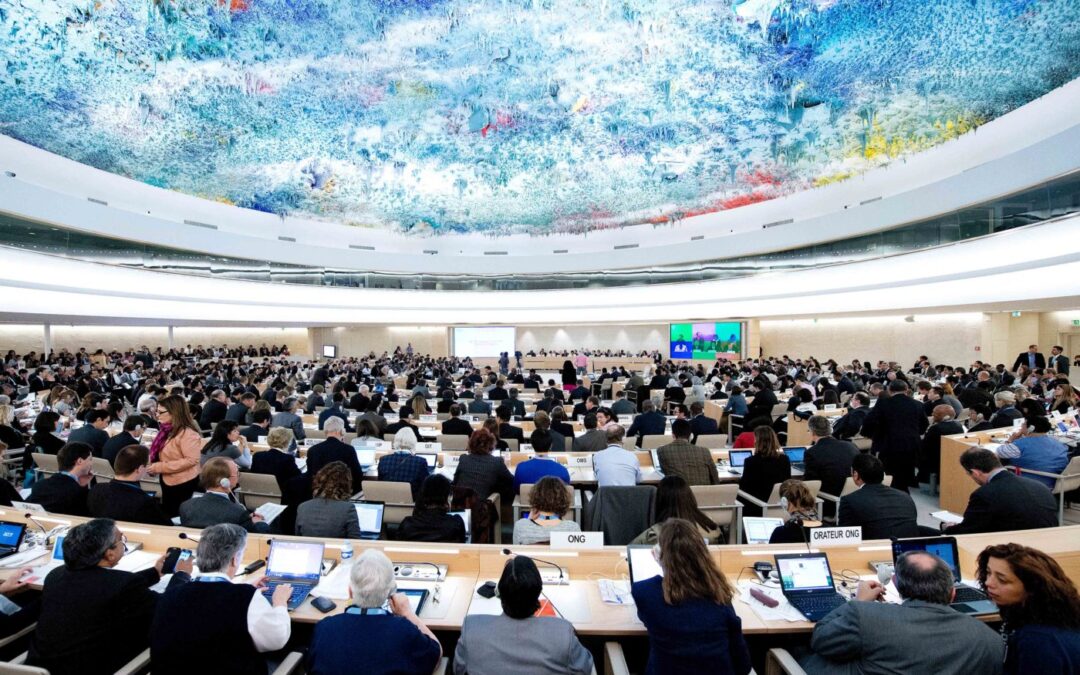
The UN Human Rights Council (HRC) convened today in Geneva for the start of its 54th session. The ICJ delivered statements on three situations in which gross and systematic violations of human rights are committed: Myanmar, Sri Lanka and Afghanistan. These situations require sustained attention by the international community, including within the HRC, and more robust measures to ensure accountability for these violations, some of which are likely to constitute crimes under international law.
Sep 4, 2023 | News
We, nine international human rights organizations, have grave reservations about the Sri Lankan government’s proposed National Unity and Reconciliation Commission. Our concerns echo many of those already raised by victims of conflict-related abuses and their families. Sri Lanka has a long history of convening similar bodies, none of which has provided justice, truth or reparation to the many people who have engaged with them. The latest initiative risks repeating the mistakes of the past, exposing victims to renewed security threats and re-traumatization without any realistic chance of a different outcome. There have not been any genuine confidence-building measures, or steps to ensure a safe and conducive environment for such a commission to function effectively.