Jan 12, 2024 | News
The ICJ firmly condemns the criminal conviction and sentencing of journalist and columnist Zied Elheni to a six-month suspended sentence of imprisonment on 10 January 2024 on spurious charges — an act of clear retaliation for Zied Elheni’s legitimate exercise of his right to freedom of expression, including to criticize government members.
البيان باللغة العربية
“This guilty verdict is part and parcel of an escalation in attacks on journalists and another concrete illustration of the Tunisian authorities’ authoritarian drift and of their drive to restrict the legitimate exercise of the right to freedom of expression and to silence independent voices in the country,” said Said Benarbia, ICJ Middle East and North Africa programme director. “These attacks violate media freedom and the right of the public to freely access information and have a chilling effect on free speech,” he added.
On 28 December 2023, Zied Elheni was summoned to appear before the Fifth Central Cybercrime Brigade of the Aouina National Guard, a few hours after he had made a statement critical of the Minister of Commerce on Radio IFM. On the same day, the public prosecutor at the Tunis First Instance Tribunal decided to remand Elheni in custody on suspicion of offences under article 24 of Decree-Law 54; his detention was extended by 48 hours on 30 December.
On 1 January, the public prosecutor at the Tunis First Instance Tribunal charged Elheni with “harming or disturbing third parties through public telecommunications networks,” under article 86 of the Telecommunications Code, and remanded him in custody pending trial. On 10 January, Elheni was tried before the Criminal Chamber of the Tunis First Instance Tribunal and convicted of the charges.
In June 2023, Elheni was arrested and questioned by the Fifth Central Cybercrime Brigade of the Aouina National Guard in a distinct case, following a statement he had made on the radio in which he had criticized the authorities’ arbitrary reliance on the crime of offending the President of the Republic under article 67 of the Criminal Code. He was later released and there have been no further developments in this case.
The ICJ calls on the Tunisian authorities to quash Elheni’s conviction and sentence under article 86 of the Telecommunications Code and to drop all charges against all journalists currently being prosecuted solely for the legitimate exercise of their journalistic duties and the peaceful exercise of their right to freedom of expression, and to immediately cease all practices that impede the independent work of journalists.
Background
There has been a growing pattern of prosecutions against journalists since July 2021 in Tunisia. Monia Arfaoui and Mohamed Boughalleb were prosecuted in March and April 2023 based on Decree-Law 54, in relation to their work as investigative journalists. Noureddine Boutar, journalist and director of Mosaique FM, was also arrested and placed in pre-trial detention in February 2023 in relation to criminal proceedings based on “State security-related” charges aimed to crack down on government critics, before being released on bail in May 2023. The charges against him, however, are still pending.
Contact
Said Benarbia, Director, ICJ Middle East and North Africa Programme, t: +41-22-979-3800; e: said.benarbia(a)icj.org
Dec 21, 2023 | News
On 18 December 2023, the International Commission of Jurists (ICJ) filed a submission to the Human Rights Committee (the Committee) on Tunisia’s implementation of the Committee’s 2020 concluding observations regarding the Constitutional Court and the use of counter-terrorism provisions in the context of the Committee’s follow-up procedure.
“Since July 2021, President Kais Said has systematically eroded all checks on his authority, including by curtailing the powers of the Constitutional Court under the 2022 Constitution and by instigating arbitrary prosecutions against those suspected of opposing his rule , including judges, journalists, human rights defenders, and political opponents,” said Said Benarbia, ICJ MENA director. “The Tunisian authorities must abide by their obligations under international law, immediately reinstate a democratic constitutional order, and end the use of the criminal process and counter-terrorism measures to crackdown on dissent and free speech.”
In April 2022, pursuant to the Committees’ request to the State party to provide follow-up information on the implementation of its recommendations regarding the Constitutional Court, the state of emergency and counter-terrorism, and freedom of peaceful assembly and excessive use of force by the State’s agents, Tunisia submitted further information regarding its obligations under the International Covenant on Civil and Political Rights (ICCPR) as they pertain to the above-mentioned concerns. During the Committee’s 140th session between 4 and 28 March 2024, this information, and Tunisia’s implementation of the Committee’s recommendations on the same, will be reviewed.
The ICJ’s submission to the Committee highlights a number of ongoing human rights concerns with respect to the country’s implementation of and compliance with the provisions of ICCPR, which are not adequately addressed in the State’s submission of further information, including:
- Article 2(3). By failing to establish a Constitutional Court, and by severely limiting the independence and powers of the Constitutional Court under the new Constitution – should one ever be established – Tunisia has failed to provide recourse to resolve disputes about the constitutionality of the exceptional decrees promulgated by the President under the state of exception, including by removing the power of the legislature to challenge the constitutionality of such decrees in the new Constitution;
.
- Article 4(1) and (3). By failing to specify the nature of the public emergency that purportedly necessitated the suspension of the Constitution in July 2021 per article 80 of the 2014 Constitution on state of exception, and the corollary interference with ICCPR rights, and by failing to notify the derogation to these rights, Tunisia has failed to meet its obligations to prove and ensure that the exceptional measures adopted by the President were “strictly required by the exigencies of the situation”;
.
- Article 9(1). By arbitrarily detaining perceived political opponents, lawyers or judges under counter-terrorism provisions without reliable evidence, Tunisia is unlawfully interfering with their right to liberty;
.
- Article 19 (1) and (3). By arbitrarily investigating and prosecuting members of the judiciary, political opponents and lawyers under counter-terrorism provisions, Tunisia is unlawfully interfering with their right to express their opinions both in their professional and personal capacity; and
.
- Article 14(1). Through interference in the appointment, career, disciplining and dismissal of judges, prosecutors and High Judicial Council members, the President has undermined the independence and impartiality of tribunals presiding over criminal investigations and prosecutions, including with respect to counter-terrorism proceedings against perceived political opponents and members of the judiciary.
Contact
Said Benarbia, Director, ICJ Middle East and North Africa Programme, t: +41-22-979-3800; e: said.benarbia(a)icj.org
Dec 18, 2023 | Attacks on Justice, Publications
In a briefing paper published today, the ICJ called on the Tunisian authorities to immediately end their attacks on independent judges and prosecutors, drop any criminal charges against them, and reinstate all those arbitrarily dismissed.
التقرير بالغة العربية
On 1 June 2022, President Kais Saied granted himself, via decree, absolute power to fire judges and prosecutors summarily, and [on the same day] promptly dismissed 57 of them. The President had earlier pledged to “cleanse” the judiciary on spurious accusations of widespread political bias and corruption.
The ICJ analysis of the cases of 18 dismissed judges and prosecutors, as well of another judge subjected to disciplinary and criminal proceedings, establishes a pattern of arbitrary disciplinary and criminal processes effectively aimed at purging the judiciary of those who asserted their independence and challenged the dismantling of the institutional independence of the judiciary.
“The ongoing arbitrary criminal prosecutions against independent judges and prosecutors for the legitimate exercise of their professional functions or of their right to freedom of expression is an affront to the rule of law and judicial independence in Tunisia,” said Said Benarbia, ICJ MENA director. “The authorities must immediately end such prosecutions and reinstate all judges and prosecutors who have been dismissed without legitimate grounds or due process”
In the aftermath of his speech on 25 July 2021 announcing exceptional measures, the President promised to “cleanse” and “purify” the judiciary, which he accused of complicity with political parties in power before July 2021, as well as of inefficiency, corruption and political bias. He also targeted the High Judicial Council and its members, limiting certain of their financial benefits. Since then, the President has followed up on his rhetoric with successive decisions and measures aimed directly at dismantling the judiciary’s institutional independence.
The ICJ’s analysis examines the process of arbitrarily dismissing and prosecuting judges and prosecutors in Tunisia since the adoption of these measures in light of the country’s obligations under international human rights law.
The ICJ’s analysis is primarily based on: (i) a review of 20 criminal cases opened by the authorities against 18 dismissed magistrates and of the case of Anas Hmedi, the President of the Association of Tunisian Magistrates (AMT), which is directly linked to his support of the dismissed judges and proseuctors; (ii) 15 interviews with judges, prosecutors and their lawyers; (iii) an analysis of the First President of the Administrative Court’s decisions to suspend the dismissal of 49 magistrates and to dismiss the request for suspension of seven others; and (iv) an analysis of decisions and reports by the General Inspection Service, the High Judicial Council and the Temporary High Judicial Council.
The ICJ considers that the conduct of the dismissed judges and prosecutors, on the basis of which they have apparently been subject to criminal proceedings, did not amount to recognizably criminal offences under general principles of criminal law and international human rights law and standards.
On the contrary, the ICJ’s analysis of these cases establishes that these judges and prosecutors were arbitrarily dismissed and then subject to criminal proceedings in relation to serious offences solely for three types of conduct, none of which is a legitimate basis for criminal prosecution:
- for the exercise of their prosecutorial and judicial functions in compliance with the law and ethical standards, and
- for the exercise of human rights protected by international human rights law, including the rights to freedom of expression and freedom of association
- for private conduct, unrelated to their performance of their duties, which, in any event, was not criminal in nature.
Contact
Said Benarbia, Director, ICJ Middle East and North Africa Programme, t: +41-22-979-3800; e: said.benarbia(a)icj.org
Download:
Download ICJ briefing on Attacks on Judges and Prosecutors in Tunisia in English: Here
Download ICJ briefing on Attacks on Judges and Prosecutors in Tunisia in Arabic: Here
Nov 7, 2023 | News
Arbitrary restrictions and excessive government control.
(Tunis, 7 November 2023) – The draft law on associations submitted by 10 parliamentarians to the Tunisian Parliament on 10 October 2023 would violate the right to freedom of association and endanger civic space in Tunisia if adopted as currently formulated, 8 rights groups said today.
البيان باللغة العربية على هذا الرابط
The draft law, if passed, would replace Decree-Law 2011-88 on associations, which enabled the emergence of a diverse civil society in the aftermath of Tunisia’s 2011 revolution. As presently drafted, it threatens to end more than a decade of work by independent groups. According to official data, over 24,000 civil society organizations are currently registered with the Tunisian authorities, although it remains unclear how many are active today. If adopted in its current form, the draft law would grant the government pervasive control and oversight over the establishment, activities, operations and funding of independent groups, which are one of the last remaining counterweights to President Kais Saied’s autocratic rule.
While the text claims to maintain a notification system for establishing new associations, it would actually introduce a thinly disguised registration system, granting a department under the Prime Minister’s Office the authority to deny a group the right to operate within a month after of registering (article 9.2). Without being required to provide any reasons, the government would also be able to petition the judiciary at any time requesting the cancellation of an association’s registration (article 9.3).
In addition, new organizations would not be allowed to operate until a government-headed “administration of associations” publishes a notice in the Official Gazette, leaving open the possibility of denying a group’s registration. At present, under Decree-Law 2011-88 on associations, an association may begin operating once the representative of the association has notified its registration to the Official Gazette.
Under the draft law, international organizations would be required to obtain prior authorization to register from the Foreign Affairs Ministry (articles 8 and 19). Without setting conditions or deadlines for any such a process, the draft law empowers the Ministry to issue temporary authorizations and to revoke and suspend them at its own discretion (article 20). As a result, international organizations may be arbitrarily denied registration for any reason and without due process, the groups said.
In 2012, the United Nations Special Rapporteur on the rights to freedom of peaceful assembly and association’s report on best practices related to the right to freedom of association recommended a “notification procedure”, rather than a “prior authorization procedure” requesting the authorities’ approval to establish an association as a legal entity. The 2017 Guidelines on Freedom of Association and Assembly in Africa of the African Commission on Human and Peoples’ Rights stipulate that “registration shall be governed by a notification rather than an authorization regime, such that legal status is presumed upon receipt of notification” and that the administrative body overseeing registration should carry out its functions “impartially and fairly.”
The draft law’s preamble states that associations must operate in accordance with the “principles of national orientation,” and must not “violate laws related to good morals,” “disturb public security,” “undermine the unity of the national territory and the republican system,” or “violate national sovereignty.” Such terms are vague, imprecise, arbitrary and overly broad and, as such, do not comply with the principle of legality. As a result, these concepts are open to broad interpretations and the authorities could use them to justify arbitrarily restricting or closing associations that displease them, the groups said.
The draft law places national organizations under “the supervision and control” of the Ministry relevant to their main area of work and international organizations under Prime Minister Office’s supervision (article 6). The current draft law does not specify what such “supervision and control” entail. It also requires associations to inform the pertinent Ministry of any planned activities (article 13).
The draft law also gives rise to concern about surveillance as it empowers the authorities to establish a digital database of associations and volunteers (article 14).
If the draft law is adopted in its current form, then the authorities may interpret its many vague provisions to ban or dissolve associations. The establishment of associations on religious or ethnic grounds is forbidden in the draft law. In addition, the qualification that a group’s work must be “voluntary” may be interpreted as a ban on paid labour by non-profit groups (article 2). The draft text further provides that the Prime Minister’s Office can “automatically” dissolve any group “suspected of terrorism” or that has a “terrorist background” (article 24), without judicial review.
This text also dangerously conflates associations with unions (article 15), which are currently separately governed by the Tunisian labour law, without providing any specific guarantees or sufficient protections for union rights.
National associations would have to obtain prior approval from the Prime Minister’s Office before receiving foreign funding (article 18). Associations that fail to comply with this requirement would risk immediate suspension or dissolution (article 24).
The draft law requires all existing associations to “rectify” their situation in accordance with the new law within a year of the law’s publication.
In 2013, the Special Rapporteur on the right to freedom of peaceful assembly and of association’s report affirmed that a civil society organization’s access to funding from domestic, foreign and international sources was “an integral part of the right to freedom of association.” Requiring groups to get prior government approval to receive foreign funding without specifying the grounds for refusal is inconsistent with the principle of legality and constitutes an arbitrary interference with the right to freedom of association.
Under Article 38 of the Guidelines on Freedom of Association and Assembly in Africa, governments may neither impose blanket bans on foreign funding for civil society groups nor require prior government authorization to receive it.
Decree-Law 2011-88 on associations provides sufficient guarantees and procedures to ensure that civil society groups’ funding be transparent and law compliant, the groups said. The draft law’s foreign funding provisions are open to abuse and may be used to punish and reject funding for organizations critical of the government.
In February 2022, a draft law on associations prepared by the executive that threatened human rights safeguards was leaked and denounced as restrictive by the Tunisian civil society. Shortly after, on 24 February 2022, President Saied announced his intention to “prevent foreign funding to associations.” In light of this, UN experts expressed concern over the then draft law in a communication to the Tunisian authorities in April 2022, to which the Tunisian government responded in June 2022, confirming their intention to amend Decree-law 88.
Since 25 July 2021, President Saied has dismantled Tunisia’s democratic institutions, undermined judicial independence, stifled the exercise of freedom of expression and repressed dissent.
Tunisia is obliged to respect, protect, promote and fulfill the right to freedom of association, guaranteed by Article 22 of the International Covenant on Civil and Political Rights and Article 10 of the African Charter on Human and Peoples’ Rights. Restrictions on the exercise of this right may be permissible only when they are prescribed by law and necessary in a democratic society; that is, using the least restrictive means possible and reflecting basic values of pluralism and tolerance.
“Necessary” restrictions must also be proportionate; that is, carefully balanced against the specific reason for imposing them in the first place. In addition, they may not be discriminatory, including on the grounds of national origin or political opinion or belief.
The Tunisian authorities should refrain from adopting the proposed draft law and, instead, should commit to safeguarding the right to freedom of association as enshrined in Decree-law 88 and under international human right law binding on Tunisia, the groups said. The authorities should ensure that associations are able to operate without political interference, intimidation, harassment or undue restrictions.
Signatories:
1-International Commission of Jurists (ICJ)
2-Euromed Rights
3-Human Rights Watch (HRW)
4-Avocats Sans Frontières (ASF)
5-Access Now
6-World Organisation Against Torture (OMCT)
7-Tahrir Institute for Middle East Policy (TIMEP)
8- International Service for Human Rights (ISHR)
Nov 6, 2023 | News
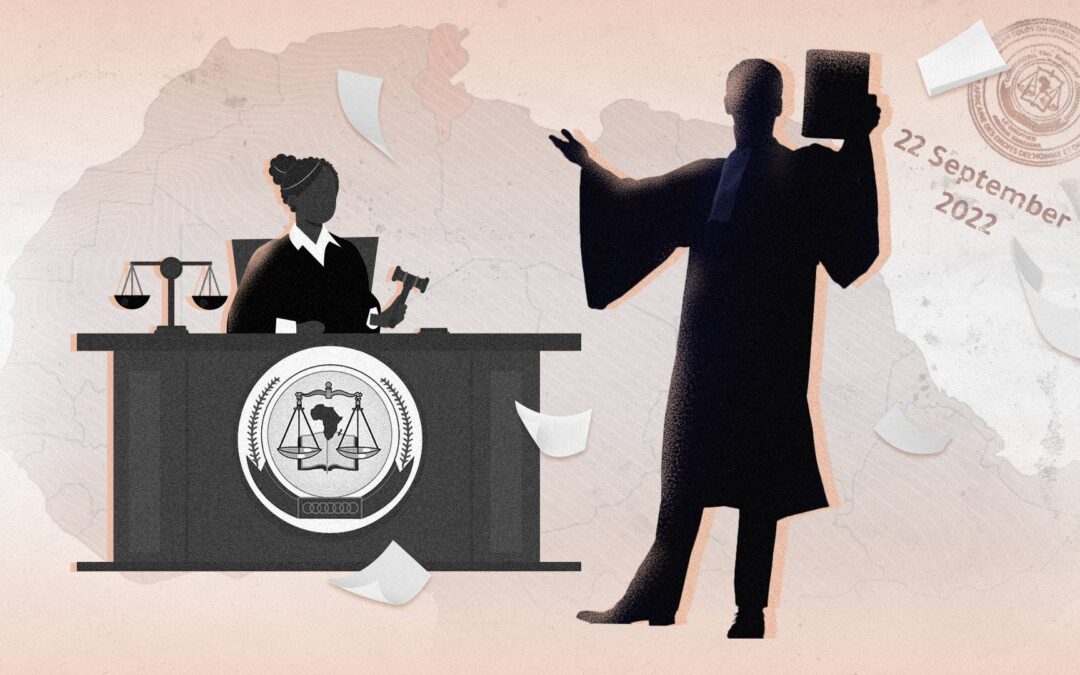
Today, the African Court of Human and Peoples’ Rights (AfCHPR) opens its 71st Ordinary Session. To mark the occasion, the International Commission of Jurists (ICJ), in collaboration with inkyfada, looks back at AfCHPR’s September 2022 judgement against Tunisia, in which it ordered the republic to return to constitutional democracy and establish an independent constitutional court. The ICJ examines the impact of the judgement on human rights in Tunisia, and how individuals can operationalize the AfCHPR to challenge the curtailment of fundamental freedoms, judicial independence and rule of law in Tunisia.
ICJ’s questions and answers:
It has been more than a year since the African Court on Human and People’s rights issued its judgment in case No. 017/2021, “Ibrahim Ben Mohamed Ben Brahim Belguith v. Republic of Tunisia”, of 22 September 2022. The case was brought by Mr. Belguith, a national of Tunisia and a lawyer, who complained of violations of his rights under the African Charter on Human and Peoples’ Rights and other human rights instruments as a result of the promulgation of several Tunisian presidential decrees adopted under the “state of exception” pursuant to article 80 of the 2014 Constitution since 25 July 2021. In this judgment, the African Court ordered Tunisia to repeal these decrees, to return to constitutional democracy within two years and to ensure the establishment and operation of an independent constitutional court within the same period.
What does this judgment mean and why is it important for the rule of law and human rights in Tunisia? The ICJ provides answers in the Q&A below:
-
- What is the African Court on Human and Peoples’ Rights?
* The African Union
* The African Charter on Human and Peoples’ Rights
* The African Commission on Human and Peoples’ Rights
* The African Court on Human and Peoples’ Rights
* Tunisia’s adherence to the African Human Rights System
-
- Why was the African Court seized of the situation in Tunisia? Contextual overview
* President Kais Saied’s power grab of 25 July 2021
* The absence of a Constitutional Court
-
- What did the 22 September 2022 judgment rule?
* How the African Court came to rule on the matter: the application
* What the judgment ruled:
-
- What are the next steps?
* Implementation
* Other complaints against Tunisia pending before the African Court
Download the full Q&A in English here
Download the full Q&A in French here
Download the full Q&A in Arabic here