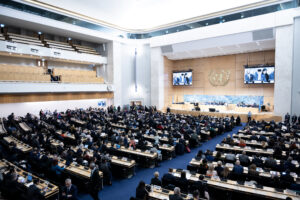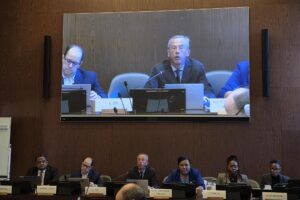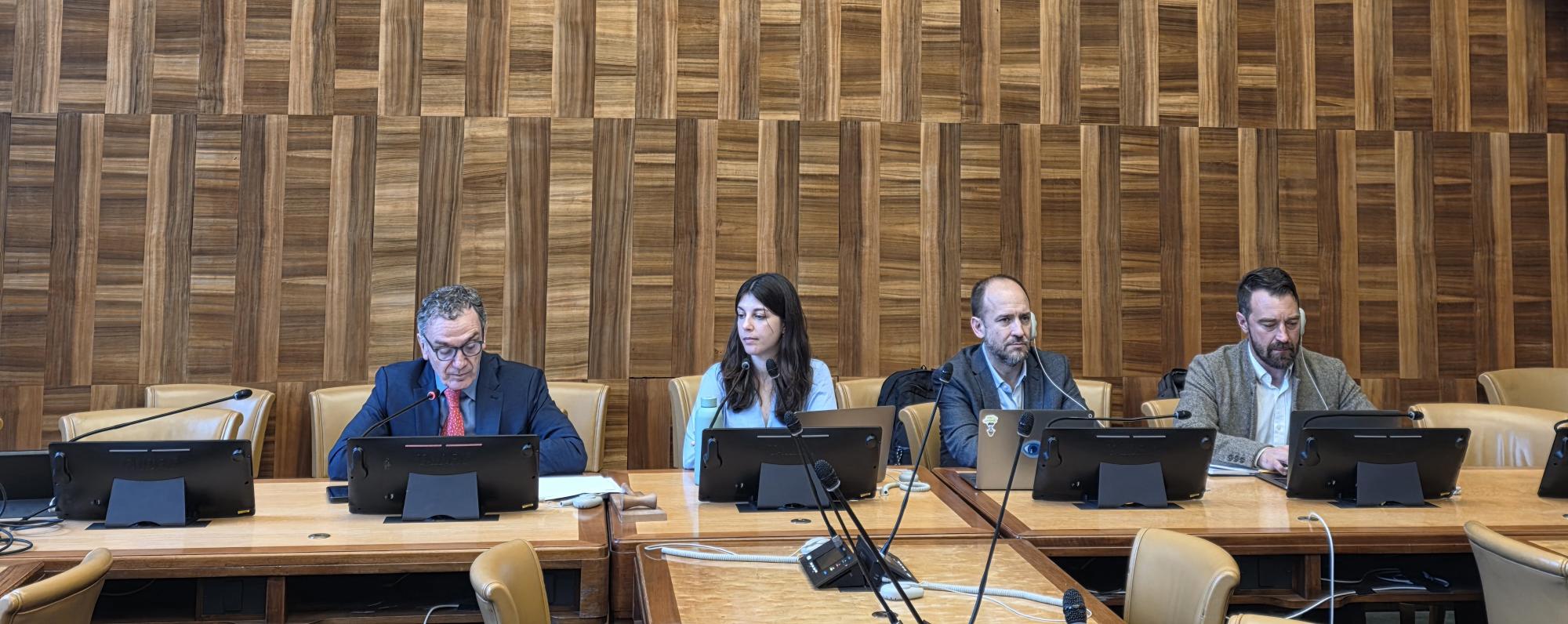
The International Group of Experts for the Investigation of Human Rights Violations under the State of Exception in El Salvador (GIPES)—established in 2024—has reported that there are reasonable grounds to conclude that crimes against humanity are being committed in the country. This critical finding was presented during a side event at the UN Human Rights Council in Geneva, where experts detailed the systematic nature of the violations occurring under the current legal framework.
The event, held within the framework of HRC61, was organized by a prominent coalition of human rights organizations, including the ICJ, the Centre for Civil Political Rights (CCPR), Cristosal, Due Process of Law Foundation (DPLF), Inter Just, the International Federation for Human Rights (FIDH), Redress, and Rights Security International. Together, these organizations called for international attention and accountability regarding the findings presented by GIPES.
In a detailed report, “El Salvador at the Crossroads: Crimes against Humanity in the Framework of Public Security Policy,” the GIPES examined the grave human rights situation and the erosion of the rule of law in the country.
“The Bukele model is sustained by the dismantling of the rule of law to systematically violate human rights without institutional restraints. In the very short term, it may appear to improve security, but it inevitably weakens the very security it claims to protect. The danger is that this approach is increasingly being promoted across Latin America by authoritarian and unscrupulous political leaders as a solution to crime”, said Santiago Canton, General Secretary of the International Commission of Jurists (ICJ).
The Human Rights Council event brought together international jurists, human rights defenders and civil society representatives to discuss the findings of the extensive investigation by the GIPES into the state of exception that has been in force since March 2022.
GIPES is composed of five independent jurists: Susana SáCouto, Claudia Martin, Gino Costa, José Guevara and [ICJ Secretary General] Santiago Canton. The initiative has been supported by the ICJ, the Due Process of Law Foundation (DPLF), the International Federation for Human Rights (FIDH), InterJust, the IMPACTUM research project, and the Human Rights in Context programme of Ghent University (Belgium).
The report concludes that there are reasonable grounds to believe that the systematic and widespread violations committed pursuant to El Salvador’s security policy may constitute crimes against humanity under international law.
The report highlighted the scale of the crackdown, noting that while more than 89,000 individuals have been detained, thousands of these detentions appear to be arbitrary, often under spurious charges of gang membership or ‘terrorism’, frequently based on discriminatory profiling or arrest quotas. The report cites President Nayib Bukele’s public admission that at least 8,000 of those detained were innocent of the crimes alleged. Evidence presented during the event documented 403 deaths in state custody—including four children—and 540 cases of enforced disappearance as of early 2025. Jurists emphasized that these patterns point not to isolated abuses but to the implementation of a deliberate policy carried out without effective institutional oversight.
The report also examines the institutional context in which these violations have occurred. According to the experts, many of the practices documented—such as mass arbitrary detentions without individualized evidence, the prolonged suspension of procedural guarantees and restrictions on access to legal defence—would be difficult to sustain in a system where judicial independence is effectively guaranteed and institutional checks operate effectively.
The report identifies 1 May 2021 as the institutional breaking point, when the Legislative Assembly summarily dismissed the magistrates of the Constitutional Chamber of the Supreme Court and the Attorney General. This was followed by a series of legal “reforms” that forced the retirement of more than 200 judges, allowing the Executive to install political loyalists throughout the judiciary. With institutional checks neutralized, the government intensified the stigmatization of journalists and human rights organizations, restricted access to public information and deployed unlawful surveillance measures against critical voices.
The document warns that elements of this model are increasingly being applied in other countries. Political actors across Latin America have publicly praised or proposed replicating aspects of this approach as a response to insecurity, with some leaders placing the so-called “Bukele model” at the center of electoral campaigns or presenting it as a blueprint for government policy. According to the GIPES, this trend reflects a growing discourse portraying the concentration of power and suspension or unwarranted restrictions on human rights as legitimate tools for public security. The report concludes that the effectiveness of this model depends on the progressive deterioration of the rule of law, as its core practices require the absence of effective institutional checks and judicial independence.
Background
The document and the expert discussion follow several years of monitoring by GIPES members and supporting organizations regarding the deterioration of constitutional guarantees in El Salvador. The investigation sought to provide a rigorous legal framework to assess whether security policies that sacrifice human rights can be considered compatible with international law.
The experts conclude with recommendations requiring immediate implementation, including the establishment of an international investigative mission, the creation of an independent case-review commission for detainees, and the restoration of judicial independence and the rule of law.
The experts reaffirm that the State’s human rights obligation to ensure the security of persons is indivisible from its other international duties; therefore, it cannot be fulfilled by violating international law or by dismantling the democratic institutions designed to prevent the abuse of power.
The International Group of Experts (GIPES) is composed of five independent jurists with extensive experience in international law and human rights:
- Santiago Canton, General Secretary of the International Commission of Jurists (ICJ).
- Susana SáCouto, Director of the War Crimes Research Office at the American University Washington College of Law.
- Claudia Martin, Co-Director of the Academy on Human Rights and Humanitarian Law and Resident Professor at the American University Washington College of Law.
- Gino Costa, Former Minister of the Interior of Peru and expert in public security and human rights.
- José Antonio Guevara Bermúdez, Former Chair-Rapporteur of the UN Working Group on Arbitrary Detention.
The GIPES initiative has been supported by a coalition of international organizations and academic programs, including the International Commission of Jurists (ICJ), the Due Process of Law Foundation (DPLF), the International Federation for Human Rights (FIDH), InterJust, the IMPACTUM research project, and the Human Rights in Context programme of Ghent University (Belgium).