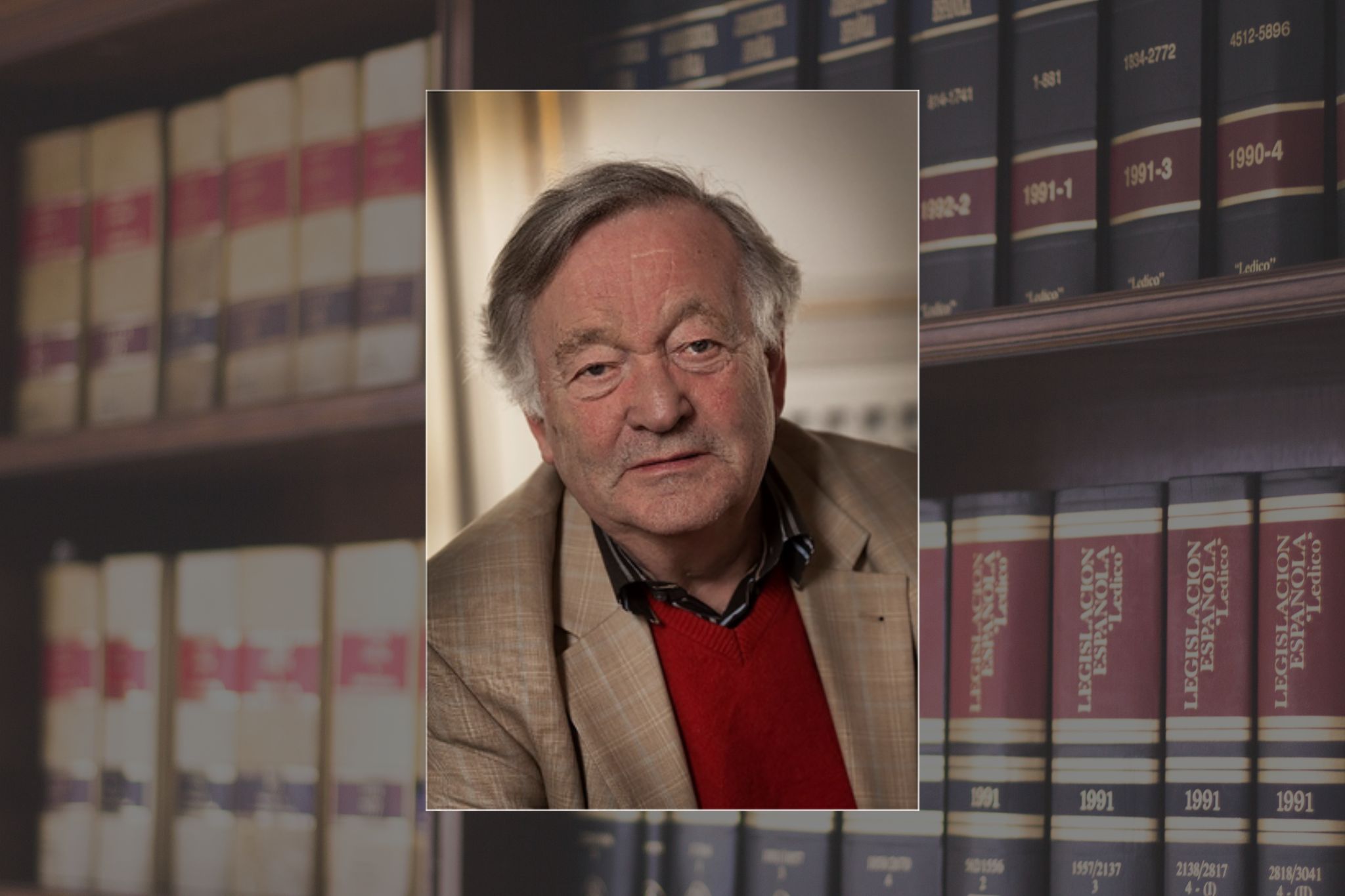
The International Commission of Jurists (ICJ) mourns the loss of Professor Theo van Boven, a towering figure in the defense of human rights globally for over five decades, who died on 9 May.
Professor van Boven, who served as ICJ Vice-President, Commissioner, Executive Committee member, and, most recently, Honorary Member, played a wide range of roles in defense of human rights, including as Director of the Human Rights Division of the United Nations (the predecessor to the present Office of the High Commissioner for Human Rights) from 1977 to 1982.
In that position, Theo van Boven courageously sought to shift the UN’s human rights work from a soft, abstract approach to one that brought to light the actual conduct of States and held them to account. He called critical attention to human rights atrocities, including under dictatorships in Latin America, at a time when the UN headquarters in New York found it inconvenient to do so.
His efforts, which upset powerful actors, ultimately cost him his job. His term was not extended in 1982. A UN spokesperson said, “that he made public statements not wholly in keeping with his status as an international public servant.” In response, Theo van Boven said: “Whenever necessary, we must speak out on matters of principle, regardless of whom we please or displease within or outside the organization.”
“As Secretary General of the ICJ, but also as someone from the Southern Cone of Latin America, I know the importance Theo van Boven had for a generation that saw the United Nations begin, finally, to move beyond the old ‘no power to act’ doctrine that for too long had treated grave human rights violations with silence and diplomatic caution. For many victims of dictatorship and repression in Latin America and elsewhere, Theo van Boven represented one of the first voices within the UN willing to confront abuses openly and insist that the rights of victims could not be subordinated to political convenience,” said Santiago A. Canton, Secretary General of the International Commission of Jurists.
Among the many positions that Theo van Boven subsequently held were: Member of the UN Sub-Commission on the Prevention of Discrimination and Protection of Minorities (twice); Member of the UN Committee on the Elimination of Racial Discrimination; Special Rapporteur on Torture of the UN Human Rights Council; first Registrar of the International Tribunal for the Former Yugoslavia (ICTY); and Head of the Dutch Delegation to the UN Diplomatic Conference for the Establishment of the International Criminal Court.
Much of his work was conducted alongside his longtime position as Professor of Law at Maastricht University and his scholarly writings.
Theo van Boven’s work for the UN Sub-Commission developing principles on the right to remedy and reparation for victims of gross human rights violations became the basis for the UN Basic Principles on the Right to a Remedy and Reparation for Victims of Gross Violations of International Human Rights Law and Serious Violations of International Humanitarian Law, adopted by the UN General Assembly in 2005. Professor van Boven worked with the ICJ and others to advance these principles, which remain the global standard for reparative justice.
Professor van Boven was highly active in the work of the ICJ, working, among other things, to develop the organization’s abolitionist position on the death penalty, concluding that it was per se a violation of the right to life and cruel, inhuman, and degrading treatment.
“At a time when multilateral human rights institutions and civil society organizations again face growing political pressure and attempts to weaken their independence, Theo van Boven’s legacy of moral clarity and willingness to act remains a powerful lesson for the present moment,” added Santiago A. Canton.