Jul 26, 2018 | News, Op-eds
An opinion piece by Kingsley Abbott, ICJ Senior Legal Adviser in Bangkok, Thailand.
Over recent decades, international observers have tended to view the human rights and political situation in Cambodia as a series of predictable cycles that does not warrant too much alarm.
The conventional wisdom has been that Prime Minister Hun Sen and his government routinely tightens their grip on the political opposition and civil society in advance of elections before relaxing it again after victory has been secured.
But that analysis is no longer valid.
The reason is simple: During the course of ensuring it will win the national election scheduled for this Sunday (29 July), Hun Sen’s ruling Cambodian People’s Party (CPP) has, since the last election, systematically altered the country’s constitutional and legal framework – and these changes will remain in place after the election has passed.
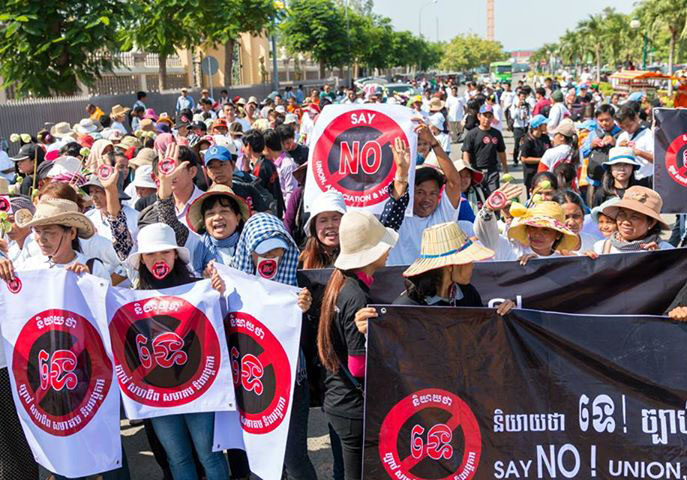
Through the passage of a slew of new laws and legal amendments inconsistent with Cambodia’s obligations under international law, and the frequent implementation of the law to violate human rights, the legal system has been weaponized to overwhelm and defeat the real and perceived opponents of the CPP, including the political opposition, the media, civil society, human rights defenders and ordinary citizens.
This misuse of the law is a significant development in the history of modern Cambodia and represents a determined move away from the vision enshrined in the historic 1991 Paris Peace Agreements that ended years of conflict and sought to establish a peaceful and democratic Cambodia founded on respect for human rights and the rule of law.
And it risks cementing the human rights and rule of law crisis that now exists within Cambodia for years to come.
To facilitate the closure of civil society space, and contrary to international law and standards, in 2015 the Law on Associations and Non-Governmental Organizations (LANGO) was passed, which requires the mandatory registration of all NGOs and Associations, provides the government with arbitrary powers to deny or revoke registration, and places a vaguely worded duty on NGOs and associations to “maintain their neutrality towards political parties”.
The biggest blow to the political opposition has been the amendment last year of the Law on Political Parties (1997), amended twice within four months, which empowers the Supreme Court to dissolve parties, and four election laws, which permits the redistribution of a dissolved party’s seats in the country’s senate, national assembly, and commune and district councils.
Last November, the Supreme Court, presided over by a high-ranking member of the CPP, used the amended Law on Political Parties to dissolve the main opposition party, the Cambodia National Rescue Party (CNRP), which had received just under 44% of the vote – or about 3 million votes – in communal elections held in June 2017.
After the CNRP’s dissolution, the amended election laws were then used to redistribute CNRP seats at every level of government, from the commune to the senate, to the CPP and minor parties.
To silence the media, the country’s media and taxation laws have been invoked – local radio stations have been ordered to stop broadcasting Radio Free Asia and Voice of America “in order to uphold the law on media” and the independent Cambodia Daily was forced to close after being presented with a disputed US $6.3 million tax bill which the Daily claimed was “politically motivated” and not accompanied by a proper audit or good faith negotiations.
To curb the exercise of freedom of expression, the Constitution has received vaguely worded amendments placing an obligation on Cambodian citizens to “primarily uphold the national interest” while prohibiting them from “conducting any activities which either directly or indirectly affect the interests of the Kingdom of Cambodia and of Khmer Citizens”.
Meanwhile individual journalists, members of the political opposition including the CNRP’s leader, Kem Sokha, human rights defenders and an Australian documentary filmmaker have been charged with any number of a kaleidoscope of crimes ranging from intentional violence and criminal defamation to treason and espionage.
And Cambodia lacks an independent and impartial judiciary.
In 2014, three “judicial reform laws” were passed which institutionalized the prosecution and judiciary’s lack of independence from the executive.
At the same time, the government perversely uses the doctrine of the “rule of law” to justify its actions.
Just hours after the Supreme Court dissolved the CNRP, Hun Sen announced that the decision was made “in accordance with the rule of law.”
When members of the diplomatic community and senior UN officials meet government officials to express concern at the increasing misuse of the law they receive an absurdist legal lecture on the “importance of the rule of law”.
What is happening in Cambodia is the opposite of that.
The International Commission of Jurists, UN authorities and others have been defining the rule of law since the Universal Declaration of Human Rights was pronounced in 1948.
All agree that that the rule of law entails passing and implementing laws consistent with a country’s international human rights obligations.
It is time for the international community to recognize that a frank and fresh analysis of the situation in Cambodia is urgently required which acknowledges the way the country’s underlying legal and constitutional framework has been deliberately altered, and the way in which this will impact the country adversely long past this month’s election.
This acknowledgment must be accompanied by a coherent and, where possible, joint, plan of action that clearly sets out, with a timeline, what is required to bring Cambodia back on track with the agreed terms of the Paris Peace Agreements – including necessary legal and justice sector reforms – and the political and economic consequences for not doing so.
As long as Hun Sen’s Government deploys increasingly sophisticated justifications for its repressive actions, a more refined, multilayered and vigorous response from the international community is required – grounded on a proper application of the rule of law and Cambodia’s international human rights obligations.

Jul 16, 2018 | Multimedia items, News, Video clips
Changes within the Commission enhance the organization’s capacity to respond to increased threats to rights protection via erosion of the rule of law, particularly in relation to the independence of the judiciary.
The ICJ is pleased to announce new leadership at the ICJ as Professor Robert K. Goldman (US) has been elected President of the organization and Justice Radmila Dragicevic-Dicic (Serbia) has been elected Vice-President, a role she will undertake jointly with Professor Carlos Ayala (Venezuela) who was also appointed Vice-President earlier in the year.
Professor Robert K. Goldman served as Acting President of the ICJ following the sad passing of former President Professor Sir Nigel Rodley in 2017.
The President and Vice-Presidents are supported by the Executive Committee, which has also been bolstered by new members Justice Sir Nicolas Bratza (UK), former President of the European Court of Human Rights; Dame Silvia Cartwright (New Zealand), former Governor-General of New Zealand; and Shawan Jabarin (Palestine), prominent human rights activist and Director General of Al-Haq, an independent Palestinian non-governmental human rights organization.
“I am honoured to have been elected President of the ICJ and to be able to work with such proficient and inspiring jurists amongst ICJ leadership and in the wider Commission itself, without whom the ICJ could not provide the expertise and leadership it does on such a wide range of human rights issues,” said Professor Robert K. Goldman, ICJ President.
“Those that have taken on a new role in ICJ leadership will help guide the organization in augmenting efforts to defend the rule of law amidst the current political backdrop of increasing antipathy and hostility towards rights protections,” he added.
In addition to these changes in the senior leadership of the ICJ, the organization is also pleased to welcome five new members:
Justice Chinara Aidarbekova (Kyrgyzstan), judge of the Constitutional Chamber of the Supreme Court of Kyrgyzstan; Gamal Eid (Egypt), prominent lawyer and human rights defender; Jamesina Essie L. King (Sierra Leone), Commissioner of the African Commission on Human and Peoples’ Rights; Michael Sfard (Israel), prominent human rights lawyer who has represented many Israeli and Palestinian individuals and organizations; and Ambiga Sreenevasan, former President of the Malaysian Bar Council.
“The ICJ is alarmed by the increasing volume of worldwide attacks on the institutions that uphold human rights both at an international level, where UN mechanisms are constantly condemned rather than supported and enhanced to maximize their efficacy; and also on the local level, for example when we see the independence of the judiciary, an essential element of maintaining rights protections, coming under attack in places like Guatemala, Poland and South Korea,” said Saman Zia-Zarifi, ICJ Secretary-General.
“The ICJ relies on its global advocates of human rights to advance and defend the rights of others through the culmination of their vast and varied expertise and I am pleased to welcome our newest Commissioners to help in this regard, ” said Zia-Zarifi.
A further nine Commissioners were elected to serve additional terms on the Commission:
Professor Roberto Garreton (Chile), Professor Robert K. Goldman, Hina Jilani (Pakistan), Professor Jose Antonio Martin Pallin (Spain), Justice Sanji Monageng (Botswana), Tamara Morschakova (Russia), Dr Jarna Petman (Finland), Belisario dos Santos Jr (Brazil) and Justice Philippe Texier (France).
Hina jilani (Pakistan) and Belisario dos Santos Jr (Brazil) were both also re-elected to the Exectuive Committee and Professor Marco Sassoli (Italy/Switzerland) and Justice Stefan Trechsel (Switzerland) were re-elected as Alternates to the Executive Committee.
On video: Bob Goldman talks about the ICJ and the Rule of Law
Jun 27, 2018 | Events, News
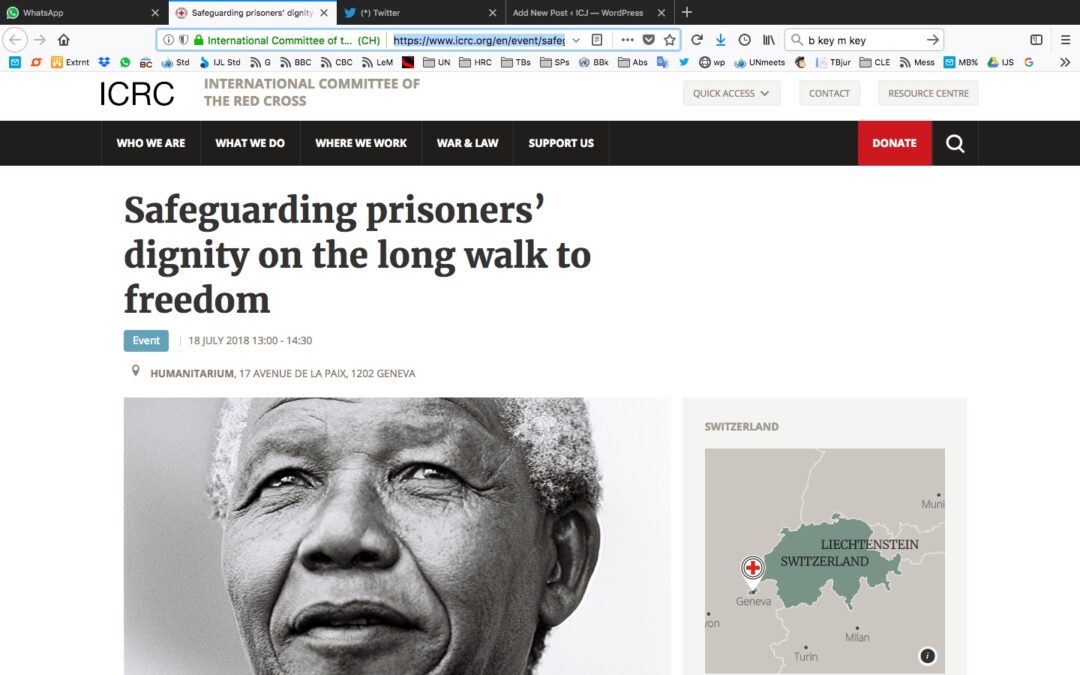
ICJ Senior Legal Adviser Matt Pollard will speak at an ICRC event on 18 July, marking Nelson Mandela International Day.The event, 18 July 2018, 13:00 – 14:30, will take place at the ICRC Humanitarium, 17 avenue de la paix, in Geneva.
On 18 July, the ICRC is marking Nelson Mandela International Day with the launch of a new edition of ‘A Human Rights Approach to Prison Management’ by the Institute for Criminal Policy Research. This Handbook, which has been translated into 19 languages, is used by the ICRC and many others around the world.
During the launch, author Professor Andrew Coyle will reflect on developments in the use of imprisonment worldwide over the last 20 years, focusing on topical issues such as the use of highly restrictive forms of detention for certain categories of prisoner, including solitary confinement. Detention experts from the ICRC and Geneva-based international organizations, the Association for the Prevention of Torture (APT) and the International Commission of Jurists (ICJ) will respond, and there will be space for questions and discussion.
In December 2015 the UN General Assembly adopted revised United Nations Standard Minimum Rules for the Treatment of Prisoners, to be known as the Nelson Mandela Rules in honour of the contribution of South Africa to the Rules’ development and of the legacy of the late President of South Africa, Nelson Rolihlahla Mandela, who spent 27 years in prison. In the accompanying resolution, the General Assembly decided to extend the scope of Nelson Mandela International Day as an opportunity to promote humane conditions of imprisonment, raise awareness about prisoners being a continuous part of society and to value the work of prison staff as a social service of particular importance.
Speakers:
- Andrew Coyle, Emeritus Professor of Prison Studies at Kings College, University of London
- Barbara Bernath, Secretary General of the Association for the Prevention of Torture
- Matt Pollard, Senior Legal Adviser to the International Commission of Jurists
- Sara Snell, Prison System Adviser to the International Committee of the Red Cross
- Valérie Belchior-Bellino Captier, Detention Nutrition Adviser to the ICRC
For more information and to register, click here.
Jun 12, 2018 | Advocacy, Cases, Legal submissions
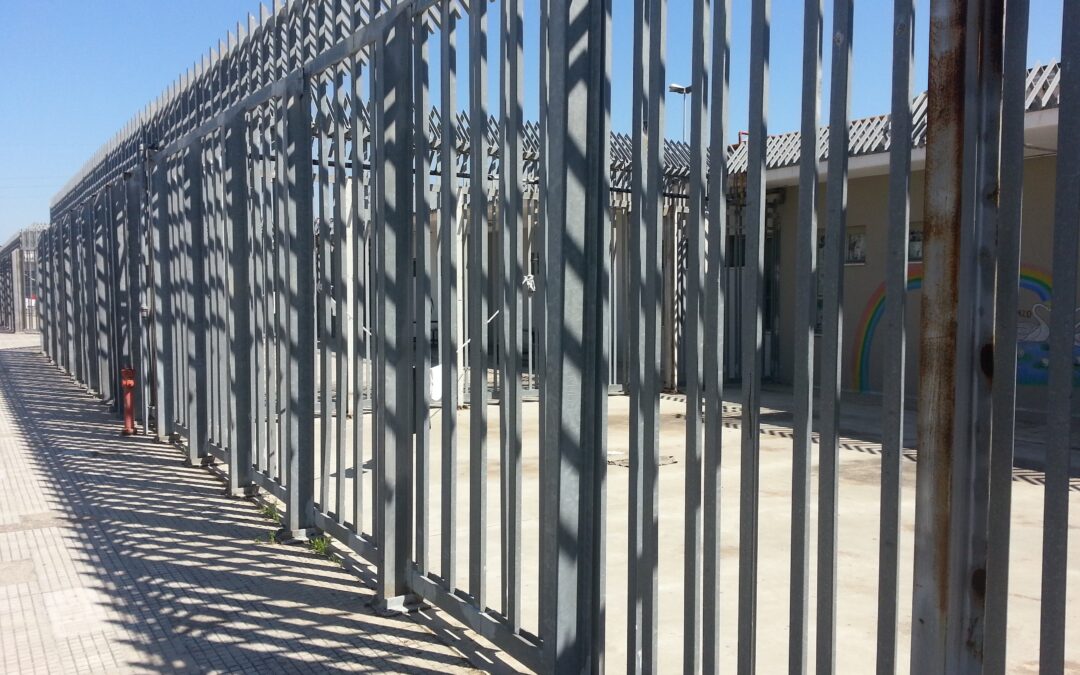
The ICJ and others intervened before the European Court of Human Rights in a case of thirteen undocumented children held in a hotspot in Italy.
The International Commission of Jurists (ICJ), the European Council on Refugees and Exiles (ECRE), the Dutch Council for Refugees and the AIRE Centre jointly intervened in the case of Trawalli and others v. Italy.
In this case, the European Court of Human Rights is called to rule, among other issues, on whether their detention and reception conditions were lawful and/or constituted an inhuman or degrading treatment under the European Convention on Human Rights.
In their third party intervention, the three human rights organizations submitted the following arguments:
a) Taking into consideration migrant children’s status as persons in situations of vulnerability and the principle of the best interests of the child, article 5 ECHR should be read in light of the rising consensus in international law towards a prohibition of detention of children on immigration grounds, in particular based on the consolidated and clear position of the UN Committee on the Rights of the Child. This applies to all instances of deprivation of liberty irrespective of their classification under domestic law.
b) In addition to the above, detention under article 5.1 ECHR will in any event be unlawful and arbitrary where it lacks a clear and accessible legal basis, outlining the permissible grounds of detention as well as the relevant procedural guarantees and remedies available to detainees, including judicial review and access to legal advice and assistance. In light of the obligations of EU Member States under EU law, the interveners submit that detention of asylum seeking children falling within the scope of the recast Reception Conditions Directive will result in a breach of the Convention standards also where it is not used as a measure of last resort, but rather is imposed without consideration of less onerous alternative measures and where the child’s best interests assessment has not been carried out and reflected in this decision.
c) Due to children’s extreme vulnerability, their detention for immigration purposes risks leading to a violation of Article 3 ECHR because of inadequate living conditions and/or to a violation of Article 8 ECHR because of a disproportionate and unnecessary interference with their development and personal autonomy, as protected under Article 8. In this sense, Article 8 must be regarded as affording protection from conditions of detention which would not reach the level of severity required to engage Article 3.
d) When the authorities deprive or seek to deprive a child of her or his liberty, they must ensure that he/she effectively benefits from an enhanced set of guarantees in addition to undertaking the diligent assessment of her/his best interest noted above. The guarantees include: prompt identification and appointment of a competent guardian; a child-sensitive due process framework, including the child’s rights to receive information in a child-friendly language, the right to be heard and have her/his views taken into due consideration depending on his/her age and maturity, to have access to justice and to challenge the detention conditions and lawfulness before a judge; free legal assistance and representation, interpretation and translation. The Contracting Parties must also immediately provide the child access to an effective remedy.
e) In order to fully comply with their obligations under the Convention, Contracting Parties must guarantee that asylum seeking children are accommodated in reception facilities which are adapted to their specific needs and provide adequate material conditions adapted to their age, condition of dependency and enhanced vulnerability. To do otherwise results in a failure by States to comply with their obligations under Article 3 ECHR and their specific obligations under EU law.
Italy-icj&others-Trawalli&others-Advocacy-legal submission-2018-ENG (download the intervention)
Apr 17, 2018 | Advocacy, Cases, Legal submissions, News
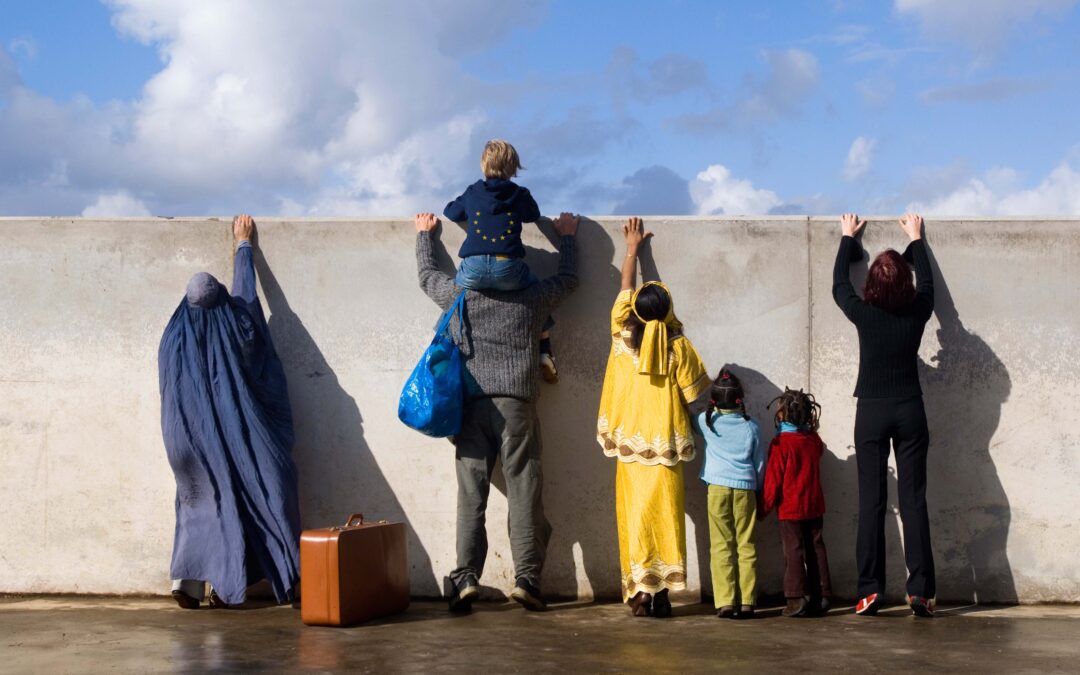
The ICJ and other NGOs jointly intervened before the Grand Chamber of the European Court of Human Rights in a case against Spain on the denial of entry of asylum seekers in the enclave of Melilla.
The ICJ, the European Council on Refugees and Exiles, the AIRE Centre, Amnesty International and the Dutch Refugee Council argued that the European Convention on Human Rights prohibits refusal of entry, and/or return of a person to face serious violations of human rights, including of the right to life, the prohibition of torture or inhuman or degrading treatment or punishment, or flagrant denial of justice and of the right to liberty.
They submitted that these refusals of entry are also contrary to the rights set out in the EU Charter of Fundamental Rights (CFR) and the prohibition on non-refoulement found in the 1951 Geneva Convention on the Status of Refugees (Refugee Convention).
The joint interventions presents the argument that, for these prohibitions to be practical and effective and not theoretical and illusory, Contracting Parties must have in place effective systems for identifying people within their jurisdiction who are entitled to benefit from the prohibition on refusing entry.
Spain-ICJ&others-AmicusBrief-ND&NT-ECtHR-GC-legalsubmission-2018 (download the thirty party intervention)