Apr 27, 2016 | News
The three human rights defenders selected for the award are Zone 9 Bloggers (Ethiopia), Ilham Tohti (China) and Razan Zaitouneh (Syria). The ICJ is member of the MEA Jury.
The Martin Ennals Award for Human Rights Defenders (MEA) is the main award of the human rights movement and as such can be labelled as the Nobel Price for human rights.
It is a unique collaboration among ten of the world’s leading human rights organizations to give protection to human rights defenders worldwide.
This award is selected by the International Human Rights Community (members of the jury are ICJ, Amnesty International, Human Rights Watch, Human Rights First, International Federation for Human Rights, World Organisation Against Torture, Front Line Defenders, EWDE Germany, International Service for Human Rights and HURIDOCS).
It is given to Human Rights Defenders who have shown deep commitment and face great personal risk.
The aim of the award is to highlight their work and protect them through increased visibility.
The MEA Award 2016 will be presented on October. 11th at a ceremony hosted by the City of Geneva.
Kality prison in Ethiopia, which holds many journalists and political prisoners, has 8 zones. Zone 9 Bloggers selected their name as a symbol for Ethiopia as a whole where political freedoms are severely restricted.
They write opinion pieces and feature articles that focus on the constitution, economic, educational and cultural issues. They document human rights abuses and violations of law by both state and non-state actors.
Furthermore, they shed light on the situation of political prisoners in Ethiopia.
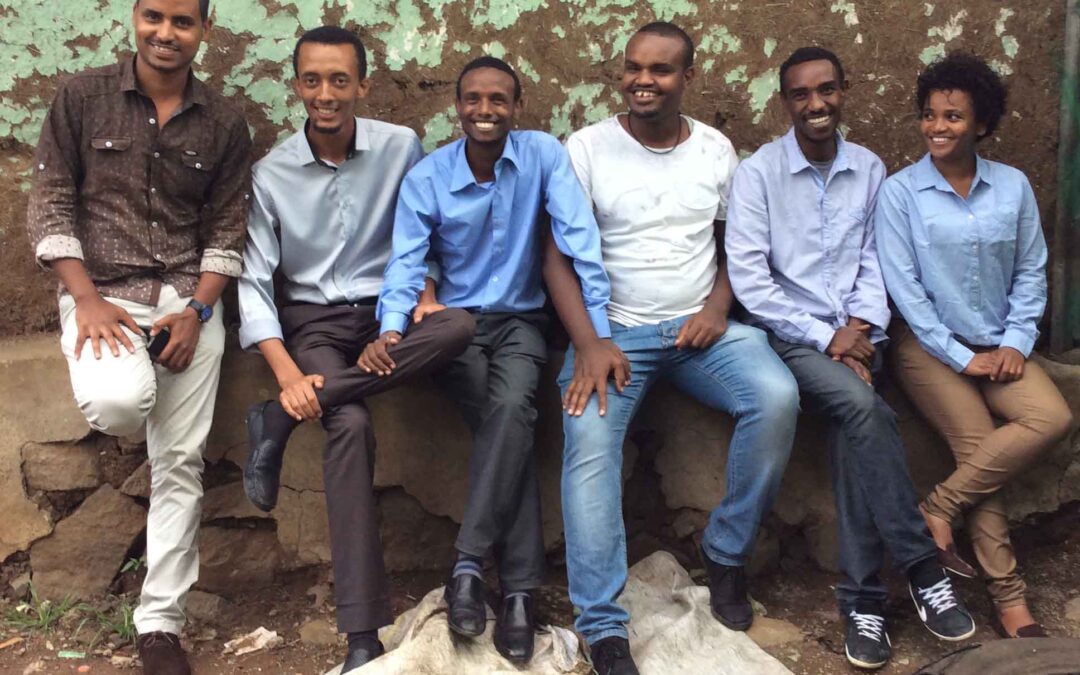
Two weeks after creating their blog, it was blocked. Two years later six of its members (photo) were arrested and charged with terrorism.
Although they have now been released, three are in exile while those still in Ethiopia are banned from travel.
They said: “We are extremely humbled to be nominated for the Martin Ennals Award. This recognition raises our visibility enough to increase our safety, and also shows that the World is the home of the same family. It is proof that when one part of the world is silenced, the rest will speak on behalf of it. This recognition will definitely motivate us to push forward on our struggle to create a better Ethiopia where human rights are respected.”
A renowned Uyghur intellectual in China, Ilham Tohti has worked for two decades to foster dialogue and understanding between Uyghurs and Han Chinese.
He has rejected separatism and sought reconciliation based on a respect for Uyghur culture.
Beginning in 1994, he began to write about problems and abuses in Xinjiang, which led to official surveillance.
From 1999 to 2003 he was barred from teaching, after posting information on Uyghurs who had been arrested, killed and “disappeared” during and after protests. Ilham Tohti was arrested on January 15, 2014.
He was charged with separatism and sentenced to life imprisonment after a two-day trial.
A prominent human rights lawyer, activist, and journalist in Syria, Razan Zaitouneh has dedicated her life to defending political prisoners, documenting crimes against humanity, and helping others free themselves from oppression. This resulted in a travel ban in 2002.
Following the beginning of the conflict in 2011, she founded the Violations Documentation Center (VDC), which documents the death toll and ill-treatment in Syria’s prisons.
On December 9, 2013, a group of masked gunmen stormed the VDC office in Douma, near Damascus, and kidnapped Razan along with her husband, Wael Hamada, and two colleagues. Their whereabouts remain unknown.
Contact:
Olivier van Bogaert, Director Media & Communications, ICJ representative in the MEA Jury, t: +41 22 979 38 08 ; e: olivier.vanbogaert(a)icj.org
Michael Khambatta, Director, Martin Ennals Foundation, t: +41 79 474 8208 ; e: khambatta(a)martinennalsaward.org

Apr 5, 2016 | News
The Court of Appeal’s decision to lift the stay of execution of Kho Jabing is a serious blow to human rights in Singapore, the International Commission of Jurists (ICJ) said today.
The ICJ urges the Government of Singapore to grant Kho Jabing clemency and immediately impose a moratorium on executions, with a view towards abolishing the death penalty in the near future.
“The death penalty is never justifiable,” said Sam Zarifi, ICJ’s Regional Director for Asia and the Pacific. “If Singapore goes through with the execution of Kho Jabing, it will go against the growing international consensus to abolish the death penalty.”
Currently, 117 member states of the United Nations support the General Assembly resolution passed in December 2014 calling for an international moratorium on the use of death penalty, the ICJ reminds.
The Geneva-based organization opposes the death penalty in all circumstances and considers the imposition of the death penalty to constitute a denial of the right to life and a form of cruel, inhuman and degrading punishment.
The ICJ has received information that there are nine other individuals currently on death row in Singapore.
Authorities have not yet released the date of Kho Jabing’s execution.
The lawyers of Kho Jabing will be filing a petition for clemency in the next few days.
The ICJ urges the Government of Singapore to halt the imminent execution of Kho Jabing, grant the petition for clemency and commute his death sentence.
Background
Kho Jabing, a Malaysian national, was convicted of murder and sentenced to death in Singapore in 2010. After amendments were made in 2012 on the laws on the death penalty in Singapore, Kho Jabing was re-sentenced to life imprisonment and 24 strokes of the cane. The prosecution, however, appealed the re-sentencing and the case was brought to the Court of Appeal.
The court rejected his application for clemency in October 2015. On 23 November 2015, he was granted a temporary reprieve pending the outcome of a petition filed by his lawyers, which raised questions of fact and law.
The decision of the Court of Appeal this morning lifted the temporary reprieve and upheld its decision to impose the death penalty on Kho Jabing.
Contact
Emerlynne Gil, ICJ’s Senior International Legal Advisor, tel. no. +66840923575, email: emerlynne.gil(a)icj.org
Mar 31, 2016 | News
A Delhi Court acquitted human rights defender Irom Sharmila of an “attempt to commit suicide” charge. The government of Manipur must in turn immediately drop the charges against her, said the ICJ today.
Irom Sharmila, was charged under section 309 the Indian Penal Code.
She has been on a continuous hunger strike for over 15 years, demanding repeal of the Armed Forces Special Powers Act (AFSPA).
“This order is a welcome recognition that Irom Sharmila’s hunger strike is a form of peaceful dissent and protest protected by the right to freedom of expression,” said Sam Zarifi, ICJ’s Asia Director.
This week, Iron Sharmila was acquitted of the charges against her in Delhi. The case against her in Manipur is, however, still on-going.
The decision of the Delhi court is not binding on the courts in Manipur, but the charges are analogous, and similar reasoning should prevail, the ICJ says.
“The government of Manipur should drop the other charges under section 309 against her, and release her immediately and unconditionally,” said Zarifi.
On at least two occasions previously, courts in Manipur have directed that Irom Sharmila be released, saying that charges under section 309 were not applicable.
“The use of section 309 against Sharmila highlights the outdated and absurd nature of this law,” Zarifi said.
“The government should expedite the repeal of 309 and, instead of criminalizing Irom Sharmila’s protest, focus on the reason behind it and repeal the AFSPA,” he added.
The AFSPA gives armed forces a range of “special powers” in “disturbed areas”, which include the power to arrest without warrant, to enter and search any premises, and in certain circumstances, “fire upon or otherwise use force, even to the causing of death”.
Furthermore, under the AFSPA, governmental permission, or sanction, is required before any member of the armed forces can be prosecuted for crimes in a civilian court.
These provisions are inconsistent with a range of human rights, including the right to life and right to remedy.
They have also facilitated torture, rape and enforced disappearances in areas where operational, the ICJ notes.
“This law is inconsistent with India’s human rights obligations, and has led to human rights violations, wide-spread impunity, and immense grief and suffering in the areas where it operates”, Zarifi said.
“It is high time that it was taken off the books”.
Background
Irom Sharmila began a hunger strike in November 2000, calling for the repeal of the AFSPA, following the unlawful killing of 10 civilians by security forces purportedly acting under it in Malom.
She was arrested by the Manipur government in 2000 under section 309 of the Indian Penal Code, which prohibits an “attempt to commit suicide”.
Irom Sharmila has been in custody almost continuously since her initial arrest, and has continued her hunger strike.
She is fed through a nasal tube at the Jawaharlal Nehru hospital in Imphal where she is usually held.
The Delhi government also charged her on similar grounds with respect to an incident from 2006, when she held a protest in their jurisdiction.
In 2014, a Manipur court quashed charges under section 309 against Irom Sharmila, saying “The agitation of Irom Chanu Sharmila is a political demand through lawful means of repealing a valid statute. … she may continue with the fast till her demand is met politically by the Government”.
However, since she continued her hunger strike, she was immediately re-arrested on the same grounds.
In its 210th report, the Indian Law Commission has recommended that section 309 be repealed. In 2011, the Supreme Court said: “the time has come when [section 309] should be deleted by Parliament as it has become anachronistic.”
In 2014, the government announced that it was in the process of repealing 309.
The AFSPA applies to “disturbed areas” in the states of Arunachal Pradesh, Assam, Manipur, Meghalaya, Mizoram, Nagaland and Tripura.
An almost identical law is also applicable in Jammu and Kashmir.

Mar 29, 2016 | News
The ICJ expresses its grave concern at the 28 March 2016 conviction and sentencing of 17 Angolan activists to terms of imprisonment ranging from two years to more than eight years, for the peaceful exercise of their human rights of freedom of association and freedom of expression.
Following an unfair trial, they were found guilty of “preparatory actions of rebellion and association of evildoers” [malfeitores], based on having read and discussed reading material on nonviolent means for resisting dictatorship or being associated with others who did so.
The ICJ joins numerous civil society organizations in condemning the failure by the authorities in Angola to conduct the trial in a manner consistent with its obligations under international human rights law.
“Judicial persecution of opponents of the government in Angola must be stopped forthwith” said Arnold Tsunga, ICJ’s Africa Director.
“A worrisome trend and pattern is emerging where the authorities in Angola are increasingly using the law and legal system as an instrument of repression targeting critics of the government as well as human rights defenders,” he added.
The ICJ calls on the Angolan authorities to invalidate the conviction and sentences, and to take concrete measures to strengthen the rule of law by ensuring the independence of the judiciary and legal profession as well as fully implementing international human rights standards in the national legal system.
Contact
Arnold Tsunga, ICJ’s Africa Director, t: +27731318411 or +263777283249 ; e: arnold.tsunga@icj.org
Background
Fifteen of the Accused were arrested in June 2015 and later joined by another two accused.
They were initially charged with rebellion and a conspiracy to mount a coup against the President for studying and discussing reading material on nonviolent means for resisting dictatorship.
The prosecution later dropped the second charge but added a charge of “criminal association” or “association with evildoers”.
The defense maintains that the state did not manage to prove anything beyond the fact that the accused discussed politics, which is allowed under the Angolan constitution.
No independent observers were allowed to attend the trial, raising serious concerns about the right to fair trial.
The African Charter on Human and Peoples’ Rights and the International Covenant on Civil and Political Rights, treaties to which Angola is a party, recognize freedom of expression and freedom of association as human rights, and prohibit governments from arbitrarily or otherwise illegitimately interfering with them.
Domingos da Cruz was sentenced to 8 years and six months; Luaty Beirão to 5 years and 6 months; Nuno Dala, Sedrick de Carvalho, Nito Alves, Inocêncio de Brito, Laurinda Gouveia, Fernando António Tomás “Nicola”, Afonso Matias “Mbanza Hamza”, Osvaldo Caholo, Arante Kivuvu, Albano Evaristo Bingo -Bingo, Nelson Dibango, Hitler Jessy Chivonde e José Gomes Hata were all sentenced to 4 years and 6 months); while Rosa Conde e Jeremias Benedito got 2 years and 3 months in jail.

Mar 24, 2016 | Advocacy, News
The ICJ and ECRE presented today a joint submission on the situation of the asylum and reception systems in Greece to the Committee of Ministers of the Council of Europe.
The submission was presented in view of a meeting of the Committee of Ministers of the Council of Europe on the implementation by Greece of the European Court of Human Rights’ judgment in the case of M.S.S. v Belgium and Greece that will take place next June.
The submission refers to the previous detailed joint submissions of ICJ and ECRE and provides recent information on the state of the asylum procedure, reception conditions and detention practices, which are likely to be of importance to the supervision of the execution of the M.S.S. v. Belgium and Greece ruling. It focuses on:
- ongoing obstacles to accessing the asylum procedure, namely concerning registration before the Asylum Service, the operation of appeals bodies, as well as the likely application of the “safe third country” concept regarding Turkey;
- the state of Greece’s reception system, with a view to properly assessing its capacity to accommodate asylum seekers and migrants on its territory; and
- updated information on the lawfulness and conditions of immigration detention, including new risks of detention stemming from nationality-profiling and the establishment of “hotspots” at points of arrival.
Greece-ICJECRE-MSS-CommitteeMinisters-5thsubmission-legal submission-2016-ENG (download the joint submission)