Apr 27, 2015 | News
The ICJ urged the Government of Indonesia today to stop the imminent execution of nine persons convicted of drug-related offenses.
The ICJ emphasized that the death penalty constitutes a denial of the right to life and freedom from cruel, inhuman, or degrading punishment.
Emerlynne Gil, ICJ’s Senior Legal Advisor, said: “The government is trying to send the message that it is forcefully cracking down on crime, especially on drug-related offenses. Extinguishing the lives of nine people will almost certainly not serve to reduce crime, but it will clearly subvert human rights and the rule of law.”
Recent studies have called into question the notion of any meaningful deterrent effect of capital punishment on the commission of crimes, the ICJ says.
“Indonesia, by imposing the death penalty on those convicted in drugs related cases, is violating its obligations under the International Covenant on Civil and Political Rights,” Gil added.
Indonesia is a State Party to the ICCPR, having acceded to it in 2006.
The ICJ opposes capital punishment in all cases without exception.
In line with the plea by the UN General Assembly in repeated resolutions, the ICJ calls on the Government of Indonesia, as a first step, to establish a moratorium with a view of abolishing the death penalty in the near future.
Background
Nine persons are scheduled to be executed in the next few days: Myuran Sukumaran (Australia), Andrew Chan (Australia), Mary Jane Veloso (Philippines), Rodrigo Gularte (Brazil), Sylvester Obiekwe Nwolise (Nigeria), Okwudili Oyatanze (Nigeria), Martin Anderson (Ghana), Zainal Abidin (Indonesia), and Rahem Agbaje (Nigeria).
Last month, the UN Human Rights Committee strongly criticized Indonesia for its failure to respond to the Committee’s call in 2013 to stop executing prisoners for drug-related crimes.
After a regular review of Indonesia’s human rights record, the Committee in August 2013 urged the State to reinstate the de facto moratorium on the death penalty and to ensure that, if capital punishment was maintained, it was only for the most serious crimes, which do not include drug-related offences.
In December 2014, the UN General Assembly adopted a resolution, for the fifth time since 2007, emphasizing that that the use of the death penalty undermines human dignity and calling on those countries that maintain the death penalty to establish a moratorium on its use with a view to its abolition. A majority of 117 UN Member States voted in favor of a worldwide moratorium on executions as a step towards abolition of the death penalty, with only 37 opposed.
Contact:
Emerlynne Gil, ICJ Senior Legal Adviser, in Bangkok, t: +66840923575, e: emerlynne.gil(a)icj.org
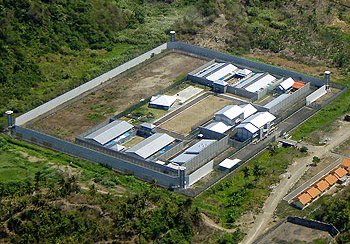
Photo: aerial view of a prison on Nusakambangang, the island where the executions take place.
Apr 22, 2015 | Multimedia items, News, Video clips
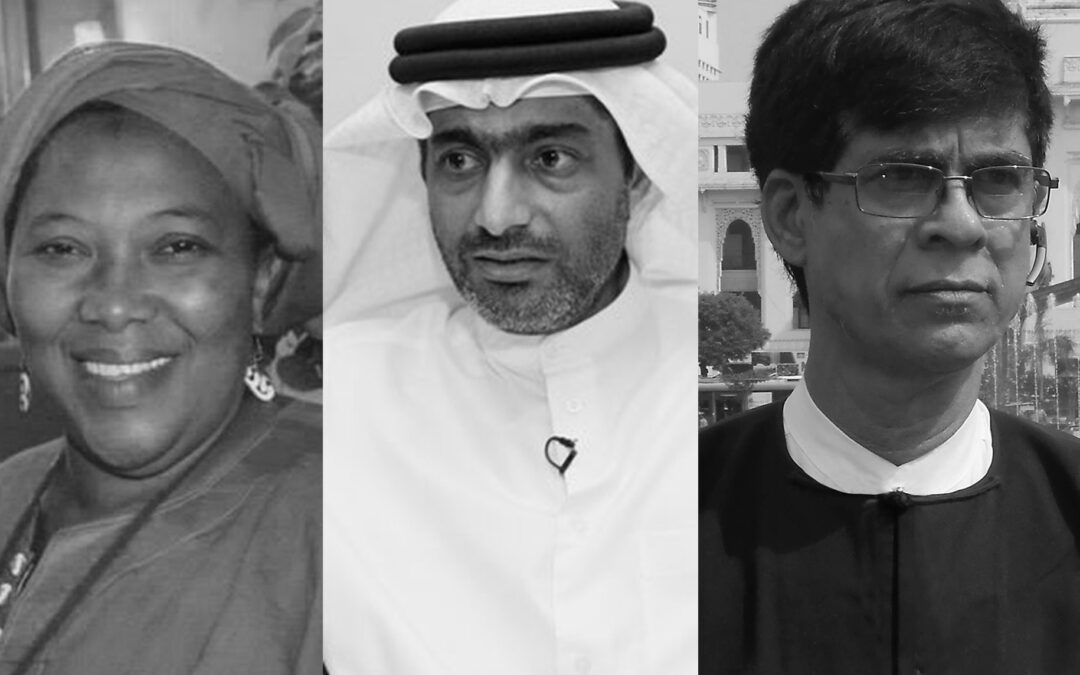
The three final human rights defenders who will compete for the award are Ahmed Mansoor (United Arab Emirates), Robert Sann Aung (Myanmar) and Asmaou Diallo (Guinea). The ICJ is member of the MEA Jury.
The Martin Ennals Award for Human Rights Defenders (MEA) is the main award of the human rights movement and as such can be labelled as the Nobel Price for human rights.
It is a unique collaboration among ten of the world’s leading human rights organizations to give protection to human rights defenders worldwide.
This award is selected by the International Human Rights Community (members of the jury are ICJ, Amnesty International, Human Rights Watch, Human Rights First, International Federation for Human Rights, World Organisation Against Torture, Front Line Defenders, EWDE Germany, International Service for Human Rights and HURIDOCS).
It is given to Human Rights Defenders who have shown deep commitment and face great personal risk. The aim of the award is to highlight their work and protect them through increased visibility.
The 2015 Award will be presented on Oct. 6th at a ceremony hosted by the City of Geneva.
Since 2006, Ahmed Mansoor (United Arab Emirates) has focussed on initiatives concerning freedom of expression, civil and political rights.
He successfully campaigned in 2006-2007 to support two people jailed for critical social comments. They were released and the charges dropped.
Shortly after, the Prime Minister of UAE issued an order not to jail journalists in relation to their work.
He is one of the few voices within the United Arab Emirates who provides a credible independent assessment of human rights developments.
He regularly raises concerns on arbitrary detention, torture, international standards for fair trials, non-independence of the judiciary, and domestic laws that violate international law.
He was jailed in 2011 and since then has been denied a passport and banned from travelling.
“I’m very pleased to be nominated for the Martin Ennals award,” he said. “This recognition indicates that we are not left alone in this part of the world and I hope it will shed further light on the human rights issues in the UAE. It is not just full of skyscrapers, big malls and an area attractive to businesses, but there are other struggles of different sorts beneath all of that.”
Since his first year of University in 1974, Robert Sann Aung (Myanmar) has courageously fought against human rights abuses.
He has been repeatedly imprisoned in harsh conditions, physically attacked as well as regularly threatened.
His education was interrupted numerous times and he was disbarred from 1993 – 2012.
In 2012, he managed to regain his license to practice law. Since then he has represented jailed child soldiers, those protesting at a contested copper mine, peaceful political protesters, those whose land has been confiscated by the military, as well as student activists.
Throughout his career he has provided legal services, or just advice, often pro bono, to those whose rights have been affected.
“I feel humble and extremely honored to be nominated for this prestigious award. This nomination conveys the message to activists, human rights defenders and promoters who fight for equality, justice and democracy in Myanmar that their efforts are not forgotten by the world,” he said.
Asmaou Diallo (Guinea)’s human rights work started following the events of 28 September 2009 when the Guinean military attacked peaceful demonstrators.
Over 150 were killed, including her son, and over 100 women raped. Hundreds more were injured.
She and l’Association des Parents et Amis des Victimes du 28 septembre 2009 (APIVA), which she founded, work to obtain justice for these crimes and to provide medical and vocational support to victims of sexual assault, many of whom cannot return to their homes.
She has worked to encourage witnesses to come forward and supported them as they provided information and testimony to court proceedings.
As a result, eleven people have been charged, including senior army officers.
“Being among the nominees for the Martin Ennals Foundation encourages me to continue my fight for the protection and promotion of human rights in Guinea. I trust that this award will have a positive effect on the legal cases concerning the events of the September 28, 2009, and will be a lever for all defenders of human rights in Guinea,” she said.
Contact:
Olivier van Bogaert, Director Media & Communications, ICJ representative in the MEA Jury, t: +41 22 979 38 08 ; e: olivier.vanbogaert(a)icj.org
Michael Khambatta, Director, Martin Ennals Foundation, t: +41 79 474 8208 ; e: khambatta(a)martinennalsaward.org
Universal-MEA Final Nominees 2015-News-Press Release-2015-ENG (Official press release in English)
Universal-MEA Final Nominees 2015-News-Press Release-2015-FRE (Official press release in French)
Universal-MEA Final Nominees 2015-News-Press Release-2015-ARA (Official press release in Arabic)
Universal-MEA Final Nominees 2015-News-Press Release-2015-BUR (Official press release in Burmese)
UAE-MEA 2015 Bio Ahmed Mansoor-2015-ENG (full bio in PDF)
Myanmar-MEA 2015 Bio Robert Sann Aung-2015-ENG (full bio in PDF)
Guinea-MEA 2015 Bio Asmaou Diallo-2015-ENG (full bio in PDF)
Apr 11, 2015 | News
The ICJ today condemned the execution of Muhammad Kamaruzzaman following an unfair trial. The ICJ repeated its call for the authorities in Bangladesh to institute an immediate moratorium on executions with a view to abolishing the death penalty in the country.
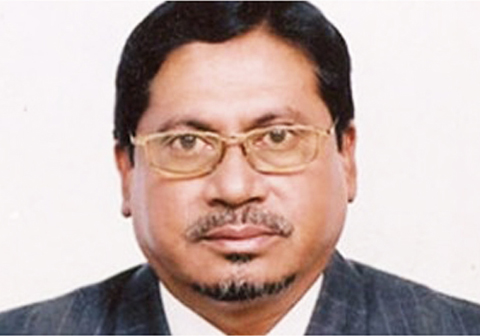
Muhammad Kamaruzzaman (photo), a senior leader of the Jamaat-e-Islami party, was hanged today in Dhaka Central jail.
He had been sentenced to death by the Bangladesh International Crimes Tribunal (ICT) in 2013 for his role in the atrocities committed during the 1971 war for independence in Bangladesh.
His conviction and sentence were confirmed on appeal in 2014.
The government established the ICT in 2010, after amending the International Crimes (Tribunals) Act 1973.
The ICT has jurisdiction to try crimes against humanity, crimes against peace, genocide, violations of the Geneva conventions and any other crimes under international law.
The ICJ has previously raised concerns that trials before the ICT do not comply with international standards for fair trials.
According to the ICJ, there are serious procedural flaws at all stages: pre-trial release has been routinely and arbitrarily denied; witnesses have been abducted and intimidated; and there have been credible allegations of collusion between the Government, prosecutors and judges.
“This execution constitutes a violation of the right to life and freedom from cruel, inhuman and degrading punishment,” said Sam Zarifi, the ICJ’s Director for Asia and the Pacific. “The fact that this execution was based on a trial that was procedurally and substantively flawed is all the more regrettable and a perversion of justice.”
On 6 April 2015, the Supreme Court rejected Muhammad Kamaruzzaman’s petition for a review of his sentence.
The UN High Commissioner for Human Rights has denounced the death sentence, noting that his review petition was summarily rejected without consideration on merits.
Government officials have reported that Muhammad Kamaruzzaman decided to not seek a presidential pardon for his sentence, following the rejection of his review petition.
After Abdul Qader Mollah in 2013, Kamaruzzaman is the second individual to be executed after being sentenced to death by the ICT.
“The ICJ supports the rights of all victims of the atrocities committed during the 1971 war for independence in Bangladesh to truth and justice. But the death penalty is not the answer,” Zarifi added. “Bangladesh should impose an official moratorium on the death penalty, with a view to abolishing it outright.”
The ICJ opposes capital punishment in all cases without exception. The death penalty constitutes a violation of the right to life and the right not to be subjected to cruel, inhuman or degrading punishment.
In December 2014, the UN General Assembly adopted a resolution, for the fifth time since 2007, emphasizing that that the use of the death penalty undermines human dignity and calling on those countries that maintain the death penalty to establish a moratorium on its use with a view to its abolition.
A majority of 117 UN Member States voted in favor of a worldwide moratorium on executions as a step towards abolition of the death penalty, with only 37 opposed.
Contact:
Sam Zarifi, ICJ Asia Pacific Regional Director (Bangkok), t: +66 807819002; email: sam.zarifi(a)icj.org

Apr 9, 2015 | News
The ICJ today condemned the passing of the amendments to the archaic 1948 Sedition Act by Parliament’s House of Representatives.
The amendments broaden and deepen even further the scope for this law to be abused by authorities in order to violate human rights.
The amendments were passed after a final vote that saw 108 MPs in favour and 79 MPs against the proposal.
“The passed amendments were part of a series of bills that were rushed through Parliament this week, including the draft Prevention of Terrorism Act”, said Emerlynne Gil, ICJ’s International Legal Adviser. “It is unfortunate that Prime Minister Najib Razak has chosen to renege on his promise to abolish the Sedition Act and instead went ahead to make the law worse than it already is.”
“It is undeniable that these amendments would send a further chilling effect on the freedom of expression in Malaysia that is already restricted,” Gil added.
The amendments will now need to be passed by the Senate and thereafter, receive assent of the Malaysian King before it becomes law.
CONTACT:
Emerlynne Gil, ICJ International Legal Adviser, email: emerlynne.gil(a)icj.org or mobile: +66 84 092 3575

Apr 7, 2015 | News
The Malaysian government must cease efforts to strengthen the country’s draconian Sedition Act 1948, which has been used with increasing frequency and severity to suppress and punish criticism of the government, said the ICJ today.
An amendment to Malaysia’s Sedition Act tabled at parliament today would make sedition a non-bailable offence, aggravating the Sedition Act’s incompatibility with international human rights standards.
“The Sedition Act has been used against the government’s political opposition much more frequently than in previous years,” said Emerlynne Gil, ICJ’s International Legal Advisor for Southeast Asia. “Since January 2015, ICJ has recorded at least 36 academicians, lawyers, politicians, students, and activists have been investigated, arrested, or charged under the Sedition Act.”
According to the ICJ, this is a significant spike when compared to the total number of reported sedition cases recorded by Malaysian civil society in previous years: 2010 (5 cases); 2011 (3 cases); 2012 (7 cases); 2013 (19 cases); 2014 (42 cases).
“Instead of repealing or restricting the Sedition Act, the new amendment actually makes it worse by limiting the ability of courts to grant bail to people accused under the Sedition Act,” Gil added.
The amendment specifically states that if the Public Prosecutor certifies in writing that it would not be “in the public interest” to grant bail to the person charged with sedition, the person shall therefore not be released on bail, a matter otherwise normally determined by the courts in each case.
Denying bail based on a mere certificate by the Public Prosecutor removes any requirement that the court be presented with evidence to remand a person in custody and it may also preclude effective inquiry by the court into the lawfulness of the arrest and detention.
“The proposed amendment removes the court’s discretion to determine whether to grant bail or not when presented with a certification from the Public Prosecutor,” Gil said. “It appears therefore that the court has no power to require evidence or even articulation of the reasons to evaluate whether it is reasonable and necessary to remand the person charged with the offence in custody.”
Under international law, the right to seek provisional release before final conviction, for instance through posting bail, is closely linked to the right not to be subjected to arbitrary detention.
Under international standards, a detention that complies with national law can nevertheless be considered arbitrary based on elements of inappropriateness, injustice, and lack of predictability.
In principle, anyone arrested on criminal allegations should have the right to seek release pending trial, including through bail proceedings before a court of law.
National laws should only allow bail to be denied where the facts of the individual case give rise to some specific reasonable ground for continued detention, such as preventing flight, or interference with evidence, or the commission of further violent offences.
Further, where the charges are incompatible with human rights – for instance when it is based entirely on protected freedom of expression – then there can be no basis whatsoever for pre-trial detention. Thus, any detention under the Sedition Act, a vague and ambiguously defined law, would be an arbitrary deprivation of liberty.
Finally, the ICJ recognizes that there have been instances when those arrested under the Sedition Act have allegedly committed acts that are recognizably criminal in character.
In these instances, other criminal laws in Malaysia could provide a proper basis for any investigation and detention.
Contact:
Emerlynne Gil, ICJ’s International Legal Advisor for Southeast Asia: emerlynne.gil@icj.org or +66840923575.
NOTE:
The figures above and the information contained in the chart and graph below are based on ICJ’s documentation in 2015 in comparison with the documentation of reported sedition cases for the past five years done by one of Malaysia’s leading organizations, Suara Rakyat Malaysia (SUARAM).
Malaysia-Graph Sedition Cases 2010to2015-Advocacy-2015-ENG (full graph in PDF)
Malasia-Sedition table 2015-Advocacy-2015-ENG (full ICJ table in PDF)
Malaysia-SUARAM document Overview – Sedition cases 2010to2014-Advocacy-2015-ENG (full SUARAM table, in PDF)