Sep 17, 2013 | News
The ICJ said that the death sentence handed down today by Bangladesh’s Supreme Court against Abdul Quader Mollah is incompatible with international principles of fair trial.
If carried out, the sentence would violate his right to life and freedom from cruel, inhuman, or degrading punishment.
On 17 September 2013, the Appellate Division of the Supreme Court of Bangladesh upheld the prosecution’s appeal to impose the death sentence on Abdul Quader Mollah (photo), the assistant Secretary-General of Jamaat-I-Islami.
Abdul Quader Mollah had received a life sentence on February 5, when the International Crimes Tribunal (ICT) convicted him on five counts, including murder and rape.
“The prosecution’s appeal to impose the death sentence on Abdul Quader Mollah was based on a law that was not in force when he was first convicted, and applying that law retroactively, especially for the death penalty, violates international law,” said Sam Zarifi, ICJ’s Asia-Pacific Director.
On 17 February 2013, Parliament passed an amendment to the International Criminal (Tribunals) Act 1973 to enable prosecutors to appeal a life sentence and seek the death penalty.
Before this amendment, the prosecution was only allowed to appeal if the accused was acquitted.
The ICJ says the retrospective application of the amendment in Abdul Quader Mollah’s case is incompatible with Bangladesh’s obligations under the International Covenant on Civil and Political Rights (ICCPR), including Article 15, which prohibits the imposition of a heavier penalty than provided for at the time the criminal offence was committed.
“Judgments such as these highlight the serious problems with the war crimes tribunal that undermine its legitimacy,” Zarifi further said. “The wounds of war can only be healed through a fair and transparent trial process that meets international standards of fair trial and due process of law.”
“It is essential that those responsible for committing atrocities during the Bangladeshi war of liberation are prosecuted and brought to justice,” Zarifi added. “But the death penalty perpetuates the cycle of violence and is a perversion of justice, and all the more so when it is imposed in violation of due process.”
The ICJ considers the death penalty in all cases to constitute a violation of the right to life and the right not to be subjected to cruel, inhuman or degrading punishment.
The ICJ calls on Bangladesh to join the great majority of States around the world in rejecting the use of the death penalty.
To that end, Bangladesh should impose a moratorium on the practice and take steps towards its abolition, as prescribed by repeated United Nations General Assembly Resolutions.
Contacts:
Sam Zarifi, ICJ Asia-Pacific Regional Director, (Bangkok), t:+66 807819002; email: sam.zarifi(at)icj.org
Sheila Varadan, ICJ Legal Advisor, South Asia Programme (Bangkok), t: +66 857200723; email: sheila.varadan(a)icj.org
Sep 13, 2013 | News
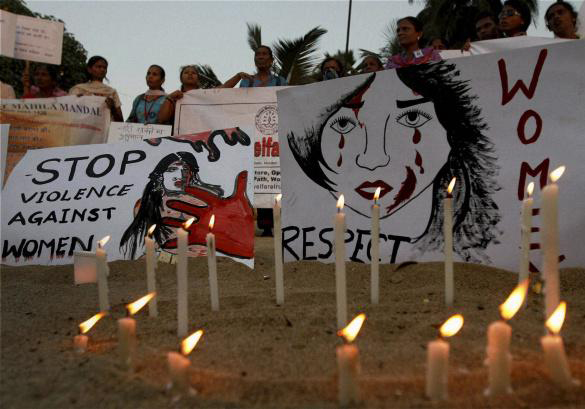
The ICJ denounced the death sentences handed down in the Delhi gang rape and murder case and urged the Indian Government to take steps to abolish the death penalty in law and practice.
A special fast-track court today sentenced to death four men convicted for the gang rape and murder of a 23-year-old student on 16 December 2012.
The fifth accused, who was a minor at the time he committed the crime, was convicted and sentenced to three years in a reform home by a juvenile court on 31 August 2013.
“Women’s rights groups in India have taken a firm stance against the death penalty and strongly believe that the death penalty is counterproductive in every way to preventing and curtailing sexual violence against women,” said Vrinda Grover, leading human rights lawyer and ICJ’s South Asia advocate.
The ICJ considers the death penalty to constitute a violation of the right to life and the right not to be subjected to cruel, inhuman or degrading punishment.
“Those who commit acts of violence against women must be prosecuted and brought to justice,” said Sheila Varadan, ICJ’s South Asia Legal Advisor. “But the sentence and the administration of the death penalty constitutes a perversion of justice.”
“Instead of giving in to the vengeful demand for killing the perpetrators of this horrific crime, the Indian Government must take concrete steps to prevent, investigate and punish acts of violence against women,” Varadan added.
A high level commission constituted to reform Indian law on violence against women, led by the late Chief Justice of the Indian Supreme Court Justice J.S. Verma, recommended that the death penalty should not be used in rape cases.
“In demanding and securing the death penalty, Indian authorities have created a spectacle that distracts from their responsibility for systemic change in the legal system which alone will create deterrence in law,” said Vrinda Grover.
The ICJ calls on India to join the great majority of States around the world in rejecting the use of the death penalty.
To that end, India should impose a moratorium on the practice and take steps towards its abolition, as prescribed by repeated United Nations General Assembly Resolutions, the ICJ says.
Contacts:
Sheila Varadan (Bangkok), ICJ South Asia Legal Advisor, t: +66 857 200 723 (mobile); email: sheila.varadan(a)icj.org
Ben Schonveld (Kathmandu), ICJ South Asia Director, t: +977 980 459 6661 (mobile); email: ben.schonveld(a)icj.org
Additional Information
The United Nations has adopted various instruments in support of the call for the worldwide abolition of the death penalty. In 2007, the UN General Assembly adopted a resolution emphasizing that ‘that the use of the death penalty undermines human dignity’ and calling for the establishment of a moratorium on the use of the death penalty ‘with a view to abolishing the death penalty.’ The resolution was reaffirmed in 2008, 2010, and most recently in December 2012, when a large majority of UN Member States voted in favor of a worldwide moratorium on executions as a step towards the death penalty’s abolition.
Currently, 150 countries worldwide, including 30 states in Asia and the Pacific region, have abolished the death penalty in law or in practice.
Rape and other forms of sexual violence against women are pervasive in India. According to the National Crime Records Bureau, 24,923 rape cases were registered in India in 2012. Experts believe that the actual number is much higher, as rape is vastly under-reported. In most cases, however, victims and survivors get no justice from a criminal justice system that has been widely characterized as gender-insensitive, under-resourced and corrupt.
Photo: PTI

Sep 11, 2013 | News
The ICJ expressed its disappointment over the continued arbitrary detention and refusal of bail of Secretary of human rights organization, Odhikar, and Supreme Court Advocate Adilur Rahman Khan.
The ICJ urged the Bangladeshi authorities to drop their opposition to Adilur Rahman Khan’s bail application.
On 9 September 2013, a Magistrates Court in Dhaka refused Adilur Rahman Khan’s bail application for the second time. He had earlier been denied bail on 11 August 2013.
“Adilur Rahman Khan is being arbitrarily detained for his lawful exercise of the right to freedom of expression and his legitimate work as a human rights defender,” said Ben Schonveld, ICJ’s South Asia Director. “What we are seeing is a Government crackdown on voices of dissent.”
Under international law, all persons are presumed innocent until proven guilty.
Under Article 9 of the International Covenant on Civil and Political Rights (ICCPR), to which Bangladesh is a party, there is a presumption of pre-trial release.
A person can only be denied pre-trial release where it is reasonable and necessary in all of the circumstances to prevent absconding, interference with evidence or recidivism.
“The Government cannot show that Adilur Rahman Khan poses a flight risk,” Schonveld added. “In fact, he faces a serious threat of torture and ill-treatment during detention, as documented by Odhikar and other human rights organizations.”
The ICJ reiterates its call on Bangladesh to immediately and unconditionally drop all charges against Adilur Rahman Khan and Nasiruddin Elan, ensure Adilur Rahman Khan is treated in accordance with international law in custody, and cease its harassment of Odhikar.
Contact
Ben Schonveld, ICJ South Asia Director (Kathmandu), t: +977 14432651; email: ben.schonveld(a)icj.org
Additional information
Adilur Rahman Khan was arrested his home on 10 August 2013 without an arrest warrant.
On August 11, a Magistrate’s Court refused his bail application and remanded him for five days of custodial interrogation.
On August 12, the High Court Division of the Supreme Court stayed the remand order and directed that Adilur Rahman be sent back to jail, where he could be interrogated ‘at the gate of the jail.’
On 4 September 2013, the Detective Branch of Police filed a charge sheet against Adilur Rahman Khan and Odhikar’s Director, Nasiruddin Elan, under Section 57 of the International Communication and Technology Act 2006.
They were accused of distorting information, presenting false evidence and manipulating photographs regarding a police operation on a Hefazat-e Islam rally in May this year.
Odhikar had reported that 61 people were killed in the police crackdown on the rally. The government contested the number of casualties.
Adilur Rahman Khan and Nasiruddin Elan will be formally charged on 12 September 2013.
LATEST UPDATE: Letter to Prime Minister Sheikh Hasina Wazed on the Continued Detention of Adilur Rahman Khan
Bangladesh- Letter Adilur Rahman Khan-Advocacy-Open letter-2013 (full text in pdf)
Aug 30, 2013 | News
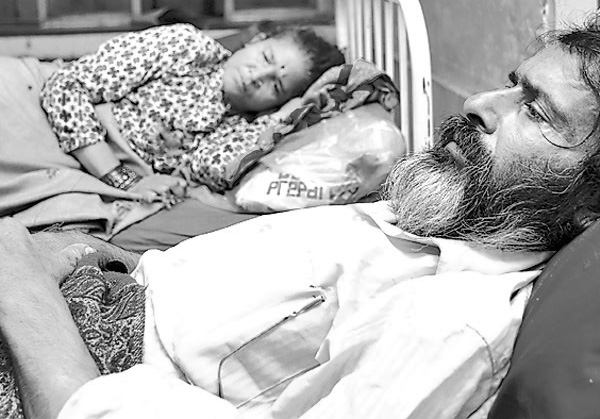
The ICJ is highly concerned by the deteriorating health of Nanda Prasad and Gangamaya Adhikari who are on hunger strike, protesting the failure of the state to investigate and prosecute the 2004 killing of their son Krishna by Maoist insurgents.
Ben Schonveld, the South Asia Director of ICJ said: ” Mr and Mrs Adhikari are just one of thousands of families in Nepal who are asking for something very simple: justice. They are not looking for more commitments or words. They are asking the State of Nepal to obey its own laws and investigate and punish very serious crimes (committed by both sides to the conflict) that violate international human rights law; laws that Nepal has repeatedly committed itself to uphold.”
Contact:
Ben Schonveld, South Asia Director, t: +977 9804596661; email: ben.schonveld(a)icj.org
Photo by eKantipur.com
Aug 30, 2013 | News
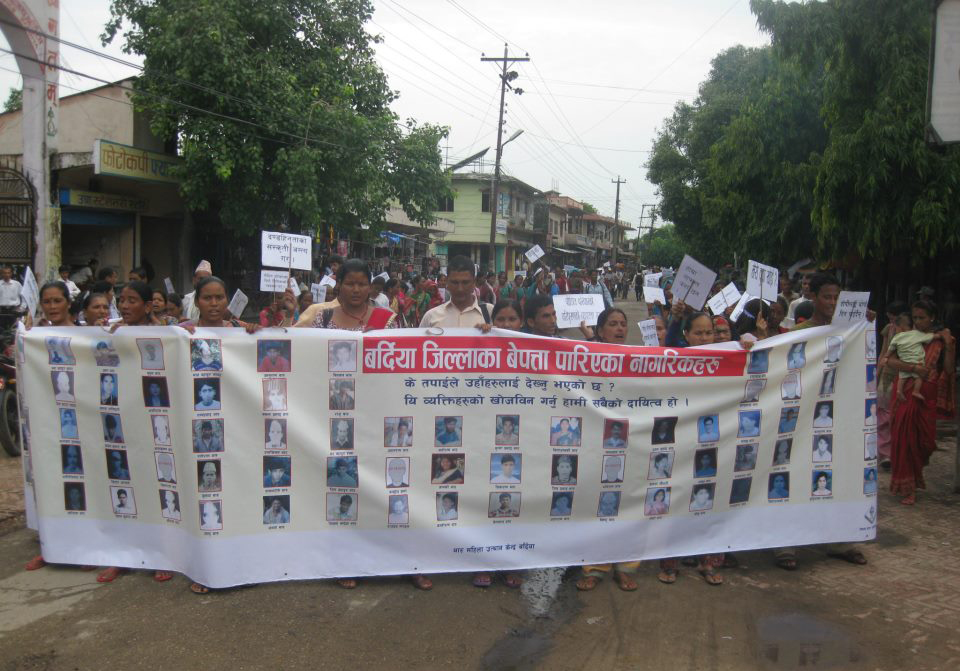
On the 30th annual International Day of the Disappeared, the ICJ urged the Nepali Government to act immediately to disclose the fate and whereabouts of “disappeared” persons and to provide accountability for the perpetrators of these gross violations of human rights.
The systematic practice of enforced disappearance during Nepal’s 1996-2006 armed conflict was among the worst anywhere in the world, the ICJ says.
The fate and whereabouts of more than 1,300 possible victims of enforced disappearance are still unknown.
To date, not one individual suspected of criminal responsibility for serious human rights violations or crimes under international law committed during the conflict has been brought to justice.
“The Government must meet its human rights obligations”, said Ben Schonveld, ICJ’s South Asia Director. “Ending impunity, ensuring accountability, and strengthening the rule of law are essential for a durable transition from armed conflict to sustainable peace in Nepal”.
On 21 November 2006, the Government of Nepal and Communist Party of Nepal (Maoist) signed the Comprehensive Peace Agreement (CPA), committing to investigate and reveal the fate of those killed or disappeared during the armed conflict within 60 days.
Both parties promised they would “not protect impunity” and vowed to safeguard the rights of families of the “disappeared.”
Almost seven years later, the promises made in the CPA have still not been fulfilled, the ICJ says.
Instead, the Government has actively protected and even promoted those suspected of committing human rights violations.
On 14 March 2013, Nepal’s President promulgated an Ordinance to establish a Commission on Investigation of Disappeared Persons, Truth and Reconciliation to investigate human rights violations committed during the armed conflict.
However, the establishment of the commission was temporarily halted after the Supreme Court issued a stay order in April following legal challenges.
The proposed commission is not in compliance with international law and standards on commissions of inquiry to effectively discharge Nepal’s duty to provide remedy and reparation to victims in a number of respects.
First, the process of the appointment of the Chairperson of the Commission does not ensure independence and impartiality.
Second, the Commission has wide discretion to recommend amnesty for crimes under international law, including enforced disappearance, to those who repent.
When combined with the fact that the crime of enforced disappearance is not yet a distinct offence punishable under the law of Nepal, there are grounds for real concern that impunity for the hundreds of enforced disappearances carried out during the course of the conflict will continue.
“The framework for the Commission set out in the Ordinance was the result of a bargain between the political parties”, Schonveld added. “The Commission seems designed to enable those suspected of criminal responsibility to avoid accountability for human rights violations and crimes under international law committed over the course of Nepal’s decade-long conflict”.
The ICJ urges the Government of Nepal to:
1. Withdraw the Ordinance, or establish a mechanism for its review and amendment, which includes inclusive consultation with victims of conflict related human rights abuses and representatives of civil society, with the aim of ensuring that the Commission established is consistent with international law and standards;
2. Promptly accede to the UN International Convention for the Protection of All Persons from Enforced Disappearance;
3. Ensure that enforced disappearance, as defined under the International Convention for the Protection of All Persons from Enforced Disappearance, is included as a distinct offence and is punishable by penalties that are proportionate with its gravity criminalized under domestic law;
4. Respect court orders calling on the police to investigate human rights violations and crimes under international law and, if there is sufficient admissible evidence, prosecute those suspected of criminal responsibility in trials that meet international due process standards;
5. Ensure that victims of enforced disappearance, other human rights violations and crimes under international law have access to effective remedies and receive adequate reparation, including appropriate compensation, restitution, rehabilitation and measures of satisfaction;
Contact:
Ben Schonveld, ICJ South Asia Director, (Kathmandu); t: 977 9804596661; email: ben.schonveld(at)icj.org
NOTES:
Enforced disappearance occurs when a person is arrested, detained or abducted by an agent of the State and then officials refuse to acknowledge the deprivation of liberty or conceal the fate or whereabouts of the “disappeared” person.
These acts remove an individual from the protection of the law, leaving the individual at the mercy of his or her captors.
Enforced disappearance violates many rights of the victims and their families alike, which are guaranteed under the under the International Covenant on Civil and Political Rights (ICCPR), which Nepal, as a State Party, is obliged to respect.
The UN General Assembly has described enforced disappearances ‘an offence to human dignity’ and a grave and flagrant violation of international human rights law.

![Smoke rises after an Israeli air strike on the village of Taybeh in southern Lebanon [Source: Al Jazeera]](https://www.icj.org/wp-content/uploads/2026/03/Screenshot-2026-03-20-at-15.56.24-300x200.png)