Mar 14, 2018 | Events, Multimedia items, News, Video clips
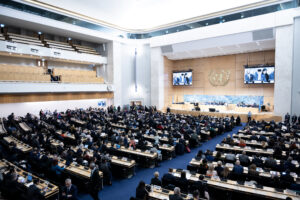
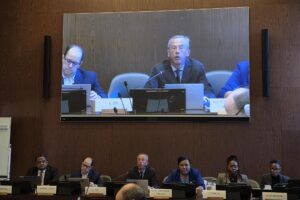
Today, the ICJ highlighted threats to and defenders of the rule of law around the world, at a side event to the UN Human Rights Council, at the Palais des Nations in Geneva.
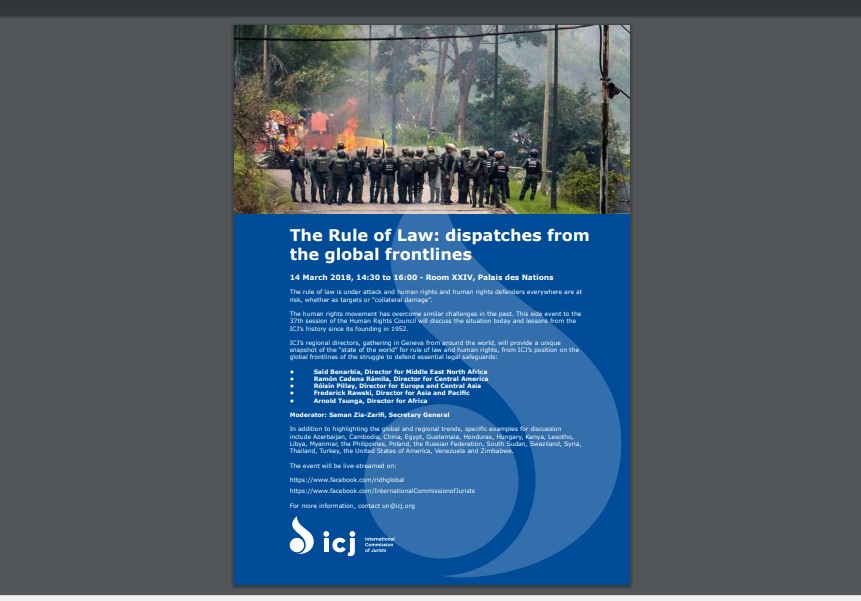
The rule of law is under attack and human rights and human rights defenders everywhere are at risk, whether as targets or “collateral damage”.
The human rights movement has overcome similar challenges in the past. This side event to the 37th session of the Human Rights Council discussed the situation today and lessons from the ICJ’s history since its founding in 1952.
ICJ’s regional directors, gathering in Geneva from around the world, provided a unique snapshot of the “state of the world” for rule of law and human rights, from ICJ’s position on the global frontlines of the struggle to defend essential legal safeguards:
• Saïd Benarbia, Director for Middle East North Africa
• Ramón Cadena Rámila, Director for Central America
• Róisín Pillay, Director for Europe and Central Asia
• Frederick Rawski, Director for Asia and Pacific
• Arnold Tsunga, Director for Africa
Moderator: Saman Zia-Zarifi, Secretary General
In addition to highlighting the global and regional trends, specific examples for discussion included Azerbaijan, Cambodia, China, Egypt, Guatemala, Honduras, Hungary, Kenya, Lesotho, Libya, Myanmar, the Philippines, Poland, the Russian Federation, South Sudan, Swaziland, Syria, Thailand, Turkey, the United States of America, Venezuela and Zimbabwe.
For more information, contact un@icj.org
Watch the video:
https://www.facebook.com/ridhglobal/videos/10157996747579616/
Universal – Rule of law frontlines – News – Event – 2018 – ENG (Event flyer in PDF)
Mar 13, 2018 | Agendas, Events, Human Rights Council, News, Work with the UN
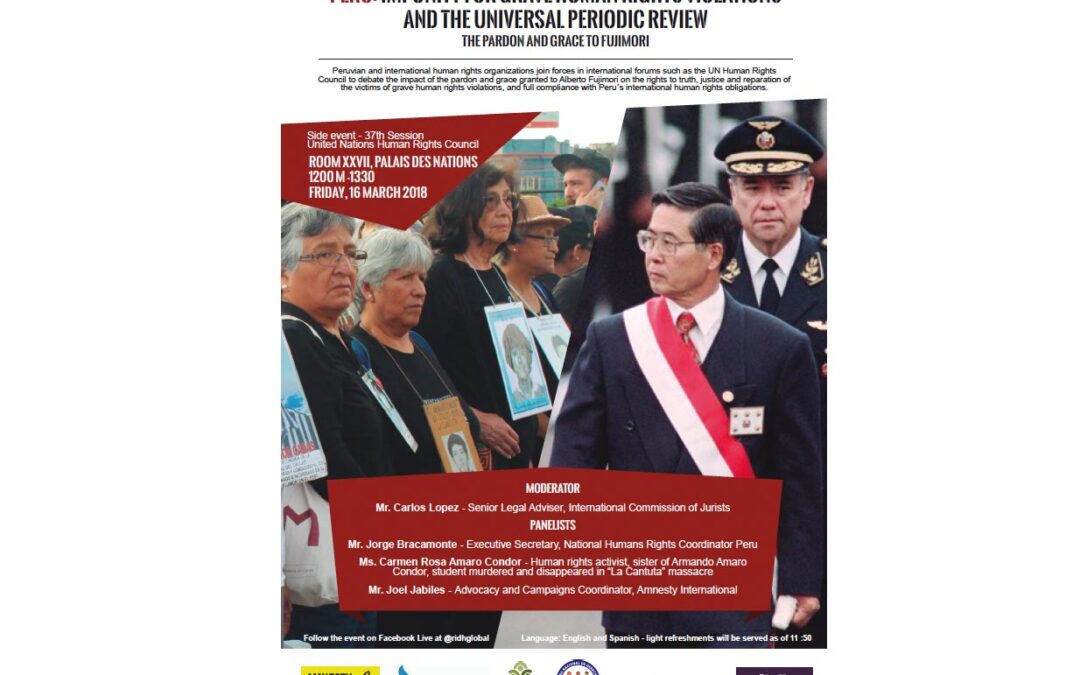
This side event to the 37th Session of the United Nations Human Rights Council takes place on Friday, 16 March 2018, from 12.00 to 13.30, Room XXVII, Palais des Nations, Geneva. It is co-sponsored by the ICJ.
Peruvian and international human rights organizations join forces in international forums such as the UN Human Rights Council to debate the impact of the pardon and grace granted to Alberto Fujimori on the rights to truth, justice and reparation of the victims of grave human rights violations, and full compliance with Peru´s international human rights obligations.
Moderator
- Mr. Carlos Lopez – Senior Legal Adviser, International Commission of Jurists
Panelists
- Mr. Jorge Bracamonte – Executive Secretary, National Humans Rights Coordinator Peru
- Ms. Carmen Rosa Amaro Condor – Human rights activist, sister of Armando Amaro
Condor, student murdered and disappeared in “La Cantuta” massacre
- Mr. Joel Jabiles – Advocacy and Campaigns Coordinator, Amnesty International
Follow the event on Facebook Live at @ridhglobal
Language: English and Spanish – light refreshments will be served as of 11 :50
Mar 8, 2018 | News
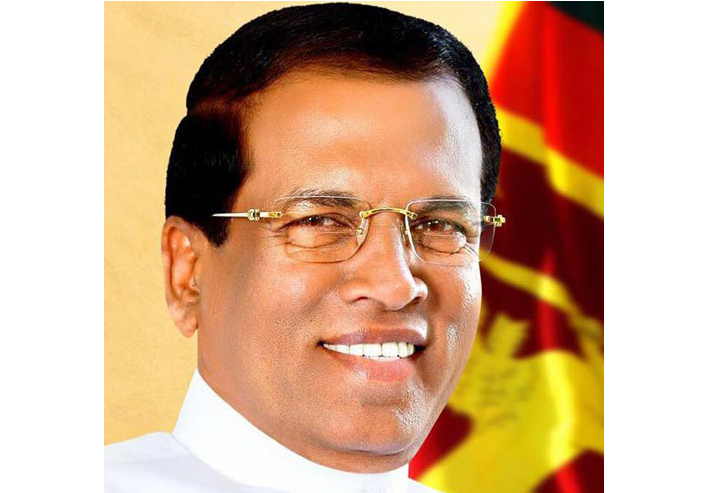
The Sri Lankan government must act swiftly and in line with human rights to prosecute those responsible for recent communal violence.
Particularly for attacks against the minority Muslim community in Kandy district, while avoiding the abusive practices of the past, said the ICJ today.
Sri Lanka’s President, Maithripala Sirisena, proclaimed an island-wide state of emergency on 6th March 2018, following a curfew imposed in several areas since Monday.
The action came following a spate of attacks against members of the Muslim community that was spreading in the Kandy district, following attacks in Ampara last week, in Gintota in 2016, and Aluthgama in 2014.
“The government must show that it will bring to account those who have incited communal violence, particularly notorious figures who have been emboldened by the pervading impunity to preach hatred openly and publicly. The arrest of key suspects yesterday is a start and convictions must follow,” said Frederick Rawski, ICJ’s Asia director.
“But the government must ensure that its investigation is impartial and effective and follows due process of the law,” he added.
The ICJ called upon the government of Sri Lanka to swiftly prosecute those responsible for inciting and carrying out the communal violence using existing legal provisions in the Penal Code and the ICCPR Act, the latter of which prohibits advocating “national, racial or religious hatred that constitutes incitement to discrimination, hostility or violence.”
The ICJ is concerned that the Emergency Regulations issued by the President through powers under the Public Security Ordinance, confer excessively broad powers on the army and the police to search, arrest and investigate.
“Given Sri Lanka’s experience of Emergency Regulations, the government should ensure that these regulations are time-bound and comply with Sri Lanka’s international human rights obligations, including under the International Covenant on Civil and Political Rights,” said Rawski.
The government has further restricted access to selected instant messaging applications and social media platforms “as an extraordinary but temporary response to limit the increasing spread of hate speech and violence through social media websites and phone messaging applications.”
“Blocking social media and other communication channels, even with the best of intentions, typically has the negative effect of restricting affected persons from seeking assistance, journalists from reporting around the situation and may actually undermine efforts to counter violence and hate speech. Any such measures should be narrowly targeted and limited in time,” said Rawski.
“A better approach would be for the Sri Lankan government to aggressively push back against these hateful narratives by demonstrating in actions as well as its rhetoric that Sri Lanka is a diverse country in which all of its citizens’ rights are respected and protected equally,” he added.
Background
Chapter XVIII of the Constitution and the Public Security Ordinance of Sri Lanka empowers the President to make emergency regulations in the interest of ‘public security and the preservation of public order or for the maintenance of supplies and services essential to the life of the community.’ Sri Lanka has a history of governance using emergency powers, which in the past has posed a challenge for democratic governance and human rights, providing law enforcement with wide powers, circumventing ordinary checks and balances.
The President, while justifying circumstances that led to his proclamation of a state of emergency, has stated that he “has given special instructions the Police and the tri-forces to take action in terms of these regulations, in a lawful manner in good faith while ensuring minimum disturbance to the life and well-being of people, in conformity with Fundamental Human Rights of people.”
Mar 1, 2018 | Events, News
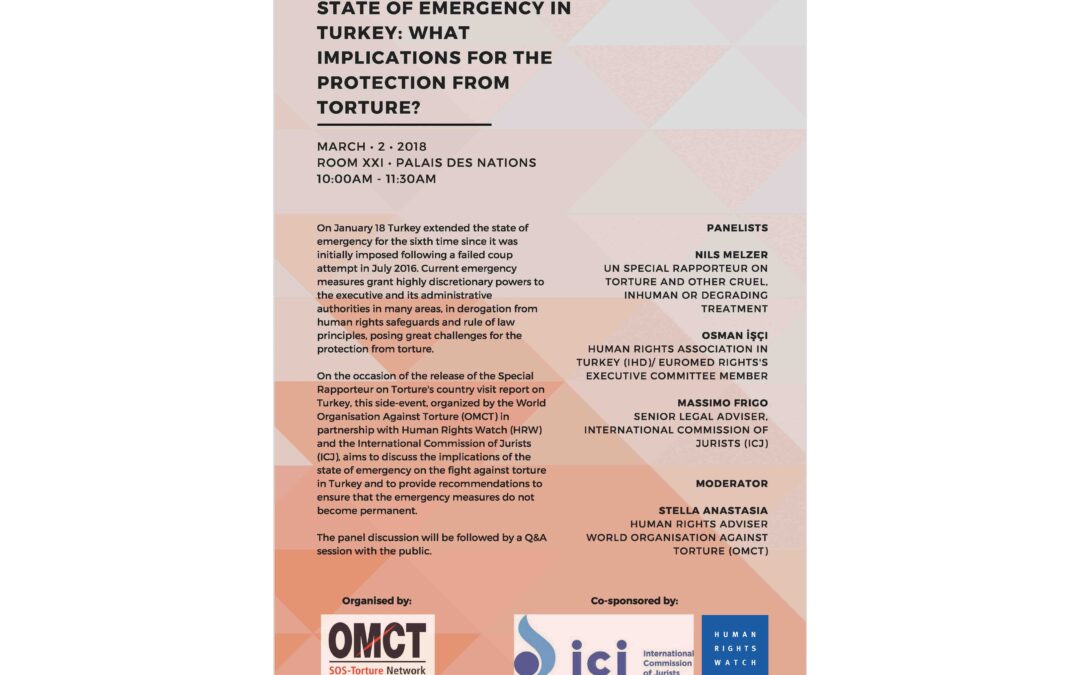
This side event at the Human Rights Council takes place on Friday, 2 March, 10:00-11:30, room XXI of the Palais des Nations. It is organized by the World Organization Against Torture (OMCT) and co-sponsored by the ICJ.
On January 18 Turkey extended the state of emergency for the sixth time since it was initially imposed following a failed coup attempt in July 2016.
Current emergency measures grant highly discretionary powers to the executive and its administrative authorities in many areas, in derogation from human rights safeguards and rule of law principles, posing great challenges for the protection from torture.
On the occasion of the release of the Special Rapporteur on Torture’s country visit report on Turkey, this side-event, organized by the World Organisation Against Torture (OMCT) in partnership with Human Rights Watch (HRW) and the International Commission of Jurists (ICJ), aims to discuss the implications of the state of emergency on the fight against torture in Turkey and to provide recommendations to ensure that the emergency measures do not become permanent.
The panel discussion will be followed by a Q&A session with the public.
Panelists:
UN Special Rapporteur on Torture and Other Cruel, Inhuman, or Degrading Treatment
Human Rights Association in Turkey (IHD)/Euromed Rights’s Executive Committee Member
Senior Legal Adviser, International Commission of Jurists (ICJ)
Moderator:
Stella Anastasia
Human Rights Adviser World Organization Against Torture (OMCT)
Turkey – Protection from Torture – News – Events – 2018 – ENG (flyer in PDF)
Mar 1, 2018 | Events, News
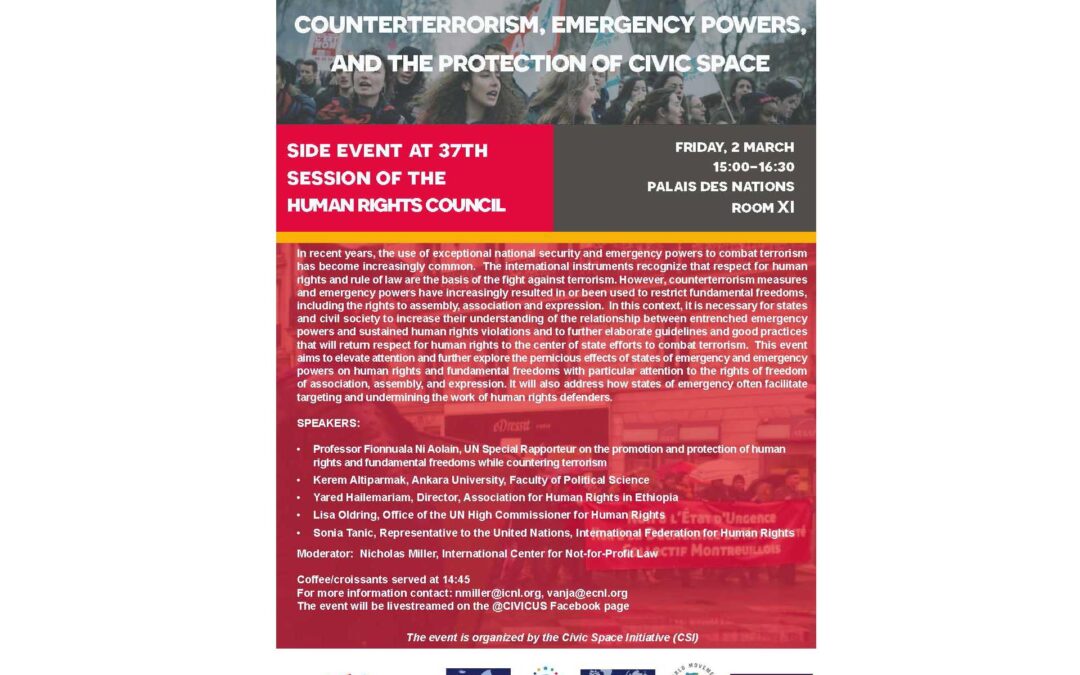
This side event at the 37th session of the Human Rights Council takes place on Friday, 2 march, 15:00-16:30, room XI of the Palais des Nations. It is organized by the Civic Space Initiative (CSI) and co-sponsored by the ICJ.
In recent years, the use of exceptional national security and emergency powers to combat terrorism has become increasingly common.
The international instruments recognize that respect for human rights and rule of law are the basis of the fight against terrorism.
However, counterterrorism measures and emergency powers have increasingly resulted in or been used to restrict fundamental freedoms, including the rights to assembly, association and expression.
In this context, it is necessary for states and civil society to increase their understanding of the relationship between entrenched emergency powers and sustained human rights violations and to further elaborate guidelines and good practices that will return respect for human rights to the center of state efforts to combat terrorism.
This event aims to elevate attention and further explore the pernicious effects of states of emergency and emergency powers on human rights and fundamental freedoms with particular attention to the rights of freedom of association, assembly, and expression. It will also address how states of emergency often facilitate targeting and undermining the work of human rights defenders.
Speakers:
- Professor Fionnuala Ni Aolain, UN Special Rapporteur on the promotion and protection of human
rights and fundamental freedoms while countering terrorism
- Kerem Altiparmak, Ankara University, Faculty of Political Science
- Yared Hailemariam, Director, Association for Human Rights in Ethiopia
- Lisa Oldring, Office of the UN High Commissioner for Human Rights
- Sonia Tanic, Representative to the United Nations, International Federation for Human Rights
Moderator:
- Nicholas Miller, International Center for Not-for-Profit Law
Coffee/croissants served at 14:45
For more information contact: nmiller@icnl.org, vanja@ecnl.org
The event will be livestreamed on the @CIVICUS Facebook page
Universal – Counterrorism and Civic Space – News – Events – 2018 – News (Event flyer in PDF)