Feb 6, 2018 | News
The ICJ today condemned the Maldivian Government’s assault on the Supreme Court and its judges and the suspension of human rights protections under the state of emergency.
“President Yameen and his Government have dealt a grave blow to the rule of law and independence of the judiciary in the Maldives,” said Ian Seiderman, ICJ’s Legal and Policy Director.
“The actions by the government are a wildly unjustifiable and disproportionate response to the decision of the Supreme Court”, he added.
On 5 February, the Maldivian Government declared a 15-day state of emergency under Article 253 of the Constitution, suspending a range of human rights protections.
The declaration of emergency followed a Supreme Court judgment on 1 February that ordered the release of at least nine members of opposition parties, who were in detention on a number of charges.
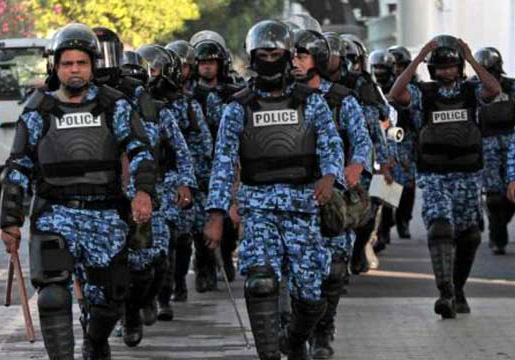
The Government, however, refused to implement the Supreme Court’s judgment, which resulted in the outbreak of protests in the country.
The national defense forces also reportedly entered the premises of the Supreme Court and arrested at least two senior judges, including Chief Justice Abdulla Saeed.
“Summarily suspending basic rights protections and arresting judges whose decisions the President disagrees with is itself a display of sweeping lawlessness in the country,” Seiderman said.
According to the President’s office, the state of emergency was imposed because the Supreme Court order resulted in “disruption of the functions of the executive power, disruption of the functions of the state institutions…and infringement of national security and public interest.”
According to an unofficial translation of the emergency decree received by the ICJ, the constitutionally and internationally protected rights that have been suspended in part or in full during the state of emergency include, among others, the right to liberty; the right to freedom of assembly; the right to privacy; and the right to obtain remedy from the courts.
Basic safeguards surrounding arrest, detention, search and seizures have also been suspended.
In addition, laws providing certain immunities to judges and the right of judges to be informed if any action is taken against them have also been suspended.
“The complete suspension of constitutional protections for human rights such as the right to liberty and right to free assembly goes far beyond anything that could be justified by the alleged grounds cited by the government,” Seiderman added.
The ICJ notes that international law strictly regulates attempts by governments to suspend or otherwise derogate from human rights on the grounds of emergency.
The International Covenant on Civil and Political Rights (ICCPR), to which the Maldives is a State Party, expressly permits derogations only for certain human rights, and then only ‘in time of public emergency which threatens the life of the nation’.
Measures of derogation may only be taken to the extent necessary to meet a specific threat to the life of the nation.
“Maldivian authorities have not even come close to explaining how the current situation constitutes a threat to the ‘life of the nation’, the high threshold set by international law for the derogation of rights in times of emergency,” Seiderman said.
The ICJ urges the Government to immediately lift the state of emergency, release judges of the Supreme Court, implement the ruling of the Supreme Court and ensure the independence of the judiciary.
Contact
Ian Seiderman, ICJ Legal and Policy Director, T: +41 22 979 38 37 ; e: ian.seiderman@icj.org
Reema Omer, ICJ International Legal Adviser for South Asia (London), t: +447889565691; e: reema.omer@icj.org
Additional information
Under international standards, including the UN Basic Principles on the Independence of the Judiciary, it is the duty of all governmental and other institutions to respect and observe the independence of the judiciary.
This means that there shall not be any inappropriate or unwarranted interference with the judicial process and judges shall be free to decide cases without any restrictions, pressures, threats or interferences.
In August 2015, following a joint fact-finding mission to the Maldives, the ICJ and South Asians for Human Rights (SAHR) documented the breakdown of the rule of law and human rights in the Maldives in a 35-page report, Justice Adrift: Rule of Law and the Political Crisis in the Maldives.
Jan 30, 2018 | Agendas, Events
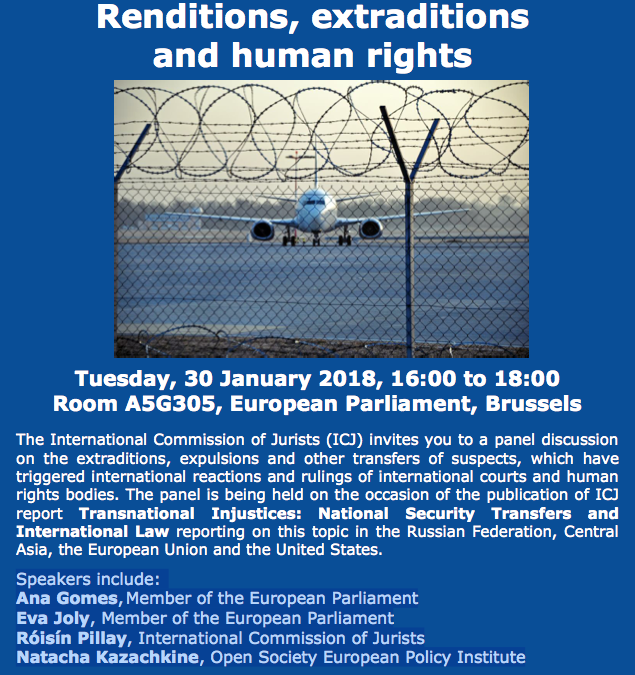
The ICJ invites you to an event to discuss challenges in prevention of, and accountability for, violations of human rights in renditions and other transfers of suspects, including through past European complicity in US-led renditions, and in ongoing transfers of suspects in the CIS region.
Join us for a discussion marking the EU launch of the International Commission of Jurists’ report, Transnational Injustices: National Security Transfers and International Law. The event is kindly hosted by Ana Gomez and Eva Joly, MEPs.
Panelists will discuss the ongoing practice of states unlawfully rendering people accused of terrorism, accountability for violations of human rights in past renditions, and how the EU institutions and EU Member States should address these.
When: Tuesday 30 January 16.00 – 18.00
Where: Room A5G305, European Parliament, Brussels
RSVP to: anamaria.gomes@europarl.europa.eu
Speakers include:
- Ana Gomes, Member of the European Parliament
- Eva Joly, Member of the European Parliament
- Róisín Pillay, International Commission of Jurists
- Natacha Kazachkine, Open Society European Policy Institute
A flyer for this event is available in PDF format by clicking here.

Jan 25, 2018 | News
Myanmar’s publication in state media of lists with the names and accompanying photographs of more than 1,400 men, women and children under the heading “Members of ARSA Terrorist Group” constitutes an assault on human rights and contravenes key principles of the rule of law.
Authorities have not explained why or how listed persons were identified, if they are currently in detention, or if they are wanted for prosecution or for questioning pursuant to criminal investigations. Some or all persons listed appear to have been “accused” outside any formal judicial process.
Given the lack of publicly available information as to the basis of ascribing membership of a prescribed terrorist organization to the persons in the photos, and the manner in which their information has been publicized, the ICJ is concerned that the stated accusations may be arbitrary.
To the extent that there may be any credible basis for ascribing criminal conduct, the authorities have an obligation to administer justice through due process and fair trials, and not name calling and public shaming.
Authorities should cease publishing such material and take effective protective measures to ensure the safety and security of the people named in these publications and their families.
Serious crimes, including alleged acts of terrorism as well as human rights violations, necessitate investigations that are prompt, independent, impartial, effective and transparent in line with international standards.
As with other crimes, the investigation and prosecution of alleged acts of terrorism should conform to applicable national laws, including Myanmar’s Code of Criminal Procedure, to the extent these do not violate applicable international standards.
If any of the listed individuals have been detained, they must be brought promptly before a judge and charged with a cognizable offense or else released.
Accused persons must be afforded legal protections, and if properly charged, they must be brought to justice through fair trials.
State authorities have a duty to respect and ensure the presumption of innocence.
Authorities must refrain from making public statements that are defamatory in nature, that violate fair trial rights by affirming or implying the guilt of persons accused of crimes, and that violate the principle of judicial independence and the separation of powers, all of which are recognized in national and international law.
Particularly given the heightened tensions prevailing in northern Rakhine State, persons included in these lists and their families are at great risk of extra-judicial reprisals, which violates their right to security of the person.
In addition, the potentially defamatory publication of these photos by the government constitutes a violation of their right to privacy.
It also seriously undermines the government’s stated commitments to facilitating the safe return of refugees, and its responsibility to safeguard the physical security and integrity of all individuals from all communities in Myanmar.
Background
From 17 to 23 January 2018, Myanmar authorities published lists with the names, photos and identifying information of more than 1,400 men, women and children who they summarily accuse in the publications of involvement in or association with terrorism-related acts in Rakhine State.
These lists contain photos accompanied by captions with information variously including the name, age, village, alleged transgression, and other identifying information.
Most individuals are identified as “the terrorist” while others are characterized as a “family member of terrorists” or having “sympathized with the terrorist groups.”
The lists have run as supplements in the daily Burmese-language Myanmar Alinn newspaper and in the daily English-language Global New Light of Myanmar newspaper, published by the Ministry of Information.
Extracts have been published by the Office of the President of the Union, and by the Ministry of Foreign Affairs, which on 16 January requested Bangladesh authorities to extradite “accused” persons to Myanmar.
The ICJ has previously expressed concern that during and following security operations in Rakhine State, authorities have systematically failed to respect the rights of detainees in accordance with national and international law and standards.
Authorities have also so far failed to hold to account members of security forces, including soldiers and police, who appear to have perpetrated crimes against both Rohingya and Rakhine inhabitants of Rakhine State.
More than 650,000 inhabitants of northern Rakhine State, the vast majority of whom are Rohingya Muslims, have been displaced as a result of security operations commanded by Myanmar’s military, the Tatmadaw, following attacks on police posts by the Arakan Rohingya Salvation Army (ARSA) on 25 August 2017.
The government’s Counter-Terrorism Central Committee has declared ARSA as a ‘terrorist organization’ and stated that its supporters would be held responsible for acts of terrorism, pursuant to the 2014 Counter-Terrorism Law.
Myanmar-Terrorist Lists-News-web story-2018-BUR (story in Burmese, PDF)
Jan 19, 2018 | News
The ICJ today condemned the executions of 22 civilians during the past month, following death penalty cases before military courts in which fair trial guarantees appear to have been flagrantly violated.
The Egyptian authorities should establish an immediate moratorium and halt all pending executions with a view towards the total and permanent abolition of the death penalty, the ICJ added.
“The executions of these civilians constitute blatant, egregious violations of the right to life by the Egyptian authorities,” said Said Benarbia, ICJ MENA Director.
“Carrying them out based on military trials, which furthermore failed to scrupulously observe international fair trial standards, amounts to the arbitrary deprivation of life,” he added.
Based on information provided by the defendants’ lawyers and families, Egyptian NGOs have reported a litany of fair trial violations that marred these proceedings.
These included the case of a defendant who was convicted following one trial session, in the absence of his counsel.
It also included instances involving enforced disappearances and allegations of torture and other ill-treatment, some of which were documented in the prosecution reports.
In one case the defendants’ lawyers filed a motion to “review the case” under article 448 of the Code Criminal Procedure which should normally suspend the carrying out of any sentence of execution.
The executions were nevertheless carried out on 9 January, before the Military Court’s review, which was due on 28 February 2018.
“The Egyptian authorities have brushed aside the most basic legal safeguards on the imposition and carrying out of the death penalty,” Benarbia said.
“Because they cannot ensure respect of fair trial rights, they must impose an immediate moratorium on executions.”
Under international standards, proceedings in death penalty cases must conform to the highest standards of judicial independence, competence and impartiality, and must strictly comply with all fair trial rights.
The ICJ has previously documented how the Egyptian judiciary fails to conform to these standards.
Contact
Saïd Benarbia, Director of the ICJ Middle East and North Africa Programme, t: +41.22.979.3817, e: said.benarbia(a)icj.org
Egypt-Executions-News-2018-ARA (Arabic translation in PDF)
Background
International standards recognize the particular concerns with judicial independence and impartiality that arise in relation to the trial of civilians by military courts.
Accordingly, the jurisdiction of military courts should be limited to military personnel in cases of strictly military offences, i.e. alleged breaches of military discipline.
The above-mentioned cases involved civilians and allegations of ordinary offenses, including theft, rape, and murder (including murder of military officers).
Particularly in these circumstances, there could be no justification for these cases to have been adjudicated before military courts and the ICJ considers that this factor in itself renders the executions in violation of the right to life.
The ICJ furthermore opposes the death penalty in all circumstances as a violation to the right to life and to the prohibition of cruel, inhuman or degrading treatment or punishment.
The cases in question were: Case No. 411/2013 before the Ismailiya Criminal Military Court (15 executions in 26 December 2017), case No. 22/2015 before Tanta Criminal Military Court (4 executions in 2 January 2018) and case No. 93/2011 before the Ismailiya Criminal Military Court (3 executions in 9 January 2018).
Dec 8, 2017 | News
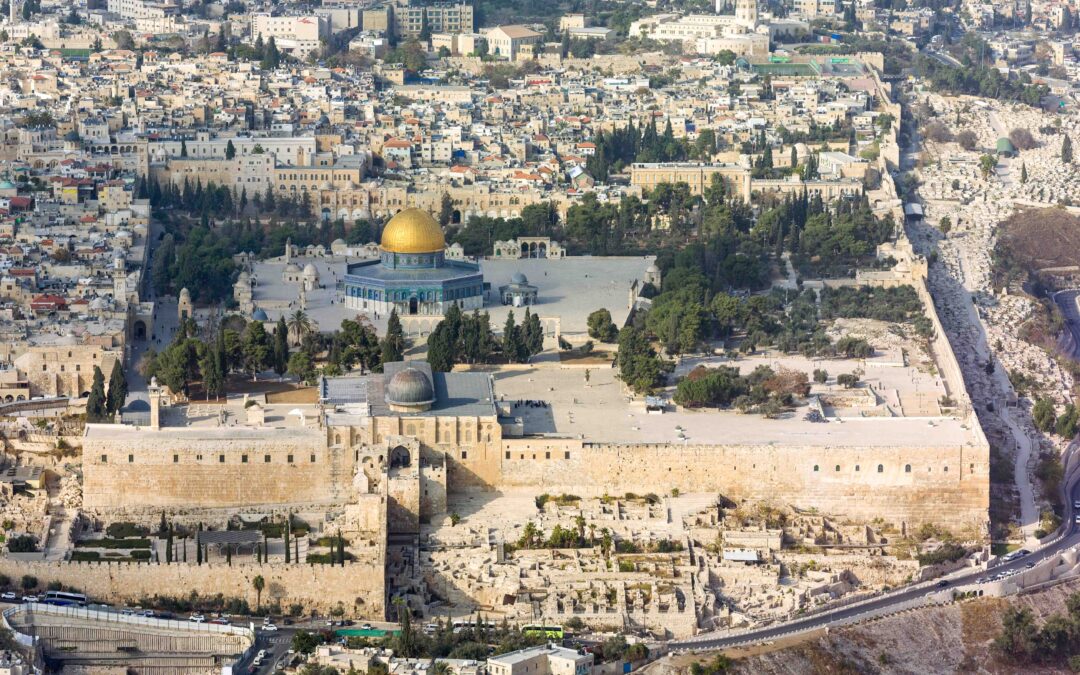
US President Donald Trump’s declaration recognizing Jerusalem as Israel’s capital and indicating an intention to move its embassy there, dangerously ignores long-standing international law, the ICJ said today.
Numerous United Nations Security Council’s Resolutions have reiterated the inadmissibility of the acquisition of territory by war, and have urged the withdrawal of Israel armed forces from territories occupied in the 1967 conflict, including East Jerusalem.
Trump’s announcement turns a blind eye on this legal reality and the related 50 years of occupation.
It also implicitly condones Israeli policies and practices that aim at altering the character and status of the Palestinian territory, including through the annexation of East Jerusalem, particularly by failing explicitly to similarly endorse Palestinian claims to East Jerusalem.
“Trump’s declaration cannot form the basis for any alteration of the status of Jerusalem under international law. However, it has the potential of provoking and fuelling a new cycle of violence in the region,” said Said Benarbia, ICJ MENA Director.
Thousands of Palestinians have taken to the streets to protest against Trump’s declaration. Dozens were injured in clashed with Israeli forces.
“The Israeli authorities should guarantee the right to peaceful protest and refrain from any disproportionate use of force against protesters, including the unlawful use of lethal force,” Benarbia added.
Background
The 2016 UN SC Resolution 2334 specifically reiterate that the Security Council “will not recognize any changes to the 4 June 1967 lines, including with regard to Jerusalem, other than those agreed by the parties through negotiations,” and that “the establishment by Israel of settlements in the Palestinian territory occupied since 1967, including East Jerusalem, has no legal validity and constitutes a flagrant violation under international law and a major obstacle to the achievement of the two-State solute on and a just, lasting and comprehensive peace.”
This reaffirms a series of similar resolutions by the Security Council since 1967.
Palestine-Trump Decla-News-2017-ARA (Statement in Arabic, PDF)