Sep 5, 2017 | Events, News
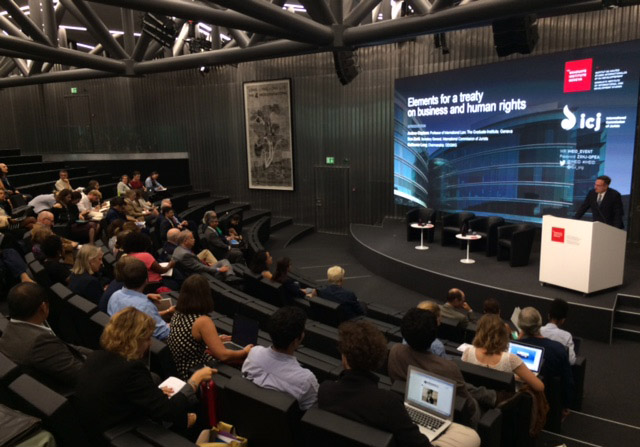
Today the ICJ and the Graduate Institute of International and Development Studies co-organized a public conference: Elements of a treaty on Business and Human Rights.
In June 2014, the United Nations Human Rights Council established an inter-governmental working group to “elaborate an international legally binding instrument to regulate, in international human rights law, the activities of transnational corporations and other business enterprises”.
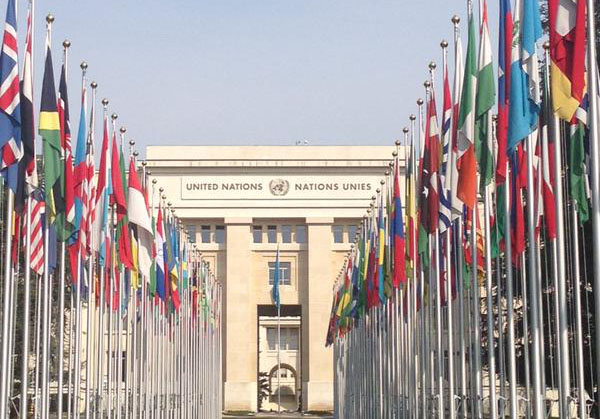
The third session of the working group will take place from 23-27 October 2017 at the Palais des Nations.
Today’s event took place at a critical moment to inform the process of elaboration by the working group.
It fosters the exchange of views among international actors, with the aim of creating the basis for consensus on possible contents of a legally binding instrument in the field of business and human rights.
The prospective treaty is expected to contribute to fill some accountability gaps in the international normative framework, in relation to the operations of business enterprises in terms of human rights.
The treaty should also enhance States’ action to ensure effective remedies and reparations for the victims of abuses.
This treaty will be the first in the international human rights law framework to address directly activities of business corporations.
The issue of human rights impacts by business enterprises has reached the top of the international agenda, and several non-treaty instruments have been developed, foremost among them the Guiding Principles on Business and Human Rights.
The process towards a treaty in this field is expected to build on the achievements so far, filling remaining gaps and enhancing rules for and action by states and businesses alike.
For additional information & registration click here
See also the photo of the week on Genève Internationale
Jul 27, 2017 | News
Pakistani authorities must implement the United Nations Human Rights Committee recommendations to ensure compliance with Pakistan’s human rights obligations under the International Covenant on Civil and Political Rights (ICCPR), the ICJ said today.
The Human Rights Committee, the treaty-monitoring body that oversees countries’ implementation of and compliance with the ICCPR, reviewed for the first time Pakistan’s human rights record under the Covenant on 11 and 12 July.
It issued its “Concluding Observations”, along with its recommendations, today, on 27 July.
“While it is encouraging to see Pakistan’s increased engagement with United Nations human rights mechanisms in recent years, it is deeply worrying that since ratifying the ICCPR, Pakistan’s human rights situation has worsened in a number of aspects, including with the restoration of the death penalty and the introduction of military trials for civilians,” said Livio Zilli, ICJ’s Senior Legal Adviser and UN Representative.
“It is of the utmost importance for Pakistan to reverse this trend, and make sincere efforts to implement the recommendations made by the Committee,” added Zilli.
The Committee’s recommendations include:
- Ensure the National Commission for Human Rights is able to carry out its mandate independently and effectively;
- Reinstate the moratorium on the death penalty;
- Abolish mandatory death penalty and ensure the death penalty is provided only for the “most serious crimes” involving intentional killing;
- Criminalize enforced disappearance and put an end to the practice of enforced disappearance and secret detention;
- Ensure that all allegations of enforced disappearance and extrajudicial killings are promptly and thoroughly investigated; all perpetrators are prosecuted and punished with penalties commensurate with the gravity of crimes;
- Review legislation relating to the military courts with a view to abrogating their jurisdiction over civilians as well as their authority to impose the death penalty;
- Reform the proceedings of military courts and bring them into full conformity with Articles 14 and 15 of the Covenant to ensure a fair trial;
- Ensure that all elements of the crime of torture are prohibited in accordance with article 7 of the Covenant;
- Repeal all blasphemy laws or amend them in compliance with the strict requirements of the Covenant; and
- Review policies and legislation on registration of international NGOs, including the vague grounds on which registrations can be cancelled.
This is the first time Pakistan’s human rights record is being reviewed by the Human Rights Committee since Pakistan ratified the Covenant in 2010.
Contact:
Livio Zilli, ICJ Senior Legal Advisor and UN Representative (Geneva), e: livio.zilli(a)icj.org
Reema Omer, ICJ International Legal Adviser for Pakistan (Lahore), t: +923214968434; e: reema.omer(a)icj.org
Background:
Pakistan ratified the International Covenant on Civil and Political Rights (ICCPR) in June 2010.
Following ratification/accession, every state party to the ICCPR is required to submit an initial “state report” containing information on the implementation of each provision of the treaty.
Pakistan submitted its initial state report to the Human Rights Committee in October 2015.
In light of the information provided in the State report, as well as information received from civil society, the Human Rights Committee then prepared a List of Issues containing particular issues of concern to the Committee, and asking whatever questions it sees fit in light of those concerns.
The answers provided by the State party to these questions, as well as other information submitted by civil society and others formed the basis of the “review” of the State’s compliance with the treaty, which was carried out on 11 and 12 July by the Human Rights Committee.
During the review, the Committee met with Pakistan’s delegation, headed by Federal Minister for Human Rights, Senator Kamran Michael, who presented answers to the List of Issues and responded to the Committee’s questions.
The Committee’s Concluding Observations issued today are highly authoritative, and highlight the Committee’s concerns and make recommendations to the State on improving the implementation of the ICCPR.
The ICJ made submissions to the Human Rights Committee in relation to the formulation of List of Issues in 2016 and the Review in 2017.
In its submissions, the ICJ raised concern about the inadequate legal framework on torture and other ill-treatment; the continuing practice and impunity for enforced disappearances; the incompatibility of military trials of civilians with the right to a fair trial; the incompatibility of Pakistan’s blasphemy laws with the rights to freedom of religion and belief, expression and fair trial; and the vaguely defined INGO policy.
The Human Rights Committee picked up ICJ’s concerns as its principle matters of concern and recommendations in its Concluding Observations.
Jul 6, 2017 | News
The ICJ welcomed today’s judgment by the International Criminal Court (ICC) that South Africa had violated its legal obligations by failing to arrest Sudanese President Omar al-Bashir during his visit to the country in June 2015.
The ICC said the South Africa should have surrendered him to the ICC for prosecution.
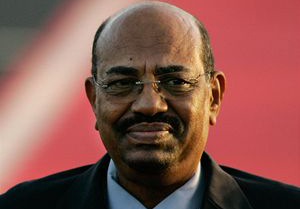
President al-Bashir (photo) had been indicted by the ICC for genocide, crimes against humanity and war crimes in connection with attacks against civilians in the Darfur region of the country.
“The judgment is a victory for international justice. It is an extremely important step toward tackling impunity in Sudan and worldwide,” said Arnold Tsunga, the ICJ Africa Regional Director.
The court said unequivocally that South Africa had a duty to arrest and surrender president Bashir to the ICC for prosecution.
It said that South Africa had a duty to recognize that head of state immunity did not apply to al Bahsir under the terms of the Rome Statute, and that leaving the question of immunity to South Africa’s voluntary discretion would have created “an insurmountable obstacle for the court to exercise its jurisdiction.”
The Court also said that Sudan itself had an obligation to remove and immunities for al-Bashir in respect to matters for which he was under indictment.
“The ICJ calls upon the Governments of South Africa and Sudan to respect the judgment of the Court, and urges all States to cooperate with the Court to bring President al-Bashir, and others indicted to justice,” Tsunga added.
The ICC also called on the UN Security and the Assembly of States Parties of the ICC to take appropriate measures to address the non-compliance by South Africa and Sudan.
Background
South Africa has been a party to the Rome Statute of the International Criminal Court since 27 November 2000.
States parties to the Rome Statute are obliged to cooperate with ICC, including by arresting and surrendering persons under indictment by the ICC who may be on their territory.
South Africa took measures to cooperate with the ICC by enacting the Implementation of the Rome Statute of the International Criminal Court Act, 2002.
Accordingly, South Africa had a duty to arrest President al-Bashir when he visited South Africa in 2015
President al-Bashir stands accused of serious crimes, with two warrants of arrest issued by the pre-trial chamber of the ICC.
They all are for war crimes, crimes against humanity and genocide, related to events in the Darfur region of Sudan.
Among the acts are widespread murder, rape and torture.
Read also:
South Africa appears before ICC for failure to arrest Sudanese President Bashir – The ICJ observes the hearing
Contact
Arnold Tsunga, ICJ Director for Africa, t +27716405926 ;
Thulani Maseko, ICJ Legal consultant, t: +268 7602 5165
Ian Seiderman, ICJ Legal & Policy Director, t: +41 22 979 3837
Jun 30, 2017 | Advocacy
A Joint NGO Statement was issued on the occasion of the Twenty-ninth meeting of UN treaty body chairs 27-30 June 2017, New York
This statement includes some reflections and recommendations, by the undersigned organisations (see list on p.6-7), in relation to the programme of work for the 2017 annual meeting.
Some of the comments and recommendations stem from a two-day consultation involving representatives of NGOs, States, treaty body members, OHCHR and academics, which took place in Geneva on 23-24 May 20171.
The consultation focused on developing a strategy for the Treaty Body strengthening process.
A report will shortly be made public.
The comments and recommendations below are structured around the substantive treaty body chairs meeting agenda items.
Universal-MeetingTreatyBodies-Advocacy-2017-ENG (full text in PDF)
Jun 30, 2017 | News
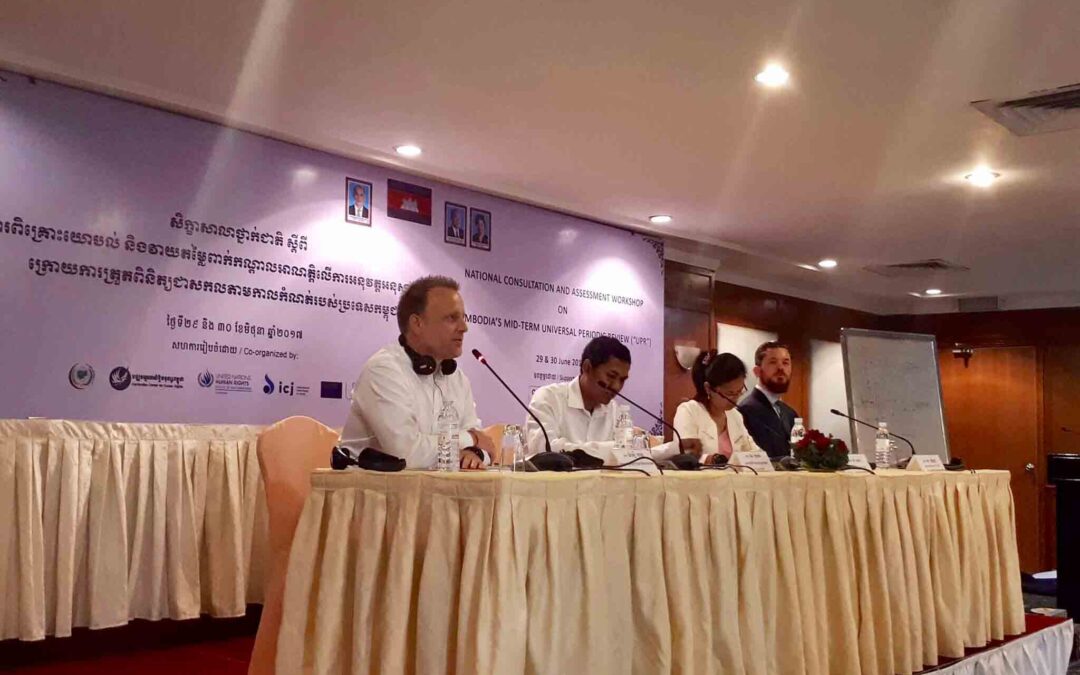
On 29 and 30 June, the ICJ co-organized a workshop for Cambodian civil society on the UPR.
The workshop was organized with the Cambodian Center for Human Rights, the Cambodia Country Office of the Office of the High Commissioner for Human Rights, UPR Info, and the Cambodian Human Rights Committee on the mid-point review of the Human Rights Council’s (HRC) Universal Review (UPR) of Cambodia.
The Royal Government of Cambodia (RGC) underwent its second UPR in January 2014.
The objectives of the workshop were to:
1. conduct a comprehensive mid-term assessment of the progress and challenges as of late June 2017 of the RGC’s implementation of those recommendations made during the second UPR cycle of Cambodia that the RGC had accepted with a view to informing advocacy around the September 2017 session of the HRC;
2. To take stock of the situation of UPR implementation to provide a basis for preparation of NGO shadow reports during the 3rd cycle of the UPR;
3. To discuss a specific set of UPR recommendations among relevant government bodies and civil society organizations in order to build relationships and raise awareness of the recommendations;
4. To advocate for the full implementation of the recommendations accepted during the second UPR cycle of Cambodia; and
5. To increase awareness of and demand among the Cambodian public for the implementation of the accepted UPR recommendations and to increase awareness of the HRC and UPR process.
Kingsley Abbott, Senior International Legal Adviser for Southeast Asia for the ICJ, moderated a panel discussion on “developing strategic advocacy plans for monitoring the implementation of UPR recommendations” and delivered a presentation on “strategies to effectively implement recommendations and lessons learned from other countries” focusing on past UPR cycles of Thailand Lao PDR.
After a comprehensive review of the recommendations accepted by the RGC during the last UPR cycle it was determined that many of the recommendations had not been implemented.
Civil society agreed that it was important to further strengthen coordinated efforts to monitor and conduct advocacy around the UPR process, engage constructively with the RGC, and begin preparation for the third UPR cycle focusing on lessons learned from the last cycle and regional experiences.
Contact
Kingsley Abbott, ICJ Senior International Legal Adviser for Southeast Asia, t: +66 94 470 1345 ; e: kingsley.abbott(a)icj.org