Jan 22, 2014
An ICJ legal opinion issued today concludes that recent Amendments to the NGO Law amount to an illegitimate interference with rights to freedom of association and expression protected in international human rights law.
Amendments to the NGO Law require a wide range of Russian non governmental organizations (NGOs) to register as “foreign agents” or else face severe sanctions.
Analyzing the law and its recent application in practice, the ICJ opinion describes the serious impact of the law on Russian civil society organizations that seek to contribute to public debate on issues such as the protection of human rights or the environment.
Under the law, NGOs that receive donations from foreign sources and engage in “political activity” must register as “foreign agents”.
Those NGOs that register as foreign agents are subject to additional burdensome administrative requirements. NGOs that fall within the definition of foreign agents but do not register are liable to heavy fines and other penalties.
Róisín Pillay, Director of the Europe Programme at the ICJ said: “This law confronts many NGOs with unacceptable choices. They may opt to stop receiving foreign funding, which may threaten their very viability and survival. They may withdraw from any activity that could be considered ‘political’, meaning that they cease to take action or voice their opinions on the issues of public concern that the NGO was formed to address. Or, they may register as a foreign agent, which is likely to impair the organization’s capacity to function effectively, if at all. Whichever route an NGO chooses, its freedom of association and expression will be detrimentally affected.”
The ICJ opinion concludes that the inherently vague scope of application of the law, and in particular the wide and unclear definition of “political activity” as well as of other terms in the law, mean that NGOs are unable to predict with any certainty whether or not they will be required to register as “foreign agents”, or when they will be liable to criminal or administrative penalties under the law.
It adds that the broad terms in which the law is formulated leave room for inconsistent or arbitrary application of the law by courts, contrary to international human rights law.
The opinion also notes that it is not clear that the restrictive measures introduced by the amendments serve any of the legitimate aims recognized by international human rights law on freedom of expression or freedom of association.
It finds that the severity of the punitive measures for NGOs that fail to register as “foreign agents” in accordance with the law, as well as the additional requirements imposed on those that do, cannot be justified as necessary and proportionate restrictions on rights.
Róisín Pillay added: “Given the wide range of NGOs directly affected by the law, and the even wider group on whose exercise of their freedom of association and expression the law is likely to have a chilling effect, it is clear to us that the measures are disproportionate to any aims to which they might be directed, and therefore violate international human rights law.”
Contact:
Róisin Pillay, Director, Europe Programme, t + 32 273 48 46, roisin.pillay(a)icj.org
Temur Shakirov, Legal Adviser, Europe Programme, t + 41 22 979 38 32, temur.shakirov(a)icj.org
Russia-NGO law amendments-analysis brief-2014 (download in pdf)
Russia-NGO law amendments-press release-2014-rus (download in pdf)
Russia-NGO law amendments-analysis brief-2014-rus (download in pdf)
Nov 22, 2013
The ICJ’s submission is based on an ICJ study that was released in early October 2013, after a year of research and consultations in El Salvador.
Provided to the UN Committee on Economic, Social and Cultural Rights (CESCR), the submission suggests main issues of concerns and questions that should be clarified in the upcoming dialogue between the CESCR and the State of El Salvador regarding the implementation of the International Covenant on Economic, Social and Cultural Rights in the country.
During its meeting on 2-6 December 2013, the CESCR’s Pre-Sessional Working Group will adopt a list of issues on El Salvador.
These issues will be put to the Salvadorian Government for formal response ahead of the CESCR’s full examination of the third, fourth and fifth combined reports of El Salvador in April/May 2014.
The ICJ study deals with access to justice and analyses the availability and effectiveness of remedies in cases of violations of economic, social and cultural rights.
Among others, the study highlights the lack of constitutional guarantee of certain ESC rights, the length of judicial procedures and the inadequacy of sanctions, especially in the case of breaches of the labour code by employers, and the comprehensive prohibition of abortion, even in cases in which the life and health of the mother is at risk.
El Salvador-ICJ Submission ESCR-advocay-legal submission-2013 (full text in pdf)
Nov 21, 2013 | Articles, Nouvelles, Publications
Ce nouveau rapport de la CIJ sur accès à la justice pour les droits économiques, sociaux et culturels au Maroc a été présenté à l’issue d’une mission de quatre jours dans le pays. Il a largement bénéficié des informations et discussions collectées et menées au cours d’un processus entamé en 2012.
Le rapport souligne que les provisions de la Constitution de 2011 devraient contribuer à garantir les droits économiques, sociaux et culturels.
Mais il identifie aussi un certain nombre de lacunes qui privent de nombreux(ses) Marocain(e)s d’accès à la justice en cas de violation de ces droits.
Un atelier organisé en collaboration avec l’Organisation marocaine des droits humains en septembre 2012 et une mission de recherche organisée conjointement par les programmes DESC et MENA de la CIJ en avril 2013 ont été l’occasion de consulter des acteurs pertinents, qu’ils soient utilisateurs ou au service de la justice.
Morocco-Access to Justice ESCR-publications-report-2013-Fr (full text in French, pdf)
Nov 21, 2013
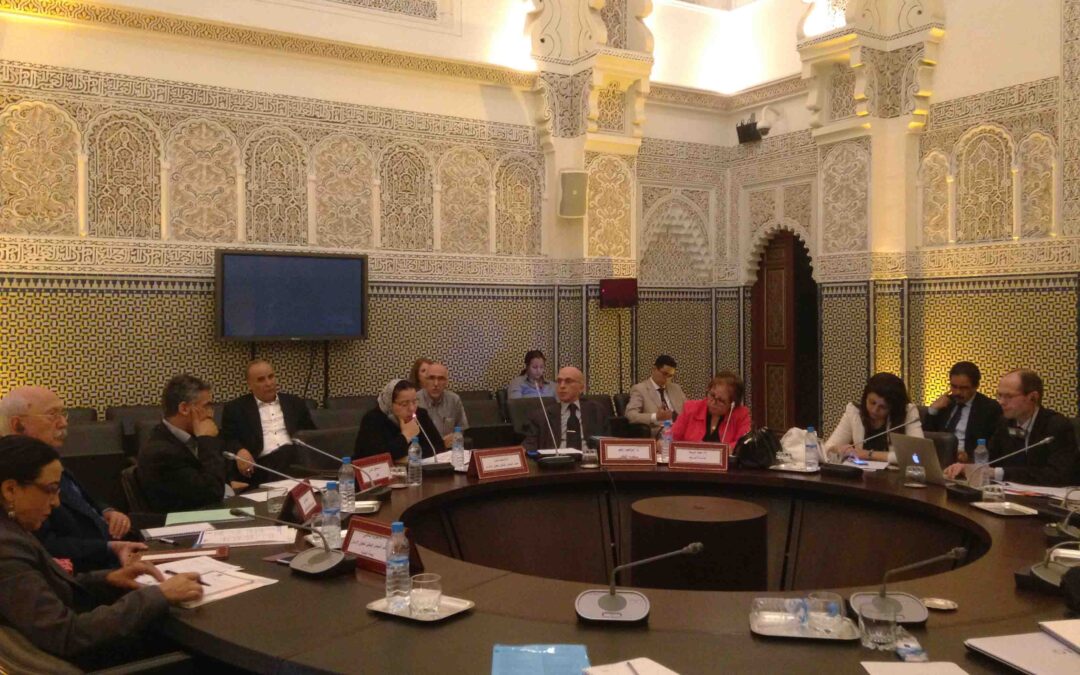
The new ICJ study on access to justice for economic, social and cultural rights in Morocco was presented during a 4-day mission in this country.
The study welcomes the provisions of the 2011 Constitution that should contribute to better guarantee and protect economic, social and cultural rights (ESCR).
It also welcomes a number of recent social policies initiated to improve access to important social services and goods, especially to the benefit of disadvantaged and marginalized sectors of the Moroccan society.
But the report also identifies and describes significant gaps and issues in the normative, institutional and remedial frameworks that deprive many Moroccans from accessing justice in cases of violations of ESCR, and from enjoying their right to an effective remedy when facing such violations.
The ICJ is especially concerned at the prevalence of legal provisions that discriminate against women in areas that are fundamental to ESCR, such as inheritance, or family law.
The inaccessibility of judicial remedies for victims of violations of ESCR for procedural reasons, and the weakness of sanctions in certain cases of abuses of ESCR (for ex. in labour matters) is another area of concern.
In the coming months, the ICJ will continue to promote and discuss the findings of the study, which is the result of over a year of research and consultations on the advances and obstacles in the access to justice for alleged victims of ESCR in Morocco – a country that has initiated deep legal reforms.
Beside civil society actors, the new publication was handed over to several public authorities, including the Minister of Justice, the President of the Cour de Cassation, the Ombudsman, the President of the Human Rights Commission of the Parliament and the Secretary General of the Government.
Morocco-Access to Justice ESCR-publications-report-2013-ara (full text in Arabic, pdf)
Nov 5, 2013
The ICJ has provided a submission to the UN Committee on Economic, Social and Cultural Rights (CESCR) for its consideration during the adoption of a list of issues for the examination of the initial report of Indonesia under the International Covenant on Economic, Social and Cultural Rights.
During its meeting on 2-6 December 2013, the CESCR’s Pre-Sessional Working Group will adopt a list of issues on Indonesia. These issues will be put to the Government of Indonesia for formal response ahead of the CESCR’s full examination of the initial report of Indonesia in April/May 2014.
The ICJ’s submission raises matters and suggests concrete questions to be put to the Government of Indonesia concerning the right to freely choose work, and to just and favourable working conditions; the right to freedom of association and trade unions; the right to water; and the right to cultural life.
Indonesia-CESCR-PSWG52-ListOfIssues-LegalSubmission-2013 (download full submission in PDF)