Sep 21, 2023
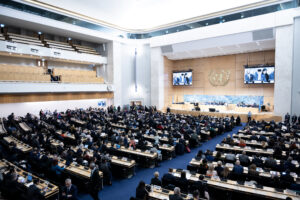
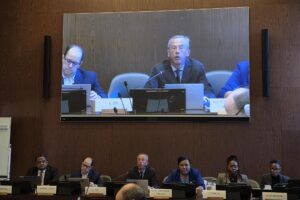
Joint Oral Statement
The International Bar Association’s Human Rights Institute (IBAHRI) and the International Commission of Jurists (ICJ) condemn the widespread and escalating attacks on independent lawyers, including legal harassment, disciplinary actions, disbarments, and arbitrary criminal charges.
We deplore the abusive Foreign Agents Law, with its overbroad definition that covers any persons under “foreign influence”. The Law has been instrumentalized to violate the rights to freedom of expression, association, assembly, and public participation. Lawyers are repeatedly labelled as “foreign agents”, for exercising their human rights and performing their legitimate duties, and many had their licenses suspended.
The Ministry of Justice has listed lawyers as “foreign agents” for lawfully representing human rights defenders, including lawyers Pavlov and Vetoshkina.
Russia’s Constitutional Court has abdicated its responsibility to protect rights by summarily dismissing challenges to legislative provisions criminalizing “public actions aimed at discrediting” the Russian Armed Forces.
We are concerned that the Bar Association intends to set up an Integrated Information System of the Bar of Russia, with the legal obligation for every lawyer to be part of this system, increasing risks of digital surveillance, breach of lawyer-client confidentiality and further harassment.
The repressive legislation in Russia leaves few domestic options to seek justice. It is imperative to maintain rigorous monitoring. We therefore urge this Council to renew the mandate of the Special Rapporteur and ensure additional resources necessary to fulfil its role.
This statement was delivered by:
Francesca Restifo, Senior Human Rights Lawyer and UN Representative
International Bar Association’s Human Rights Institute (IBAHRI)
For further information please contact:
Francesca Restifo, IBAHRI, francesca.restifo@int-bar.org
Sandra Epal Ratjen, ICJ, sandra.epal@icj.org

Aug 30, 2023 | News
The ICJ expressed concern about attacks on the independence of the judiciary in Sri Lanka under cover of parliamentary privilege.
On 22 August 2023, Sarath Weeresekera, a former Minister and a Member of Parliament belonging to the Sri Lanka Podujana Peramuna, the country’s ruling political party, made an inflammatory speech with racist undertones in Parliament, referring to T. Saravanaraja, the Mullaitivu Court’s Magistrate repeatedly as “a mentally ill person”, and criticizing a court order Judge Saravanaraja had made, while making personal remarks about him, including a mention of his wife. Judge Saravanaraja has been the target of this invective following an order he made upholding the right of religious worship of Hindu devotees at a Hindu shrine on Kurundur Hill, a contested religious site in the North of the country.

Aug 30, 2023 | Advocacy, News
On the International Day of the Victims of Enforced Disappearances, the ICJ denounces Egypt’s widespread and systematic resort to enforced disappearance to crackdown on dissidents, and calls on the Egyptian authorities to:
As part of its campaign, “Stop Enforced Disappearance,” launched on the International Day of the Victims of Enforced Disappearances on 30 August 2015, the Egyptian Commission for Rights and Freedoms has published annual reports on enforced disappearances in Egypt since 2015. Over the course of seven years, the campaign has documented the enforced disappearance of 3,088 people from the headquarters of the National Security Agency (NSA) and other official and unofficial detention sites. The campaign has also monitored the phenomenon’s patterns over the same period, showing that its practice is systematic and widespread.

Aug 21, 2023 | Attacks on Justice, News
البيان باللغة العربية على هذا الرابط
On August 21, Judge Anas Hmedi, President of the Tunisian Judges’ Association (Association des Magistrats Tunisiens, AMT), is set to appear before an investigating judge at the Kef Court of First Instance, facing charges of “inciting to cease work” arising from a judicial strike in 2022, seven human rights groups said today.
The undersigned human rights organizations call on the Tunisian authorities to drop the charges against Anas Hmedi and end all forms of harassment against judges exercising their rights to peaceful freedom of expression, assembly, and association.

Aug 11, 2023 | News
Geneva – The International Commission of Jurists (ICJ) is concerned that legislation introduced by the Government on 16 July could serve to further impunity for serious crimes by giving the Government authority to withdraw criminal cases. The ICJ calls on the government to withdraw or modify the proposed bill to bring it into conformity with its international legal obligations.
The Bill to Amendment Some Nepal Acts, 2023 (2080 BS), particularly its