
Mar 31, 2014 | News
The crisis for the rule of law in Nauru, triggered by actions by the executive government that undermine the independence of the judiciary, has deepened.
Nauru Chief Justice Geoffrey Eames resigned on 13 March 2014, two months after the Nauru government summarily dismissed and expelled a judge despite the Chief Justice’s orders to the contrary, and blocked the Chief Justice from returning to the country. A letter of concern ICJ wrote to the government of Nauru several weeks ago remains unanswered.
The decision of the Chief Justice to resign ended the stalemate the government had created by continuing to deny him entry to the country despite the legislature’s refusal to allow the government to impeach him on spurious grounds. It did not, however, end the continuing crisis the government’s actions have created for the independence of the judiciary and the rule of law in Nauru.
The ICJ had earlier publicly expressed its deep concern about the removal of Magistrate Law from office in absence of any due process, and in violation of an injunction issued by the then Chief Justice Eames, and the arbitrary denial of the Chief Justice of access to Nauru. Chief Justice Eames has said that, even by the time of his resignation in mid-March, he had not received any explanation of the specific reasons for cancellation of his visa.
The ICJ’s Centre for the Independence of Judges and Lawyers (CIJL) wrote to President Baron Waqa and relevant ministers of government on 8 March 2014 requesting information and calling upon the government to immediately reverse and remedy the actions taken against the Resident Magistrate and Chief Justice, and to adhere to concrete procedural safeguards to re-establish protection of the rule of law (PDF: Letter-Nauru-IndependenceJudiciary-03032014). To date, the ICJ has received no response.
Mar 27, 2014 | News
The UN Human Rights Council resolution to establish an international investigation into allegations of human rights violations and abuses committed by both sides in Sri Lanka’s civil war gives hope to tens of thousands of victims who continue to be denied truth and justice.
Mar 18, 2014 | News
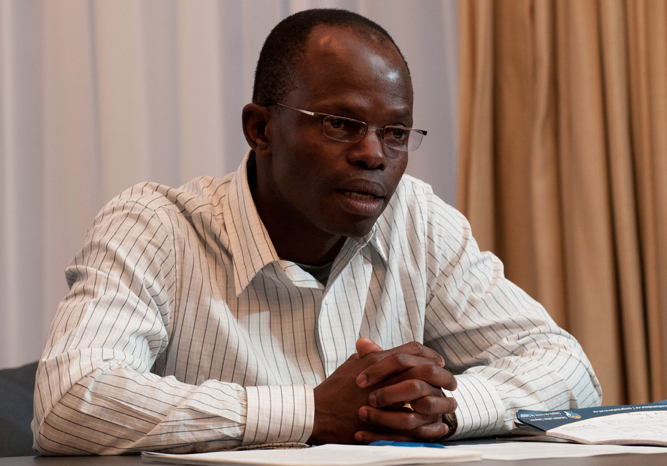
The ICJ today condemned the arrest and detention on 17 March of prominent human rights lawyer, Thulani Maseko and Nation Magazine editor, Bheki Makhubu.
The ICJ is concerned that Thulani Maseko is being subject to persecution for the legitimate exercise of his professional functions as a lawyer, and that both men appear to be detained for exercising their right to freedom of expression.
The men were arrested after Chief Justice Ramodibedi had issued a warrant for their arrest on charges of “scandalizing the judiciary” and contempt of court.
The charges arise from articles allegedly written by Thulani Maseko and Bheki Makhubu in February and March 2014, in which they questioned circumstances surrounding the arrest of government vehicle inspector, Vincent Gwebu.
The vehicle inspector had been arrested and charged with contempt of court after he had arrested the driver of a High Court Judge.
Thulani Maseko and Makhubu, were jointly charged on 18 March 2014 and remanded to appear on 24 March for a bail hearing.
Their lawyer was not allowed to appear on their behalf, in contravention of international and African regional law and standards guaranteeing the right to be represented by a lawyer in legal proceedings.
The ICJ is also concerned that the accused did not appear in open court, but instead in the Chief Justice’s chamber and were not allowed to apply immediately for bail, also in contravention of international and African regional standards.
The ICJ calls upon the Swazi immediately to release the two men. For as long as they are in detention they must be given access to their lawyers.
For further information contact:
Arnold Tsunga, Arnold.tsunga(a)icj.org, Director, ICJ Africa Regional Programme
Or
Martin Okumu-Masiga, Martin.okumu-masiga(a)icj.org, Deputy Director.

Mar 14, 2014
The ICJ brought to the attention of the UPR mechanism issues regarding the effective impunity of the security and armed forces in Egypt for past and present human rights violations, and other key issues to be addressed in the review of Egypt’s compliance with international human rights.
From 27 October to 7 November 2014, the Human Rights Council’s Working Group on the UPR will consider the situation of human rights in Egypt. Ahead of the Working Group’s review, the ICJ has made a submission in which it has identified suggested recommendations concerning:
- The rule of law and civilian oversight of the armed forces;
- The independence of the judiciary and the use and jurisdiction of military courts; and
- The effective impunity of the security and armed forces for past and present human rights violations.
Egypt-UPR20-StakeholderSubmission-LegalSubmission-2014 (download full submission in pdf)

Mar 8, 2014 | News
The ICJ today condemned as a miscarriage of justice, Malaysian opposition leader Anwar Ibrahim’s conviction on sodomy charges.
The ICJ said the overturning of his 2012 High Court acquittal — following an appeal by the Malaysian government — by a Court of Appeal panel contravenes international human rights standards and the rule law.
“The ICJ condemns the use of the colonial-era Article 377B of the Malaysian Penal Code, which prohibits consensual same-sex sexual conduct, in conflict with international standards regarding respect for the right to privacy,” said Sam Zarifi, ICJ’s Regional Director for Asia and the Pacific.
“This article is seldom used in Malaysia, but this is the second time it has been used to convict Anwar, and both times its use seemed clearly motivated to hobble his ability to challenge the government as a politician.”
The sodomy charges against Anwar, which date back to 2008, were dismissed by the High Court on 9 January 2012, but the Court of Appeal today overturned that acquittal and instead sentenced Anwar to five years’ imprisonment. The Court of Appeal ruling took less than two hours.
The ICJ has been observing the proceedings in what has been called Anwar’s ‘Sodomy 2’ trial. ICJ Commissioner Justice Elizabeth Evatt AC, from the Australian High Court and a former member of the United Nations Human Rights Committee, was at the Court of Appeal today on behalf of the ICJ.
“This decision certainly casts doubts on the independence and impartiality of the Malaysian judiciary and tarnishes the reputation of the country’s legal system,” said Zarifi.
The judgement means Anwar will not be able to run for election in a local state seat later this month.
After sentencing, Anwar’s lawyers were successful in arguing for a stay in execution and bail, pending appeal.
CONTACT
Sam Zarifi, ICJ Asia-Pacific Regional Director, (Bangkok), t:+66 807819002, e-mail: sam.zarifi(a)icj.org
Craig Knowles, ICJ Media & Communications, (Bangkok), t:+66 819077653, e-mail: craig.knowles(a)icj.org



![Smoke rises after an Israeli air strike on the village of Taybeh in southern Lebanon [Source: Al Jazeera]](https://www.icj.org/wp-content/uploads/2026/03/Screenshot-2026-03-20-at-15.56.24-300x200.png)