Jan 30, 2013 | News
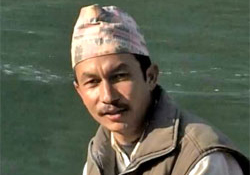 The Nepali government must ensure that the case of the 2004 killing of journalist Dekendra Thapa (photo) can proceed without further political interference, the ICJ said today.
“Political interference into an ongoing criminal investigation constitutes a fundamental attack on the rule of law in Nepal,” said Frederick Rawski, ICJ Nepal Country Representative. “The Government must ensure that there are no further attempts to subvert the course of justice.”
On 11 January, Nepal’s Attorney General, Mukti Pradhan, sent a written instruction to the local police and prosecutor not to move forward with the investigation and prosecution.
In response to a petition challenging the instruction, on 16 January, the Supreme Court ordered both Prime Minister Baburam Bhattarai and the Attorney General not to intervene in the ongoing investigation.
The Home Ministry subsequently ordered the transfer of officials involved in the investigation, and the Prime Minister himself has made public statements calling for the suspects to be released pending the much-delayed formation of a promised truth commission.
“It is now the obligation of the justice system to ensure due process and the right to a fair trial,” Rawski added. “This is an opportunity for Nepal to illustrate the political will exists to address past human rights violations, and that the country’s judiciary can provide justice for the victims while protecting the rights of the defendants.”
Dekendra Thapa was allegedly tortured and buried alive by Maoist cadres in 2004 during the country’s decade-long civil war, which ended in 2006.
The case was finally submitted to a District Court yesterday (January 28, 2013) by the District Attorney of Dailekh in Mid-Western Nepal. The Dailekh District Attorney has charged nine people alleged to be involved.
Five of the suspects have been arrested and produced before the district court.
“Dekendra Thapa was one of the thousands of civilians whose deaths have gone without proper explanation or justice,” said Rawski. “Thanks to the courageous decision of the local authorities to proceed with this case, there is now an opportunity for the Nepali justice system to begin answering the demands for justice.”
Contact:
In Kathmandu, Frederick Rawski, ICJ Nepal Country Representative : t +977-984-959-7681
In Bangkok, Sam Zarifi, ICJ’s Asia Director: t +66-807-819-002
Photo credit: Dhurba Basnet
Jan 23, 2013
Today, senior judges and eminent jurists from around the world joined together, calling on the Government of Sri Lanka to reinstate the legal Chief Justice Dr Shirani Bandaranayake.
An open letter issued by the Centre for the Independence of Judges and Lawyers of the International Commission of Jurists (ICJ) was sent to the Honorable Speaker of Parliament Chamal Rajapakse and H.E. President Mahinda Rajapakse, condemning the removal of Chief Justice Dr Shirani Bandaranayake as unconstitutional and in contravention of international standards on judicial independence.
The letter emphasized that an independent and impartial judiciary is essential for the protection of human rights, the rule of law, good governance and democracy.
It says: “The irremovability of judges is a main pillar of judicial independence. Judges may be removed only in the most exceptional cases involving serious misconduct or incapacity. And in such exceptional circumstances, any removal process must comport with international standards of due process and fair trial, including the right to an independent review of the decision.”
The impeachment process, and subsequent removal of the legal Chief Justice disregarded international standards of judicial independence and minimum guarantees of due process and fair trial.
“The Rajapakse Government has brought Sri Lanka on the path toward authoritarian rule, dismantling the system of checks and balances and eviscerating judicial independence,” said Wilder Tayler, ICJ Secretary General.
The Government’s conduct is a flagrant violation of the core values of the Commonwealth of Nations, notably the Latimer House Principles on the Three Branches of Government 2003.
The Latimer House Principles require the State to uphold the rule of law by protecting judicial independence and maintaining mutual respect and cooperation between Parliament and the Judiciary.
The Commonwealth Magistrates’ and Judges’ Association endorsed the letter.
In recent days, lawyers and advocates, opposing the impeachment have allegedly been sent threatening letters from a group identified as the Patriotic Taskforce.
The group has targeted the lawyers as traitors. Civil society groups have also been targeted in smear campaigns in the media. The Chief Justice has voiced concern for her and her family’s safety, calling on the international media to “…look after the three of us.”
“Sri Lanka must act immediately to guarantee the security of persons who have been the subject of threats or intimidation and must initiate prompt, thorough and impartial investigations into such allegations,” Tayler added.
The ICJ’s Centre for the Independence of Judges and Lawyers and the undersigned jurists urge H.E. President Mahinda Rajapakse and Speaker of Parliament Chamal Rajapakse to act immediately to restore the independence of the judiciary by reinstating the legal Chief justice Dr. Shirani Bandaranayake.
CONTACT:
Sam Zarifi, ICJ Asia-Pacific Regional Director, (Bangkok), t: +66(0) 807819002; sam.zarifi(at)icj.org
Sheila Varadan, ICJ Legal Advisor, South Asia Programme, (Bangkok), t: +66 857200723; sheila.varadan(at)icj.org
Sri Lanka-ICJ Open letter impeachment Chief Justice-openletters-2012 (full text in pdf)
Jan 15, 2013 | News
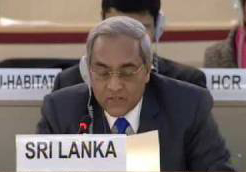 The appointment of former Attorney General Mohan Peiris (photo) as Sri Lanka’s new Chief Justice raises serious concerns about the future of the Rule of Law and accountability in the country, the ICJ said today.
Mohan Peiris has served in a variety of high-level legal posts in the past decade, always playing a key role in defending the conduct of the Sri Lankan government.
He served as Sri Lanka’s Attorney-General from 2009 to 2011. Since then he has served as the legal adviser to President Mahinda Rajapakse and the Cabinet.
“During his tenure as Attorney-General and the government’s top legal advisor Mohan Peiris consistently blocked efforts to hold the government responsible for serious human rights violations and disregarded international law and standards,” said Sam Zarifi, ICJ’s Asia director.
“Mohan Peiris’ appointment as the new Chief Justice, after a politically compromised and procedurally flawed impeachment, adds serious insult to the gross injury already inflicted on Sri Lanka’s long suffering judiciary.”
The International Commission of Jurists, in its recent report on impunity in Sri Lanka, highlighted Mohan Peiris’ lack independence as Attorney-General, noting the alarming number of cases involving prominent politicians that were withdrawn during his tenure.
In November 2011, as Attorney General, Peiris told the UN Committee Against Torture in Geneva that political cartoonist Prageeth Ekneligoda, believed to have been subjected to enforced disappearance in January 2010, had actually left Sri Lanka. In June 2012, Peiris admitted to a court in Colombo that this claim was groundless.
“ICJ condemns this appointment as a further assault on the independence of the judiciary and calls on the Sri Lankan government to reinstate Chief Justice Shirani Bandaranayake. If there are grounds for questioning the Chief Justice’s actions, they should be pursued following due process and a proper impeachment process.”
CONTACT:
Sam Zarifi, ICJ Asia-Pacific Regional Director, Bangkok, t:+66 807819002; email: sam.zarifi(at)icj.org
Sheila Varadan, ICJ Legal Advisor, South Asia Programme, Bangkok, t: +66 857200723; email: sheila.varadan(at)icj.org
NOTE:
In a statement today (see below), Justice Bandarayanake strongly denied all the charges against her and asserted her status as the legal Chief Justice of Sri Lanka’s supreme court. She said: “The accusations leveled against me are blatant lies. I am totally innocent of all charges…Since it now appears that there might be violence if I remain in my official residence or my chambers I am compelled to move…”
Sri Lanka-CJ final speech-2012 (full statement, in pdf)
Read also:
ICJ condemns impeachment of Sri Lanka’s Chief Justice
Sri Lanka’s Parliament should reject motion to impeach Chief Justice
Impeachment of Sri Lankan Chief Justice: Government must adhere to international standards of due process

Jan 11, 2013 | News
The ICJ condemned the decision of Sri Lanka’s parliament today to impeach the country’s Chief Justice, Shirani Bandaranayake (photo).
“Parliament’s impeachment motion has defied the rulings of the country’s Supreme Court and Court of Appeal, and thus thrown into chaos the entire system of checks and balances in the country,” said Sam Zarifi, ICJ’s Asia-Pacific director.
“Sri Lanka’s parliament and executive have effectively decapitated the country’s judiciary in pursuit of short term political gain. As an immediate matter, this has precipitated a legal and constitutional crisis of unprecedented dimensions; but just as worrying are the consequences of this action, which severely erodes accountability and the rule of law in a country already suffering from decades of impunity.”
The impeachment decision now goes to President Mahinda Rajapakse, who precipitated this crisis initially. Under Article 107 of the 1978 Constitution of Sri Lanka, a Chief Justice can only be removed by an order of the President after a motion supporting the removal is passed by a simple majority of Parliamentarians.
The impeachment process against Chief Justice Shirani Bandaranayake has been widely criticized for ignoring international standards and practice. On 6 December 2012, the Chief Justice and her team of lawyers walked out of the impeachment hearing in protest over the denial of a fair hearing. On 1 January 2013, the Supreme Court ruled that the impeachment procedure in Parliament was not constitutionally valid, finding that such procedures could only be established ‘by law’ enacted by Parliament.
The Bar Association of Sri Lanka has publically vowed that it will not welcome a new Chief Justice and the Lawyers Collective has called on the Supreme Court and the superior judiciary to not recognize the newly appointed Chief Justice.
“President Rajapakse should refuse to appoint a new Chief Justice, and instead call on Parliament to enact a new law – through a transparent and democratic process – to govern the impeachment process. Any such law must comport with international standards on judicial independence and guarantees of due process and fair trial,” Zarifi added.
CONTACT:
Sam Zarifi, ICJ Asia-Pacific Regional Director, Bangkok. t:+66 807819002; email: sam.zarifi(at)icj.org
Sheila Varadan, ICJ Legal Advisor, South Asia Programme, Bangkok. t: +66 857200723; email: sheila.varadan(at)icj.org
See also previous ICJ press releases:
Sri Lanka’s Parliament should reject motion to impeach Chief Justice
Impeachment of Sri Lankan Chief Justice: Government must adhere to international standards of due process
Sri Lanka: new ICJ report documents ‘Crisis of Impunity’
Jan 10, 2013 | News
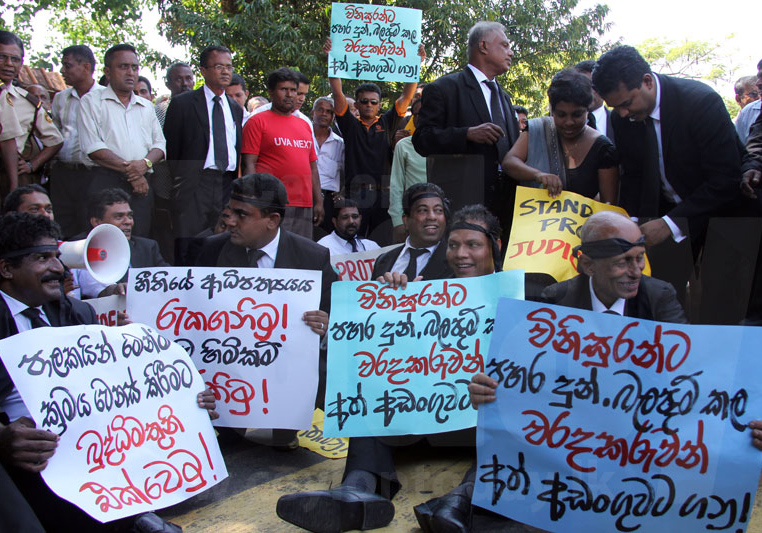
Like the ICJ, the Bar Association of Sri Lanka (BASL) issued a statement strongly condemning the impeachment of Chief Justice Bandaranayake.
The BASL called on its members to refrain from attending Court or engaging in any professional duties on 10 and 11 January 2013 in protest of Parliament’s decision to move forward with the impeachment process. The statement is reproduced below:
The Bar Association of Sri Lanka strongly, unequivocally and with no reservations whatsoever condemns the decision to take up for debate the impeachment motion against her Ladyship the Chief Justice Dr. Shirani A. Bandaranayake based on the findings of the Parliamentary Select Committee which was quashed by the Court of Appeal and determined to be unlawful by the Supreme Court. The Bar Association has decided to call for all its members (in 78 Branch Associations) to refrain from attending to any Professional duty in protest on the 10th and 11th of January 2013 to express our deplorable condemnation.
The Bar Association of Sri Lanka further urges H. E. the President of the Republic, Hon. Speaker and the leaders of all political parties representing the Parliament to honour and respect the determination of the Supreme Court which in terms of the Constitution of our country is vested with the sole and the exclusive jurisdiction as regards to Constitutional Interpretation and Determinations.
The Bar Association of Sri Lanka is seriously concerned about the negative and eroding impact that any action of the legislative and executive organs of the government to disrespect and dishonour such determination would have on the Rule of Law in this Country.
Sanjaya Gamag
Secretary
Bar Association of Sri Lanka
On 10 November 2012, the BASL held a Special General Meeting and passed a resolution expressing ‘grave concern about the impeachment and the independence of the Judiciary’ urging the President and Speaker of Parliament to ‘reconsider’ the impeachment or alternatively to adopt a transparent and accountable procedure.
On 15 December 2012, the BASL passed a further three resolutions calling on the President of Sri Lanka to again reconsider the impeachment or alternatively enact a procedure for impeachment which guaranteed the right to a fair trial. The BASL warned that if the rule of law or fair trial rights were not observed in the impeachment process, the Sri Lankan Bar would not welcome a new Chief Justice.
On the same issue: Sri Lanka’s Parliament should reject motion to impeach Chief Justice