
Attacks on Justice 2005: Guatemala
In Guatemala, the independence and impartiality of the judiciary is severely threatened by the increasing politicization of the justice system and, in particular, of the members of the Constitutional Court.

In Guatemala, the independence and impartiality of the judiciary is severely threatened by the increasing politicization of the justice system and, in particular, of the members of the Constitutional Court.

The Honduran Judiciary remains deeply politicized with the highest judicial offices still being distributed between the two main parties.

The Malaysian government frequently asserts that the judiciary is free from external control, pressure or influence.

In Uganda, the administration of justice lacks both human and financial resources to enable it to function properly.
The judiciary is generally independent, although it is constantly subjected to attacks from the executive. In addition, corruption within the judiciary is rampant and widespread and damages its public perception.
In an effort to combat this, accountability mechanisms have been set up to enhance judicial integrity. Advocates’ freedom of expression has been restricted and access to justice remains limited. Counter-terrorism legislation has undermined respect for the right to a fair trial.
Uganda-Attacks on Justice-Publication-2008 (full text, PDF)

Serbia and Montenegro (Yugoslavia until February 2003) entered the process of democratic transition, the creation of a system based on the rule of law, much later than other former socialist countries.
On 4 February 2003 the new state union of Serbia and Montenegro was proclaimed. Under the Constitutional Charter of the State Union of Serbia and Montenegro, there is only one instance of Serbia and Montenegro having a common judiciary – the Court of Serbia and Montenegro.
Otherwise, each state – the Republic of Serbia and the Republic of Montenegro – has its own internal courts system.
A set of important judicial reforms came into force on 1 March 2002 in the Republic of Serbia and in July 2002 amendments to these laws were made that violate the principle of separation of powers and the independence and impartiality of the judiciary.
In Montenegro, several laws relating to the judiciary were passed or amended during 2003.
On 19 March 2003, the National Assembly of the Republic of Serbia dismissed 35 judges from office, including seven Supreme Court judges, amid accusations that the judiciary had failed to take tougher measures in dealing with remnants of the former regime as well as in prosecuting organized crime. The legal system in Serbia and Montenegro is still characterized by a number of contradictory and inconsistent regulations, resulting in legal insecurity.
Serbia & Montenegro-Attacks on Justice-Publication-2008 (full text, PDF)
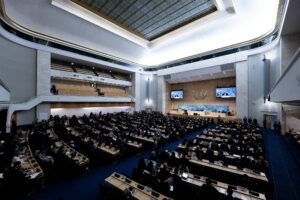 ICJ Oral statement at HRC urgent debate on protection of children and schools in armed conflict
 Joint Statement from Legal Experts on Genetic Sex Testing in Sport
 HRC on Iran: the Council must condemn human rights violations by all parties to this conflict
 Lao PDR: Addressing gaps in access to justice for survivors of sexual and gender-based violence