Nov 27, 2019
Tunisian authorities must ensure that the process of developing and adopting a Judicial Code of Ethics and Judicial Conduct in the country is inclusive and transparent, said the ICJ in a briefing paper released today in Tunis.
The Code must also align with international standards and be effectively and independently implemented to secure judicial independence and accountability, the memo Tunisia: Judicial Conduct and the Development of a Code of Ethics in Light of International Standards (available in English and Arabic), adds.
In the paper, the ICJ recommends the adoption of a clear, transparent and inclusive procedure for developing and adopting the Judicial Code, and for its content to conform to the UN-endorsed Bangalore Principles of Judicial Conduct.
“Adopting a Code of Ethics and Judicial Conduct is a unique opportunity for Tunisian authorities to bolster judicial independence and restore public confidence in judicial institutions,” said Saïd Benarbia, Director of the Middle East and North Africa Programme at the ICJ.
“The authorities should get both the process and the content right, and ensure that such a code provides detailed guidance to judges on what kind of conduct is expected of them,” he added.
The adoption of a Code of Ethics has the potential to remedy the shortcomings of the current legal framework on judicial independence and accountability.
Organic Law No. 67-29 on the Judiciary, the High Judicial Council and the Statute for Judges, even as modified by Organic Law No. 2013-13, does not adequately or sufficiently provide for the guarantees to uphold judicial individual independence, the criteria and procedures for recusal or disqualification, or the need to avoid use of one’s office for private gain.
This is particularly problematic given that the current disciplinary procedures are inconsistent with international standards and best practices for judicial independence and impartiality, including because of the role of the Minister of Justice in initiating such procedures.
Against this background, the ICJ calls on the Tunisian authorities to:
- Ensure that the Judicial Code is established in law as the basis on which judges will be held to account professionally;
- Ensure that the principles of independence, impartiality, integrity, propriety, equality, competence and diligence are clearly incorporated in the Judicial Code of Ethics in accordance with the Bangalore Principles and other relevant international standards;
- Amend Organic Law No. 67-29 to ensure that judges in Tunisia enjoy personal immunity from civil suits for monetary damages for improper acts or omissions in the exercise of their judicial functions; instead, in appropriate cases, persons who suffer losses as a result of such improper acts or omissions should be able to make a claim for compensation against the State itself;
- Ensure that the law and the Judicial Code clearly and precisely define the forms of misconduct that may lead to a judge’s discipline;
- Provide, in a manner consistent with independence of the judiciary, for individual judges to be held responsible, through disciplinary or criminal proceedings or both as appropriate, for perpetration of or complicity in violations of human rights, international humanitarian law and for judicial corruption; in this regard clearly prescribe the offences that could give rise to disciplinary liability for such acts or omissions, in line with international law and standards; and
- Ensure, in defining grounds for disciplinary action, that the fundamental rights and freedoms of judges are upheld and respected.
Contact
Saïd Benarbia, Director of the ICJ Middle East and North Africa Programme, t: +41.22.979.3817, e: said.benarbia(a)icj.org
Additional information
ICJ Commissioner Martine Comte led the delegation that met with different Tunisian authorities and justice actors this week in Tunis in order to present ICJ’s memo and discuss its findings and recommendations. The ICJ delegation met with Mr. Youssef Bouzeker, President of the Tunisian High Judicial Council, and other senior officials of the Tunisian Ministry of Justice and of the Tunisia Bar Association.
Tunisia-Code of Ethics-Advocacy-Analysis Brief-2016-ENG (full paper, in PDF)
Tunisia-judicial code-news-press release-2019-ARA (full story, Arabic version, in PDF)
Tunisia-Code of Ethics-Advocacy-Analysis Brief-2016-ARA (full paper, Arabic version, in PDF)
Nov 18, 2019
Today, the ICJ and the Human Rights Joint Platform (IHOP) published the briefing paper assessing the reforms proposed in the Judicial Reform Strategy to promote judicial independence.
The briefing paper concludes that any judicial reform will be meaningless if implemented in the context of a judiciary which has been taken control of by the executive.
The lack of institutional independence of the judiciary, and the chilling effect of the mass dismissals of judges in the last years are serious threats to the rule of law. These factors clearly undermine the capacity of the judiciary as a whole to provide an effective remedy for human rights violations, both in regard to measures taken under the state of emergency, and in general.
The new Judicial Reform Strategy should be read against this background. Considering that problems relating to the independence of judiciary in Turkey are structural and that the situation has even further deteriorated due to recent amendments, the ICJ considers that the new Strategy will not be able to achieve its stated objectives unless it is amended or supplemented to address these structural problems.
In their briefing paper, the ICJ and IHOP note the commitment of the Turkish authorities to reform the systems of discipline, transfer, accession, promotion and ethics of judges and prosecutors in line with international standards.
However, these measures are deemed insufficient to restore judicial independence in Turkey without essential further reforms:
- reform of the Council of Judges and Prosecutors,
- reform of the Criminal Peace Judgeships system and
- repeal of Law no. 7145 that still allows for arbitrary dismissals of judges and prosecutors, among other civil servants
- introduction of judicial review for all decisions of the CJP
- introduction of a transparent and fair process of selection and appointment of judges and prosecutors ensuring the independence of the committee and process from the executive.
The briefing paper is a comment on the chapter of the Judicial Reform Strategy on judicial independence and it does not provide a full assessment of the situation of Turkish judiciary for which reference should be had to the ICJ reports Justice Suspended and Justice in Peril.
Download
Turkey-Justice Reform Strat-Advocacy-Analysis brief-2019-ENG (PDF, English)
Turkey-Justice Reform Strat-Advocacy-Analysis brief-2019-TUR (PDF, Turkish)
Nov 18, 2019 | News
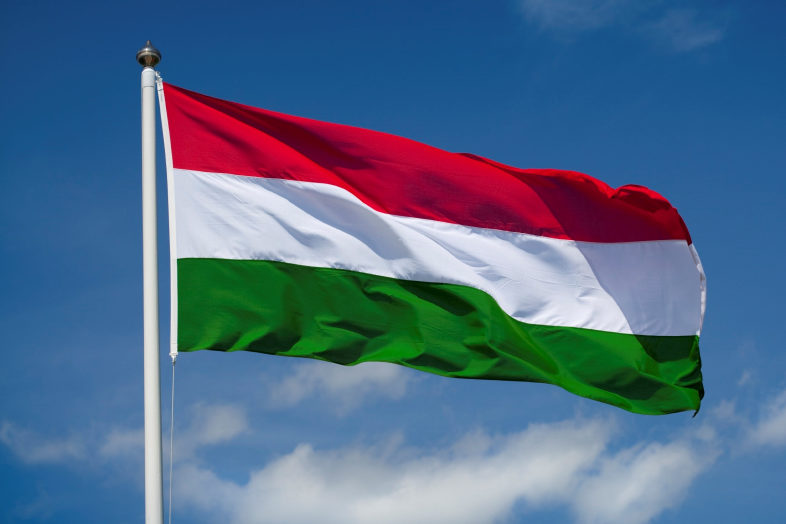
The ICJ today called on the Hungarian authorities to desist from instigating disciplinary proceedings threatened against Judge Csaba Vasvári, a judge of the Central District Court of Pest and a member of the Hungarian National Judicial Council.
The imminent threat of disciplinary action is a consequence of a preliminary reference Judge Vasvári made to the Court of Justice of the European Union.
“Judge Vasvári faces disciplinary action as a direct result of his request for a preliminary ruling of the Court of Justice of the EU on the very question of judicial independence in Hungary. This is an extremely concerning attempt to interfere with the independence of a judge in discharging his judicial function which, if it proceeds any further, will set a dangerous precedent.” said Róisín Pillay, Director of the ICJ’s Europe and Central Asia programme.
A motion to begin disciplinary proceedings against Judge Vasvári was brought by the Acting President of the Budapest Regional Court in October, following Judge Vasvári’s request in criminal proceedings before him last July, for a preliminary ruling the Court of Justice of the EU (CJEU) under Article 267 of the Treaty on the Functioning of the European Union (TFEU).
In the request to the CJEU, Judge Vasvári raised questions regarding compliance with the principle of judicial independence under Article 19.1 of the Treaty of the European Union (TEU), in particular the appointment procedures for court presidents, and remuneration for judges, as well as questions regarding the right to interpretation in court.
Following a decision of the Hungarian Supreme Court in September that the reference was contrary to Hungarian law since it was irrelevant to the case, disciplinary action against judge Vasvári was sought on the grounds that in making the reference, he violated the requirement to conduct himself with dignity and refrain from action which would undermine the dignity of the judiciary.
The motion for disciplinary proceedings is now expected to be considered by a panel of the Service Court, which will decide if disciplinary proceedings will commence.
“The actions of Judge Vasvári in making a preliminary reference to the CJEU were an entirely legitimate exercise of his judicial functions in accordance with EU law. It is essential that judges are able to use all appropriate judicial avenues to address and uphold the rule of law, including to protect the right to a fair trial and the independence of the judiciary” said Róisín Pillay. “It is also necessary for the proper application of EU law, that judges are able refer questions to the CJEU under Article 267 of the Treaty without undue hindrance.”
The ICJ recalls that under international standards on the independence of the judiciary, judges must decide matters before them impartially, without any restrictions, improper influences, inducements, pressures, threats or interferences, direct or indirect, from any quarter or for any reason (Principle 2, UN Basic Principles on the Independence of the Judiciary). Council of Europe Recommendation CM/Rec (2010) 12 of the Committee of Ministers specifies that “the interpretation of the law, assessment of facts or weighing of evidence carried out by judges to determine cases should not give rise to civil or disciplinary liability, except in cases of malice and gross negligence.”
The UN Basic Principles on the Independence of Judiciary (principle 8) also affirm that “members of the judiciary are like other citizens entitled to freedom of expression, belief, association and assembly; provided, however, that in exercising such rights, judges shall always conduct themselves in such a manner as to preserve the dignity of their office and the impartiality and independence of the judiciary.”

Nov 14, 2019 | News
On 14 November 2019, the ICJ called on the Government of Cambodia to drop apparently politically-motivated charges of treason against Kem Sokha, leader of the now-defunct Cambodia National Rescue Party (CNRP).
The ICJ also called on the government to remove restrictions on the exercise of fundamental freedoms of all individuals in Cambodia.
On 10 November, Kem Sokha was released from court-imposed conditions amounting to house arrest, following his arrest in 2017 on spurious charges of treason under article 443 of the Criminal Code. This came after Phnom Penh Municipal Court partially lifted the judicial supervision conditions to which Sokha had been subject. He remains banned from participating in political activities and from leaving Cambodia, and must respond to summons from any authority. Charges of alleged “conspiracy with a foreign power” remain active against Sokha, pursuant to which he risks being imprisoned for between 15 and 30 years.
“Although the release of Kem Sokha from house arrest is a welcome development, it is not nearly enough to show that the government is committed to ending its persecution of civil society and political rivals,” said Frederick Rawski, ICJ’s Asia Pacific Director.
The release comes just after the European Commission released a preliminary report outlining the findings of an investigation triggered in February 2019 on possible removal of tariff preferences granted to Cambodia under the ‘Everything But Arms’ (EBA) trade agreement, on the basis that the Cambodian government had failed to comply with its international obligations to respect, protect and fulfil human rights and the rule of law. A fact-finding mission completed by the Commission last year found ongoing serious, systematic violations of human rights in Cambodia, particularly of the rights of free expression, association, assembly and political participation. In February 2020, the European Commission will finalize its decision.
“The fact that the charges remain in place, and Kem Sokha’s rights to freedoms of association, expression and the right to political participation continue to be suppressed is further evidence of an overall dire human rights and rule of law environment in Cambodia,” said Rawski.
Cambodia has seen a sharp deterioration in human rights and the rule of law since before the 2018 general elections, which has seen abuse of legal and judicial processes to harass and silence members of the political opposition, civil society, and independent media.
Members of the political opposition have been targeted in recent months. In 2019 alone, Cambodian authorities have charged more than 100 members of the political opposition with offences for political reasons, and detained more than half of them. The Cambodian government has also attempted to ban the return of opposition members in exile by urging neighbouring governments to stop their movement into Cambodia, and through increased monitoring of border crossings. In October 2019, the ICJ and other organizations also called for the dropping of spurious charges against former Radio Free Asia (RFA) journalists Yeang Sothearin and Uon Chhin, who are being tried for multiple offences in connection with carrying out their journalist functions.
Background
The charges against Kem Sokha appear politically-motivated. His arrest in 2017 came just months before the CNRP – the main opposition party which he led – was dissolved, and more than 100 of its members banned from political activity following a Supreme Court judgment in November 2017. Soon after, the ruling Cambodian People’s Party won the July 2018 general elections by a landslide. The ICJ has highlighted that the “single largest problem facing the Cambodian justice system is the lack of independent and impartial judges and prosecutors”, including “an endemic system of political interference in high-profile cases and an equally entrenched system of corruption in all others”.
Contact
Frederick Rawski, ICJ Asia and Pacific Regional Director, e: frederick.rawski(a)icj.org
See also
ICJ, ‘Cambodia: charges against journalists Yeang Sothearin and Uon Chhin must be dropped’, 4 October 2019
ICJ, ‘Misuse of law will do long-term damage to Cambodia’, 26 July 2018
ICJ, ‘Cambodia: weaponization of the law (UN Statement)’, 22 March 2018
ICJ, ‘Cambodia: the ICJ condemns dissolution of main opposition party’, 16 November 2017
Nov 12, 2019 | News
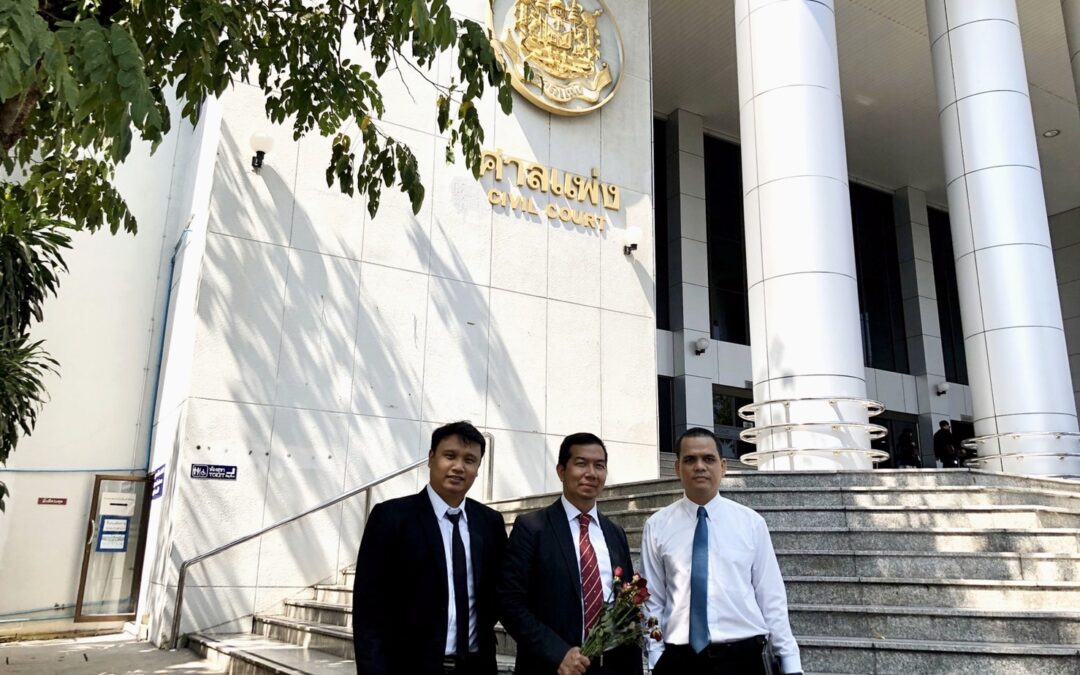
Today, the ICJ condemned the use of civil proceedings to harass Nakorn Chompuchart and Sira Osottham, lawyers representing labour rights researcher Andy Hall.
The ICJ called on Thailand to take measures to protect lawyers so that they can perform their duties without intimidation, harassment or improper interference.
On 12 November 2019, the Bangkok Civil Court conducted its first hearing in a tort case under the Civil and Commercial Code by a Thai fruit processing company, Natural Fruit Company Ltd. (‘the Company’), against the lawyers. The two lawyers represent Andy Hall in several criminal and civil proceedings brought against him seeking damages claimed to have resulted from his research into labour rights abuses allegedly committed by the Company. In the lawsuit against the lawyers, the Company is seeking 50 million Thai baht (approximately 1.65 million USD) as compensation for lost business.
“This legal action is part of a pattern of harassment by Natural Fruit against Andy Hall,” said Frederick Rawski, ICJ Asia Pacific Regional Director. “It is a bedrock principle of the rule of law that lawyers should not be identified with their clients or their clients causes as a result of discharging their function.”
In the complaint, Natural Fruit claims that Andy Hall and his lawyers “excessively exercise their rights”, “intentionally damage the Company’s reputation”, and “caused financial loss in their business” when they brought a case in 2017 against the Company, the Company’s lawyers, and public prosecutor for allegedly “giving false testimony” and “filing false complaint” in other criminal proceedings. The case was dismissed by the Supreme Court who was of the view that the Company exercised its right in good faith.
“This is not the first time in Thailand that lawyers have faced the unwarranted threat of criminal or civil prosecution when representing their clients,” said Rawski. “As with the criminal proceedings brought against Sirikan “June” Charoensiri for her professional activities as a lawyer, such vexatious actions set a precedent that endangers the ability of lawyers to effectively represent their clients. The government must take prompt and effective measures to ensure that the safety and independence of lawyers is guaranteed in law and in practice.”
Background
This case was also initially brought against Andy Hall, but was later withdrawn because the Court could not send court writs to Andy as he does not reside in Thailand.
Criminal and civil proceedings have brought against Andy Hall were in relation to the report of a Finnish NGO, Finnwatch, published in January 2013, called Cheap Has a High Price, which alleged that labour rights violations were taking place at Natural Fruit Company.
Thailand is a party to the International Covenant on Civil and Political Rights (ICCPR). Article 14 of the ICCPR guarantees the right of the clients of the concerned lawyers to an effective defense.
UN Basic Principles on the Role of Lawyers also provides that “governments shall ensure that lawyers are able to perform all of their professional functions without intimidation, hindrance, harassment or improper interference” and “shall not suffer, or be threatened with, prosecution or administrative, economic or other sanctions for any action taken in accordance with recognized professional duties, standards and ethics.” Moreover, lawyers should not be identified with their clients or their clients causes as a result of discharging their function.
To download the statement in Thai, click here. (PDF)
Contact
Frederick Rawski, ICJ Asia-Pacific Director, t: +66 64 478 1121; e: frederick.rawski(a)icj.org
Further reading
Thailand: verdict in Andy Hall case underscores need for defamation to be decriminalized
Thailand: amicus in criminal defamation proceedings against human rights defender Andy Hall