Oct 11, 2019 | News
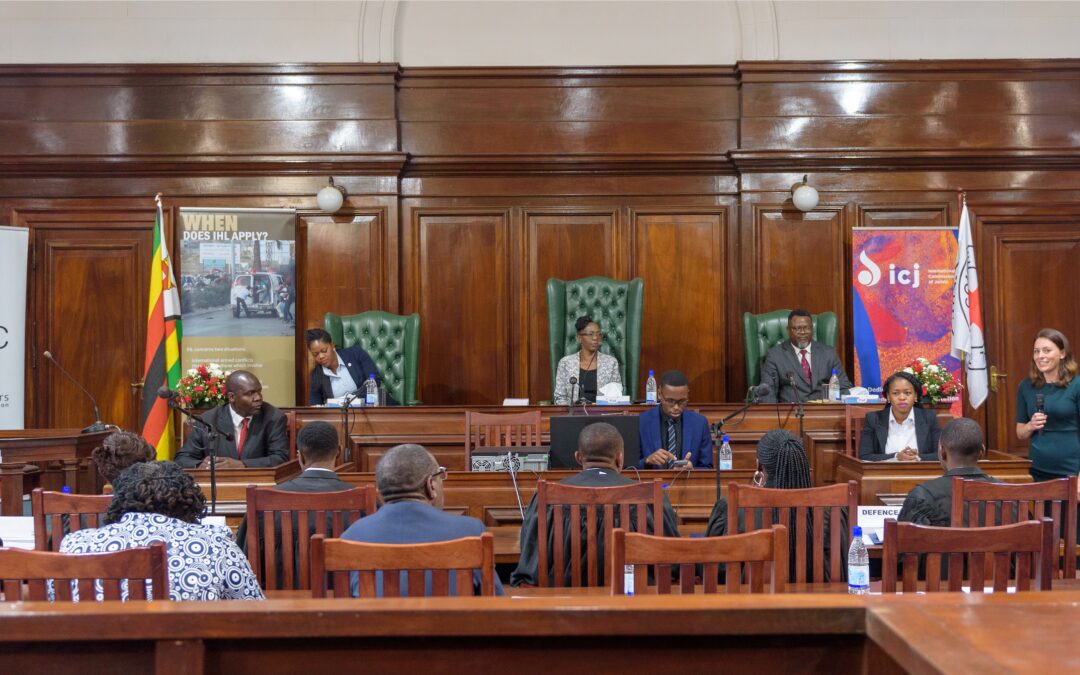
The ICJ in partnership with the International Committee of the Red Cross (ICRC) convened the 2019 International Humanitarian Law (IHL) moot court competition.
The IHL moot court competition brought together 12 law students from Great Zimbabwe University, Midlands State University, University of Zimbabwe and Zimbabwe Ezekiel Guti University; to engage with IHL issues.
The Great Zimbabwe University students won the competition and will participate in the All Africa Moot Court Competitions to be held in Arusha, Tanzania representing Zimbabwe.
Moot Court competitions are a part of the philosophy of developing a conscientious lawyer and contributing to law graduates who have an affinity for defending human rights and the rule of law. IHL incorporates human rights principles in times of war. As a result, understanding IHL allows students to have an understanding of the application and limitations of human rights during times of war. The moot court competitions additionally equip the students with an invaluable opportunity to develop key advocacy skills.
“The moot competition gives law students the opportunity to have experiential learning and can be one among an array of interventions that could be done to supplement the university education of lawyers in Zimbabwe that has not been very strong on human rights and humanitarian law,” said Arnold Tsunga, Director of ICJ’s Africa Regional Programme.
The competition was held from 8 October to 11 October 2019. On 8 October the law students underwent an advocacy boot camp which was a full training day on advocacy skills. The four law faculties participated in a preliminary round on 9 October. The top two, Great Zimbabwe University and Midlands State University qualified for the final round. The winning team, Great Zimbabwe University will participate in the All Africa Moot Court Competitions which brings together IHL national champions from all over Africa.
The competition was supported by the European Union.
Contact
Arnold Tsunga, t: +26377728 3248; e: arnold.tsunga(a)icj.org
Rumbidzai Muyendesi, t: +263771666579; e: rumbidzai.muyendesi(a)icj.org
Oct 7, 2019 | Artículos, Noticias
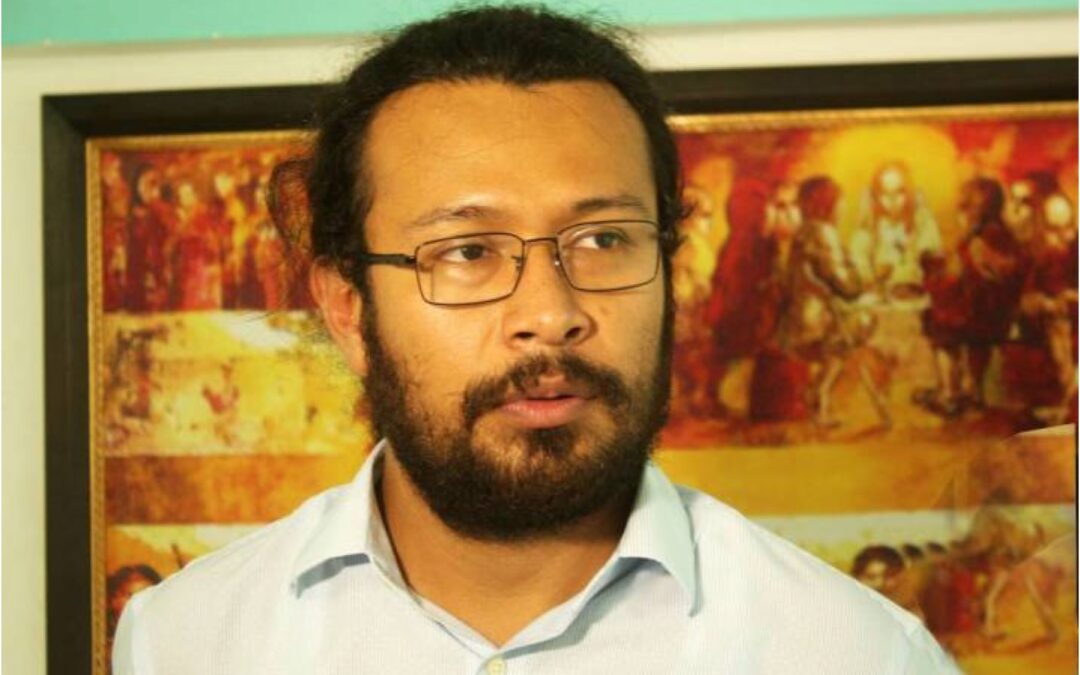
La semana pasada el defensor de derechos humanos Germán Romero Sánchez recibió nuevas amenazas que estarían relacionadas con su labor de abogado defensor de víctimas de graves violaciones a los derechos humanos por parte de agentes estatales
En esta ocasión, las amenazas se realizaron a través de llamadas telefónicas a la residencia del abogado Romero. La primera llamada fue atendida por la compañera del abogado Romero a la cual le dijeron “no te voy a dejar vivo toda la vida, ¿oyo?”. La llamada se produjo minutos después de que el abogado Romero saliera de su casa a llevar a una de sus hijas al colegio.
Esta no es la primera vez que el abogado Romero recibe amenazas por su labor como representante de víctimas y defensor de derechos humanos. Hace menos de un mes, el abogado Romero realizó una denuncia pública dando cuenta de varios hechos de hostigamiento y percusión de los que ha sido víctima él y su familia. Igualmente, en enero de este año, recibió amenazas contra su vida por su labor como abogado defensor de Alfamir Castillo, cuyo hijo fue ejecutado extrajudicialmente por parte de miembros del Ejército Nacional.
El abogado Romero es un reconocido abogado de derechos humanos con más de quince años de experiencia acompañando víctimas de crímenes de Estado. Es uno de los abogados líderes de la organización Asociación Red de Defensores y Defensoras de Derechos Humanos (dhColombia) con la cual la CIJ ha realizado diferentes proyectos en Colombia.
Como lo hizo en oportunidades pasadas, la CIJ vuelve a resaltar la difícil situación de seguridad que atraviesan los defensores de derechos humanos en Colombia. Solo en el año 2018, la Oficina en Colombia de la Alta Comisionada de las Naciones Unidas para los Derechos Humanos reportó el asesinato de 110 personas defensoras de derechos humanos. La CIJ exhorta al Gobierno Nacional y las demás autoridades competentes para que se tomen medidas efectivas que garanticen la seguridad de los defensores de derechos humanos colombianos.
Oct 4, 2019 | News
The ICJ today called on the Egyptian authorities to immediately release all lawyers arrested for discharging their professional functions, and ensure they and other lawyers in the country are allowed to perform their work without threats or intimidation.
The Egyptian authorities have arrested more than 2400 people over the past two weeks following anti-government protests.
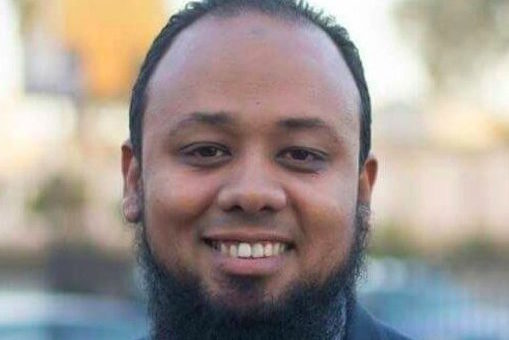
Many of the detainees’ lawyers have themselves been arrested, including Mahienour Al-Massry, Sahar Ali, Mohamed Salah Ajaj, Mohamed Al-Baqer (photo), Mohamed Helmy Hamdoun, Ahmed Sarhan, and Ahmed Abd El-Azim.
On 29 September, while representing prominent human rights defender Alaa Abdelafttah during questioning before the State Security Prosecution, lawyer Mohamed Al-Baqer was arrested and charged with, among other charges, “spreading false information aiming at disturbing the public and peaceful order” and “joining a terrorist organization.”
The ICJ has previously documented how lawyer Mahienour Al-Massry was arrested under similar circumstances, and called for her immediate release.
Mahienour was also charged with “spreading false information” and “joining a terrorist organization.”
“By arresting lawyers and prosecuting them on trumped-charges, the Egyptian military is dismantling the very last line of defense against its ruthless crackdown on human rights and fundamental freedoms, and silencing the very same voices that can still witness, challenge and report on its industrial-scale human rights abuses,” said Said Benarbia, ICJ MENA Director.
Under international standards reflecting core rule of law principles, lawyers must be able to discharge their professional functions without hindrance, harassment or improper interference.
They shall not suffer, or be threatened with prosecutions for any action taken in accordance with their professional duties.
The ICJ emphasized that these standards are there not only for the interests of the lawyers and those they represent or might in the future represent, but also to ensure that the rule of law remains operative for the society as a whole.
The Egyptian authorities must conform to these standards, refrain from its attacks against the legal profession, and immediately release all lawyers and other individuals arbitrarily detained.
Contact:
Said Benarbia, Director of the ICJ Middle East and North Africa Programme, t: +41-22-979-3817; e: said.benarbia(a)icj.org
Egypt-Attacks on Lawyers-News-web stories-2019-ARA (story in Arabic, PDF)
Sep 29, 2019 | News
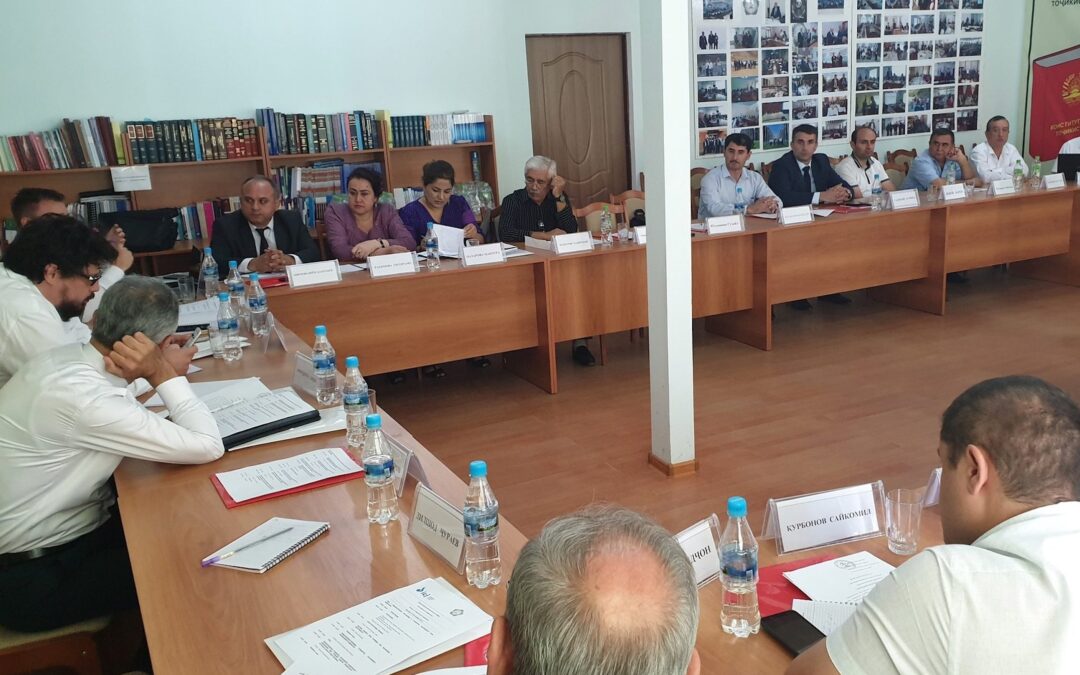
On September 27-28, the International Commission of Jurists (ICJ), in cooperation with the Union of Lawyers of the Republic of Tajikistan, held a training on protecting the rights of lawyers and guarantees of the legal profession as well as the role of the Bar Association in protecting its members.
Around thirty lawyers from all regions of the Tajikistan took part in the training. Over two days lawyers discussed effective use of international mechanisms and international law and standards related to the protection of the rights of lawyers.
Particular attention was paid to the organization, functioning and role of the Commission for the Protection of the Professional Rights of Lawyers of the Union of Lawyers of the Republic of Tajikistan.
The event was attended by members of the Commission who had an opportunity to discuss the role and the effective work of this specialized body on protection of lawyers.
The Committee on the protection of the rights of lawyers of the Ukrainian National Bar Association delegated its members to the event to share their best practices and recommendations to overcome the challenges which arise in the work of these bodies.
Sep 24, 2019 | Events, News
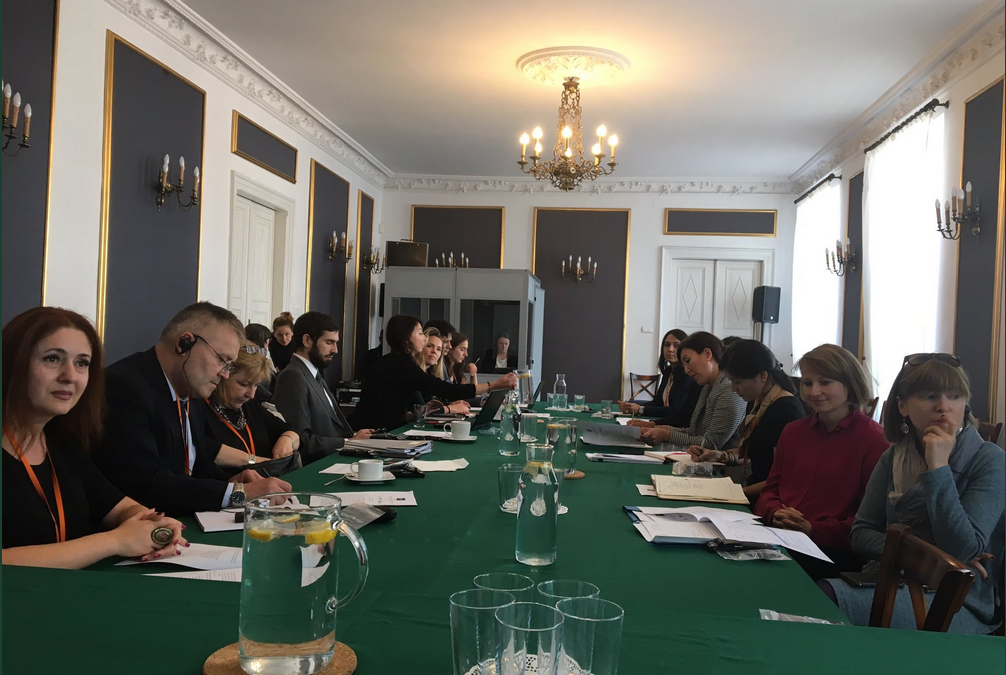
The ICJ in cooperation with a number of other leading international NGOs has organised a discussion on key challenges and opportunities for the legal profession in a number of CIS countries. The discussion aimed to share the experience of bar associations in achieving greater independence from the governmental authorities and any other undue influences.
The participants have shared their legislation and practices, specific challenges and lessons learned in taking steps to achieve institutional sustainability and independence to date, and opportunities for the legal profession, domestically and in coordination with other associations and international NGOs, to raise awareness and build legal and practical framework to enable a stronger institutional capacity and independent functioning. In addition, the ICJ, ABA, IBA, Lawyers for Lawyers, representatives of bar associations and legal experts have discussed what steps should be taken to support these efforts.