May 20, 2019 | Communiqués de presse, Nouvelles
L’ICJ, l’Ordre des avocats de Genève et la communauté juridique de Genève joignent leurs forces pour lancer l’ICJ-Geneva Lawyers International Cooperation Initiative qui consistera en des missions de coopération sur les cinq continents afin de soutenir les avocats et magistrats menacés dans leur indépendance et ainsi œuvrer à la promotion de l’Etat de droit.
La première d’entre elles commence demain 21 mai. Une avocate de l’Ordre des avocats de Genève va se rendre au Guatemala pour enquêter sur le déplacement forcé de la communauté indigène de La Laguna d’El Petén.
D’une manière générale, ces missions consisteront notamment en des :
- Observations de procès ;
- Participations à des missions d’enquête ;
- Soutiens à l’indépendance des avocats et des Barreaux ;
- Participations à des activités de formations ;
- Expertises et soutiens académiques.
Depuis sa création en 1952, l’ICJ joue un rôle unique et prééminent en tant qu’organisation non-gouvernementale pour la défense de l’Etat de Droit dans le monde auquel participe l’indépendance des juges et des avocats.
De par la présence de son siège à Genève depuis 60 ans, l’ICJ souhaite cultiver son lien particulier avec la Cité, la faire rayonner et partager l’esprit de Genève.
Pour Michaël Sombart, Directeur des Partenariats Stratégiques de l’ICJ : “Il s’agit de renouer un lien professionnel fort entre l’ICJ, l‘Ordre des avocats de Genève et la communauté juridique genevoise. C’est aussi une opportunité de porter le message de la Genève humanitaire au-delà des frontières et de bénéficier de la réputation, neutralité et compétence de la communauté juridique suisse.”
“Cette initiative est bienvenue et nous la soutenons avec engagement,” souligne Me Sandrine Giroud, Membre du Conseil de l’Ordre des avocats de Genève et Présidente de sa Commission des droits de l’Homme. “L’Etat de droit est attaqué partout dans le monde et les avocats jouent un rôle primordial pour sa défense et l’impartialité de la justice. Notre soutien à l’ICJ-Geneva Lawyers International Cooperation Initiative est en ligne avec la mission de l’avocat comme rempart contre l’arbitraire et la tradition de défense de la défense de l’Ordre des avocats de Genève. Nous nous réjouissons de cette collaboration qui participe du combat pour la justice et le respect des garanties et droits fondamentaux.”
Pour Me Nicolas Gürtner, Premier Secrétaire du Jeune Barreau de l‘Ordre des avocats de Genève : “Ce projet offre une chance remarquable pour de jeunes avocats d’œuvrer, aux côtés des augustes juristes de l’ICJ, en faveur de la garantie de l’Etat de droit.”
Le Comité de Pilotage de ce projet comprend :
- L’ICJ ;
- Pour l’Ordre des avocats de Genève : la Commission des droits de l’Homme et le Jeune Barreau ;
- Des représentants du monde de la magistrature et académique genevois dont le Professeur Robert Roth, ancien Président de la Cour de Cassation, ancien directeur de la Geneva Academy, Professeur Emérite de l’Université de Genève
Contact :
Michaël W. Sombart, ICJ, Directeur des Partenariats Stratégiques, t: +41 22 979 38 31 ; m: +41 77 965 98 45 ; e: michael.sombart(a)icj.org

May 20, 2019 | News
The ICJ, the Geneva Bar Association and the Geneva legal community have joined forces to launch the ICJ-Geneva Lawyers International Cooperation Initiative. Under the Initiative, Geneva lawyers will join ICJ missions on the five continents to support the independence and integrity of lawyers and judges at risk, and to promote the Rule of Law.
The Initiative launches with a mission tomorrow, May 21st. A lawyer from the Geneva Bar Association will go to Guatemala to work the ICJ team and lawyers investigating and fighting the forced displacement of the indigenous community of La Laguna de El Petén.
Missions under the initiative will typically involve, among other things:
– Trial observations;
– Fact-finding missions;
– Support for the independence of lawyers and bar associations;
– Capacity building and training activities;
– Expertise and academic support.
Since its founding in 1952, the ICJ has played a unique and preeminent role as a non-governmental organization for the defense of the Rule of Law around the world, and the independence of judges and lawyers.
With the presence of its headquarters in Geneva for more than 60 years, through the Initiative the ICJ is further deepening its special bond with the city, to spread and share the spirit of Geneva.
“International support and solidarity are crucial to the work of lawyers defending the human rights of those who are often marginalized from power,” said Michaël Sombart, Director of Strategic Partnerships of the ICJ. “With this project the ICJ can help lawyers around the world benefit from the reputation and high standing of the Swiss legal community and bring the message of the Genève humanitaire beyond borders.”
“This initiative is welcome and we support it with commitment,” said Sandrine Giroud, member of the Geneva Bar Council and Chair of its Human Rights Commission. “The Rule of Law is under attack around the world and lawyers play a vital role in its defense and the impartiality of justice. Our support for the ICJ-Geneva Lawyers International Cooperation Initiative is in line with the lawyer’s mission as a bulwark against the arbitrariness and the defense advocacy tradition of the Geneva Bar Association. We welcome this collaboration, which is part of the fight for justice and respect for fundamental rights and guarantees. ”
Nicolas Gürtner, First Secretary of the Young Bar Association of the Geneva Bar Association, said: “This project offers a remarkable opportunity for young lawyers to work alongside the jurists of international repute of the ICJ in favour of the guarantee of Rule of Law.”
The Steering Committee for the Initiative includes:
– The ICJ;
– For the Geneva Bar Association: the Commission on Human Rights and the Young Bar Association;
– Representatives of the Geneva judicial and academic world, including Professor Robert Roth, former President of the Court of Cassation, former director of the Geneva Academy, Professor Emeritus of the University of Geneva
Contact :
Michaël W. Sombart, ICJ, Director of Strategic Partnerships, t: +41 22 979 38 31 ; m: +41 77 965 98 45 ; e: michael.sombart(a)icj.org
May 8, 2019 | News
The recommendations published today follow the Conference on the Independence of the Legal profession held by the International Commission of Jurists (ICJ), the Council of Europe (CoE) Office in Baku and the Azerbaijan Bar Association (ABA) in Baku, on 15-16 November 2018.
The Conference created much-needed space for a dialogue on the issue of independence of lawyers in Azerbaijan with both national and international stakeholders, as lawyers from Azerbaijan, Georgia, Kazakhstan, the Netherlands, the Russian Federation, Switzerland, Turkey, Ukraine, the United Kingdom and Uzbekistan shared their experiences and good practices in addressing challenges to the independence of lawyers. Drawing on the discussions at the Conference, and taking into account key findings of the ICJ report of 2016 “Defenceless Defenders: Systemic Problems in the Legal Profession of Azerbaijan” as well as more recent legislative and administrative developments, the ICJ makes recommendations aimed at strengthening the role and independence of lawyers and improving access to justice in Azerbaijan. The recommendations are informed by international law and standards on the role of lawyers and cover four main aspects: adequacy of the number of lawyers to ensure access to justice; the examination procedure for qualification as a lawyer; professional ethics of lawyers and disciplinary proceedings against lawyers.
Click to read the recommendations
May 6, 2019 | Agendas, Events
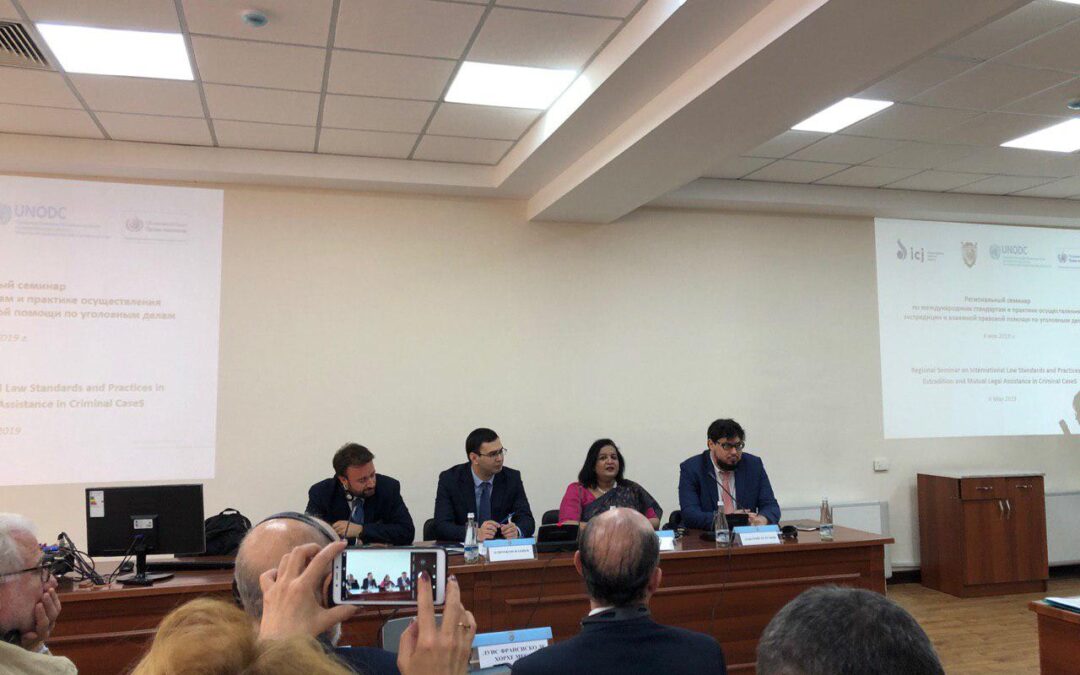
Today, the ICJ, together with the General Prosecutor’s Office of Uzbekistan, UNODC and OHCHR are holding the first regional meeting of prosecutors from Central Asia and the Russian Federation to discuss international law and standards in the field of extradition, mutual legal assistance, the rule of law and human rights.
The workshop aims to facilitate exchange of experiences regarding the law and practice of extradition in European and Central Asian countries. Presentations at the workshop will analyse international law and standards on effective criminal justice co-operation and the protection of human rights in extradition, and their application in practice..
The workshop will present cases of mutual cooperation in the field of criminal law from national courts as well as from international mechanisms such as the European Court of Human Rights, the UN Committee against Torture and the UN Human Rights Committee.
The workshop is taking place in Tashkent (Uzbekistan) and is hosted by the Prosecutor General’s Office of Uzbekistan.
More than twenty prosecutors from Kazakhstan, Kyrgyzstan the Russian Federation Tajikistan, Turkmenistan, and Uzbekistan are participating in the event that includes international experts from UNODC, ICJ, including ICJ Commissioner and Emeritus Spanish Supreme Court Justice, José Antonio Martin Pallin, and Italian Prosecutor Lorenzo Salazar.
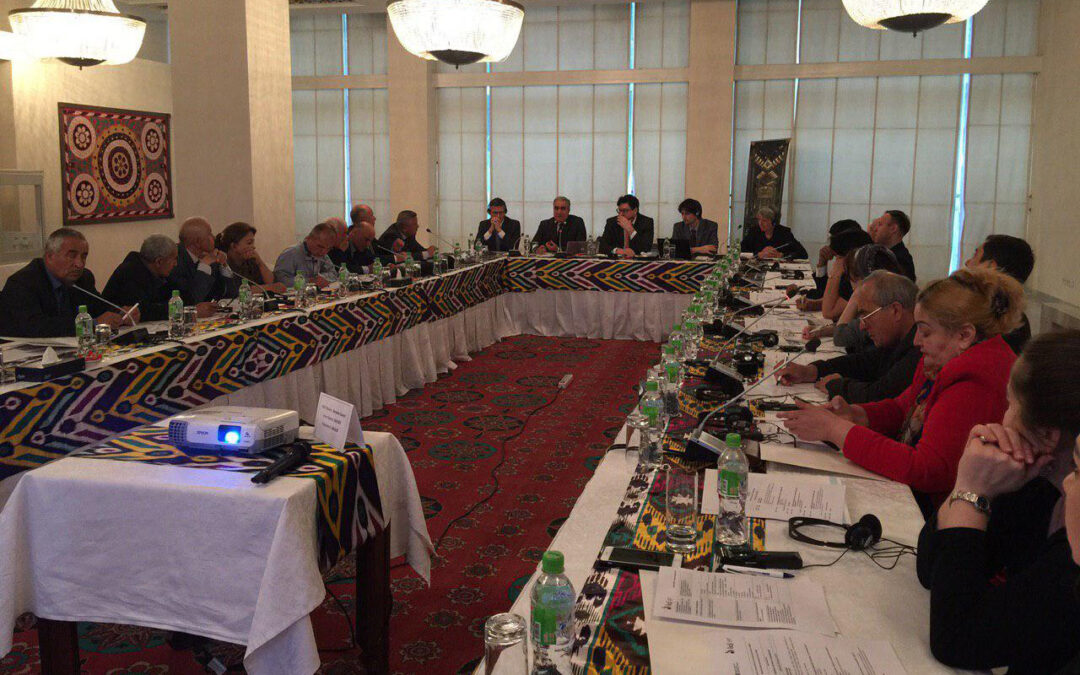
May 4, 2019 | News
The ICJ concluded a research mission on the independence of the judiciary in Tajikistan on 3 May. Following the mission, the ICJ expressed concerns about the independence of individual judges as well as the functioning of judicial institutions and procedures in law and in practice.
The mission included ICJ Commissioner Justice (ret.) Martine Comte of the Orleans Court of Appeal (France) and ICJ Secretary General Saman Zia-Zarifi.
The ICJ spoke with a wide cross-section of stakeholders, including senior government officials, numerous former judges, senior advocates and working lawyers, as well as journalists and members of civil society. The ICJ will provide its findings in a final mission report that will set out include key recommendations to help Tajikistan meet its international obligations.
Among other things, the ICJ mission discussed recent initiatives to reform the judiciary, including the Judicial Reform Programme of 2019-2021 which has been recently been adopted by the President of Tajikistan, and which provides an opportunity to strengthen judicial independence.
The ICJ mission gathered information about the newly formed Qualification Commission for qualification and disciplinary procedures for judges. This replaced the Council of Justice, which had been criticized by international observers for its lack of independence.
Although formally established under the Supreme Court, the Qualification Commission consists predominantly of members of the executive with only two out of seven members being representatives of the judiciary.
Multiple lawyers and former judges expressed serious concerns about the right to a fair trial in criminal proceedings, pointing in particular to the extremely low acquittal rate for suspects. It appears that numbers of acquittals have declined over several decades and that acquittals are now extremely rare.
The ICJ also received complaints that pubic access to court hearings is impeded in practice despite clear legal provision for the public nature of court proceedings, with limited exceptions. Members of the public were said to be generally unable to attend court hearings freely where they are not parties to the proceedings.
Furthermore, the ICJ heard that judicial decisions are generally not available to members of the public unless they are participants in the proceedings.
The ICJ wishes to express its gratitude to everyone who contributed to the successful conduct of the mission, including State, inter-State and non-State organisations and bodies which the ICJ met and communicated with.
The ICJ wishes to stress its appreciation of the support provided by the OSCE Office in Dushanbe and the United Nationals Human Rights Office.

![Smoke rises after an Israeli air strike on the village of Taybeh in southern Lebanon [Source: Al Jazeera]](https://www.icj.org/wp-content/uploads/2026/03/Screenshot-2026-03-20-at-15.56.24-300x200.png)