Dec 4, 2023 | Events, News
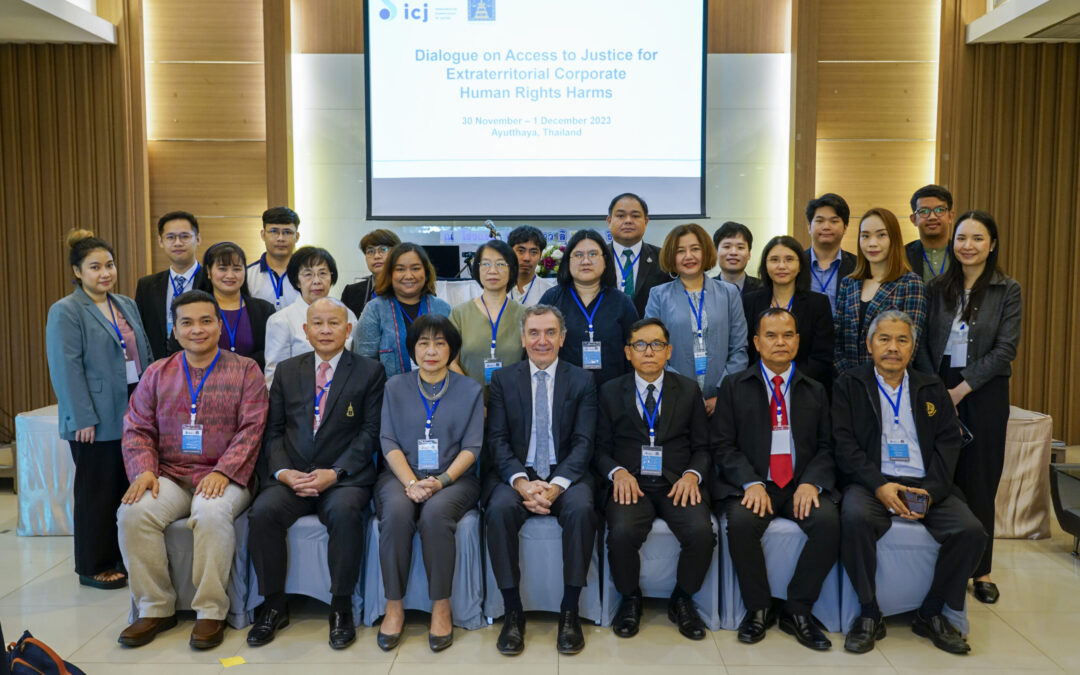
The conclusion drawn at a workshop hosted by the International Commission of Jurists (ICJ) and Thailand’s Ministry of Justice on 30 November and 1 December 2023, in Ayutthaya province, was that Thailand should step up efforts to provide real access to justice for victims of corporate human rights abuses involving Thai companies abroad. This is imperative to make sure that Thailand meets its international legal obligations and fulfills the commitment it made in adopting a National Action Plan on Business and Human Rights Phase 2 (NAP), aimed at regulating the conduct of Thai companies abroad.
The workshop advanced a crucial component of the set of action points outlined in the NAP, engaging nearly 30 members from the justice sector, relevant authorities across various departments, academics, lawyers, and civil society actors.
“This workshop holds particular importance as it contributes to the global initiative aimed at addressing the lack of human rights regulation and the accountability of transnational corporations, a significant gap in human rights protection,” remarked Santiago A. Canton, ICJ’s Secretary-General in an opening statement.
“The state’s obligation to prevent human rights abuses committed by the companies it may influence does not stop at the border. The adoption of the Maastricht Principles in 2011 revealed evidence of State obligations to protect economic, social, and cultural rights beyond its borders, including in the context of corporate conduct, and this obligation binds the judiciary of the State. These principles have subsequently been confirmed by several jurisprudences of the UN treaty bodies,” said Sandra Epal Ratjen, ICJ’s UN Senior International Legal Adviser.
During the workshop, participants discussed existing challenges, covering areas such as corporate veils, conflicts of law, jurisdictional issues, statutes of limitations, and remedies.
“When an abuse occurs, the legal separation of corporate entities often allows parent companies and their representatives to evade responsibility for human rights abuses committed by them, leaving victims with no means to enforce compensation awards,” said Sanhawan Srisod, ICJ’s Legal Adviser.
“Courts in the parent company’s home country may serve as an alternative forum for claims seeking remedy or reparation. However, affected foreign citizens generally encounter greater barriers than Thai citizens in accessing justice due to several reasons, including language barriers, lack of understanding of the Thai legal system, financial constraints, short statutes of limitation, and the unavailability of access to legal aid, local lawyers, and internal corporate documents,” added Srisod.
Proposals from the participants included amending laws to shift the burden of proof, especially when critical facts or documents necessary to resolve a claim reside exclusively within the knowledge of the corporate defendant. This involves considering the potential influence parent companies exert over their subsidiaries in relevant actions. Other recommendations involved extending the statute of limitations for cases involving victims of transnational corporate human rights abuses, acknowledging the existence of corporate veils under Thai law, strengthening the enforcement of foreign judgments against parent companies in Thailand.
Effective measures aimed at ensuring remedies could include requiring businesses to obtain insurance coverage or establishing preventive remedial funds for Thai businesses before embarking on overseas investment. The eligibility criteria of existing funds and grievance mechanisms could be widened within Thailand to explicitly allow affected persons outside the country access to such remedies and mechanisms. There were also suggestions to explicitly broaden the scope of duties of the National Human Rights Commission of Thailand (NHRCT) to investigate and reconcile abuses occurring abroad.
Further recommendations included establishing standards for remedies with a human-centered approach and exploring the implementation of social sanction measures.
Participants considered how best to implement measures through bodies such as the Securities and Exchange Commission (SEC) and the Board of Investment (BOI), whose representatives attended the Workshop. This encompassed proposals for sustainable disclosure of corporate information to both the SEC and BOI. Additionally, there were suggestions to strengthen the BOI’s role or assign a permanent mandate to the NAP Committee for overseeing Thai investments abroad. Participants also explored the idea of incorporating human rights challenges faced in foreign investment as mandatory disclosure points in the SEC’s One-Report, which listed companies are required to submit annually. Furthermore, there were discussions regarding the Stock Exchange of Thailand (SET) assuming a more influential role in regulating transnational corporations.
Background
Thailand’s National Action Plan on Business and Human Rights Phase 2 (2023-2027) outlines various activities within the Action Plan on Cross Border Investment and Multinational Enterprises.
Its Action Point 1.3 designates the Ministry of Justice, supported by the Ministry of Foreign Affairs and the Office of the Attorney General, with the responsibility of conducting a study. This study aims to offer recommendations for amending laws or establishing measures aimed at ensuring access to the justice system and effective civil, criminal, and administrative remedies for communities, both locally and overseas, affected by the operations of Thai companies or state enterprises abroad.
This workshop was the second of its kind. The first meeting was conducted on 10 and 11 September 2022 by the ICJ and Thailand’s Ministry of Justice.
Speakers at the Workshop included:
- Darunee Paisanpanichkul, Deputy Dean, Faculty of Law, Chiang Mai University
- Ruangsak Suwaree, Director-General, Rights and Liberties Protection Department, Ministry of Justice
- Sandra Epal Ratjen, Senior International Legal Adviser and UN Representative, ICJ
- Sanhawan Srisod, Legal Adviser, ICJ
- Santiago A. Canton, Secretary-General, ICJ
- Sayamol Kaiyoorawong, National Human Rights Commissioner of Thailand
- Teerachai Sanjaroenkijthaworn, Co-ordinator, Extra-Territorial Obligation Watch Coalition
Contact
Sanhawan Srisod, ICJ Associate International Legal Adviser, e: sanhawan.srisod@icj.org
Further reading
Thailand: Barriers persist in access to justice for victims of human rights abuses involving Thai transnational corporations abroad – ICJ report

Oct 23, 2023 | News
On 11 and 12 October 2023, the International Commission of Jurists (ICJ), People’s Matrix Association and Seinoli Legal Centre (SLC) jointly held a workshop for magistrates and judges in Maseru, Lesotho’s capital. Drawing on ICJ’s 8 March Principles for a Human Rights-Based Approach to Criminal Law Proscribing Conduct Associated with Sex, Reproduction, Drug Use, HIV, Homelessness and Poverty, the workshop was aimed at enhancing the Lesotho judiciary’s ability to apply a human rights-based approach in the application and enforcement of domestic criminal law.
The central theme explored by participants throughout the workshop was the profoundly negative human rights impact of unjustified criminalization, especially for marginalized individuals and communities. At the workshop, the Acting Chief Justice of Lesotho, Tšeliso Monapathi, emphasized the importance of the judiciary as the last line of defence for ensuring the protection of human rights.
Participants at the workshop noted some positive legal developments in Lesotho that are consistent with international human rights law, including the repeal of vagrancy laws through the introduction of the 2010 Penal Code. Most recently, in October 2022, the High Court of Lesotho, sitting as a Constitutional Court, declared section 32(a)(vii) of the 2003 Sexual Offences Act unconstitutional. The Court ruled that the provision, which imposes the death penalty on HIV-infected persons who commit sexual offences, was unconstitutional to the extent that it violated the rights to equality before the law and equal protection of the law, freedom from discrimination, and freedom from inhuman treatment as guaranteed by the Lesotho Constitution. However, in June this year, in their joint submission to the UN Human Rights Committee, the ICJ, People’s Matrix and Seinoli Legal Centre noted with concern that the Sexual Offences Act left the common law offence of “sodomy” intact.
“Despite some progressive milestones in the protection and promotion of fundamental human rights and freedoms of all persons, it is deeply concerning that there remain a number of criminal laws that disproportionately impact sex workers, LGBTQI+ persons, those seeking sexual and reproductive health care services, such as abortion care, and other marginalized groups,” said Mosa Lestie, Programme Lawyer at Seinoli Legal Centre.
The participants, the majority of whom were magistrates, discussed measures the courts have employed to promote and protect the human rights of marginalized groups. This includes sensitization on the human rights of persons with disabilities, LGBTQI+ persons and other marginalized groups, particularly their right to access to justice and the implementation and continual development of court rules to ensure that all persons can participate in court proceedings on an equal basis as complainants, witnesses, accused persons or experts. For instance, in July 2023, the Lesotho National Federation hosted a training workshop with some magistrates and prosecutors on access to justice for persons with disabilities and the 2023 Disability Equity (Procedure) Rules.
Despite these efforts, participants expressed concern that limitations continue to exist in relation to: the provision of accommodations for accused and witnesses at court; worrying trends of discrimination within the wider criminal justice system, especially among the police. They also identified the need for ongoing human rights training for magistrates and other actors in the criminal justice system.
“The unjustified or arbitrary over-criminalization of conduct associated with LGBTQI+ individuals in Lesotho continues to result in discrimination and stigmatization. In turn, this has significantly impeded access to justice for the communities the People’s Matrix supports,” said Giselle Ratalane, Programme Manager at the People’s Matrix Association.
“As the ICJ’s 8 March Principles underscore, these criminal laws have discriminatory effects on marginalized groups and violate Lesotho’s obligations under international human rights law, including with respect to the rights to equality, non-discrimination, dignity, privacy, freedom of expression and more,” concluded Mulesa Lumina, ICJ Africa’s Legal and Communications Associate Officer.
Contact
Mulesa Lumina, Legal and Communications Associate Officer (Africa Regional Programme), e: mulesa.lumina@icj.org
Kaajal Ramjathan-Keogh, Director (Africa Regional Programme), e: kaajal.keogh@icj.org
Background
While Lesotho has made some strides in recognizing and safeguarding the human rights of all persons, including through the introduction of various laws and policies, certain conduct continues to be targeted by criminal laws notwithstanding the fact that under general principles of criminal law and international human rights law and standards, such conduct should not be criminalized in the first place.
As a State Party to a number of international human rights instruments, including the International Covenant on Civil and Political Rights (ICCPR), the African Charter on Human and Peoples’ Rights and the Protocol to the African Charter on Human and Peoples’ Rights on the Rights of Women in Africa, Lesotho must ensure that its criminal laws do not directly or indirectly discriminate against anyone on grounds prohibited by international human rights law.
The 8 March Principles for a Human Rights-Based Approach to Criminal Law Proscribing Conduct Associated with Sex, Reproduction, Drug Use, HIV, Homelessness and Poverty, recently published by the ICJ, offer a clear, accessible, and operational legal framework and practical legal guidance for a variety of stakeholders, including judges and magistrates, on the application of criminal law to conduct associated with consensual sexual activities, such as consensual same-sex sexual relations and sex work (Principles 16 and 17); the criminalization of sexual orientation, gender identity and gender expression (Principle 18); drug use (Principle 20); as well as homelessness and poverty (Principle 21). As stated in Principles 7 and 8, criminal law “must be interpreted consistently with international human rights law” and “…may not, on its face or as applied, in substance or in form, directly or indirectly discriminate on any, including multiple and intersecting, grounds prohibited by international human rights law”.

Sep 28, 2023 | News
The ICJ is concerned at Thailand’s continued failure to bring justice to the loved ones of Karen activist Pholachi ‘Billy’ Rakchongcharoen, who was the victim of an apparent enforced disappearance in 2014, and apparent subsequent killing.
The ICJ calls on the responsible authorities to ensure that there is continuous effective investigation to determine definitively the fate of Billy and deliver justice to his family.
Today, Thailand’s Criminal Courts for Corruption and Misconduct Cases acquitted four Kaeng Krachan National Park officials, the last individuals seen with Billy, of murder-related charges, including premeditated murder and concealing the victim’s body. Only one of the accused, Chaiwat Limlikit-aksorn, former chief of Kaeng Krachan National Park, was convicted of charges and sentenced to three years in prison related to “malfeasance in office” for failing to hand Billy over to the responsible authorities after his arrest.
The Court, constituted of a panel of two judges, indicated that it did not believe that Billy had been released as claimed by the accused. Nevertheless, the Court concluded that there was not sufficient evidence to prove that the park officials orchestrated the killing.
“More than nine years of delays, including by inaction by the government until recently, and still no justice, is a blow to the victims. This constitutes yet another marker of Thailand’s consistent failure to hold accountable perpetrators of serious human rights crimes, potentially committed by State authorities,” said Sanhawan Srisod, ICJ Legal Adviser.
Billy was the victim of an apparent enforced disappearance, as he was last seen on 17 April 2014 in the custody of Kaeng Krachan National Park officials. The officials claimed they detained Billy for illegal possession of honey, but that they released him later the same day.
On 12 September 2019, the DSI located bone fragments, along with an oil tank submerged in water, which they identified as likely belonging to Billy. The subsequent DNA test indicated a maternal relation between the fragment and Billy’s mother, suggesting a blood relationship through the maternal line. However, the Court ruled today that there was insufficient evidence to establish that they belong to Billy, as opposed to other relatives who may have passed away during the same period.
This decision was made despite testimony from State forensic experts affirming the validity of the DNA test used in this case, which needed to be considered alongside other supporting facts. This includes testimonies given by the relatives and cultural expert about the absence of known blood relatives who had passed away without knowledge, and the Karen practice of not scattering the remains of the deceased in the river. Such testimony also aligns with the opinions of international forensic experts, specifically the Independent Forensic Expert Group established by the International Rehabilitation Council for Torture Victims, who were consulted by the prosecutors’ lawyers.
Enforced disappearance was recently made a specific crime under Thai law, following the adoption of the long-delayed Act on Prevention and Suppression of Torture and Enforced Disappearance, which came into effect in February this year. Under the Act, and international law, enforced disappearance is a continuous crime, which is not completed until the fate or whereabouts of the victim becomes known. Therefore, to the extent that there is any doubt that the discovered remains belonged to Billy, the crime must be considered to be ongoing and the law is applicable to Billy, even if it was not in force when he first “disappeared.”
Nevertheless, the Prosecution did not attempt to charge the accused with enforced disappearance, and the Court consistently rejected any reference to the crime made by the prosecution during the proceedings. This includes the rejection of expert witnesses proposed by the prosecutor’s lawyers who intended to testify about international law and standards governing enforced disappearance, following the rejections made by the accused.
“It is also unfortunate that the Thai court did not take into consideration the specific nature of the crime of enforced disappearance, often accompanied by very limited circumstantial evidence, which may be the only available means of establishing the crime. Such a crime also normally includes the powerlessness of the victim in the hands of the authorities, the use of state power to destroy direct evidence in an attempt at total impunity or to create the illusion of a perfect crime, all factors that have been taken into consideration in many cases in various jurisdictions worldwide when assessing the possible involvement of the suspects in crimes of this nature,” added Srisod.
During the trial, pursuant to the Act on Establishment of the Criminal Court for Corruption Cases B.E. 2559 (2016), the Court also used the so-called inquisitorial system, which is new to both lawyers and public prosecutors accustomed to the accusatorial style of the usual Thai court system. In this regard, lawyers voiced complaints that the judge on several occasions cut short the follow-up questions that the lawyers had planned to ask, citing that these issues had already been covered during their own examinations and other written submissions.
Background
Chaiwat Limlikit-aksorn was convicted under section 157 of the Criminal Code and section 123 of the Organic Act on Counter Corruption B.E. 2542 (1999).
Thailand has signed but not yet ratified the International Convention for the Protection of All Persons from Enforced Disappearance (ICPPED) and is a State Party to the International Covenant on Civil and Political Rights (ICCPR) and the Convention against Torture and other Cruel, Inhuman or Degrading Treatment or Punishment (CAT). The latter two treaties prohibit conduct making up enforced disappearance, and the crime is recognized as violation of both treaties.
The National Human Rights Commission of Thailand and local Thai Civil Society Organizations continue to receive complaints of alleged human rights violations at the hands of security forces constituting serious criminal conduct, including extraterritorial killings, torture and other ill-treatment, and enforced disappearances.
Between 1980 and August 2023, the UN Working Group on Enforced or Involuntary Disappearances also recorded and transmitted 93 cases of alleged enforced disappearance to Thailand. Currently, 77 of these cases remain unresolved.
Unfortunately, the number of cases in which these allegations have been investigated, let alone perpetrators prosecuted, remains low, as are instances where there has been access to effective remedies and provision of reparations for victims. In several instances, alleged victims of torture and other ill-treatment or the families of those who died as a result of these abuses have received some monetary payments falling short of full reparation, but the perpetrators have not yet been brought to justice.
This case also follows the acquittal of five police officers charged with the robbery and coercion of the “disappeared” human rights lawyer Somchai Neelapaijit in December 2015 due to a lack of evidence.
Further reading
Thailand: Indictment of park officials for killing of “Billy” is a significant step towards justice
Thailand: discovery of “Billy’s” remains should reinvigorate efforts to identify perpetrator(s)
Thailand: special investigation into apparent enforced disappearance of “Billy” welcome, but much more is needed
Thailand: ICJ submits recommendations on draft law on torture and enforced disappearance amendments
Justice for Billy: Time for Thailand to Account for Activist’s Disappearance
Contact
Sanhawan Srisod, Associate International Legal Adviser, ICJ, e: sanhawan.srisod@icj.org