Dec 20, 2017 | Artículos, Noticias
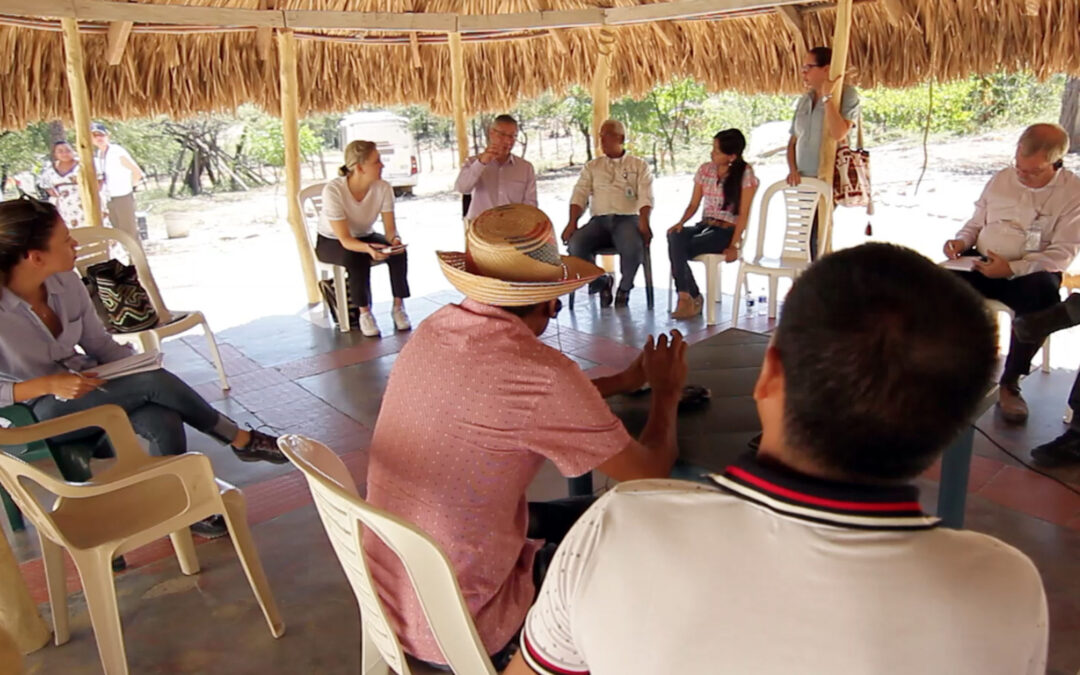
Entre el 9 y el 13 de diciembre, una delegación de la CIJ visitó el departamento de La Guajira para analizar el funcionamiento y eficacia del mecanismo de quejas de la empresa Carbones del Cerrejón LLC (El Cerrejón), propiedad de Glencore plc, Anglo American y BHP Billiton.
La visita se realizó en el marco de la iniciativa de la CIJ sobre la eficacia de mecanismos de reclamación establecidos por empresas para remediar impactos negativos y abusos de derechos humanos.
Los miembros de la delegación eran: Comisionado de la CIJ Marco Sassoli, accompañado con Sr. Carlos Lopez, Asesor Legal Senior de la CIJ, y Sra Laura Knopfel, Investigadora.
El texto de la declaración: Declaracion final
Ver la video:
Dec 18, 2017 | Multimedia items, News, Video clips
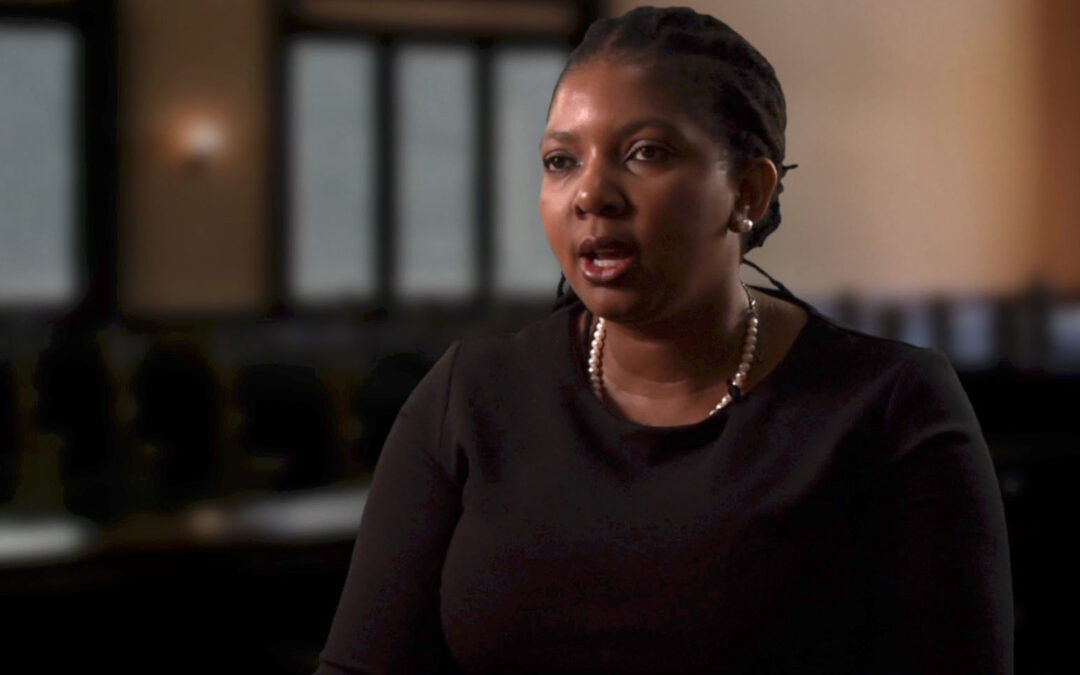
Raquel Yrigoyen Fajardo, Karabo Ozah and Charles Dinda talk about traditional justice systems in video interviews recorded at the 2017 ICJ Geneva Forum.
Dr. Raquel Yrigoyen Fajardo, Lawyer and Professor at the Law Faculty of the Pontifical Catholic University of Peru, and founding member of the International Institute on Law and Society (IIDS), describes the survival and contemporary recognition of justice systems of indigenous peoples in the Americas, despite the history of colonial domination.
She argues that indigenous justice systems often already reflect many international human rights standards, and where there may be discrepancies change should be sought through respectful engagement and consultation rather than coercive imposition.
In contrast, Ms Karabo Ozah, Deputy Director of the Centre for Child Law at the University of Pretoria in South Africa, argues that it is crucially important to ensure that customary and traditional courts respect domestic legislation and international standards on human rights.
Otherwise she warns, based on her experience, customary courts too frequently fail to protect the rights of marginalized groups, children, LGBTI, and women.
Charles Dinda, Senior Legal Adviser with the Danish Institute for Human Rights in Zambia, points out that while traditional and customary justice institutions are the most easily accessible and in many respects most credible institutions for some populations, their decisions are too often inconsistent or unfair.
To avoid this, he insists on the importance of understanding and studying the way these systems operate and on the need to engage with them to learn about their practices and to build their capacities so that they have better knowledge of international human rights standards and indeed of the national laws in the countries where they operate.
Watch the interview with Dr. Raquel Yrigoyen Fajardo
Watch the interview with Karabo Ozah
Watch the interview with Charles Dinda
NOTE:
The views expressed by the participants do not necessarily reflect those of the ICJ.
For more information about the 2017 Geneva Forum on Customary and Traditional Justice Systems, click here or contact matt.pollard(a)icj.org .
Dec 18, 2017 | Multimedia items, News, Video clips
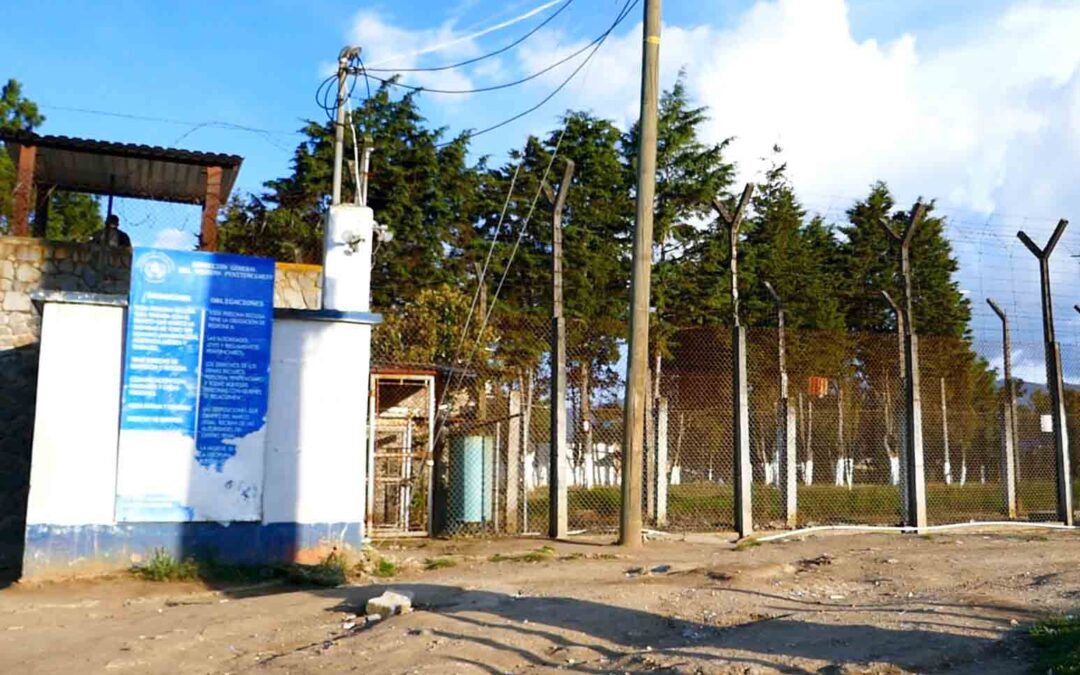
Leaders of indigenous communities in Guatemala, seeking to protect their lands and natural resources from the negative impacts of business operations and infrastructure projects, have been charged with alleged criminal offences and in some instances arbitrarily detained.
This response is designed to silence voices of protest and legitimate demands for free, prior and informed consent for infrastructure or other projects in indigenous communities.
The video includes interviews with Ramón Cadena, ICJ Director for Central America, two indigenous traditional leaders, who have been the victims of arbitrary detention, and a women community leader, explaining the impact of the detention on the family and the whole community.
The criminalization of human rights work is a phenomenon whereby community leaders are charged with different criminal activities because of their opposition to a development model based on extractive industries or the privatization of essential social services.
This development model affects the natural resources (water, land and the environment) on indigenous peoples’ territories.
This is a global phenomenon and is particularly acute in Guatemala.
The exploitation of natural resources, such as open-cast mining and the operations of extractive industries in the territories of indigenous peoples, is one of the main reasons which are behind the crackdown on social protest and human rights work.
The different communities that have been affected seek to defend their territories and oppose the different forms of exploitation of the natural resources found on their territories or in the surrounding areas because it can affect the water supply, the land and the environment.
A number of leaders have been killed because of their opposition to these projects.
Some family members of those killed have in turn taken on the task of opposing these projects and they have also been charged with criminal offences.
In Guatemala, there is also an intense social conflict because of the way in which electricity services are delivered.
As a result of the privatization of the service in 1996, the Guatemalan State has granted concessions to national and international companies to provide electricity services.
Over the years, many users have complained about the poor quality and high cost of the services that these private companies provide.
The National Electricity Commission has failed to respect its legal duty to “ensure that the obligations of the concessionaries and contractors are fulfilled and to protect the rights of users,” which many discontented users have demanded.
The social protests concern the three different phases of electricity production: the generation of electricity, involving the construction of hydroelectric dams by multinational companies that impact on indigenous peoples’ territories, the electricity transmission grids, and the electricity services.
Because of this situation, many electricity users have declared that they are in resistance, citing article 45 of the Guatemalan Constitution that states: “It is legitimate for the people to resist in order to protect and defend the rights and guarantees enshrined in the Constitution.”
Acting on this Constitutional protection has led to human rights attacks on many community leaders, lawyers and human rights defenders.
The ICJ supports access to justice for persons who are victims of these human rights violations.
The ICJ supports lawyers who defend these victims of the criminalization of social protest; it carries our trial observations in significant cases; it promotes dialogue between the communities and the relevant State authorities as well as the local Mayors; and in some cases, it supports submissions before the Constitutional Court.

Dec 18, 2017 | News
The ICJ today called on Myanmar authorities to immediately disclose the whereabouts of two journalists who have been detained incommunicado for nearly one week, and to grant prompt access to lawyers and families.
Reuters reporters Wa Lone and Kyaw Soe Oo have not been heard from since they were arrested by police in Yangon on Tuesday 12 December.
“Fair trial rights violations seriously undermine the rule of law in Myanmar. All detainees must be allowed prompt access to a lawyer and to family members,” said Frederick Rawski, the ICJ’s Asia-Pacific Regional Director.
“Authorities are bound to respect these rights in line with Myanmar law and the State’s international law obligations,” he added.
The right to legal counsel is a bedrock rule of law principle that is set out in a range of international human rights laws and standards, including in article 11 of the Universal Declaration of Human Rights.
Sean Bain, Legal Adviser for the ICJ, said that jurists should assess if the journalists’ detention conforms to applicable laws.
“Their situation appears to constitute arbitrary detention,” he said. “The judiciary should immediately review the lawfulness of detention and demand their release if it is indeed unlawful.”
“Judges and lawyers in Myanmar have an opportunity to assert their independence by challenging the unlawful actions of officials. Such blatant violations of fair trial rights should not go unanswered,” he added.
State media reports the journalists were charged under the 1923 Official Secrets Act in connection with their work investigating actions of security forces in Rakhine State.
More than 650,000 people, mostly Rohingya Muslims, fled to Bangladesh as a result of military operations following attacks on police posts in August by the Arakan Rohingya Salvation Army.
Reuters has reported from both sides of the Myanmar-Bangladesh Border.
“The treatment of these reporters threatens freedom of expression. The harsh penalties they face sends a clear message to other journalists that they could face the same consequences for doing their job,” said Rawski.
In Myanmar, colonial-era laws were invoked to bring criminal charges against journalists in at least three jurisdictions in 2017.
Offences in these laws are often broadly defined, carry harsh penalties, and are open to abuse by authorities.
Journalists who received ten-year jail terms in 2014 under the Official Secrets Act were later released in a Presidential amnesty.
Amendments proposed at the time in parliament were rejected.
“The abuse of archaic laws like the Official Secrets Act must end. It is within the power of the National League for Democracy-dominated legislature to review these laws with a view to aligning them with the rights reflected in Myanmar’s constitution and in international law,” Rawski added.
Contact
Frederick Rawski, ICJ Asia Pacific Regional Director, t: +66 6 4478 1121 ; e: frederick.rawski(a)icj.org
Sean Bain, ICJ International Legal Adviser, e: sean.bain(a)icj.org
Background
The UN Basic Principles on the Role of Lawyers emphasize that, “Governments shall further ensure that all persons arrested or detained, with or without criminal charge, shall have prompt access to a lawyer, and in any case not later than 48 hours from the time of arrest or detention.”
Sections 19 and 375 of the Myanmar Constitution also guarantee the right of legal defense, as does Myanmar’s Code of Criminal Procedure (section 340), Courts Manual (section 455(1)), the Police Manual (section 1198c) and the Prisons Act (section 40).
Sections 21(c) and 376 of the Constitution and section 61 of the Code of Criminal Procedure state that persons cannot be detained for more than 24 hours without a judge’s order.
The right to legal defense implies the right to access legal counsel during this 24-hour period.
Under section 403 of the Courts Manual, a detainee can be remanded only once he or she has appeared before a judge. It is unknown if the two Reuters journalists have appeared in court.
Competent judges are empowered to compel a search for a detainee if they have reason to believe the person is confined unlawfully, as per section 100 of the Criminal Procedure Code.
Lawyers and family members may also request the courts to review the lawfulness of detention, by submitting a habeas corpus petition to the High Court and or to the Supreme Court.
The Tshwane Principles on National Security and the Right to Information, which address the right to access and to share information, as an aspect of freedom of expression in the context of national security, affirm that journalists “should not be prosecuted for receiving, possessing or disclosing classified information to the public, or for conspiracy or other crimes based on their seeking or accessing classified information.”
Read also
Handbook on Habeas Corpus in Myanmar
Right to Counsel: The Independence of Lawyers in Myanmar
Myanmar-Reuters Journos-News-Press releases-2017-BUR (Story in Burmese, PDF)
Dec 15, 2017
On the fifth anniversary of the enforced disappearance of the Lao civil society leader, the ICJ and 121 other organizations, express outrage at the government’s failure to investigate Sombath Somphone’s disappearance and return him to his family.
To read the letter:
Lao PDR-Sombath 5 years-Advocacy-open letter-2017-ENG (English version, in PDF)
Lao PDR-Sombath 5 years-Advocacy-open letter-2017-LAO (Lao version, in PDF)