May 6, 2017 | News
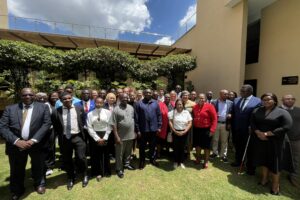
The programme, launched today in Niamey, Niger, aims to enhance the capacity of civil society organizations to use AU mechanisms for human rights protection and promotion.
The three-year Africa-wide project on Consolidating Civil Society’s Role in the Transition from African Human Rights Standards to Practice is run by the ICJ, together with the African Centre for Democracy and Human Rights Studies (ACDHRS), the Norwegian Refugee Council (NRC) and the ICJ-Kenya Section.
The programme increases awareness of people in Africa about the AU human rights mechanisms for human rights implementation and compliance. It is directed at both national and community levels.
A further objective of the project is to strengthen national and regional responses to displaced persons and other groups at risk, including women and children.
The project will also provide an opportunity to human rights defenders, CSOs and journalists, who ordinarily have no means to access and attend the African Commission on Human and Peoples’ Rights, to do so in order to increase their involvement in the AU human rights system and will provide advocacy and litigation support to them.
Arnold Tsunga, Director of the ICJ Africa Regional Programme, noted that the African Union (AU) has developed an impressive body human rights law and standards.
He observed, however, that “one of the missing links is that of implementation and that unless human rights are effectively implemented, they may just remain standards on paper.”
The launch took place in the plenary of the NGO Forum preceding the 60th Ordinary Session of the African Commission on Human and Peoples’ Rights (ACHPR).
Participants in the Forum strongly welcomed the opportunities that the project will create and many indicated that they would take advantage of the opportunity to broaden participation in the African human rights mechanisms.
The programme is supported by the European Union, which was represented at the launch by Mr. Basile Sallustio, Attaché to the Délégation in Niger.
May 5, 2017 | Advocacy, News, Publications
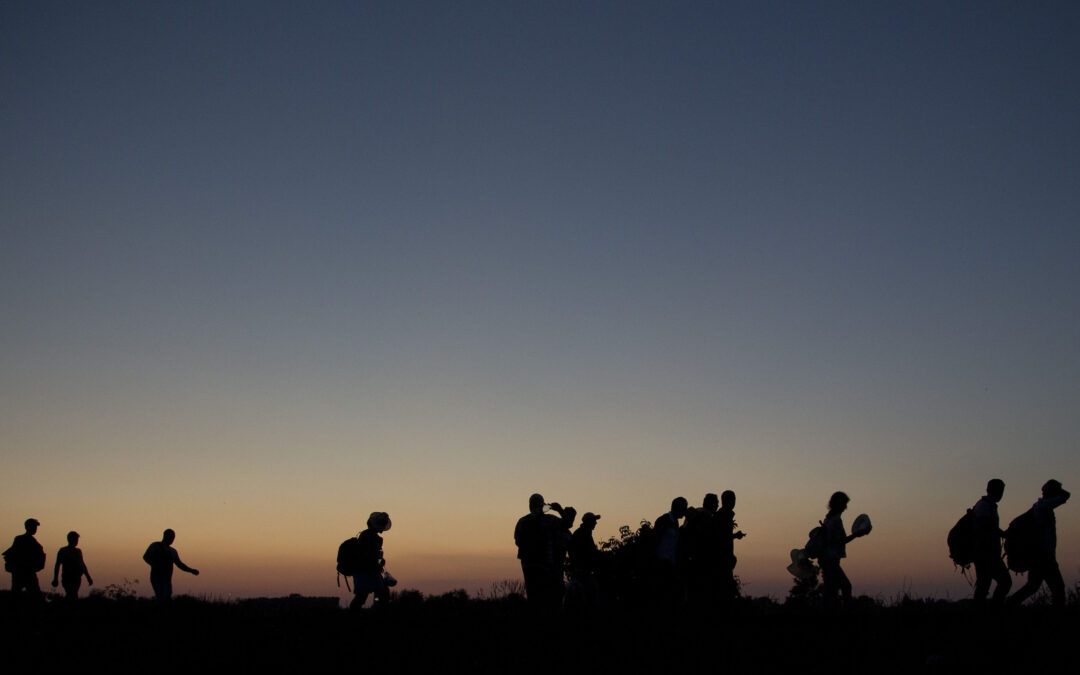
The ICJ has published a set of Principles on the Role of Judges and Lawyers in relation to Refugees and Migrants.
The Principles were developed by the ICJ on the basis of consultations with senior judges, lawyers, and legal scholars working in the field of international refugee and migration law (including at the 2016 Geneva Forum of Judges & Lawyers), as well consultations with States and other stakeholders on a draft version during the March 2017 Human Rights Council session, and other feedback.
The Principles seek to help judges and lawyers, as well as legislators and other government officials, better secure human rights and the rule of law in the context of large movements of refugees and migrants. They are intended to complement existing relevant legal and other international instruments, including the New York Declaration, as well as the Principles and practical guidance on the protection of the human rights of migrants in vulnerable situations within large and/or mixed movements being developed by the OHCHR.
The Principles address the role of judges and lawyers in relation to, among other aspects:
- determinations of entitlement to international protection;
- deprivation of liberty;
- removals;
- effective remedy and access to justice;
- independence, impartiality, and equality before the law;
- conflicts between national and international law.
The Principles, together with commentary, can be downloaded in PDF format by clicking here: ICJ Refugee Migrant Principles 2017.
They are also available in Spanish, French and Arabic.
The ICJ formally launched the published version of the Principles at a side event to the June 2017 session of the Human Rights Council (click here for details), where their importance and utility were recognised by the UN Special Rapporteur on the human rights of migrants, as well as representatives of UNHCR and the OHCHR.
The ICJ had earlier released the final text in connection with the Thematic Session on “Human rights of all migrants” for the UN General Assembly Preparatory Process for the Global Compact for Safe, Orderly and Regular Migration to be held in Geneva 8-9 May 2017, where in an oral statement the ICJ was able to highlight the potential utility of the Principles in the development of the Compact.
The ICJ further promoted consideration of the Principle, in an oral statement to the Human Rights Council.
More information about the process of development of the Principles, including the list of participants to the 2016 Geneva Forum, is available here.
The consultations, preparation and publication of the Principles was made possible with the financial support of the Genève Internationale office of the Republic and Canton of Geneva, for which the ICJ is grateful.
For further information, please contact ICJ Senior Legal Adviser Matt Pollard, matt.pollard(a)icj.org
May 5, 2017 | Nouvelles, Plaidoyer
La CIJ a publié une série de principes sur le rôle des magistrats et des avocats en relation avec les réfugiés et les migrants.
Ces Principes ont été élaborés par la CIJ, à la suite de consultations, dont le Forum de Genève 2016 des magistrats et avocats et la session du Conseil des droits de l’Homme de l’ONU en mars 2017, et sur la base des études mondiales, de l’expérience et des compétences de la CIJ.
Bien que la CIJ entende traduire, à travers les Principes, le soutien le plus large possible des personnes consultées, ces Principes ne reflètent pas nécessairement le point de vue de tous les participants à la consultation.
Ils traitent essentiellement du rôle des magistrats et des avocats, y compris des procureurs. Toutefois, la CIJ exhorte les législateurs, les représentants de l’exécutif et toutes les autres personnes exerçant d’autorité publique de jure ou de facto (en tant que fonctionnaire, par mandat de l’État ou par contrat), à mettre en œuvre, à maintenir et à respecter le rôle des magistrats et des avocats dans la protection des droits des réfugiés et des migrants, notamment ceux énoncés ci-après.
Les Principes devraient être renforcés par un cadre juridique, des politiques et des pratiques plus larges qui garantissent et appliquent les droits de l’Homme et l’état de droit au sein des États ainsi qu’à l’échelle régionale et nationale.
Dans ces principes, l’expression « réfugiés et migrants » doit être interprétée au sens large et prise dans son ensemble. Elle inclut, sans s’y limiter, les demandeurs d’asile, les apatrides, les victimes de trafics d’êtres humains, les enfants non accompagnés ou séparés ainsi que toute autre personne en situation de migration.
Elle s’applique même si l’arrivée, la présence ou la résidence d’une personne est considérée comme irrégulière par le droit national.
Les Principes visent à compléter et orienter l’application d’instruments internationaux existants relatifs à la protection des réfugiés et des migrants, y compris et sans limitation :
- la Déclaration universelle des droits de l’Homme,
- la Convention relative au statut des réfugiés et son protocole,
- le Pacte international relatif aux droits civils et politiques et le Pacte international relatif aux droits économiques, sociaux et culturels,
- la Convention internationale sur la protection des droits de tous les travailleurs migrants et des membres de leur famille,
- la Déclaration de New York pour les réfugiés et les migrants ainsi que l’ensemble des traités et des normes régionales en la matière.
Les Principes traitent du rôle des juges et des avocats en lien avec les aspects suivants, parmi d’autres:
- Détermination du droit en protection internationale;
- Privation de liberté
- Expulsions
- Recours effectifs et accès à la justice
- Indépendance, impartialité et égalité devant la loi;
- Conflits entre droit national et international;
Les Principes, avec commentaires, peuvent être téléchargés en français et au format PDF: Principes sur le rôle des magistrats et avocats en relation avec les réfugiés et les migrants
May 4, 2017 | News
Thailand should immediately end the practice of arbitrarily detaining persons in unofficial places of detention said the ICJ today.
The statement came after it was revealed that human rights lawyer, Prawet Prapanukul, who had been arbitrarily detained for five days at a detention facility inside a military base in Bangkok, finally appeared and was charged at the Bangkok Criminal Court on 3 May 2017.
During the morning of 29 April 2017, military officers invoked Head of National Council for Peace and Order (NCPO) Order 3/2015 to arrest Prawet Prapanukul and search his residence in Bangkok, seizing a number of items located at the property including computers, phones and hard-drives.
The whereabouts of Prawet Prapanukul were unknown until the afternoon of 3 May 2017, when Prawet Prapanukul contacted several lawyers including Thai Lawyers for Human Rights (TLHR) and said he had been held at the Nakhon Chaisri temporary remand facility inside the 11th Army Circle military base in Bangkok.
“Prawet Prapanukul’s five-day incommunicado detention without being brought before the courts or access to legal counsel amounts to an arbitrary detention in violation of his rights under international law and consequently he should be provided with appropriate reparation,” said Kingsley Abbott, the ICJ’s Senior International Legal Adviser for Southeast Asia.
“To ensure the protection of all persons while in detention, Thailand has a duty to detain people in officially recognized places of detention, to have their names and places of detention made available to interested persons and to bring them before a court without delay within 48-hours,” he added.
According to TLHR, on 3 May 2017, Prawet Prapanukul was charged with ten counts of the highly restrictive crime of lese majeste (article 112 of the Criminal Code), three counts of a sedition-like offence (article 116 of the Criminal Code), and violation of article 14(3) of the Computer Crime Act.
The ICJ has previously raised concerns about abusive recourse to these laws.
Pursuant to article 91(3) of the Thai Criminal Code, it is possible that, if convicted of these charges, Prawet Prapanukul could receive a maximum sentence of 50-years imprisonment.
“Freedom of expression, as protected under international law, must never be criminalized. In any event, imprisonment is never a proportionate penalty for the exercise of free expression, let alone the unthinkable possibility of 50-years, which would set a new recorded record for a sentence for lese majeste,” Abbott said.
On 25 April 2017, after reviewing Thailand’s compliance with its obligations under the International Covenant on Civil and Political Rights (ICCPR), to which Thailand is a State Party, the Human Rights Committee, the international expert body charged with supervising the implementation of the ICCPR, issued its Concluding Observations in which it noted that in Thailand “individuals were reportedly often detained without charge and held incommunicado at undisclosed places of detention for periods of up to seven days, with no judicial oversight or safeguards against ill-treatment and without access to a lawyer.” The Human Rights Committee observed that Thailand should immediately release all victims of arbitrary detention and provide them with full reparation.
“The fact that Thailand arbitrarily detained Prawet Prapanukul at a military facility just five days after the Human Rights Committee issued its Concluding Observations criticizing Thailand’s practice of detaining people incommunicado in undisclosed placed of detention demonstrates a worrying contempt for its international human rights obligations as pointed out by the Committee,” Abbott added.
Contact
Kingsley Abbott, ICJ Senior International Legal Adviser for Southeast Asia, t: +66 94 470 1345 ; e: kingsley.abbott(a)icj.org
Thailand-Prapanukul-detention-News-2017-ENG (full text with background, in PDF)
Thailand-Prapanukul-detention-News-2017-THA (Thai version, in PDF)
May 3, 2017 | Advocacy
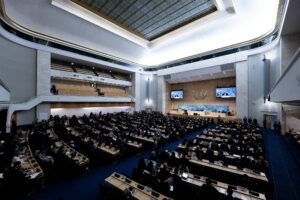
ICJ’s Senior Legal Adviser Carlos Lopez made an important speech today at a Joint Hearing of the European Parliament’s Committee on International Trade and Subcommittee on Human Rights.
The declaration was about the United Nations intergovernmental process towards a treaty in the field of business & human rights.
This treaty could be a crucial instrument for the EU, European countries and European businesses to promote common global rules of respect for human rights that are stronger and enforceable vis a vis companies from all regions.
This will help level the playing field for the companies that have a genuine interest in human rights protection by creating a common standard.
For Governments, it is an important instrument to advance the objective of a level playing field for businesses in the global marketplace.
This is not only important and a condition of success for European businesses who currently have to compete with businesses that do not have to observe the same rules in other parts of the world, but is also a condition for the sustainability of economic globalization and its potential to deliver for the human rights for all.
Download Carlos Lopez’s speech below:
Europe-ICJ speech at the european parliament-ADVOCACY-2017-ENG (in PDF)