Mar 4, 2015 | News
The ICJ today calls for the immediate suspension of the execution of 10 individuals in Indonesia who have been convicted of drug-related offences and are scheduled to be executed by firing squad this month.
“We call on President Jokowi Widodo to reconsider his decision to deny the petitions for clemency submitted to him by these individuals,” said Sam Zarifi, ICJ’s Regional Director for Asia and the Pacific. “This recent rash of executions of drug offenders violates international law and, based on experience around the globe, will not even address the real problems of drug-related crime in Indonesia.”
“The execution of these individuals would violate Indonesia’s obligations as a party to the International Covenant on Civil and Political Rights, and goes against the global trend towards the abolition of the death penalty,” Zarifi added.
According to a report by the UN Secretary General to the General Assembly in 2012, 150 of the 193 UN Member States have either abolished the death penalty or introduced a moratorium on it.
More recently, the UN General Assembly adopted a resolution calling for an international moratorium on the use of the death penalty.
The resolution, which was passed last December 2014, was supported by 117 member states.
This is a notable increase since the resolution was first adopted in 2007, when only 104 member states voted “yes”.
Earlier this year, six persons convicted of drug trafficking offences were executed by firing squad.
These executions, like those planned for the 10 later this month fly directly in the face of the findings and recommendations of the UN Human Rights Committee.
Following its review of Indonesia’s implementation of its obligations under the ICCPR in 2013, the Human Rights Committee recommended that the Government of Indonesia commute all death sentences imposed on persons convicted of drug offences, amend its laws to ensure that drug offences are not punishable by the death penalty, and to reinstate the moratorium on executions.
The ICJ also notes that the current spate of planned executions in Indonesia is inconsistent with the actions of the Government of preventing the executions of its nationals convicted of committing crimes abroad.
For example, in April last year, the Government of Indonesia paid US$2.1 million as so called ‘blood money’ to stop the execution of an Indonesian woman who had been working as a domestic helper in Saudi Arabia and was convicted of killing her elderly employer.
In addition to calling for the suspension of the planned executions, the ICJ calls on the Government of Indonesia to immediately re-establish a moratorium on the death penalty implemented from 2008 until 2013, when it resumed executions, and to take the steps necessary to abolish the death penalty.
The ICJ opposes death penalty for all crimes and considers its imposition a violation of the right to life and the right not to be subjected to cruel and inhuman treatment or punishment.
The 10 individuals scheduled to be executed are: Mary Jane Fiesta Veloso (Philippines); Myuran Sukumaran, aka Mark, (Australia); Serge Areski Atlaoui (France); Martin Anderson, aka Belo, (Ghana); Zainal Abidin (Indonesia); Raheem Agbaje Salami (Spain); Rodrigo Gularte (Brazil); Andrew Chan (Australia); Silvester Obiekwe Nwolise and Okwudili Oyatanze (both from Nigeria).
Contact:
Sam Zarifi, ICJ Regional Director for Asia and the Pacific, e sam.zarifi(a)icj.org or m +668 07819002
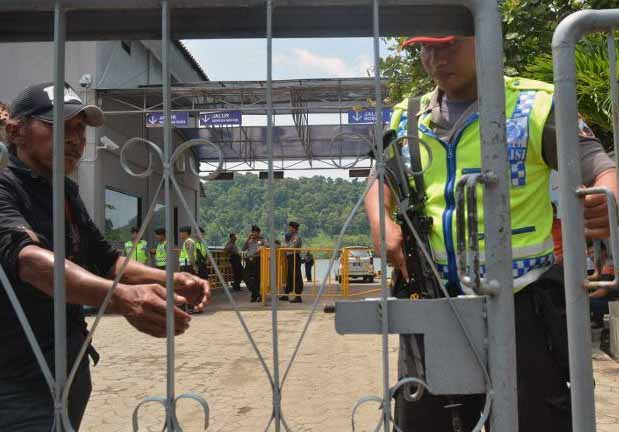
(Photo: Indonesian police at execution site).

Mar 4, 2015
The ICJ transmitted today a letter to the Chairman of the Committee on Human Rights of the House of Representatives of the Philippines responding to the position taken by the Philippines’ Department of Justice (DOJ) on House Bill No. 2401.
The ICJ, in its letter, emphasizes that House Bill No. 2401 (H.B. No. 2401) entitled “AN ACT ESTABLISHING A NATIONAL PREVENTIVE MECHANISM AGAINST TORTURE IN THE PHILIPPINES” should be a matter of priority to the Congress of the Philippines.
It adds that a law creating a national preventive mechanism (NPM) should be adopted without further delay for the Philippines to comply with its obligations under the Optional Protocol to the Convention against Torture and other Cruel Inhuman or Degrading Treatment or Punishment (OPCAT).
The Philippines acceded to the OPCAT in 2012.
In its position paper, the DOJ proposes that the NPM be merged with the Commission on Human Rights of the Philippines (CHRP), the country’s national human rights institution.
The ICJ, however, responds that the Subcommittee on the Prevention of Torture and Other Cruel, Inhuman or Degrading Treatment or Punishment (SPT), has always advocated a clean separation of powers, even where the NPM may fall within the same administrative structure or authority as the generalized NHRI.
The SPT is the international body mandated under the OPCAT to advise and assist States Parties in the establishment of NPMs.
Wilder Tayler, ICJ’s Secretary General, stated in the letter that by keeping a clear separation between the NPM and the CHRP, “the integrity and effectiveness of both the NPM and the CHRP is enhanced.”
Each body is insulated from conflict with the other.
Finally, the ICJ noted that H.B. No. 2401 has already achieved this clear separation and it would be a regression to propose that the NPM be merged with the CHRP.
Philippines-Letter to Congress-Advocacy-Open letter-2015-ENG (full text in PDF)
Mar 4, 2015 | Events
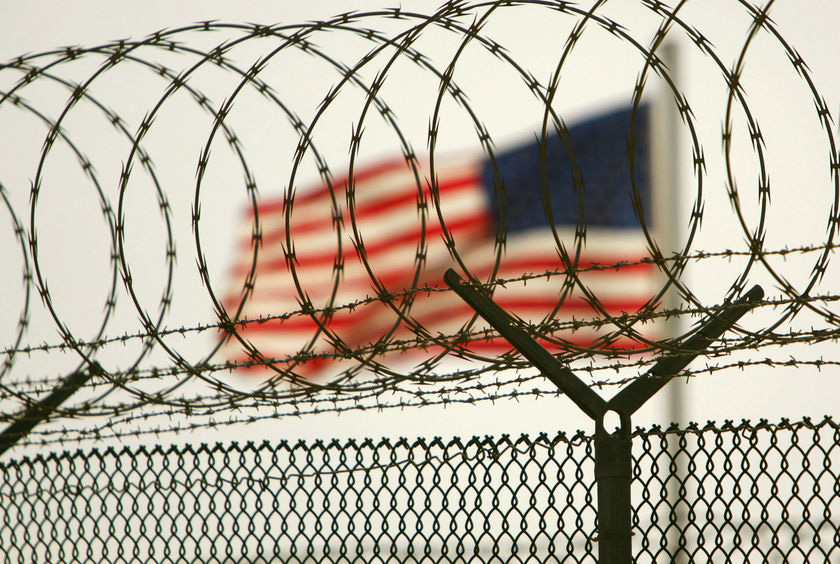
A panel discussion on Guantánamo and accountability for torture, featuring UN Special Rapporteur on Torture Juan E. Méndez and other experts, will take place in Geneva on 9 March 2015 in connection with the UN Human Rights Council session.The panel features:
- Juan E. Méndez, UN Special Rapporteur on Torture
- Jamil Dakwar, Director, Human Rights Program, American Civil Liberties Union
- Peter Jan Honigsbert, U of San Francisco Law School, Founder & Director of Witness to Guantánamo
- Julia Hall, Expert on Counter-Terrorism and Human Rights, Amnesty International
moderator: Connie de la Vega, University of San Francisco Law School & Human Rights Advocates.
The ICJ joins the ACLU, Amnesty International, Human Rights Advocates, Conectas, Human Rights Watch, CELS, and OMCT in supporting this event.
The event takes place 9 march 2015, at 15:00-17:00, Room XXIII, Palais des Nations, in Geneva.
The event flyer may be downloaded in PDF format here: SideEventTorture
Mar 3, 2015 | Advocacy
In advance of the Brussels Conference on implementation of the European Convention on Human Rights, our shared responsibility, the ICJ and nine other NGOs issued a statement on the Conference’s draft Declaration.
The statement welcomes a number of aspects of the draft Declaration, which addresses the need for more effective implementation of the Convention and the full, rapid execution of European Court of Human Rights judgments.
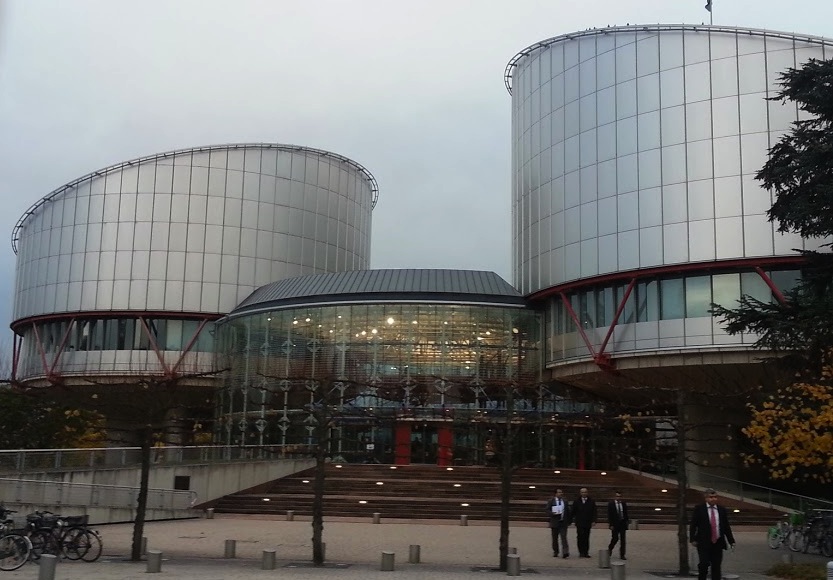
It raises concerns at several elements of the draft Declaration, including recommendations to the Court which could undermine its independence, and the lack of recognition of the role of civil society in the effective execution of judgments of the European Court of Human Rights (photo).
Europe-NGO Statement on Brussels Draft Declaration-Advocay-2015-ENG (full text in PDF)

Mar 3, 2015 | Advocacy
Thirteen human rights organizations, including the ICJ, call on the United Arabe Emirates government to release the activists jailed following the UAE 94 trial.
On the second anniversary of the start of the mass “UAE 94” trial that imprisoned dozens of government critics and reform activists in the United Arab Emirates (UAE), including prominent human rights defenders, judges, academics, and student leaders, a coalition of 13 organizations calls on the UAE government to release immediately and unconditionally all those imprisoned solely for peacefully exercising their rights to freedom of expression and association following this grossly unfair trial, as well as those who remain detained or imprisoned for publicizing concerns about it.
The organizations also call on the authorities to ensure that the allegations of torture and other ill-treatment that the individuals were subjected to prior to and following their trial are promptly, independently, impartially and thoroughly investigated, that those responsible are held to account, and that the victims have access to effective remedies and to reparation.
The organizations share the serious concerns raised since 2011 by several UN human rights bodies and human rights organizations regarding the UAE government’s continuing pattern of harassment, secret, arbitrary and prolonged incommunicado detention, torture and other ill-treatment, enforced disappearances, and unfair trials targeting activists and those critical of the authorities, as well as its increasing use of national security as a pretext to clamp down on peaceful activism and to stifle calls for reform.
The space for dissent in the UAE is increasingly shrinking. The repression has been entrenched with the enactment in 2012 of the cybercrimes law, which the government has used to silence social media activists and others who support and defend freedom of expression online, and the enactment of the 2014 counter-terror law.
The vague and overly broad definition of terrorism in the 2014 law, which treats a wide range of activities, including those protected by human rights standards, as amounting to terrorism, may be used to sentence human rights defenders or critics of the government to lengthy prison terms or even death.
The organizations call on the UAE government, which currently is a member of the UN Human Rights Council, to adhere to its obligations to uphold human rights at home, including respecting the rights to freedom of opinion and expression, and to freedom of association and peaceful assembly.
The full statement can be found here in English and Arabic:
United Arab Emirates-Release activists convicted at the UAE94 trial-Advocacy-2015-ENG (full text in PDF)
United Arab Emirates -Release activists convicted at the UAE94 trial-Advocacy-2015-ARA (full text in PDF)
Read also:
UAE: Fear that Anti-Terrorism Law will be used to curtail human rights and target human rights defenders, Gulf Centre for Human Rights, Front Line Defenders, Cairo Institute for Human Rights Studies, Arabic Network for Human Rights Information, 13 December 2014,
Mass convictions following an unfair trial: The UAE 94 case, an ICJ report, October 2013,
United Arab Emirates: ICJ condemns blatant disregard of the right to a fair and public trial, ICJ, 12 March 2013




