Oct 3, 2018
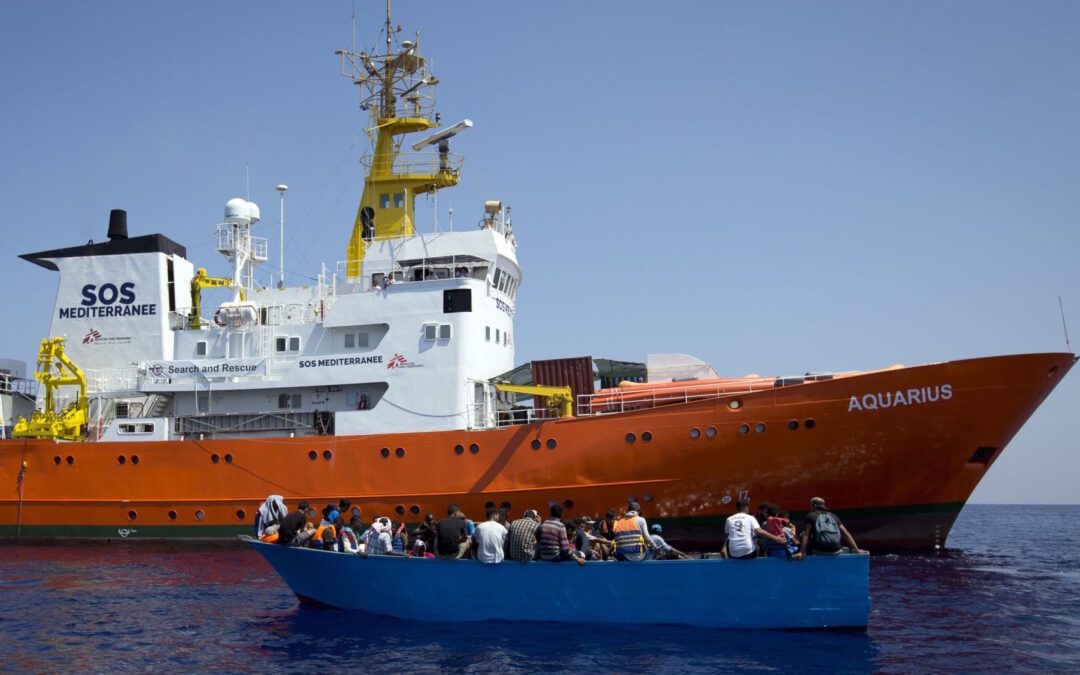
European leaders should act quickly to help the Aquarius, the last nongovernmental search and rescue ship operating in the Mediterranean, register after its flag was withdrawn by Panamanian authorities, five international rights organizations said today in an open letter.
The letter was sent to European leaders on the fifth anniversary of the Lampedusa shipwreck, in which at least 368 people died, urging them to offer the Aquarius a flag.
“The Aquarius has saved tens of thousands of lives at sea, filling a gap left by states,” said Judith Sunderland, acting Europe and Central Asia deputy director at Human Rights Watch, on behalf of the organizations. “What better homage to those who died off Lampedusa five years ago than to ensure that the Aquarius—a symbol of solidarity and respect for human life and dignity—can continue its life-saving work.”
The letter was signed by Amnesty International, Human Rights Watch, European Council on Refugees and Exiles (ECRE), International Commission of Jurists (ICJ), and the International Federation for Human Rights (FIDH).
SOS MEDITERRANEE and MSF initiated a petition here.
For more information and to arrange an interview, please contact:
Róisín Pillay, ICJ Europe Programme Director: + 32 2 734 84 46; or roisin.pillay(a)icj.org
The full letter is available here: Europe-Aquarius Letter-Advocacy-Open Letter-2018-ENG
Oct 3, 2018 | Communiqués de presse, Nouvelles, Plaidoyer
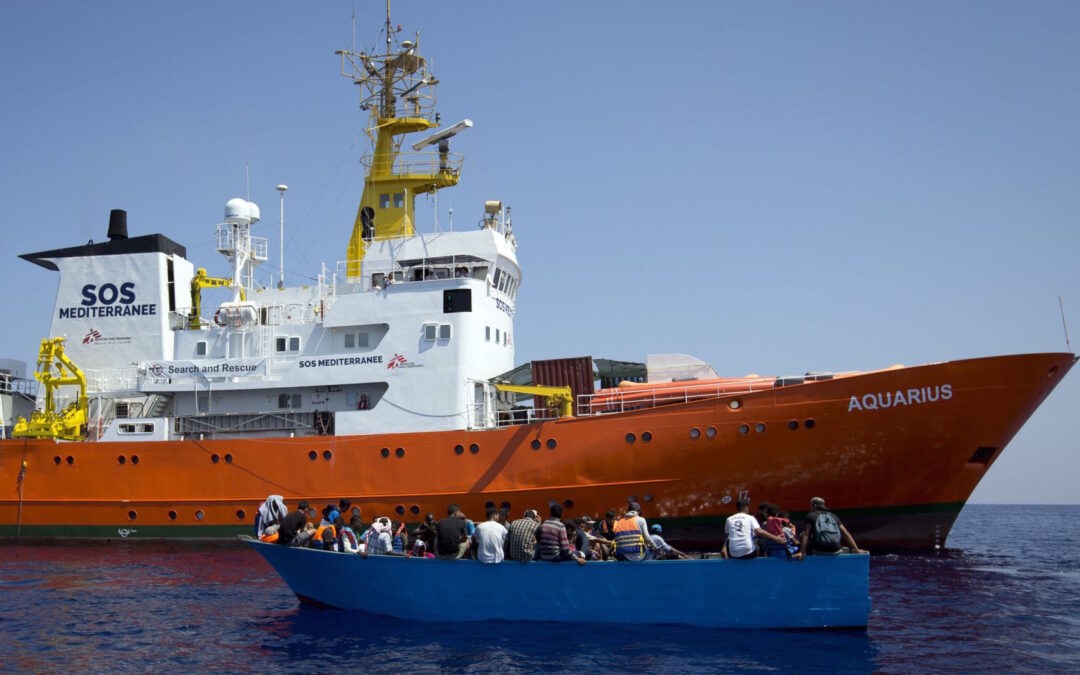
Les dirigeants européens doivent agir rapidement pour aider l’Aquarius, dernier navire de recherche et de sauvetage non-gouvernemental opérant en Méditerranée, à s’immatriculer après le retrait de son pavillon par les autorités panaméennes, ont annoncé aujourd’hui cinq organisations internationales des droits de l’Homme dans une lettre ouverte (uniquement disponible en anglais).
La lettre a été envoyée aux dirigeants européens à l’occasion du cinquième anniversaire du naufrage de Lampedusa, qui a fait au moins 368 morts, les exhortant à offrir un pavillon à l’Aquarius.
«l’Aquarius a sauvé des dizaines de milliers de vies en mer, comblant ainsi le vide laissé par les États», a déclaré Judith Sunderland, directrice adjointe par intérim de Human Rights Watch pour l’Europe et l’Asie centrale, au nom des organisations. «Quel meilleur hommage à ceux qui sont morts au large de Lampedusa il y a cinq ans que de veiller à ce que l’Aquarius, symbole de solidarité et de respect de la vie et de la dignité humaines, puisse continuer à sauver des vies».
La lettre a été signée par Amnesty International, Human Rights Watch, le Conseil européen sur les réfugiés et les exilés (ECRE), la Commission internationale de juristes (CIJ) et la Fédération internationale des droits de l’Homme (FIDH).
SOS MEDITERRANEE et MSF ont lancé une pétition ici (uniquement disponible en anglais).
Pour plus d’informations et pour organiser une interview, veuillez contacter:
Róisín Pillay, Directeur de programme auprès de la CIJ Europe: + 32 2 734 84 46; ou roisin.pillay@icj.org
La lettre complète est disponible ici: Europe-Aquarius Letter-Advocacy-Open Letter-2018-EN (uniquement disponible en anglais)
Oct 3, 2018 | News
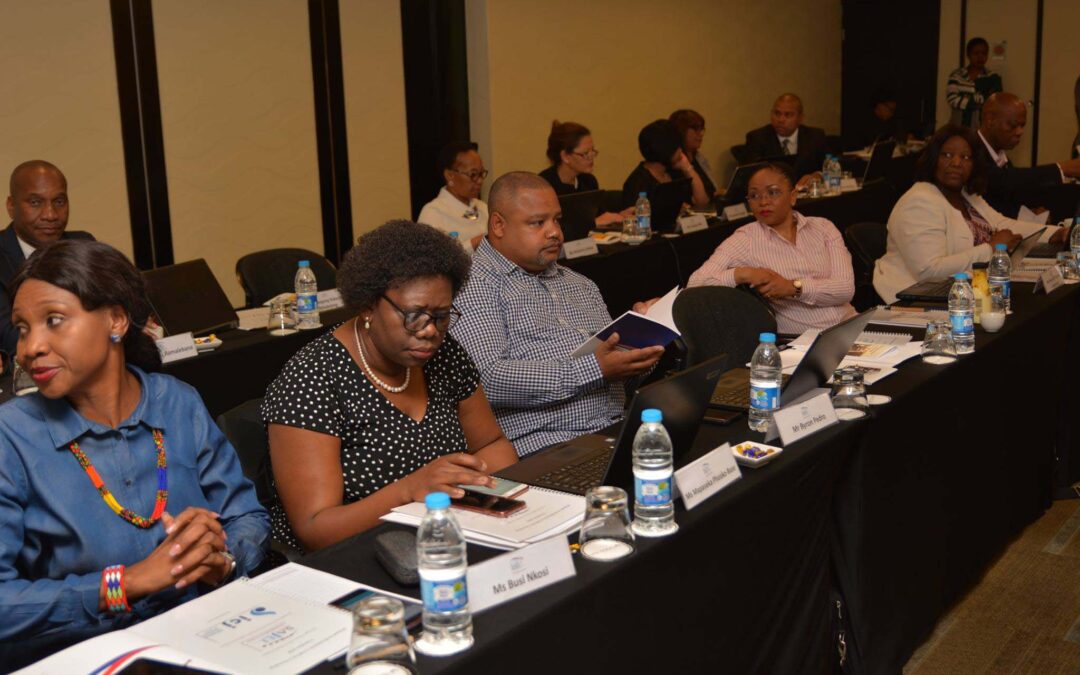
Today, the South African Judicial Education Institute (SAJEI) and ICJ held a workshop for judicial officers on housing rights in terms of South African and international human rights law.
The workshop, which was held in Johannesburg, was attended 46 participants from South Africa’s 9 provinces. It formed part of a “Human Rights Week For Judicial Officers” run by SAJEI, which on other days also covered “Refugee Rights”, “LGBTI Rights”, and “Gender and HIV”.
The objective of the SAJEI-ICJ workshop was to discuss the role of judicial officers in housing rights cases.
The content of the workshop was collaboratively determined in consultation with magistrates responsible for conducting the training of other magistrates around the country.
It sought to respond to their requests information and resources to assist in their daily decision-making.
The workshop was facilitated by a range of magistrates from around the country and judicial educators at SAJEI.
A keynote address on “Constitutional Imperatives on Rights to Housing” was presented Judge Antonie Gildenhuys, a retired judge who sat both on the High Court and the Land Claims Court in South Africa.
Workshop facilitators drew on a draft manual on housing rights, which the ICJ is working with SAJEI and a working group of magistrates to develop.
The manual’s particular focus is on international human rights standards from a range of sources including the International Covenant on Economic Social and Cultural Rights, general comments of the Committee on Economic, Social and Cultural Rights.
It is hoped that, when finalized, magistrates will be able to draw on this manual to assist in their adjudication of housing rights cases.
To assist judicial officers in understanding the challenges faced by communities advocating to prevent unlawful evictions and secure access adequate housing, Mr Thapelo Mohapi (General Secretary of Abahlali baseMjondolo) and Ms Susan Mkhwanazi (Slovo Park Community Forum) were asked to make presentations on their “lived experiences” in attempting to access protection on the right to housing.
Their important insights contributed immensely to the success of the workshop and were well received by the magistrates.
Opening remarks were delivered by Dr Gomolemo Moshoeu (CEO of SAJEI) and Mr Arnold Tsunga (Africa Director of the ICJ).
“We at the ICJ are very happy that the magistrates expressed a desire for more continuous legal education in the area of legal enforcement of economic and social rights given that historically very little attention has been paid to equipping magistrates with requisite information and resources to ensure consistent application of human rights standards in this area,” reflected Arnold Tsunga after the event.
Contact:
Timothy Fish Hodgson, ICJ Legal Adviser, t: +27828719905 ; e: timothy.hodgson(a)icj.org
Oct 1, 2018 | Advocacy, Cases, Legal submissions
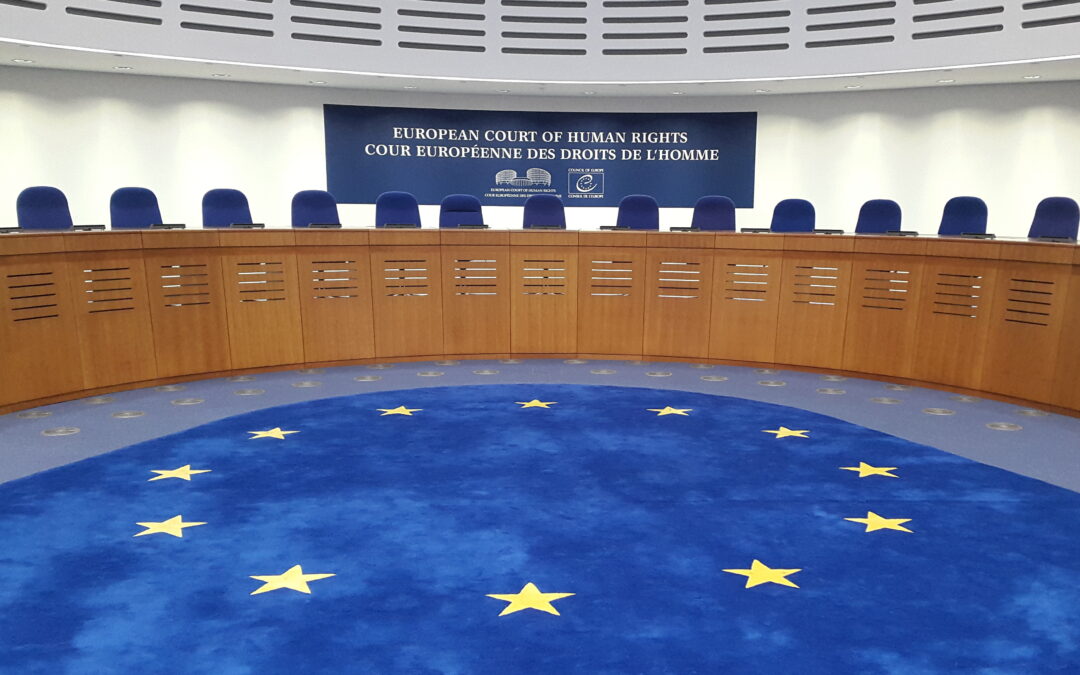
The ICJ made submissions today to the European Court of Human Rights in support of the right of association of Azerbaijan’s lawyers representing applicants before the Court and highlighting the situation of harassment of the legal profession in the country.
The ICJ intervened today in the cases of Democracy and Human Rights Resource Centre v. Azerbaijan and Mustafayev and Democracy and Human Rights Resource Centre v. Azerbaijan.
In these cases, lawyer Asabali Mustafayev and its NGO challenged the compliance of the freezing of their assets and criminal proceedings for financial offences as arbitrary interferences with their work as human rights defenders and in representation of clients before the European Court of Human Rights itself.
The ICJ has intervened to highlight the case-law regarding the right to individual application before the Court under article 34 ECHR and its application to the work of lawyers and legal NGOs.
It further examined the systemic practice in Azerbaijan of harassment of lawyers and of NGOs established by lawyers for the purpose of providing legal advice or representation, including representation of applicants before the European Court of Human Rights.
Finally, the ICJ analyzed the implications of such practices with regard to the State’s obligations under article 18 ECHR read together with article 11 ECHR.
Azerbaijan-icj-DHRRC&other-Advocacy-legal submission-2018-ENG (download the submission)
“Defenseless Defenders: Systemic Problems in the Legal Profession of Azerbaijan” – ICJ report in Azeri, Russian and English.
Question to the parties: http://hudoc.echr.coe.int/eng?i=001-184179
Oct 1, 2018 | News
The Inter-American Commission of Human Rights (IACHR) held a special hearing on the role of the International Commission against Impunity in Guatemala (CICIG) in Boulder, Colarado.
Ramón Cadena, the ICJ Director stated “We regret that the Government of Guatemala requested the IACHR to hold the hearing behind closed doors since all the points discussed were of public interest. The discussions should have been open to the press and the general public. We urge the authorities to ensure there will be no retaliations against the work carried out by human rights organizations and human rights defenders.”
The ICJ welcomed the participation of many NGOs at the event and the frank dialogue that took place on this crucial issue for human rights in that country. The Guatemalan government delegation claimed that the Inter-American System of Human Rights was not competent to consider the matter. However, the IACHR maintained it was competent, according to the American Convention of Human Rights and other regional human rights legislation. As an “external observer”, the IACHR stated it was “surprised” by the latest decisions taken by government authorities at the highest level not to extend the CICIG mandate nor allow the entry of Commissioner Iván Velásquez into the country. It considered these decisions were “excessive” and in no way strengthened the rule of law in Guatemala.
The government delegation further argued that the CICIG acted as a “parallel prosecutor” which affects the internal order of the country. The NGO delegation stated that on the contrary the CICIG acted as a “complementary prosecutor”. The delegation further noted that before the CICIG mandate was approved, the Constitutional Court, in an opinion published in the official gazette on 8 May 2007 (document no 791-2007), considered that the CICIG did not violate the constitutional order nor the rule of law in Guatemala.
The Constitutional Court referred to the CICIG as having “the function of supporting, assisting and strengthening the state institutions responsible for investigating crimes committed by illegal and clandestine security forces .. and does not exclude the possibility of receiving support from other institutions in the collection of evidence, provided that the participation has been established in a legal manner, as in the present case.”
The IACHR considered that the essential question was whether the State of Guatemala already had the judicial independence and strong institutions necessary to fight against corruption in Guatemala without the support of the CICIG. The NGO delegation considered, based on different arguments, that the presence of the CICIG in Guatemala was still necessary.
The IACHR also informed the government delegation that it was in their interest to invite an in-situ visit of the IACHR as soon as possible so as to better understand the human rights situation.
The ICJ Director for Central America Ramón Cadena participated in the hearing at the request of the Central American Institute for Social Democracy Studies (DEMOS), the Committee for Peasant Development (CODECA) and the Network of Community Defenders. The Indigenous Peoples Law Firm had been requested to attend by these organizations but was unable to do so at the last moment.