Mar 20, 2020 | News
Today, the ICJ submitted recommendations on strengthening Thailand’s Anti-Strategic Litigation against Public Participation (SLAPP) law to the Ministry of Justice.
The Ministry of Justice is tasked to conduct a “study on the guidelines for development of laws, regulations or measures to prevent SLAPP,” in accordance with Thailand’s First National Action Plan on Business and Human Rights (2019 – 2022) (NAP).
Articles 161/1 and 165/2, which are intended to implement the NAP, entered into force on 20 February 2019 and 21 March 2019. They were introduced to end SLAPP lawsuits or similar forms of harassment through the legal process against any individuals, including human rights defenders. NAP also refers to the power of a public prosecutor under Article 21 of the Public Prosecution Organ and Public Prosecutors Act as another measure to prevent SLAPP lawsuits.
The use of SLAPPs and similar procedures frequently undermine human rights, including freedoms of expression, association and assembly and the right to political participation. These are protected under Thailand’s Constitution and international human rights obligations.
In the letter, the ICJ expressed its concern that these laws were inadequate to prevent harassment through the legal process and SLAPP. The ICJ therefore called for the adoption of a comprehensive stand-alone law, or the amendment of the Civil Procedure Code and the Criminal Procedure Code, to protect human rights defenders and others from harassment through the legal process.
Background
In an effort to give effect to the UN Guiding Principles on Business and Human Rights (UNGPs), on 29 October 2019, Thailand’s Cabinet approved and adopted the First National Action Plan on Business and Human Rights, making Thailand the first country in Asia to adopt the stand-alone NAP.
The NAP sets out plans to be followed by public and private stakeholders to ensure that businesses – from small and medium-sized enterprises to multinational corporations – respect human rights, and that the government fulfils its duty to ensure remedy and reparation in cases of business-related human rights violations.
The Thai government has identified in the NAP its four key priority issues: (1) labour; (2) land, environment and natural resources; (3) human rights defenders; and (4) cross border investment and multi-national enterprises.
NAP has set out several action points aimed at protecting human rights defenders, including:
- to study the guidelines for development of laws, regulations or measures to prevent SLAPP;
- to push for the review, amendment and repeal of relevant laws, mechanisms and protocols to facilitate protection of human rights defenders, for example with respect to witness protection laws;
- to determine or review policies, protocols, procedures and mechanisms to protect human rights defenders, including women human rights defenders, and ensure their safe conditions of work, and to provide trainings for law enforcement agencies to ensure in practice these protection measures;
- to provide trainings for law enforcement officers to widen their knowledge and understanding in enforcing laws on the protection of human rights, for example with respect to the organization of assemblies, and free expression pertaining to human rights, and preventing dishonest lawsuits that attack human rights defenders;
- to provide trainings and enhance capacity of lawyers;
- to urge businesses to ensure that human rights defenders will not be sued merely calling for rights of individuals to be protected;
- to promote the use of reconciliation mechanisms at all levels of the justice system; and
- to increase access to justice of human rights defenders.
However, NAP’s effectiveness is yet to be assessed because it does not have the status of a law, and is merely a resolution by the executive branch of the Thai government. The NAP was adopted in the form of a Cabinet Resolution, which is considered a “by-law” in accordance with section 3 of the Act on Establishment of Administrative Courts and Administrative Court Procedure B.E. 2542 (1999).
Download the letter to the Ministry of Justice in English and Thai.
Further reading
Thailand: ICJ and HRLA express concern about inadequate protections for human rights defenders in draft National Action Plan on Business and Human Rights
Thailand’s First National Action Plan on Business and Human Rights (2019 – 2022)

Mar 12, 2020 | News
On 11 March 2020, the ICJ co-hosted a panel discussion and an exhibition entitled “Committed to Memory: The Disappeared and Those They Left Behind.”
The event was held to mark the 16th anniversary of the enforced disappearance of a prominent lawyer and human rights defender Somchai Neelapaijit and other individuals who were subject to apparent enforced disappearance and whose fates remain unknown.
The event was held at Bangkok Art and Cultural Centre (BACC). More than 100 participants attended the event.
Opening remarks were delivered by Jenni Lundmark, Programme Officer, Delegation of the European Union to Thailand, and Associate Professor Dr. Gothom Arya, Adviser of the Institute of Human Rights and Peace Studies at Mahidol University.
Jenni Lundmark highlighted the European Union’s commitment to address torture and enforced disappearance and urged the Thai Parliament to pass pending anti-torture and enforced disappearance legislation without undue delay. Associate Professor Dr. Gothom called on the public to preserve the memory of the Thai persons who were victims enforced disappeared as well as many others whose disappearance were not recorded. He also encouraged the establishment of a network of victims of enforced disappearances to strengthen their advocates’ ability.
The event also featured photos and personal belongings of victims or potential victims of enforced disappearance, including: Somchai Neelapaijit, Thanong Po-Arn, Porlajee “Billy” Rakchongcharoen, Kamol Laosophaphan, Jahwa Jalo, Surachai Danwattananusorn, Siam Theerawut and Den Khamlae. For some of these cases, there has been a failure of authorities to conduct a prompt, effective, impartial and independent investigation into their cases. During the event, family members of the victims described stories from photos and personal belongings of the “disappeared” that were exhibited.
The panel discussion focused on progress of the investigations into enforced disappearances and evaluated the progress in developing legislation in Thailand to address this critical issue. The speakers included Angkhana Neelapaijit, wife of Somchai Neelapaijit; Thipwimon Sirinupong, lawyer who is representing Porlajee “Billy” Rakchongcharoen’s family; and Sanhawan Srisod, ICJ’s legal adviser.
During the discussion, speakers expressed concern at the recurrent delays in the amendment and enactment of the law against torture and enforced disappearance which will be critical for ensuring accountability and justice for victims of enforced disappearance. They also regretted that the latest Draft Act, after several rounds of revisions and public hearings, still had not addressed many of the principal shortcomings which the ICJ and other stakeholders and experts have indicated need necessarily be amended in order to bring the law into line with Thailand’s international human rights obligations.
The key concerns include the incomplete definitions of the crimes of enforced disappearance, the absence of provisions concerning the continuous nature of the crime of enforced disappearance and statute of limitations for torture and enforced disappearance crimes, and the inadequacy of provisions concerning safeguards against enforced disappearances.
Background
Somchai was stopped at a Bangkok roadside on 12 March 2004 and pulled from his car by a group of men. He has not been seen since.
At the time, Somchai was defending clients from Thailand’s restive southern provinces who were accused of attacking a military base as part of the ongoing insurgency in the region. Somchai had alleged police tortured the Muslim suspects.
Since 19 July 2005, DSI has spent more than 14 years and eight months investigating the enforced disappearance of Somchai Neelapaijit. However, there is little information in the public domain regarding its progress.
From 1980 to May 2019, the UN Working Group on Enforced or Involuntary Disappearances has recorded and transmitted 90 cases of alleged enforced disappearance to Thailand. Currently, 79 cases remain outstanding.
Further reading
Ten Years Without Truth: Somchai Neelapaijit and Enforced Disappearances in Thailand
Thailand: continuing delay in the enactment of the draft law on torture and enforced disappearance undermines access to justice and accountability
Mar 9, 2020 | News
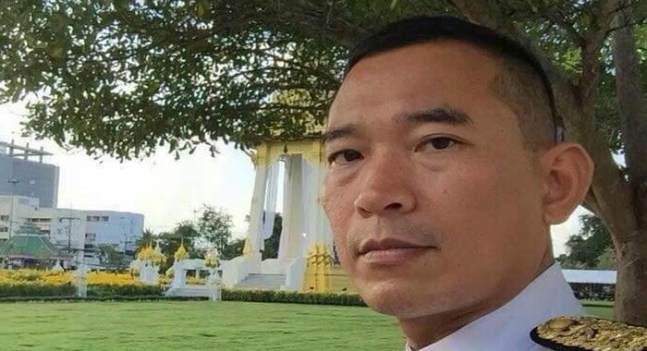
The ICJ today expressed regret at the death of Judge Khanakorn Pianchana, who committed suicide on 7 March 2020. Judge Khanakorn was widely known after an attempted suicide in October 2019 following the delivery of a verdict which he claimed was interfered by a senior judge.
Judge Khanakorn previously served as Vice Presiding Judge of the Yala Provincial Court in Thailand’s restive southern region. He passed away on 7 March 2020 at his home in Chiang Mai province.
Background
Before the suicide, Judge Khanakorn posted a two-page letter on his Facebook page, in which he claimed that he had been subject to disciplinary proceeding and had criminal charge brought against him after he had publicized his concerns about interference by a superior judge into certain rulings. These involved five individuals detained and interrogated under special security laws in southern Thailand.
In October 2019, Judge Khanakorn claimed in a public letter that he had been ordered by a senior judge to rewrite a ruling in which he exonerated the five individuals charged with murder, for lack of evidence. Following his delivery of the verdict, he shot himself in the chest in a courtroom at Yala Provincial Court.
After his first suicide attempt, according to the Office of the Judiciary’s Press Release dated 18 November 2019, the Judicial Commission initiated an investigation against him for violations of provisions on discipline of judicial officials. He was subsequently transferred to the Court of Appeal Region 5 in Chiang Mai, at which time he was further investigated for committing criminal offences under the Firearms, Ammunition, Explosives, Fireworks and Imitation Firearms Act.
On 7 March 2020, according to the interview gave by Secretary-General of Office of the Judiciary, an initial investigation of the Judicial Commission found that there had been no improper interference, and the disciplinary actions and the criminal charges that are brought against Judge Khanakorn were based on his actions for carrying a gun into court and using the gun to attempt suicide.
Contact
Frederick Rawski, ICJ Asia-Pacific Director, t: +66 64 478 1121; e: frederick.rawski(a)icj.org
Download
To download the statement in Thai, click here.
Mar 8, 2020 | News
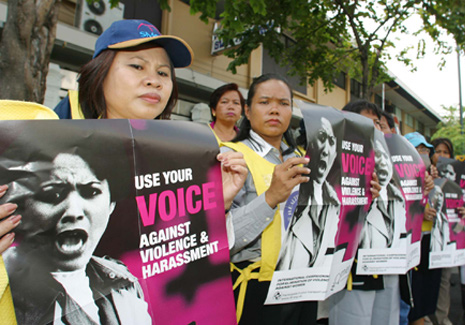
The ICJ commemorates International Women’s Day by calling on States all over the world to take decisive steps to abolish or amend laws, policies and practices that discriminate against women and girls, including those belonging to Sexual Orientation, Gender Identity and Expression and Sex Characteristics (SOGIESC) minorities.
“All over the world, we are facing increasing attacks on the rule of law, which intensify existing inequalities resulting in compounded and intersecting forms of discrimination against women and girls, especially women from SOGIESC minorities,” said Emerlynne Gil, ICJ’s global focal point on gender.
The ICJ also calls on frontline justice actors, such as judges, lawyers and law enforcement officers, to take proactive steps in eliminating gender discriminatory practices in their work to further enhance access to justice for women.
Such action includes an open and inclusive discourse on regressive interpretations of religious and customary laws that discriminate against women.
The ICJ also urges States to acknowledge the diverse voices of women in this discourse, including those of women who belong to SOGIESC minorities.
“Women and girls, including those from SOGIESC minorities, are at a heightened risk of human rights abuses, most especially because a greater number among them is now living in poverty and is unable to access information about their rights, as well as justice for the violations they suffer,” added Emerlynne Gil.
.International Women’s Day is a symbolic acknowledgement of women’s struggle for gender equality in all spheres of life.
While celebrating the recognition of women’s legal rights and entitlements, the ICJ also notes with deep concern the growing trend around the world to push back on these advances in a manner that fundamentally violates the rights of women.
In 2019, the ICJ adopted the Tunis Declaration on Reinforcing the Rule of Law and Human Rights (Tunis Declaration), wherein it highlighted how “culture, tradition, or religion are being used to justify laws, policies, and practices that discriminate against women and girls”.
The proliferation of these discriminatory laws, policies and practices “come at a time when there is growing inequality, accelerating climate change, conflict, and large-scale displacement of people.”
Upholding cultural practices is often invoked as a convenient excuse to justify the continued existence of laws, policies, and practices that discriminate against women and girls, including those belonging to SOGIESC minorities.
While the ICJ affirms the importance of respecting cultural rights, these must be exercised in a manner consistent with core rule of law principles of non-discrimination, equality and equal protection of the law.
The ICJ notes that claims of cultural preservation are often based upon harmful gender stereotypes and deeply problematic patriarchal norms and attitudes that undergird the sanctification of discriminatory cultural, religious, traditional, and customary norms.
In the Tunis Declaration, the ICJ recognized “the persistent, deep entrenchment of patriarchal culture that perpetuates gender stereotypes in many national and international institutions, including those of the legal profession and judiciary.”
Harmful gender stereotypes, in turn, severely hamper women from enjoying their human rights and from equal access to justice, including for crimes of sexual and gender-based violence perpetrated against them.
Contact
Emerlynne Gil, ICJ Senior International Legal Adviser, email: emerlynne.gil(a)icj.org
Mar 5, 2020 | Новости, Статьи
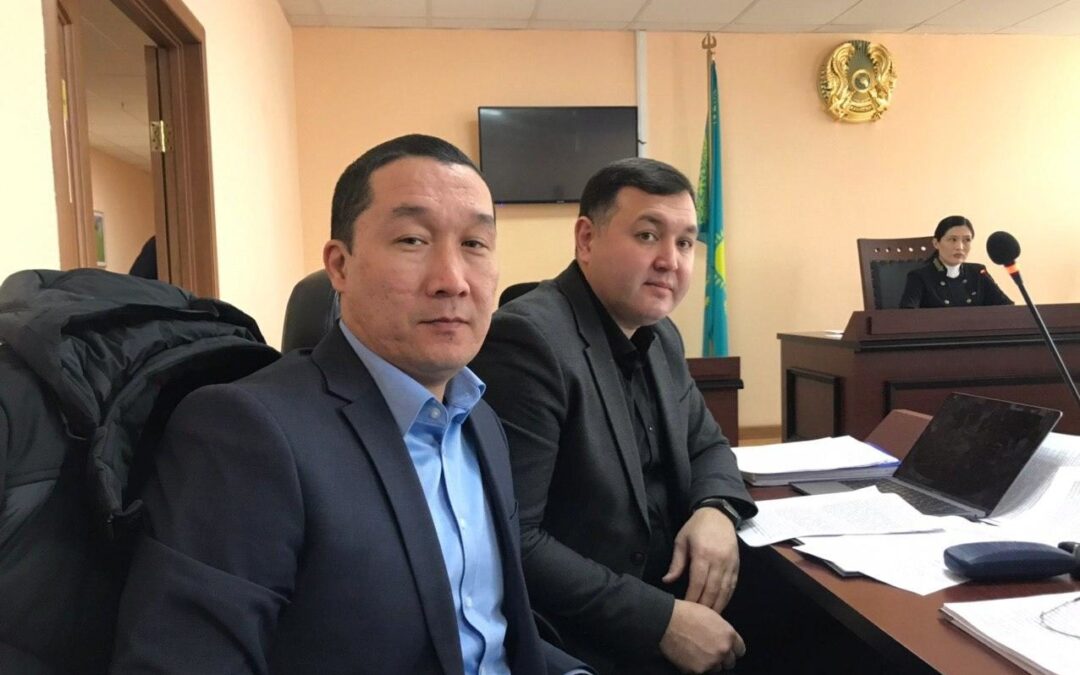
МКЮ выражает обеспокоенность в связи с решениями Есильского и Сарыаркинского районных судов г. Нур-Султан от 26 февраля о лишении лицензии двух адвокатов, Ерлана Газымжанова и Аманжола Мухамедьярова, по иску Министерства юстиции.
Данные меры наносят удар по способности адвокатов независимо осуществлять свою профессию.
Непосредственным основанием для иска Минюста стало размещение адвокатами в социальной сети фрагментов видеозаписи судебного заседания по уголовному делу, где они выступали в качестве защитников, на которых зафиксировано ненадлежащее поведение судьи. Видео было опубликовано после окончания судебного процесса по делу.
После опубликования видео специализированный судейский орган привлек судью к дисциплинарной ответственности за ее поведение в ходе судебного заседания. В то же время, судебные органы обратились в Министерство юстиции с требованием принять меры в отношении адвокатов за размещение фрагментов видео на их страницах в социальных сетях.
МКЮ осуществляла наблюдение за судебными заседаниями по вопросу о лишении адвокатской лицензии по каждому делу. Оба заседания проходили в надлежащем порядке. Тем не менее, МКЮ была встревожена тем, что пресс-служба Верховного Суда непосредственно в ходе заседания опубликовала комментарий в социальной сети, который вызывает сомнения относительно беспристрастности производства. Более того, председатели Есильского и Сарыаркинского районных судов г. Нур-Султан опубликовали идентичные комментарии, в том числе с точки зрения обоснования решений судей, рассматривавших указанные дела. Это произошло сразу же после оглашения решений сторонам. При этом устные разъяснения решений судьями, председательствующими по делу, отличались от комментариев, размещенных председателями соответствующих судов. В результате производства оба адвоката были лишены лицензии.
МКЮ с обеспокоенностью отмечает, что данные суровые меры в отношении адвокатов не предусмотрены законодательством, устанавливающим ответственность за предположительно совершенные нарушения. МКЮ подчеркивает, что принцип законности требует, помимо прочего, чтобы мера, предусматривающая ограничение прав человека, применялась исключительно в порядке, предусмотренном законом, который должен быть выражен четким и недвусмысленным образом. Требование о том, что подобная мера должна быть предусмотрена законом, отсылает не только к наличию закона как такового, но и к его качеству, т.е. закон должен быть предсказуемым, поскольку норма не может считаться законом, если она не сформулирована достаточно точно, чтобы позволить гражданам регулировать свое поведение: граждане должны иметь возможность предвидеть (насколько это объективно позволяют обстоятельства) возможные последствия своих действий.
Законодательство Казахстана не содержит запрета на опубликование видеозаписи судебного заседания в сети Интернет, не говоря уже о том, чтобы карать подобные действия лишением адвокатской лицензии. Единственным документом, нарушение которого составили действия адвокатов, является внутриведомственный приказ Департамента по обеспечению деятельности судов при Верховном Суде, который не имеет статуса закона и не предусматривает, прямо или косвенно, лишение адвокатской лицензии за опубликование видеозаписи. Ни законодательство, ни Кодекс профессиональной этики адвокатов не устанавливают какого-либо наказания за опубликование видеозаписи судебного заседания в сети Интернет. Таким образом, МКЮ обеспокоена тем, что примененная санкция не была надлежащим образом предусмотрена национальным законом и как таковая является непредсказуемой и нарушает принцип законности.
На основании иска Министерства юстиции о применении конкретной санкции по отношению к адвокатам – лишении адвокатской лицензии – суды рассматривали вопрос о применении только этой санкции. Данная санкция назначается пожизненно. Принимая во внимание правовую неопределенность характера нарушений и серьезные последствия, к которым они привели, данная санкция представляется непропорциональной.
Учитывая наличие механизма обычного дисциплинарного производства в Республиканской коллегии адвокатов, который был введен в действие новым законом об адвокатуре 2018 г., МКЮ обеспокоена тем, что данная процедура не была использована в случае адвокатов, так как иски в их отношении были поданы непосредственно в районные суды. Министерство юстиции не обращалось в дисциплинарные органы коллегии адвокатов, что придает указанным органам адвокатуры бутафорский характер.
«В ходе судебного заседания мы не услышали убедительных доводов по вопросу о том, почему не использовалось обычное дисциплинарное производство в коллегии адвокатов, в том числе в связи с предположительным нарушением адвокатской этики», – заявил Тимур Шакиров, старший правовой советник МКЮ.
«В данных обстоятельствах полномочия коллегии адвокатов по оценке поведения ее члена приобретают решающий характер с точки зрения обеспечения независимости юридической профессии, как этого требует международное право и соответствующие стандарты», – добавил Шакиров.
МКЮ призывает компетентные органы восстановить адвокатские лицензии Аманжола Мухамедьярова и Ерлана Газымжанова. Кроме того, необходимо усилить полномочия коллегии адвокатов с точки зрения различных аспектов ее независимого функционирования, в том числе в рамках дисциплинарного производства, в особенности когда адвокатам грозит лишение лицензии. С этой целью МКЮ призывает Парламент Казахстана пересмотреть действующее законодательство и устранить возможность любого органа исполнительной власти действовать в обход полномочий коллегии адвокатов по оценке профессионального поведения ее членов, в том числе в случае лишения адвокатской лицензии и иного дисциплинарного производства.
Disbarment-of-Mukhamediaov-and-Gazymzhanov-2020-ENG (полный текст документа в формате PDF с общим описанием дела, на англ.)