Dec 1, 2012
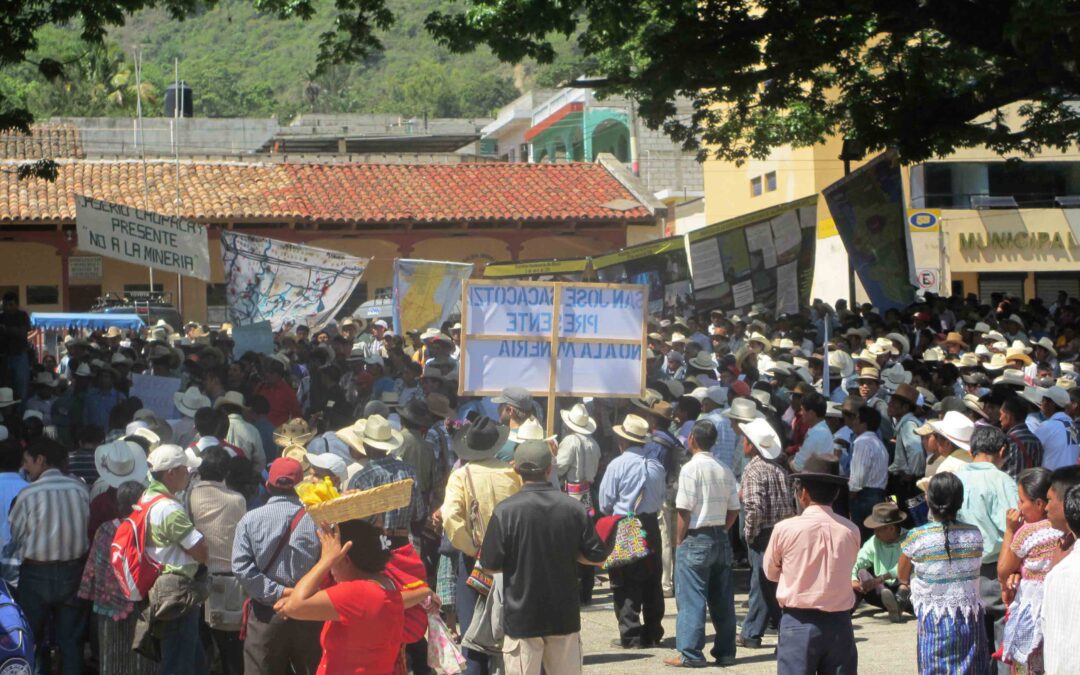
La criminalización de la protesta social en Guatemala es un fenómeno recurrente, con el objeto de deslegitimar a sus actores y anular el impacto político de las organizaciones sociales a través del uso del Derecho Penal como un instrumento de represión.
La región latinoamericana se ha caracterizado por una serie de confl ictos armados durante las últimas décadas del siglo XX y persisten las políticas discriminatorias que han generado descontento en la sociedad.
Las demandas sociales no han encontrado los canales adecuados para materializarse y la protesta social cada vez encuentra más represión por parte de agentes estatales y no estatales.
Con este fin se reprimen las libertades de pensamiento, expresión y reunión fuera de los límites establecidos por el derecho internacional de los derechos humanos.
La presente publicación aborda la criminalización de la protesta social en Guatemala y de sus actores a través del análisis de diferentes conceptos que se relacionan con la temática y de varios casos vinculados a la defensa de los derechos humanos.
En el primer capítulo se aborda la conceptualización de la protesta social y el rol que desempeñan los defensores y defensoras de derechos humanos que deriva en la penalización de sus acciones.
En el segundo capítulo se aborda el contenido de las libertades de pensamiento, expresión y reunión que pueden se objeto de determinadas limitaciones acordes a la normativa internacional de derechos humanos.
En el tercer capítulo se establecen los mecanismos de protección para defensores y defensoras de derechos humanos, tanto en el ámbito internacional como nacional.
En el cuarto capítulo se analizan los patrones de criminalización de la protesta social en algunos casos paradigmáticos en Guatemala, vinculados a la defensa de los recursos naturales de pueblos indígenas.
Guatemala-Criminalizacion de la protesta social-publications-2012-spa (full text in pdf)

Nov 25, 2012
 The commentary on the Maastricht Principles on Extraterritorial Obligations of States in the area of Economic, Social and Cultural Rights was published in the latest issue of the Human Rights Quarterly of November 2012.
This new document provides an analysis of each of the Maastricht Principles as well as the legal sources on which the latter are based.
As such, it will represent an important resource for practitioners and activists who want to protect human rights in a globalized and complex world in which traditional territorial borders have lost their primacy.
In September 2011, the Maastricht Principles had been adopted by 40 international law and Human Rights Experts during a conference convened by the Maastricht Centre for Human rights and the ICJ. They establish a set of Principles defining obligations and responsibilities for the realization of ESCR in the context of the extraterritorial acts and omissions of States.
The Principles build on the Limburg Principles on the Implementation of the International Covenant on Economic, Social and Cultural Rights (1986) and on the Maastricht Guidelines on Violations of Economic, Social and Cultural Rights (1997).
HRQMaastricht-Maastricht Principles on ETO (Full text in pdf)
Maastricht ETO Principles-booklet-2012 (Full text in pdf)
Maastricht ETO Principles-booklet-2012-Fr (Full text in pdf)
Maastricht ETO Principles-booklet-2012-Sp (Full text in pdf)

Sep 22, 2012
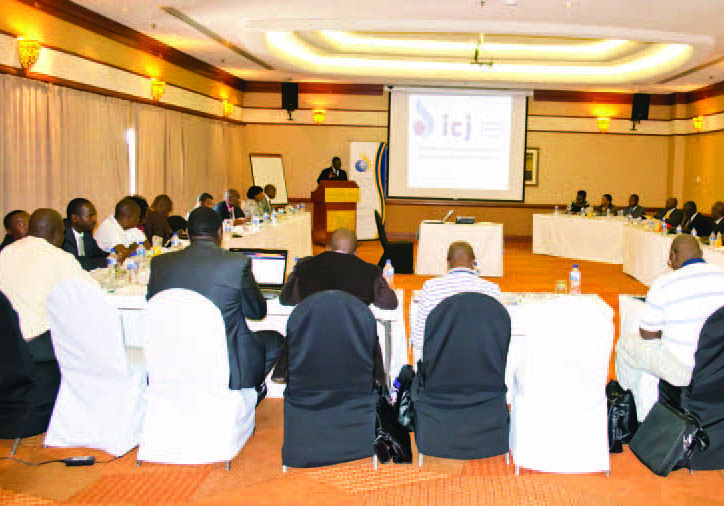 This report relates to a meeting convened by the ICJ in Zimbabwe and attended by delegates from seven African countries.
Attendees came for the Democratic Republic of Congo, South Africa, Uganda, Zambia, Kenya, Tanzania and Zimbabwe. They included two cabinets ministers (from Zimbabwe), heads of electoral commissions, academics, members of parliament, political party representatives, judges and practicing attorneys.
The African Charter on Democracy, Elections and Governance provided the the theoretical and structural framework of the Conference.
Africa-Elections and The Rule of Law-Report-Publications-2012 (full text in pdf)

Aug 22, 2012
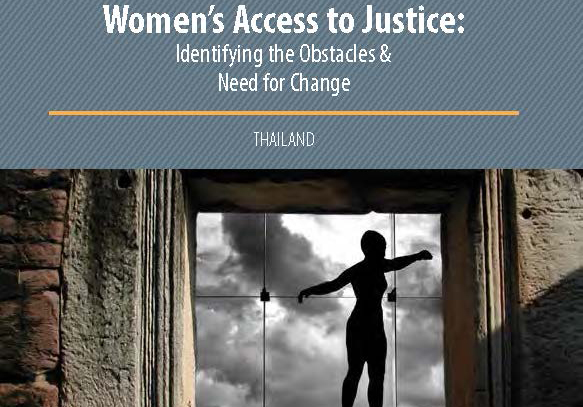 In this new report, the ICJ and and Justice for Peace Foundation (JPF) call for a series of changes in law, practice, approach and behaviour to address the justice needs of women across Thailand.
Thailand Women’s Access to Justice Report 2012 (download in English)
Thailand Women’s Access to Justice Report 2012 (download in Thai)
Aug 8, 2012
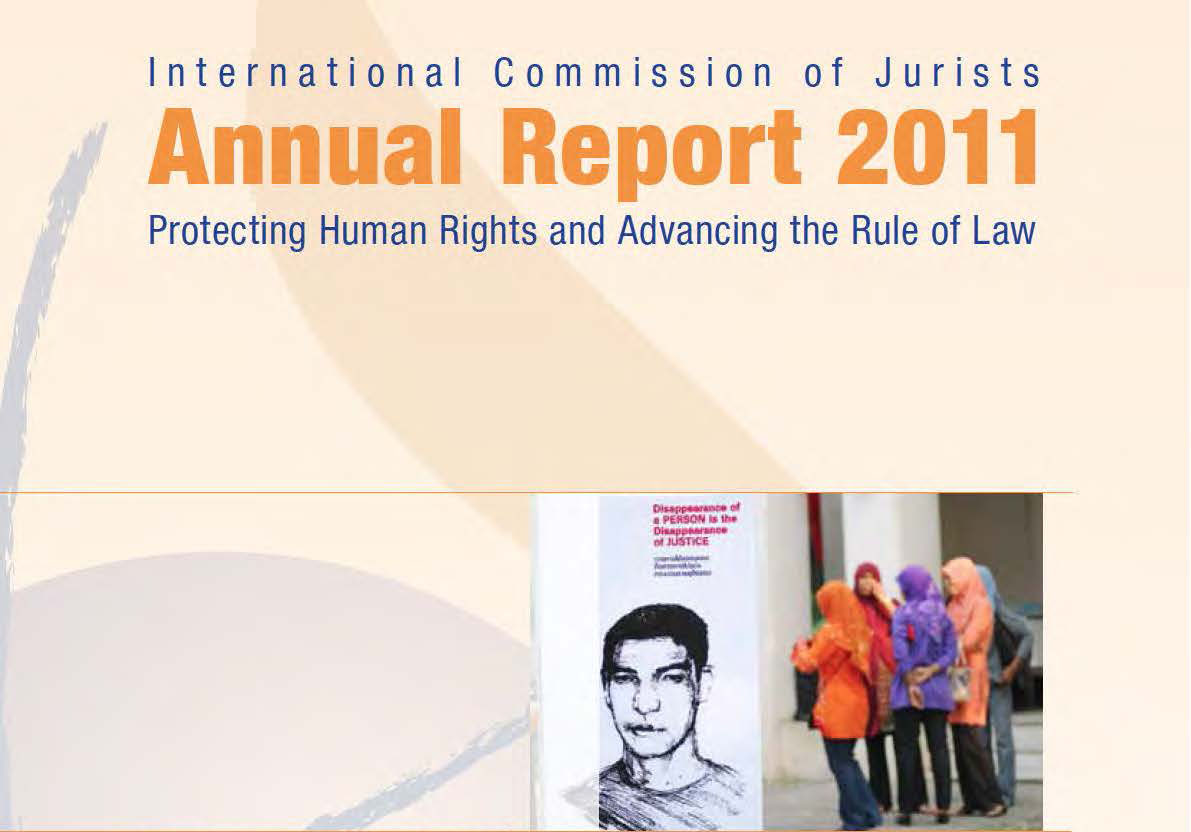 In 2011, the political and economic landscape of the Middle East was altered as ordinary people, motivated by a desire to realize their human rights, challenged their rulers in a way that had never been done before. As protests against repressive regimes swept across the Middle East in 2011, the ICJ’s work in the region became increasingly relevant. Projects previously seen as unfeasible, such as those related to constitutional and legal reform, are today being pursued with an unprecedented level of engagement.
Read more on ICJ’s achievements in 2011 in the Annual Report.
Download here: AnnualReport 2011