Feb 6, 2014
The ICJ called on the Thai government to ensure that it will continue investigating the enforced disappearance of lawyer Somchai Neelapaijit, who has not been seen since 12 March 2004.
In Geneva yesterday, the ICJ informed the United Nations Working Group on Enforced and Involuntary Disappearances (WGEID) that it was alarmed by reports that Thailand’s Department of Special Investigations (DSI) was considering closing the investigation into Somchai’s enforced disappearance.
The ICJ also shared with the WGEID an open letter to the DSI and the Royal Thai Government raising its concerns, and making a number of recommendations for Thailand to comply with its international obligations, including those under the International Covenant on Civil and Political Rights (ICCPR), the International Convention Against Torture, and the International Convention for the Protection of All Persons Against Enforced Disappearances, which Thailand has signed but not yet ratified. (Letter attached)
“It’s clear that the fate of Somchai Neelapaijit remains of concern inside Thailand and to the international community,” said Matt Pollard, the ICJ’s UN Representative in Geneva. “The DSI must continue to investigate this case because after 10 years, the family is still waiting for the full truth about what happened, and no one has been brought to justice for his enforced disappearance.”
In its letter to the DSI and the Royal Thai Government, the ICJ said: “As a party to both the ICCPR and the Convention against Torture, and signatory to the Convention against Enforced Disappearance, the authorities in Thailand are obligated to ensure that a thorough, independent and impartial investigation is conducted into all cases of alleged enforced disappearance, that those responsible are brought to justice and punished in a manner that is consistent with the gravity of the crime, and that the victims of the crime, including surviving family members, have access to effective redress, and receive adequate reparation.”
“The UN Working Group on Enforced Disappearances has demonstrated a deep commitment to the case of Somchai Neelapaijit since first being made aware of it in 2005,” said Pollard. “The ICJ appreciates the Working Group’s continuing efforts to ensure that the Thai Government properly investigates this case, prosecutes those responsible, and provides for the protection of anyone who remains at risk of intimidation or reprisals for seeking justice.”
For the full text of the ICJ’s open letter, download
Thailand-Open-letter-Somchai-Advocacy-2014
Contact:
Matt Pollard, ICJ Senior Legal Adviser, UN Representative, Centre for the Independence of Judges and Lawyers (Geneva), t:+41 792465475 email: matt.pollard(a)icj.org
Craig Knowles, ICJ Media & Communications, (Bangkok), t:+66 819077653, e-mail: craig.knowles(a)icj.org
Jan 31, 2014 | News
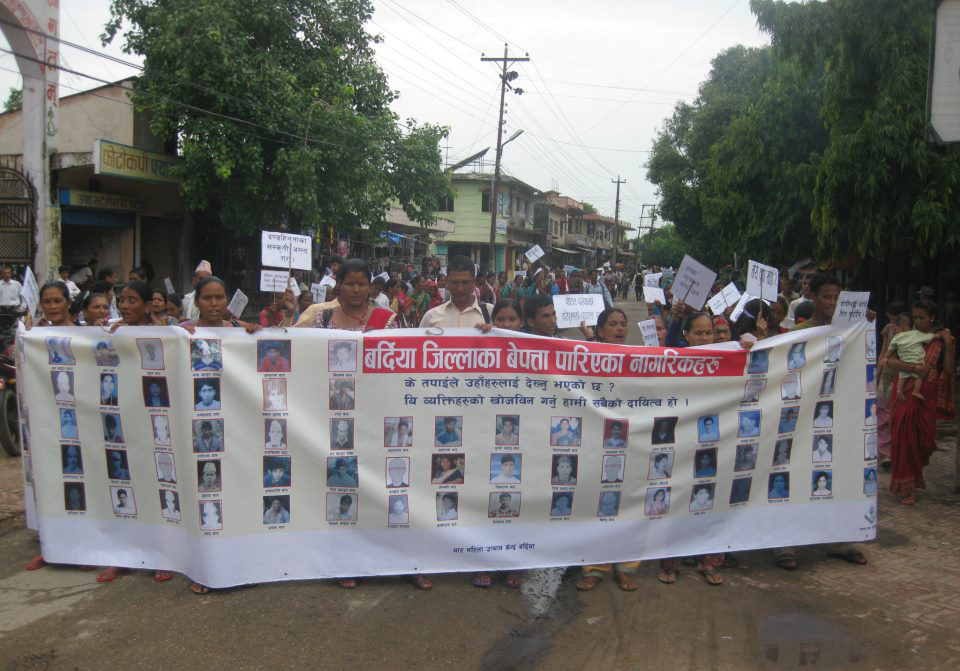
The Parliament of Nepal should reject the Ordinance on Truth, Reconciliation and Disappearances tabled this week and enact a new transitional justice mechanism that complies with international human rights law, the ICJ and HRW said today.
The Ordinance on Disappearances, Truth and Reconciliation Commission, signed by the President on 14 March, 2013, was declared unconstitutional and in violation of international human rights law by the Nepali Supreme Court on 2 January, 2014.
In a directive, the Supreme Court ordered the Ordinance be repealed or amended significantly to bring it in line with Nepal’s obligations under national and international law.
However, on 27 January, the Government reintroduced the Ordinance with no amendments in the meeting of the Legislative-Parliament – in direct contravention of the Supreme Court’s orders.
“Tabling a rejected version of the Ordinance after the Supreme Court’s landmark judgment on transitional justice is contemptuous, and raises serious concerns over the government’s respect for the rule of law in Nepal,” said Ben Schonveld, ICJ’s South Asia Director.
The Interim Constitution says clearly that the Supreme Court’s rulings are binding on the Government of Nepal. Article 116 of the Interim Constitution states that any order issued by the Supreme Court in the course of the hearing of a case shall be binding on the Government of Nepal and all its offices and courts.
The Supreme Court has previously held that any mechanism for transitional justice must conform with international standards, lead to accountability for serious human rights violations, and ensure victims their right to remedy and reparations, which includes the right to truth, justice, and guarantees of non-recurrence.
In its 2013 briefing paper, “Authority without Accountability,” the ICJ expressed concern over multiple provisions in the Ordinance, including amnesty provisions, which would entrench impunity for gross human rights violations in Nepal.
Any amnesty for gross human rights violations would add another layer to the complex web of immunities, documented in the report, that continue to shield those responsible for human rights abuse from accountability in Nepal.
“The Parliament of Nepal should strongly reject the tabled Ordinance and the government must expeditiously implement the Supreme Court’s directive,” said Meenakshi Ganguly, South Asia Director at Human Rights Watch. “The ordinance in its current form violates undertakings made as part of the peace agreement, and essentially strips victims of serious rights abuses of a proper chance at justice.”
The rights groups called on the government to implement the Supreme Court’s ruling, creating a new transitional justice law that, at a minimum:
- Establishes two separate transitional justice commissions: a “Truth and Reconciliation Commission” and a “Commission of Inquiry on Enforced Disappeared Persons;”
- Criminalizes the act of enforced disappearance in accordance with the definition set out in the International Convention on the Protection of All Persons from Enforced Disappearance and ensures that it is punishable with penalties commensurate with the gravity of the crime;
- Criminalizes other serious crimes, including crimes against humanity, and other crimes under international law, in a manner that is consistent with international law;
- Prohibits amnesties for gross human rights violations or crimes under international law;
- Does not contain a limitation period on the reporting of violations and ensures there are no time limits on the prosecutions of of serious crimes including enforced disappearance, other crimes under international law including, war crimes, and crimes against humanity;
- Ensures that the composition and structure of the Commissions complies with international standards. In particular, there should be a fair vetting system which aims to ensure the impartiality of the commission members and to ensure that no individuals against whom there are credible allegations they have committed human rights abuses are selected as Commissioners;
- Requires the necessary legal and institutional measures to be taken to enable and ensure the establishment, adequate resourcing and maintenance of effective victim and witness protection mechanisms; and
- Establishes and requires other necessary legal, administrative, institutional, or other arrangements for an effective reparation program.
Contact:
In Bangkok, Sam Zarifi: +66-857200723; or sam.zarifi(a)icj.org
In Kathmandu, Ben Schonveld +977-9804596661; : ben.schonveld(a)icj.org
Read also: ICJ releases new report on the struggle for justice in Nepal
The report Authority without accountability: the struggle for justice in Nepal can also be downloaded below:
Nepal-SUMMARY-Authority without Accountability-Publication-report summary-2012 (full text in pdf)
Nepal-FULL-Authority without accountability-publications-report-2012 (full text in pdf)
Jan 27, 2014
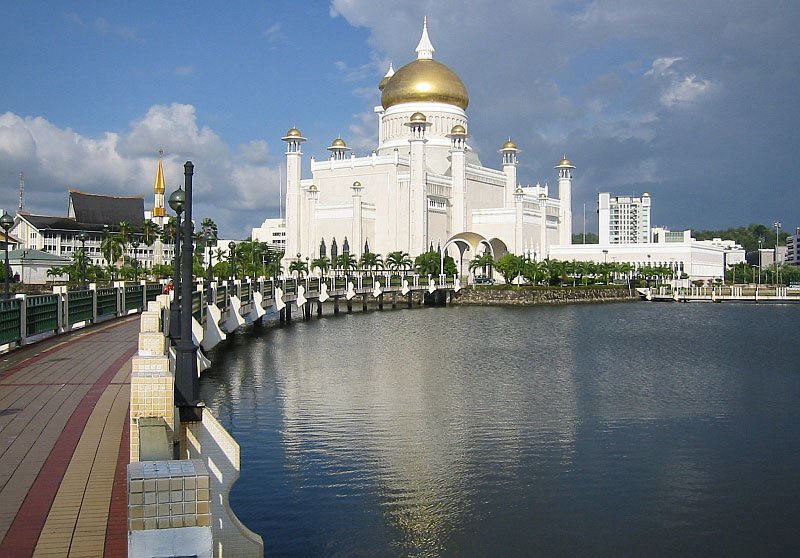
The ICJ deplores the recent enactment of a new penal code by Brunei Darussalam.
If implemented, the code would lead to serious human rights violations by reintroducing the death penalty and imposing other cruel and inhuman punishment including stoning, even for conduct that should not even be considered criminal.
In an open letter to Prime Minister, H.M. Haji Hassanal Bolkiah, the ICJ also stressed that the Syariah Penal Code Order 2013 is clearly incompatible with international human rights law and standards that prohibit discrimination against women and protect the rights to religious freedom and freedom of opinion and expression. The law also criminalizes adultery, extramarital sexual relations and consensual same-sex conduct, in contravention of international standards.
“These provisions in the 2013 Penal Code are a serious step back for Brunei,” Sam Zarifi, ICJ regional director for Asia & the Pacific, said in the letter. “These provisions are not in accord with the commitment made by Brunei as a member of the Association of Southeast Asia Nations to promote and protect human rights in the region.”
The 2013 Penal Code, enacted by the government of Brunei Darussalam in October 2013, is due to take effect in April 2014.
The ICJ condemns the adoption of provisions of the 2013 Penal Code that reintroduce the death penalty after years of an effective moratorium in the country, and provide for stoning and other forms of torture and ill treatment for a range of conduct, some of which should not be criminalized at all.
The ICJ noted the 2013 Penal Code provides for the death penalty as a possible penalty — for both Muslims and non-Muslims — for the crimes of robbery (Article 63), rape (Article 76), adultery and sodomy (Article 82). It also is prescribed as a penalty — for Muslims only — upon conviction for acts constituting extramarital sexual relations (Article 69).
“The 2013 Penal Code also specifies that a manner by which capital punishment is to be imposed for rape, adultery, sodomy and extramarital sexual relations is stoning to death, a particularly horrific form of torture and execution,” Zarifi said. “The death penalty, in any circumstance, is a form of torture and inhumane treatment, and its reintroduction in the 2013 Penal Code is out of step with the global trend towards and abolition of the death penalty and the establishment of a moratorium on execution.”
Brunei Darussalam has not carried out the death penalty since 1957 and has been viewed as de facto abolitionist.
Brunei Darussalam is a member of ASEAN, which also comprises Cambodia, Indonesia, Lao PDR, Malaysia, Philippines, Singapore, Thailand and Vietnam.
Brunei-New Penal Code Open Letter-advocay-2013 (PDF file of open letter)
CONTACT:
Sam Zarifi, ICJ Asia-Pacific Regional Director, (Bangkok), t:+66 807819002, e-mail: sam.zarifi@icj.org
Craig Knowles, ICJ Media & Communications, (Bangkok), t:+66 819077653, e-mail: craig.knowles@icj.org
Jan 23, 2014 | News
The ICJ criticized the Phnom Penh Municipal Court’s decision to deny bail to 23 people who were arrested and detained earlier this month following protests by garment factory workers seeking a higher minimum wage.
The detainees’ lawyers told the ICJ that the court denied bail for the first nine detainees, arrested on 2 January 2014, in order to “guarantee their presence for further legal proceedings”, “to preserve public order” and “to prevent instability that results from the commission of crimes”.
The remaining 13 detainees, arrested on 3 January 2014, were denied bail in order to “end crime”, “prevent new crime” and “ensure detainees are available for trial”.
The decision to deny bail to the 22 detainees followed the Court’s decision on 13 January 2014 to deny bail to Vorn Pao, President of the Independent Democracy of Informal Economy Association (IDEA).
Considering his application separately from the others, the court, similarly, provided the same reasons as in the case of the first nine detainees.
“International law is clear that pre-trial detention could only be exercised in exceptional situations, and avoided if suitable alternatives are possible,” said Sam Zarifi, ICJ’s Regional Director for Asia and the Pacific. “The reasons presented by the Court don’t justify holding these activists in prison right now.”
All 23 of those whose bail applications have been denied have been charged with causing intentional violence and damage to property. Three face additional charges for violent resistance against a public official, as well as a traffic offence.
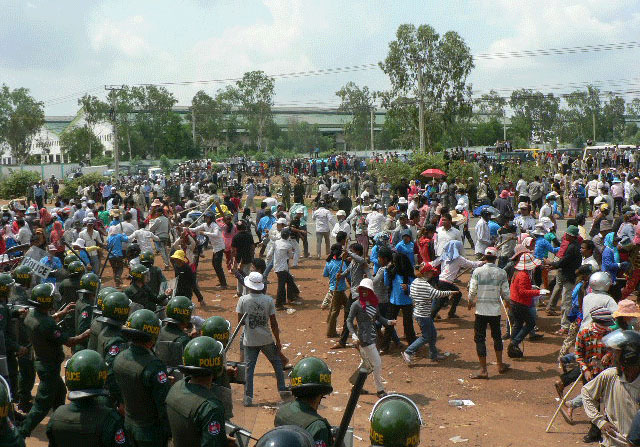
They were arrested as part of the government’s response to striking garment workers and demonstrators protesting the 28-year-rule of Prime Minister Hun Sen (photo).
Security forces shot and killed at least four protesters on 3 January. The government has banned further protests.
Article 9(3) of the International Covenant on Civil and Political Rights (ICCPR), to which Cambodia is a party, guarantees the right to liberty. It states, “It shall not be the general rule that persons awaiting trial shall be detained in custody, but release may be subject to guarantees to appear for trial”. Such guarantees include bail.
“There are alternatives to the detention, such as bail or other conditions the court could impose on these 23 detained activists if the Court is concerned, on the basis of substantiated and objective grounds that there is a risk that each of them will abscond before the trial or interfere with the investigation,” said Zarifi. “In the absence of such proof and the serious consideration of alternatives the continued pre-trial detention of each of the 23 individuals would amount to arbitrary detention under international human rights standards.”
Vorn Pao’s lawyers filed an appeal on 14 January 2014 and the Court is expected to issue a decision on his appeal by 3 February 2014.
According to the Cambodian Centre for Human Rights, Vorn Pao appears weak and continues to suffer pain from the head injuries he sustained.
Lawyers for the other 22 detainees have also expressed their intention to appeal the Court’s decision to deny them bail.
Contact:
Sam Zarifi, ICJ Asia-Pacific Regional Director, (Bangkok), t:+66 807819002, e-mail: sam.zarifi(a)icj.org
Craig Knowles, ICJ Media & Communications, (Bangkok), t:+66 819077653, e-mail: craig.knowles(a)icj.org

Jan 21, 2014 | News
The ICJ today condemned the imposition of the death penalty on 30 people found guilty of drug trafficking in Viet Nam and urged its government to amend laws and take steps towards abolishing the death penalty.
On 20 January, 21 men and nine women were convicted of drug trafficking following a 17-day trial held within the compound of a detention center rather than in a court.
“Viet Nam has the highest number of executions in the ASEAN,” said Sam Zarifi, ICJ Regional Director for Asia and the Pacific. “This is really of serious concern, especially since its courts have been widely criticized as lacking independence, and judicial proceedings have frequently violated international fair trial standards.”
The ICJ repeatedly has criticized Viet Nam’s violations of Article 14 of the International Covenant on Civil and Political Rights, which guarantees the right to a fair and public hearing by a competent, independent, and impartial tribunal established by law.
Under international law, the death penalty may only be lawfully pronounced as a sentence for the most serious crimes, after a full and fair trial. The imposition of the death penalty in this case — a prosecution for drug trafficking — is inconsistent with international law and standards that define the most serious crimes as those involving the intention to kill and resulting in the loss of life.
“Viet Nam’s failure to abolish the death penalty goes against the global trend,” said Zarifi. “The country has chosen to act contrary to repeated calls in several resolutions adopted by the United Nations General Assembly on the issue.”
According to a report by the Secretary General to the General Assembly in 2012, 150 of the 193 UN member states either have abolished the death penalty or introduced a moratorium on it.
Among member states of the Association of Southeast Asian Nations (ASEAN), the Philippines has ratified the Second Optional Protocol to the International Covenant on Civil and Political Rights (OP2), abolishing the death penalty. Cambodia also has abolished the death penalty. Lao PDR, Myanmar and Brunei have not carried out the death penalty in several years. Aside from Viet Nam, four other ASEAN Member States still retain the death penalty: Malaysia, Singapore, Thailand and Indonesia.
In November 2013, Viet Nam was elected as a member of the UN Human Rights Council.
Sam Zarifi noted, “The recent death sentences handed down in Viet Nam, in violation of international law, suggest a lack of respect for international law at odds with the spirit of a country newly taking its seat at the UN Human Rights Council.”
It is estimated that more than 600 prisoners are now awaiting execution in Viet Nam. It last imposed the death penalty on 19 December 2013 on two former shipping executives found guilty of embezzlement.
The ICJ considers the death penalty a violation of the right to life and the right to be free from cruel, inhuman or degrading treatment.
The ICJ calls on the Government of Viet Nam to immediately establish a moratorium on executions and take steps towards the complete abolition of the death penalty.
CONTACT:
Emerlynne Gil, ICJ International Legal Advisor for Southeast Asia, tel. no. (Bangkok) +66840923575, email: emerlynne.gil(a)icj.org
Craig Knowles, ICJ Media & Communications, (Bangkok), tel.no. +66819077653, email: craig.knowles(a)icj.org