
Jan 21, 2014 | News
The ICJ is deeply concerned by reports that the President of Nauru has prevented the island nation’s Chief Justice from returning to the country and expelled the sole Resident Magistrate in violation of international standards on the independence of the judiciary.
According to media reports, Nauru President Baron Waqa on January 19 removed Resident Magistrate Peter Law in violation of an injunction issued by Chief Justice Geoffrey Eames. Subsequently, Chief Justice Eames, who was in Australia at the time, had his visa cancelled. Both judicial officials are Australian citizens.
Australia administered Nauru as a dependent territory until 1968 and the two countries retain strong bilateral relations. Australian judges and magistrates often serve on Nauru Courts.
“Removing judges from office, without any process whatsoever, breaches clear international standards on the independence of the judiciary,” said Sam Zarifi, ICJ’s Regional Director for Asia and the Pacific. “It also jeopardizes the right of people in Nauru, especially those currently engaged in legal proceedings, to have a fair trial.”
Nauru is an island state in Micronesia in the South Pacific.
The ICJ’s Centre for the Independence of Judges and Lawyers (CIJL) is monitoring developments.
Contact:
Sam Zarifi, ICJ Asia-Pacific Regional Director, (Bangkok), t:+66 807819002, e-mail: sam.zarifi(a)icj.org
Craig Knowles, ICJ Media & Communications, (Bangkok), t:+66 819077653, e-mail: craig.knowles(a)icj.org
Jan 13, 2014
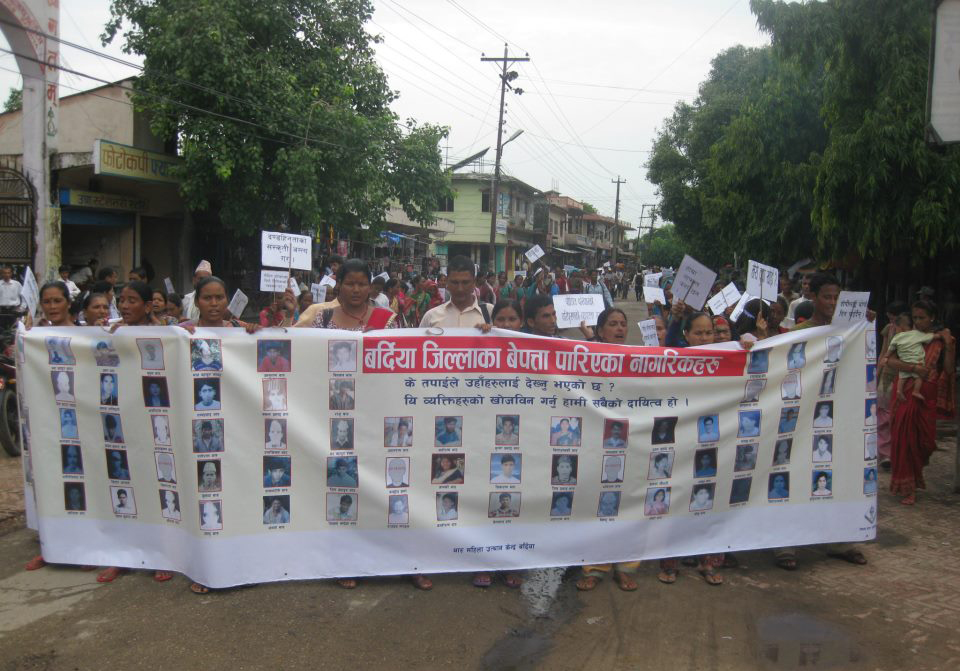
An opinion piece by Ben Schonveld, Director of ICJ’s South Asia Programme, and Govinda Bandi, an expert in constitutional and international law.
In a landmark decision last week, Nepal’s Supreme Court again demonstrated why it has been the most important bastion of hope for human rights in the country.
The ruling of 2 January struck down an executive Ordinance that represented an attempt by the country’s politicians to institutionalize impunity for the serious human rights violations and crimes of the past two decades.
It also laid down the gauntlet for the country’s political classes: political expediency cannot trump justice and accountability.
The Supreme Court’s ruling should put an end to much of the political argument around reconciliation and impunity.
It recognizes that reconciliation is an important goal in Nepal’s transitional process.
But the ruling also underlines that reconciliation cannot be built on a foundation of impunity for serious crimes and human rights abuses.
Allowing impunity for crimes under international law places certain categories of individuals above the law.
It leaves victims, who have been most affected by the conflict, with only a marginal role in the reconciliation process and in effect forces them to give up their right to justice, truth and reparation.
The case, Madhav Kumar Basnet v the Government of Nepal, was a response to a cynical effort by Nepali politicians to renege on their promise to the Nepali people to provide accountability and justice during the process of transition following the armed conflict.
Taking advantage of the absence of a legislature, an unlikely coalition of parties pushed for a sweeping amnesty from accountability under the misleading title of an Ordinance to establish a Commission of Inquiry on Disappeared Persons, Truth and Reconciliation.
Nepali civil society was not fooled by this benign title, and instead referred to the Ordinance as what it was: an amnesty for the perpetrators of years of human rights abuses.
Despite enormous criticism from a wide range of Nepali civil society and international human rights organizations, including the International Commission of Jurists, a slightly amended Ordinance received Presidential approval on 14 March 2013.
In response, civil society turned to the only branch of government that has sought to uphold the rights of Nepalis.
In a petition brought by a coalition of victims’ groups, with the assistance of the International Commission of Jurists, the Court was asked to consider the following: 1) whether or not the procedures and legal provisions of the Ordinance violated the Constitution, international human rights law and accepted principles of justice, and 2) if implemented in its present form, whether or not the Ordinance would achieve the goals of transitional justice.
In its landmark ruling of 2 January 2014, the Court held: 1) that the Ordinance was an obstacle to transitional justice and 2) that it violated Nepal’s Constitution, international human rights law and was contrary to previous rulings by the Supreme Courts and accepted principles of justice.
The Court also addressed the deficits of the Ordinance, including the absence of supporting legislation, and administrative reform that would be required for a credible transitional justice process.
On Amnesty
The Ordinance purported to give powers to the executive to grant amnesty for crimes under international law.
The Court held that such sweeping amnesties are an obstacle to truth, violate international law and the Court’s own prior decisions.
The court barred amnesty for such crimes, because they allow those suspected of criminal responsibility for crimes under international law, such as enforced disappearance, extrajudicial executions, torture and other ill-treatment, including rape and other sexual violence, to escape justice.
Statute of limitations
With regard to victims’ right to effective remedy, the Court rejected the Ordinance’s provision for a statute of limitations of 35 days for filing cases after the decision of the Commission.
The Court held that such a time limited statute of limitations “will create impunity” for international crimes.
Furthermore, the Court ruled that this limitation provided the Attorney General (AG) with excessive discretion, since any case that the AG was reluctant to pursue could be quashed simply through administrative delay.
On enforced disappearances
The Ordinance amalgamated what had been hitherto envisioned as two separate Commissions, one on truth and one designed to address the specific situation of enforced disappearances.
The Court ruled that a separate Commission of Disappearances was essential. The Court underlined that it had already ruled in the Rabindra Dhakal case that the Government must 1) criminalize the act of enforced disappearance as a continuous crime, not subject to the grant of amnesties; and 2) establish a separate commission, in accordance with international law and standards, to look into cases of enforced disappearance during the conflict.
Making transitional justice work
In addition to striking down sections of the Ordinance that contravened international law, the Constitution and prior rulings, the Court set forth a list of practical measures that need to be addressed to implement any future transitional justice mechanism. These measures include the following:
1) The need to legislate for the criminalization of human rights abuses constituting international crimes in Nepal. Currently enforced disappearance and torture are not criminal acts;
2) The Court also ruled that reparations to victims and their families for such abuses must be provided;
3) It ordered that a witness and victim protection program be established;
4) The Court ordered a vetting standard to ensure the impartiality of the Truth and Reconciliation Commission; and
5) The Court instructed the government to seek assistance from an ‘expert team’ to amend the Ordinance.
Truth as a replacement for justice
The International Commission of Jurists and many of its national and international partners have repeatedly called on Nepal’s past governments to ensure that legislation establishing transitional justice mechanisms – which must not replace judicial proceedings – conform to international standards.
Politicians in Nepal have repeatedly stressed the reverse. The Court has ruled that this debate too is at an end: transitional justice is a complement, not a replacement for criminal law.
Back to the drawing board
Nepal’s new government, once formed, now has to elaborate a substantial new legislation which will address the challenges of justice in transition.
The Court’s ruling has made it very clear that only laws that conform to international standards will be acceptable. And anything that falls below will inevitably be subject to legal challenge.
Yet successive governments have had a very poor record on implementing court judgments.
There remains a powerful resistance to ensuring accountability amongst many key political players, including the powerful military and many amongst the election victors.
This resistance reinforces a pattern of political interference with the criminal justice process and intersects with attempts to tackle corruption.
The extent of their influence can be seen in the weaknesses in the Ordinance that Nepal’s Supreme Court has now rejected.
Justice, truth and reparation for serious human rights violations were key demands of the people’s movement. They remain key demands of the Nepali people.
The Nepali Supreme Court’s decision is a landmark not just for Nepal but also for international law globally.
Is Nepal to be governed by the rule of law or continued political expediency? It is now over to the politicians.
Jan 10, 2014 | News
The ICJ calls on the Bangladeshi authorities to immediately and unconditionally drop ‘cybercrime’ charges against Nasiruddin Elan and Adilur Rahman Khan, President and Secretary of the human rights group Odhikar.
“These charges are a flagrant attempt to silence critical voices, and the Bangladeshi authorities must immediately and unconditionally drop all charges against the two human rights defenders,” said Sam Zarifi, ICJ’s Asia director.
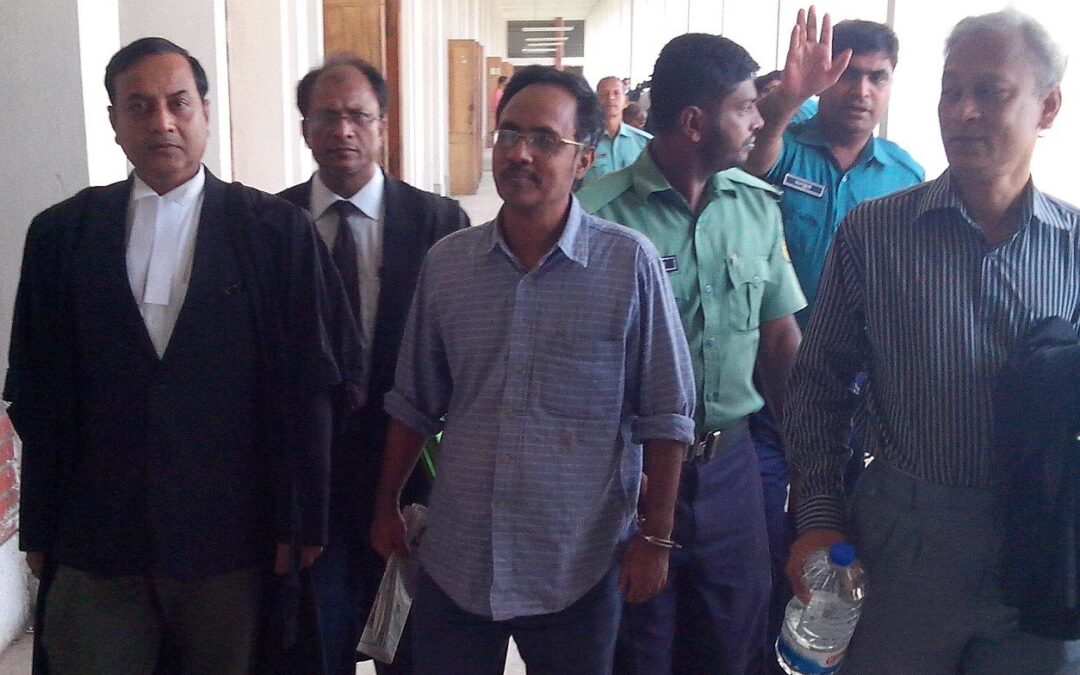
On 8 January 2014, a cyber crimes tribunal in Dhaka indicted Nasiruddin Elan (picture, on centre) and Adilur Rahman Khan under section 57 (1) and (2) of the Information and Communication Technology (ICT) Act, 2006, for publishing “fake, distorted and defamatory” information. Khan and Elan plead innocent to the charges.
The charges relate to a report by Odhikar that alleged that security forces had killed 61 people during a rally by the Islamist group Hefazat-e Islam in May 2013. The Government disputes the casualty numbers.
The trial is set to begin on 22 January 2014. Under the terms of the newly amended ACT the two human rights defenders face a minimum of seven and maximum of 14 years imprisonment.
“The ICJ has warned that the ICT Act can be used to attack freedom of expression in Bangladesh,” said Sam Zarifi. “As predicted, the Government is now using the newly amended law to silence political and public discourse through the threat of punitive sentences and deliberately vague and overbroad offences in clear violation of international law.”
In a briefing paper released on 20 November 2013, ICJ highlighted that provisions of the 2006 ICT Act (amended 2013), particularly section 57, violate Article 19 of the International Covenant on Civil and Political Rights (ICCPR), which Bangladesh ratified on 6 September 2000: the offences prescribed are poorly defined and overbroad; the restrictions imposed on freedom of expression go beyond what is permissible under Article 19(3) of the ICCPR; and the restrictions are not necessary and proportionate to achieve a legitimate purpose.
In addition, the UN Declaration on Human Rights Defenders underscores that States must take all necessary measures to protect human rights defenders “against any violence, threats, retaliation, de facto or de jure adverse discrimination, pressure or any other arbitrary action as a consequence of his or her legitimate exercise of his or her rights.”
Contact:
Sam Zarifi, ICJ Asia-Pacific Regional Director, (Bangkok), t: +66 807819002; email: sam.zarifi(a)icj.org
Ben Schonveld, ICJ South Asia Director, t: +61 422 561834; email: ben.schonveld(a)icj.org
Additional information
Adilur Rahman Khan was arrested his home on 10 August 2013 without an arrest warrant.On August 11, a Magistrate’s Court refused his bail application and remanded him for five days of custodial interrogation.
On August 12, the High Court Division of the Supreme Court stayed the remand order and directed that Adilur Rahman be sent back to jail, where he could be interrogated ‘at the gate of the jail.’
On 4 September 2013, the Detective Branch of Police filed a charge sheet against Adilur Rahman Khan and Odhikar’s Director, Nasiruddin Elan, under Section 57 of the International Communication and Technology Act 2006. On 30 October Adilur Rahman Khan was released on bail. On 6 November 2013, a Dhaka cyber crimes tribunal rejected Nasiruddin Elan’s bail application and ordered his detention in Dhaka Central Jail. Bail was granted on 24 November by the High Court. But the bail order was finally enforced after the appellate division’s order on 3 December 2013.

Dec 19, 2013 | Advocacy, News
The ICJ is profoundly concerned at the judgment of 11 December 2013 of the Supreme Court of India, which effectively recriminalizes consensual same-sex sexual conduct between adults in private.
The decision by India’s highest court in Suresh Kumar Koushal and another v NAZ Foundation and others overturned the 2009 decision of the Delhi High Court.
That earlier judgment had held section 377 of the Indian Penal Code to be unconstitutional to the extent that it violated the rights to equality before the law, non-discrimination, life and personal liberty guaranteed by the Indian Constitution.
Section 377 criminalized certain consensual sexual acts in private between adults that are particularly associated with same-sex conduct.
The 2009 High Court’s ruling had the effect of decriminalizing such conduct between adults in private in India.
Its decision was based on an in-depth analysis of India’s obligations under international human rights law and standards, as well as international comparative law.
The High Court had examined the scope of the rights to equality, non-discrimination and personal liberty under the Indian Constitution and determined Section 377 to be unconstitutional.
Section 377, which was enacted in 1860, is a historical relic from colonial times bequeathed to India under the British empire; it made it an offence to voluntarily have “carnal intercourse against the order of nature” with any man, woman or animal.
Those convicted are liable to imprisonment for up to 10 years or for life and a fine.
The Supreme Court decision of 11 December reversed the High Court’s courageous and much celebrated decision.
Purporting to uphold the separation of powers, the judgment of the Supreme Court overturned the High Court by ruling that it acted in excess of its judicial review jurisdiction by failing to exercise restraint and to accord the necessary deference to the Indian legislature in its review of the constitutionality of section 377.
The Court effectively holds that the provision is not inconsistent with human rights and India’s obligations under international human right law, and that it is up to the Indian Parliament to amend or repealed it.
The ICJ is deeply troubled by the reasoning of the Supreme Court judgment.
It would appear to constitute an abdication of the essential role of the judiciary in safeguarding human rights.
In this case, the Court failed to uphold and protect the rights to equality and non-discrimination; equality before the law and equal protection of the law; dignity; privacy; freedom of expression and association; family life; and the highest attainable standard of health.
The judgment is inconsistent with India’s obligations under international human rights law.
The judgment also disconcertingly dismisses without apparent reason the wealth of evidence before the court documenting how the criminalization of same-sex sexual conduct leads directly to human rights violations.
Dec 19, 2013 | News
The ICJ deplores the death sentences handed down by the People’s Court of Hanoi on December 17 to two former shipping executives and urges the government of Viet Nam to desist from carrying out the planned executions.
Viet Nam National Shipping Lines (Vinalines) former chairman Duong Chi Dung and former general director Mai Van Phuc were found guilty of embezzling nearly USD $1 million from the state-owned company and sentenced to death.
“The announced death sentences fly in the face of encouraging human rights developments in Viet Nam, such as the State’s signing the Convention Against Torture and other Cruel Inhuman or Degrading Treatment or Punishment in November,” said Sam Zarifi, ICJ’s regional director for Asia and the Pacific. “This is a major setback at a time when it appeared Viet Nam was making progress towards ending capital punishment.”
The ICJ considers the death penalty to constitute a violation of the right to life and the right to be free from cruel, inhuman or degrading punishment.
Following the Human Rights Council’s Universal Periodic Review in 2009, Viet Nam agreed to revise its legislation on the death penalty in line with the country’s international obligations.
Since then it has reduced the number of crimes punishable by death, and changed its method of administering the sentence from firing squad to injection by lethal substance.
It is estimated that more than 600 people remain on death row in the country. Most were convicted on drug-related offences.
“At present, approximately two thirds of the world’s countries have already either abolished capital punishment or have moratoriums on executions,” said Zarifi. “It is regrettable that Viet Nam has chosen to exclude itself from this global trend.”
The ICJ calls on the Government of Viet Nam to immediately put in place a moratorium on its practice, with a view to abolishing the death penalty, as demanded by the United Nations General Assembly in repeated resolutions on the question.
CONTACT:
Sam Zarifi, ICJ Asia-Pacific Regional Director, (Bangkok), t:+66 807819002, e-mail: sam.zarifi(a)icj.org
Craig Knowles, ICJ Media & Communications, (Bangkok), t:+66 819077653, e-mail: craig.knowles(a)icj.org