Nov 6, 2013 | News
The ICJ is calling on the Bangladeshi authorities to immediately and unconditionally release Nasiruddin Elan, Director of the human rights group Odhikar.
Odhikar is an affiliate organization of the ICJ.
On 6 November 2013, a Dhaka cyber crimes tribunal rejected Nasiruddin Elan’s bail application and ordered his detention in Dhaka Central Jail.
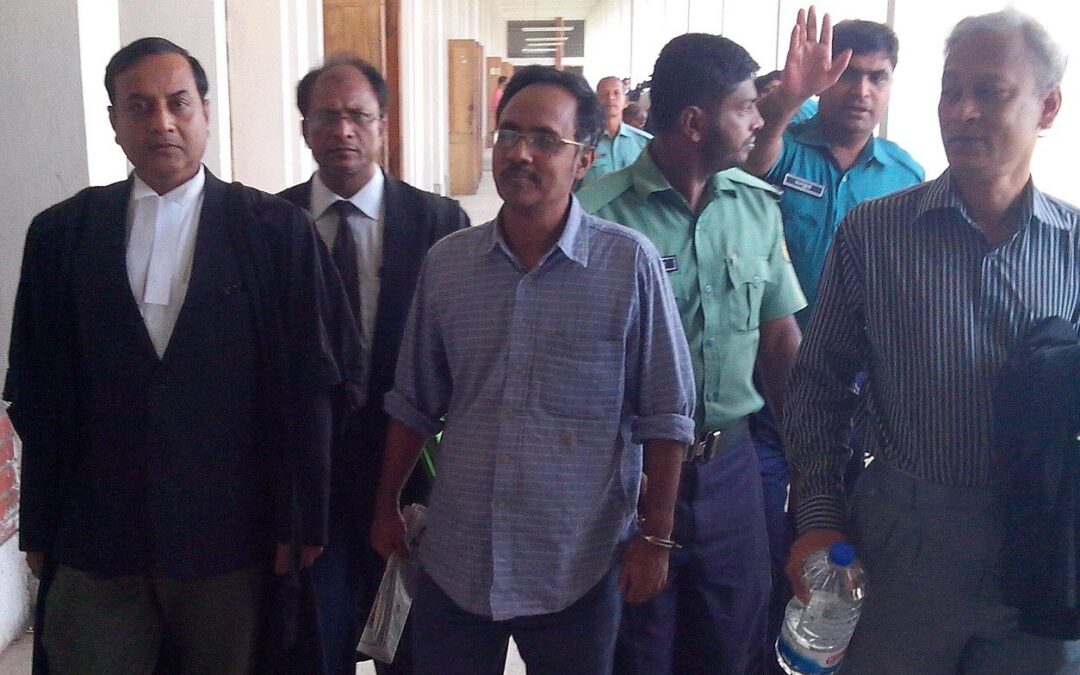
Nasiruddin Elan (in the middle on the picture) has been accused of distorting information, presenting false evidence and manipulating photographs of a Government crackdown on a rally by Hefazat-e-Islam, an Islamist political organization, in May this year.
The action reportedly resulted in multiple deaths and injuries. Odhikar had reported that 61 protestors were killed by the Rapid Action Battalion (RAB) and the police. The Government contests the number of casualties.
“What we are seeing is a continuing unlawful attack on Odhikar and voices critical of the Government,” said Ben Schonveld, ICJ’s South Asia Director. “Nasiruddin Elan is being arbitrarily detained for the lawful exercise of the right to freedom of expression and his legitimate work as a human rights defender.”
“The Government should immediately drop its opposition to Nasiruddin Elan’s bail application,” he added. “We are concerned that he will be one of the many detainees who faces torture and ill-treatment during detention, as documented by Odhikar and other human rights organizations.”
Bangladesh-Elan arrest statement-news-web story-2013 (full text in pdf)

Nov 5, 2013
The ICJ has provided a submission to the UN Committee on Economic, Social and Cultural Rights (CESCR) for its consideration during the adoption of a list of issues for the examination of the initial report of Indonesia under the International Covenant on Economic, Social and Cultural Rights.
During its meeting on 2-6 December 2013, the CESCR’s Pre-Sessional Working Group will adopt a list of issues on Indonesia. These issues will be put to the Government of Indonesia for formal response ahead of the CESCR’s full examination of the initial report of Indonesia in April/May 2014.
The ICJ’s submission raises matters and suggests concrete questions to be put to the Government of Indonesia concerning the right to freely choose work, and to just and favourable working conditions; the right to freedom of association and trade unions; the right to water; and the right to cultural life.
Indonesia-CESCR-PSWG52-ListOfIssues-LegalSubmission-2013 (download full submission in PDF)
Nov 5, 2013 | News
The ICJ condemns Bangladesh’s imposition of the death penalty in contravention of the global trend towards abolition of capital punishment.
It signifies a weakening of the rule of law and respect for human rights standards in the country.
On 5 November 2013, a special court sentenced 152 persons to death, most of them former officers of the Bangladesh Rifles (BDR), for participating in the 2009 mutiny in which 74 people were killed.
Two days earlier, the International Crimes Tribunal (ICT) had convicted Chowdhury Mueen Uddin and Ashrafuzzaman Khan in absentia for abduction and murder during Bangladesh’s liberation war in 1971 and sentenced them to death.
The ICT, set up by the Government of Bangladesh in 2010 to prosecute persons accused of committing genocide, crimes against humanity, war crimes and other serious crimes during the 1971 war, has so far convicted nine accused. Seven have been given death sentences.
“The numbers of death sentences issued by special courts in Bangladesh is alarming,” said Ben Schonveld, ICJ’s South Asia Director. “There seems little interest in seeking justice; this looks more like revenge.”
“Those responsible for committing atrocities during the Bangladeshi war of liberation and the 2009 mutiny must be prosecuted and brought to justice,” he added. “But the death penalty is a perversion of justice, even more so when imposed after trials that violate due process.”
The ICJ considers the death penalty to constitute a violation of the right to life and the right not to be subjected to cruel, inhuman or degrading punishment. The United Nations General Assembly has repeatedly called on all States to establish a moratorium on the death penalty with a view to abolition.
Under international law and standards, including the International Covenant on Civil and Political Rights, Bangladesh is required to scrupulously and strictly to observe all relevant fair trial guarantees.
This includes the right to effective legal assistance at all stages of the proceedings including the appeal.
The International Crimes Tribunal as well the Special Court set up by Bangladesh to try those accused of committing atrocities in the 2009 mutiny do not meet international standards and Bangladesh’s legal obligations concerning the right to a fair trial.
The 846 suspects tried by the special court in Dhaka for the 2009 mutiny had limited access to lawyers; did not have sufficient knowledge of the charges and evidence against them; and at least 47 suspects died while in custody, allegedly after being subjected to torture.
There are also serious procedural flaws at all stages in the ICT.
Pre-trial release has been routinely and arbitrarily denied; witnesses have been abducted and intimidated; and there have been credible allegations of collusion between the Government, prosecutors and judges.
The ICJ calls on Bangladesh to join the great majority of States around the world in rejecting the death penalty.
To that end, Bangladesh should impose a moratorium on the practice and take steps towards its abolition, as prescribed by repeated United Nations General Assembly Resolutions.
In addition, Bangladeshi authorities must order a retrial of all persons accused of participating in the 2009 mutiny and ensure that their fresh trials meet international law standards on fair trial.
Bangladesh-Death penalty statement-news-web story-2013 (full text in pdf)
Oct 29, 2013
The report explains how the historic system of statutory immunities in Nepal, compounded by the lack of political will, has prevented victims of human rights violations from obtaining effective remedy and reparation for their injuries.
The ICJ released its new 117-page report Authority without Accountability: The struggle for justice in Nepal today in Kathmandu.
During Nepal’s decade-long civil war, serious human rights abuses were committed by government security forces as well as the armed Maoist insurgents, with an estimated 17,000 persons killed, many unlawfully, and over 1,300 subject to enforced disappearance.
Despite an explicit commitment to provide for effective justice in the peace agreement between the Maoists and the government, to date, no one has been prosecuted or convicted for any conflict-related human rights violations.
Three successive governments between 2008 and 2012 have withdrawn more than 1055 criminal cases in the district courts, with many cases involving allegations of unlawful killings, torture and ill-treatment, including rape and other sexual violence.
“The political identity of the government has changed but the culture of impunity remains the same,” said Sheila Varadan, ICJ South Asia legal advisor. “Political parties continue to exploit the well-established system of political privilege and embedded impunity for personal interest and political gain.”
Numerous public officials continue to enjoy impunity for alleged violations of human rights in Nepal. For instance, Colonel Raju Basnet, suspected of being involved in the systematic enforced disappearance and torture in 2003, was promoted to Brigadier General in October 2012.
Inspector General of Police Kuber Singh Rana, who was allegedly involved in the extra-judicial killing of five students, has been promoted twice and is now the most senior police officer in the country and in charge of implementing urgent reforms that focus on accountability.
Bal Krishna Dhungel, leader of the Unified Communist Party of Nepal-Maoist (UCPN-M), was convicted of murder and sentenced to life imprisonment in 2011, but continues to be an active politician and will contest in the November 2013 parliamentary election.
Agni Sapkota, another UCPN-M Central Committee member, allegedly involved in the unlawful killing of Arjun Bahadur Lama, was appointed as Minister of Information and Communication in May 2011, despite a March 2008 Supreme Court order directing police to investigate the allegations against him.
The ICJ notes that none of the major political parties have made any tangible commitments to address accountability for human rights meaningfully, including in political manifestos in the lead up to the Constituent Assembly election in November.
“The major political parties seem unwilling to address the systemic impunity prevalent in Nepal, both for past violations and present conduct,” Varadan added.
“If there is to be lasting peace and political stability in Nepal, the people of Nepal must be afforded their right under international law to an effective remedy and reparations for violations of human rights,” Sheila Varadan said. “The Nepali people have consistently demanded justice. It’s time the politicians and military listened and delivered.”
The ICJ calls on the major political parties in Nepal to publicly pledge that, if elected, they will commit to implement the following:
(1) Ensure the new constitution does not permit any State official to grant an official pardon, withdraw a case or grant an amnesty to anyone suspected or convicted of an offence constituting a gross human rights violation or crime under international law;
(2) Enact legislation to ensure that any parliamentarian or State official against whom there are credible allegations of responsibility for gross violations of human rights or crimes under international law are suspended from service in public office, including armed forces personnel representing Nepal in international peace-keeping operations, at least pending the outcome of an independent and impartial investigation and fair trial;
(3) Limit the application of Section 5.2.7. of the Comprehensive Peace Agreement to ensure that only those cases brought during the course of the conflict and up to – and not after – the signing of the Peace Agreement are eligible for withdrawal, while also ensuring that cases involving credibly allegations of gross human rights violations are not withdrawn;
(4) Implement the decisions of the Supreme Court issuing instructions to the Attorney General and all relevant law enforcement personnel to proactively and vigorously pursue all cases alleging serious violations of international human rights law;
(5) Review the Public Security Act, 2046 (1989), the Police Act, 2012 (1955), the Armed Police Act, 2058 (2001), and the Army Act 2006, in order to remove any immunity afforded to State officials for gross violations of human rights.
Contact:
Ben Schonveld (Kathmandu), ICJ South Asia Director, t: +977 9804596661; email: ben.schonveld(a)icj.org
Sheila Varadan (Kathmandu), ICJ South Asia Legal Advisor, m: +977 9803654599 ; email: sheila.varadan(a)icj.org
Sam Zarifi (Bangkok), ICJ Asia Pacific Regional Director, m: +66 807819002 ; email: sam.zarifi(a)icj.org
Nepal-SUMMARY-Authority without Accountability-Publication-report summary-2012 (full text in pdf)
Nepal-FULL-Authority without accountability-publications-report-2012 (full text in pdf)

Oct 10, 2013 | News
The ICJ calls on the Dhaka Central Jail authority to immediately process an order for bail issued for the release of Adilur Rahman Khan.
The six-month bail was ordered by the High Court of Bangladesh on 8 October 2013.
The Attorney General filed an application seeking a stay on the bail order, which was denied by the Appellate Division of the Supreme Court of Bangladesh on 9 October 2013.
The bail order was signed by the required Sessions Judge and delivered to the Dhaka Central Jail in the late afternoon on 9 October 2013.
Over 24 hours later, Adilur Rahman Khan still remains in custody in the Kashimpur Jail.
“The bail order must be carried out expeditiously without undue delay or other obstruction, including by the Executive. To do so would undermine the independence of the judiciary and constitute arbitrary detention,” said Ben Schonveld, ICJ South Asia Director.
It has been two months to the day that Adilur Rahman Khan was arbitrarily detained for the lawful exercise of the right to freedom of expression, the ICJ recalls.
Under international law, notably Article 9 of the International Covenant on Civil and Political Rights, to which Bangladesh is a party, everyone has a right to liberty and security of person.
Any detention or deprivation of liberty must be in accordance with procedures established by law.
The ICJ calls on the jail authorities to uphold the order of the Appellate Division of the Supreme Court of Bangladesh and immediately release Adilur Rahman Khan on bail.
CONTACT:
Sheila Varadan, ICJ Legal Advisor, South Asia Programme (Bangkok), t: +66 857200723; email: sheila.varadan(a)icj.org