Sep 30, 2013
The ICJ has issued a briefing paper explaining the international legal issues and underlying political context of the case against Nepali Army officer Colonel Kumar Lama in a Question and Answer format.
The case against Nepali Army officer Colonel Kumar Lama, arrested in the United Kingdom on allegations that he was responsible for torture in Nepal, will come before the UK criminal court on 21 October 2013.
“This decision has far reaching implications, not only for the victims in this case but for all victims of torture around the world seeking justice,” said Sheila Varadan, ICJ Legal Advisor for South Asia.
Colonel Kumar Lama was arrested on the morning of Thursday, 3 January 2013 in the UK while he was on leave from his duties as a United Nations Peacekeeper in Sudan.
Exercising the principle of universal jurisdiction, Colonel Lama was charged with two counts of committing torture under Section 134(1) of the Criminal Justice Act 1988 in the United Kingdom.
“This is the first time the UK courts are seriously considering the principle of universal jurisdiction since the Augusto Pinochet case,” Varadan added.
The charges are based on allegations that Colonel Lama participated in the torture of two Nepali detainees in 2005, at the height of Nepal’s decade-long internal armed conflict.
“The case comes at a time when ongoing impunity is causing serious political instability in Nepal and calls for transitional justice mechanism continue to go unheard,” Varadan said.
CONTACTS
Sheila Varadan, ICJ South Asia Legal Adviser (Bangkok), t: +66 857 200 723 (mobile); email: sheila.varadan(a)icj.org
Ben Schonveld, ICJ South Asia Director (Kathmandu), t: +9779804596661 (mobile); email: ben.schonveld(a)icj.org
Nepal-LAMA Case Q & A -advocacy-analysis brief-2013 (full text in pdf)

Sep 26, 2013
The ICJ today called on the UN Human Rights Council to prepare to take action in March 2014 if the Government of Sri Lanka continues to fail to take concrete steps to ensure justice and accountability.
In response to an oral update of the High Commissioner for Human Rights on her mission to Sri Lanka and the implementation of Human Rights Council resolution 22/1 on promoting reconciliation and accountability in Sri Lanka, the ICJ expressed deep concern that critical measures on accountability, such as those called for in the resolution, are not being adequately implemented. Noting that the High Commissioner will present a comprehensive report to the Council during the 25th session of the Council in March 2014, the ICJ called on Council members to be ready to act in order to ensure justice and accountability for alleged gross violations of international human rights law and serious violations of international humanitarian law in Sri Lanka.
The statement was made in a General Debate under item 10 of the Council’s agenda during the 24th regular session of the Council (9 to 27 September 2013).
SriLanka-HRC24-Item10-OralStatementGD-LegalSubmission-2013 (download full statement in PDF)

Sep 25, 2013 | News
The ICJ continues to be disappointed over the continued arbitrary detention and refusal of bail of Secretary of human rights organization, Odhikar, and Supreme Court Advocate Adilur Rahman Khan.
The ICJ urged the Bangladeshi authorities to drop their opposition to Adilur Rahman Khan’s bail application.
On 25 September 2013, a cyber crimes tribunal in Dhaka refused Adilur Rahman Khan’s bail application. He had earlier been denied bail on 11 August 2013 and 9 September 2013.
“Adilur Rahman Khan is being arbitrarily detained for his lawful exercise of the right to freedom of expression and his legitimate work as a human rights defender,” said Ben Schonveld, ICJ’s South Asia Director. “What we are seeing is a Government crackdown on voices of dissent.”
Under international law, all persons are presumed innocent until proven guilty.
Under Article 9 of the International Covenant on Civil and Political Rights (ICCPR), to which Bangladesh is a party, there is a presumption of pre-trial release.
A person can only be denied pre-trial release where it is reasonable and necessary in all of the circumstances to prevent absconding, interference with evidence or recidivism.
“The Government cannot show that Adilur Rahman Khan poses a flight risk,” Schonveld added. “In fact, he faces a serious threat of torture and ill-treatment during detention, as documented by Odhikar and other human rights organizations.”
The ICJ reiterates its call on Bangladesh to immediately and unconditionally drop all charges against Adilur Rahman Khan and Nasiruddin Elan, ensure Adilur Rahman Khan is treated in accordance with international law in custody, and cease its harassment of Odhikar.
Contact
Ben Schonveld, ICJ South Asia Director (Kathmandu), t: +977 14432651; email: ben.schonveld(a)icj.org

Sep 23, 2013
The ICJ today called on Nepal to take urgent steps to implement recommendations on ending impunity accepted by the country during its first cycle Universal Periodic Review (UPR) in 2011.
In a General Debate under Item 6 of the Human Rights Council’s agenda (UPR), the ICJ pointed to Nepal’s failure to take concrete action to implement recommendations accepted by the country during its 2011 UPR as now visibly destabilising the country. It called on Nepal to take urgent measures to:
- Ensure that the truth and reconciliation commission, and a separate ‘disappearances’ commission to be established, conform fully with international standards including by precluding amnesty for gross human rights violations;
- Ensure that human rights violations constituting crimes under international law are recognised as distinct criminal offences under Nepali law; and
- Immediately commit to implement relevant Supreme Court rulings within a clearly stipulated time.
Nepal’s first cycle UPR took place in 2011. The Government of Nepal adopted a UPR implementation plan in 2012. The implementation plan failed, however, to set out timeframes for implementation or establish means to measure progress.
The General Debate took place during the 24th regular session of the Human Rights Council (9 to 27 September 2013).
Nepal-HRC24-Item6-OralStatementGD-LegalSubmission-2013 (download full statement in PDF)
Sep 19, 2013 | News
The ongoing involvement of the lead prosecutor in the hearing on the appeal against the acquittal of opposition leader, Anwar Ibrahim, raises concerns about prosecutorial impartiality, the ICJ said today.
The ICJ is particularly concerned at the failure of the lead prosecutor, Datuk Seri Muhammad Shafee Abdullah, who was said to have some prior knowledge of the facts of the case, to remove himself from involvement in the proceedings and so maintain an appearance of prosecutorial integrity and impartiality.
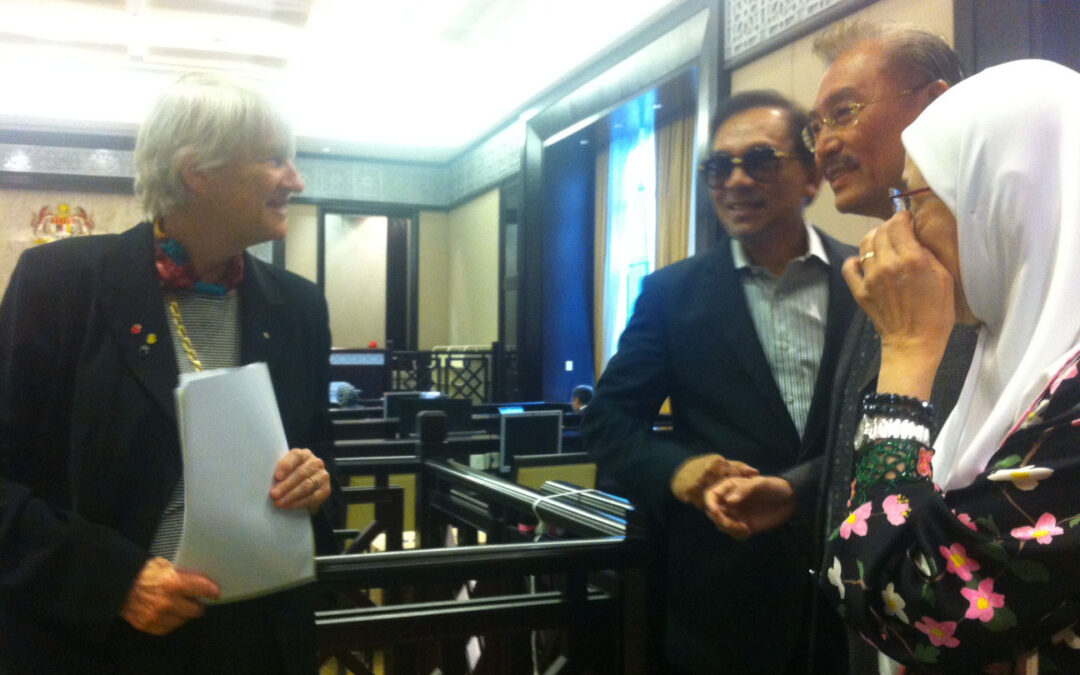
“This case is a significant test of the integrity of the judicial system in Malaysia, which for so long has been the subject of concern to human rights proponents, bodies and organizations,” said Justice Elizabeth Evatt, a Commissioner of the ICJ who was observing the proceedings.
The hearing on the appeal was postponed to allow the preliminary objection raised on the first day, 17 September, by the lawyers of Anwar Ibrahim against Judge Tengku Maimun Tuan Mat’s selection as a member of the three-person panel to hear the appeal.
The defense lawyers argued that there was a perception of bias due to Judge Tengku Maimun Tuan Mat’s former ruling in a libel suit involving Anwar Ibrahim and the then Prime Minister Mahathir Mohamad in 2007.
Judge Tengku Maimum Tuan Mat thereafter recused herself from the proceedings.
The Court of Appeal therefore reconvened on the second day, 18 September, with a new judge, Dato’ Rohana Binti Yusuf, to hear the motion objecting to the appointment of Datuk Seri Muhammad Shafee Abdullah as lead prosecutor in the case.
The motion was based partly on the fact that that Datuk Seri Muhammad Shafee Abdullah was present at Deputy Prime Minister Najib’s home at the same time as the complainant two days before the incidents leading to the filing of charges against Anwar Ibrahim.
At the very beginning of the case, Datuk Seri Muhammad Shafee Abdullah filed an affidavit concerning this fact, although he was not called as a witness in the proceedings.
The Court later denied the motion objecting to his appointment as lead prosecutor in this appeal, saying that there was no conflict of interest or apparent unfairness.
Justice Evatt, however, expressed concern that Datuk Seri Muhammad Shafee Abdullah had taken on the role of lead prosecutor in the appeal.
“We expect higher standards of prosecutorial conduct,” she said. “Considering the political overtones in this case, Datuk Seri Muhammad Shafee Abdullah should be especially sensitive to any appearance that might lead to a perception of bias and partiality that might arise from his earlier knowledge of facts of the case.”
The UN Guidelines on the Role of Prosecutors provide that in the performance of their duties, prosecutors shall carry out their duties with impartiality.
The ICJ also acknowledged Judge Tengku Maimun Tuan Mat’s recusal as a sign that the Court of Appeal recognized the need to appear impartial. Under the UN Basic Principles on the Independence of the Judiciary, “judges shall always conduct themselves in a manner as to preserve the dignity of their office and the impartiality and independence of the judiciary.”
The Bangalore Principles of Judicial Conduct, state that to ensure such impartiality “a judge shall disqualify himself or herself from participating in any proceedings in which it may appear to a reasonable observer that the judge is unable to decide the matter impartially.”
The Court did not indicate new dates on when the hearing on the appeal would take place. The ICJ will continue to monitor this case.
The ICJ has previously condemned Malaysia’s continuing use of colonial-era criminal charges of ‘sodomy’ to cover even consensual sexual relations between adults.
The ICJ believes that Article 377B of the Malaysian Penal Code is inconsistent with respect for the right to privacy under international standards.
Justice Evatt, the first female judge to be appointed to an Australian Federal Court, a former member of the United Nations Human Rights Committee, and a commissioner of the ICJ, traveled to Malaysia to observe the appeal hearing from 17 to 18 September 2013, at the Court of Appeal in Putrajaya.
Contact:
Emerlynne Gil, International Legal Adviser, t +662 6198477 ext. 206 ; email: emerlynne.gil(a)icj.org