Jun 24, 2013 | News
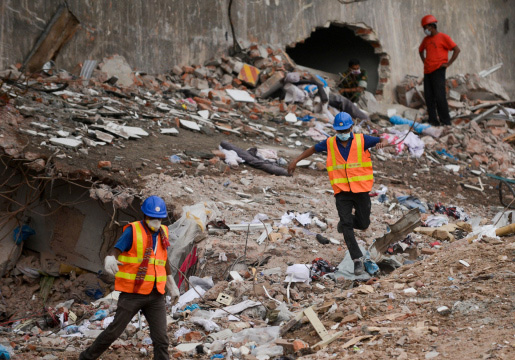
The recent Rana Plaza building disaster, in Bangladesh, could, and should, have been averted if the government had performed its obligation to adequately protect the workers, the ICJ said today.
“The Rana Plaza collapse, which killed 1,131 workers and injured close to 2,500 others, is the most recent in a long list of industrial disasters brought about by the government’s failure to regulate and monitor workplace conditions and sanction private entities violating the law,” said Sheila Varadan, ICJ Legal Advisor on South Asia. “To single out and focus solely on the role of multi-national companies does not reflect the full picture.”
“While the ICJ does not minimize the responsibility of private enterprises, unless the underlying systemic issues such as institutional weaknesses, corruption and lack of enforcement are addressed, such tragedies will continue to happen,” Varadan added.
Litigation is a vital tool to ensure accountability, remedy and reparations, where government agencies fail in their essential functions.
The Bangladesh Legal Aid and Services Trust (BLAST), a leading national human rights organization, has been petitioning the Supreme Court over the past decade, obtaining orders against government agencies and seeking compensation for victims and their families in work-related disasters.
“The government of Bangladesh must take active measures to ensure its regulatory framework is adequate and effective; its laws are rigorously enforced; and victims are adequately compensated,” Varadan also said. “Failing to do so not only violates Bangladeshi law but is also in breach of Bangladesh’s obligations to protect human rights under international law.”
CONTACT:
Sheila Varadan, ICJ Legal Advisor, South Asia Programme (Bangkok), t: +66 857200723; email: sheila.varadan(at)icj.org
Sam Zarifi, ICJ Asia-Pacific Regional Director, (Bangkok), t:+66 807819002; email: sam.zarifi(at)icj.org
Bangladesh-Rana Plaza-Public interest litigation-backgrounder-featured article-2013 (full text in pdf)
Bangladesh-WGBHR5-OralStatement-LegalSubmission-2013 (full statement to the Working Group on Business and Human Rights)

Jun 12, 2013
The ICJ has submitted an alternative report to the Human Rights Committee for the evaluation of Indonesia’s implementation of the International Covenant on Civil and Political Rights (ICCPR).
In its submission, prepared as a report alternative to Indonesia’s initial report to the Human Rights Committee, the ICJ addresses issues concerning the right to an effective remedy; the right to life; and rights of persons belonging to minorities. This follows the ICJ’s submission of information to the Committee in December 2012 in the preparation of a list of issues for the examination of Indonesia. The current report calls on the Committee to make recommendations on articles 2, 6, 7 and 27 of the ICCPR.
The initial report of Indonesia will be considered by the Human Rights Committee during its 108th session held in Geneva on 8 to 26 July 2013, following which the Committee will adopt Concluding Observations with recommendations.
Indonesia-HRCttee108-ICJ-AlternativeReport-LegalSubmission-2013 (download full alternative report by the ICJ)
ICJ submission on the list of issues for the examination of Indonesia

May 31, 2013 | Agendas, Events
Some 30 judges from the highest national courts from 16 countries in Asia and the Pacific will meet in Bangkok, Thailand on 2-4 June to discuss the role of the judiciary in the AIDS response.
The meeting is convened by the Joint United Nations Programme on HIV/AIDS (UNAIDS), the United Nations Development Programme (UNDP) and the ICJ as part of efforts to address concerns that legal environments, including laws and policies, law enforcement practices and access to justice across the Asia and the Pacific do not consistently protect people most at risk of HIV infection and those living with HIV from violations of their human rights including health, privacy, non-discrimination and freedom from violence.
The judges’ discussions will be supported by experts and resource people from communities living with HIV, representatives of sex workers and men who have sex with men, people who use drugs and transgender people and United Nations entities.
The ICJ has always believed that an independent judiciary is essential in delivering justice to vulnerable populations, including those living/infected with HIV.
As Mr. Sam Zarifi, Regional Director for Asia and the Pacific, said: “The judiciary has a crucial role to play in establishing a legal environment that assists the struggle against the spread of HIV. In Asia and the Pacific, those most at risk of contracting HIV are often among those with the least access to justice. An independent judiciary can help protect at-risk populations from discriminatory laws, negative stereotypes, and misguided policies.”

May 30, 2013
The ICJ today addressed the Human Rights Council, and the Special Rapporteur on the independence of judges and lawyers, concerning the need for protection of lawyers in Viet Nam.
In an interactive dialogue with the Special Rapporteur on the independence of judges and lawyers, Gabriela Knaul, the ICJ emphasised that legal aid (the subject of the Special Rapporteur’s report to the Council) is fruitless without proper protection of the legal profession. Referring to articles 16-18 of the UN Basic Principles on the Role of Lawyers, the ICJ drew attention to challenges faced by human rights lawyers in Viet Nam, particularly those who have been disbarred and not allowed to practice in their work representing victims of discrimination and land confiscation.
The ICJ urged the Government of Viet Nam to extend to the Special Rapporteur an invitation to undertake a mission to Viet Nam and to cooperate with her and allow her to effectively consider these and other obstacles to the effective functioning of the legal profession in the country.
The statement was delivered under Item 3 (promotion and protection of all human rights) of the agenda of the Human Rights Council’s 23rd regular session (27 May to 14 June 2013).
VietNam-HRC23-OralStatementIJL-LegalSubmission-2013 (download ICJ oral statement)
May 5, 2013 | News, Op-eds
An opinion piece by Benjamin Zawacki, Senior Legal Adviser for Southeast Asia at the International Commission of Jurists.
Thailand’s government recently passed up an opportunity for a new approach to the deep South, by declining to replace the Emergency Decree, which violates international standards on human rights, with the somewhat less heavy-handed Internal Security Act (ISA).
Equally concerning is why the government has not looked beyond the South in reconsidering the use of its other extraordinary security legislation: no fewer than 31 of Thailand’s 77 provinces are at least partially under Martial Law.
International law is clear that the extraordinary powers under security laws like the Emergency Decree and Martial Law may only be invoked under a strict set of circumstances, none of which is even arguably applicable in Thailand outside of the southern insurgency (four of the 31 provinces).
Martial Law may be invoked in Thailand “when a situation arises that makes it necessary to maintain law and order and to defend against the danger of attack”, or “when there is an outbreak of war or unrest”. All of Thailand’s provinces that are situated on one of the country’s four international borders are under Martial Law in whole or in part (including the 27 not in the deep South). Among them is Phitsanulok, whose shared border with Laos is roughly only 50km.
This province featured in Thailand’s last war, a three-month affair with Laos that ended in 1988.
Otherwise, Thailand’s border challenges are well-known: trafficking in persons, drugs, and weapons; landmines; refugees and migrants; smuggling of logs, oil, and other contraband; demarcation disputes. While doubtless all of these call for robust law enforcement, only the dispute with Cambodia over the Preah Vihear temple even arguably involves defending against the danger of armed attack.
Several minor but deadly skirmishes with Cambodian forces, as well as considerable mutual saber-rattling, have occurred in several districts of Si Sa Ket province since 2009. It is not credible to claim that Thailand needs to impose Martial Law because of external threats.
A more likely explanation is that Martial Law’s expansive application in Thailand is due to what is common to most security legislation around the region, namely vague language that lends itself to broad interpretation and granting wide powers to the military.
The Martial Law term “law and order”, in addition to more typically applying to civilian law enforcement agencies than to the military, could apply to any situation in which a law is implicated – which is nearly all situations. “Order” and “unrest” are particularly ill-defined.
Moreover, “maintain” suggests law and order need only be threatened to invoke Martial Law, rather than be lost and in need of being restored.
What constitutes an “attack” and the likelihood of such required for Thailand to be in “danger” are also essentially judgment calls. And when is an attack (or a series of attacks) tantamount to an “outbreak of war”?
A second and related reason that Martial Law is so pervasive in Thailand is the large number of military personnel empowered to invoke the law, coupled with, inversely, the difficulty in revoking it later.
While order by royal decree is required for invoking Martial Law on the first set of grounds, even local military commanders can invoke Martial Law in the area under their control on the second set (“when there is an outbreak of war or unrest”), affording them enormous discretion and authority.
In contrast, any and all revocations of the law require order by royal decree, a level of involvement as centralized and bureaucratic as a district military commander’s invocation is local and simple.
Martial Law’s use in Thailand historically supports the analysis that imprecise grounds combined with bureaucratic inertia account for the wide geographical application of the law.
Twice in the past 22 years, orders by royal decree referencing “law and order” have imposed Martial Law on the whole of Thailand, both times via coups d’état in 1991 and 2006.
On only three occasions after the 1991 coup (twice later the same year and once in 1998) was Martial Law lifted in some but not all of Thailand’s provinces. On the eve of the 2006 coup, it was still in effect in all or part of 18 provinces.
Similarly, following the blanket invocation of Martial Law on the whole country in 2006, on only two occasions since (in January 2007 and 2008, respectively) has an order by royal decree revoked the law in 46 of Thailand’s 77 provinces. Why not everywhere?
International law requires that extraordinary security legislation be invoked only in response to an exceptional situation.
Powers granted to security forces and any derogation from human rights must be strictly necessary and proportionate to the situation, and must have a time limitation attached to them.
None of these elements is met in the case of Thailand’s application of Martial Law to its international borders.
Indeed, Martial Law in Thailand allows security forces to arrest people without a warrant, and to detain them for seven days prior to charging them.
Critically, it does not require that detainees be promptly brought before a judge, in flagrant violation of Thailand’s legal obligations under the International Covenant on Civil and Political Rights (ICCPR).
This leaves detainees particularly vulnerable to torture or other ill-treatment at the hands of the security forces, which Thailand has also agreed to prevent and punish as a party to the ICCPR and the Convention against Torture.
In cases under Martial Law of alleged misconduct by security forces, victims are unable to institute a criminal prosecution (though they may initiate a civil action) or to choose their own lawyer; only a military prosecutor is entitled to institute a criminal charge. No appeal can be lodged against judgments or orders of military courts during this period.
The Thai government should reconsider its decision to keep the Emergency Decree in place throughout most of the deep South.
At the same time, it should take the long overdue step of lifting an equally heavy-handed Martial Law everywhere else.