
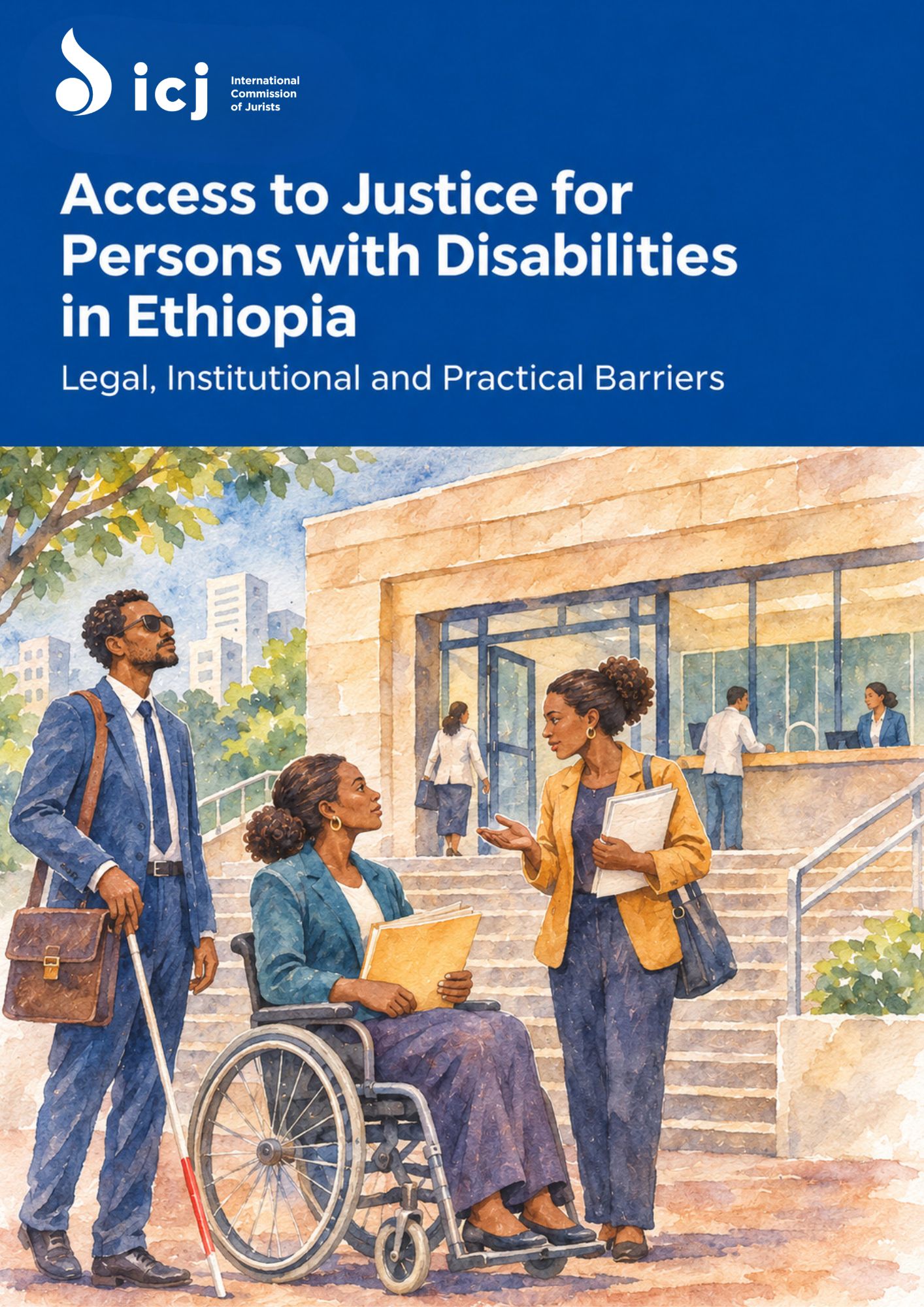
The International Commission of Jurists (ICJ) launched its report “Access to Justice for Persons with Disabilities in Ethiopia: Legal, Institutional and Practical Barriers” on 18 November 2026 in Addis Ababa, Ethiopia. The report finds that, more than 16 years after Ethiopia ratified the UN Convention on the Rights of Persons with Disabilities (CRPD), laws, institutions and practices still prevent persons with disabilities from accessing justice on an equal basis with others.
The launch event, organized in collaboration with the Ethiopian Lawyers with Disabilities Association (ELDA), brought together persons with disabilities, representatives of organizations of persons with disabilities (OPDs), researchers, lawyers with disabilities, government authorities’ representatives, justice officials, and representatives of the Ethiopian Human Rights Commission.
“The report shows that barriers to access to justice are not only in justice actors’ attitudes and beliefs about persons with disabilities. Discriminatory practices and procedures are written into many of Ethiopia’s laws.
Key examples include the Civil Code and even the newly enacted Criminal Procedure and Evidence Code, which do not fully protect the agency and legal capacity of persons with disabilities. The result is that individuals with disabilities are often excluded from participating effectively – or at all – in important judicial proceedings and processes, and they may even be committed to an institution and deprived of their liberty as a result. These are laws that, at the very least, Ethiopia is obliged to revise to comply with its legal obligations under the CRPD,” said Wilson Macharia, Legal Advisor at the ICJ.
Delivering the keynote address at the launch event, Rigbe Gebrehawaria Hagos, member-elect of the UN Committee on the Rights of Persons with Disabilities (CRPD Committee), stressed that justice must be built around the people it serves:
“For too long, persons with disabilities have been expected to fit the system. The system must instead be fashioned to fit them. That should be the guiding principle, and justice must be tailored to the person who actually arrives [at the courts].”
She also noted the importance of the timing of the report’s publication:
“This report arrives at a timely moment. On 4 November 2026, the CRPD Committee issued its List of Issues, which asks the State [Ethiopia], among other matters, to explain how courts and judicial proceedings are accessible, including through Ethiopian Sign Language interpretation, Braille and Easy Read; how procedural accommodations are provided at every stage; and when guardianship will be repealed and supported decision-making recognized.”
The ICJ made a submission to the CRPD Committee in respect of access to justice for persons with disabilities, drawing on the research undertaken to compile the report launched on 18 November.
The report assesses Ethiopia’s Constitution, laws, policies and institutions against the CRPD, drawing on legal analysis and consultations with persons with disabilities working in the justice sector, lawyers, OPDs and government officials.
Some of the key findings of the report include:
- Legal capacity is still restricted by law. The Civil Code of 1960, the Revised Family Code of 2000, and the Civil Procedure Code of 1965 treat persons labelled “insane” or “infirm” as legally incapable and rely on substituted decision-making (such as guardianship), rather than supported decision-making.
- Criminal laws allow exclusion of persons with disabilities from trial and their detention. The Criminal Code of 2004 empowers courts to find a person with intellectual and/or psychosocial disabilities, who is found “incapable of understanding the nature or consequences of his act” criminally irresponsible, and then to confine such an individual to an institution. The new Criminal Procedure and Evidence Code (Proclamation No. 1410/2026), adopted in April 2026, empowers courts to stop a witness from testifying because of their “mental illness”.
- Courts and information remain inaccessible. Accessibility requirements are set out in the Building Proclamation No. 1356/2024 and in related regulations and directives, but implementation is weak: many court buildings and trial rooms remain inaccessible, and no timeframe exists for retrofitting existing buildings. Court documents and electronic file systems are largely inaccessible to users who are blind or otherwise visually impaired, and no accessibility standards are applied to digital justice systems.
- No general duty to provide procedural accommodations. Neither the Civil Procedure Code (1965) nor the new Criminal Procedure and Evidence Code (Proclamation No. 1410/2026), places a general obligation on courts to adapt proceedings to the needs of persons with disabilities. Ethiopian law recognizes only limited measures that amount to procedural accommodation, mainly legal representation and sign language interpretation in judicial proceedings. Justice intermediaries as support persons are not provided for.
- Legal aid is scattered and limited. There is no dedicated legal aid law, and the statutory guarantees for legal aid are scattered. In practice, availability of legal services to persons with disabilities depends primarily on the limited capacity of OPDs, such as Ethiopian Lawyers with Disabilities Association (ELDA).
- Lawyers with disabilities remain excluded from the bench. In 2016, the House of Federation held that excluding law graduates who are blind or otherwise visually impaired from judicial office is discriminatory. Yet no lawyer who is blind or otherwise visually impaired is known to serve as a judge in Ethiopia. Judicial recruitment rules are silent on inclusion, and lawyers with disabilities already working in the justice sector lack reliable access to personal assistants, assistive technology, and accessible legal materials.
The report makes detailed recommendations to Ethiopian authorities, including the legislature, the executive, and the judiciary, to ensure compliance with the country’s legal obligations under the CRPD and other international human rights law and standards.
Download
The full report is available here.
A summary of the report is available here.
Unofficial translation of selected provisions of the Criminal Procedure and Evidence Code of Ethiopia (Proclamation No. 1410/2026) is available here
Background
Ethiopia ratified the CRPD in 2010. In its 2016 Concluding Observations, the CRPD Committee called on Ethiopia to: repeal laws that restrict legal capacity, including provisions allowing persons to be declared unfit to stand trial; ensure procedural accommodations at all stages of judicial proceedings and processes; ensure the accessibility of justice institutions, services, information and communication systems; guarantee the equal participation of persons with disabilities in the administration of justice; and conduct capacity-building and awareness-raising among justice sector actors. The Committee’s 2026 List of Issues raises similar concerns, and the ICJ’s July 2026 submission to the Committee, based on the report launched on 18 November, addressed the same issues.
Contact
Marishet Hamza, Disability Rights Researcher and Consultant, ICJ Africa Regional Programme, marishet.hamza@icj.org