
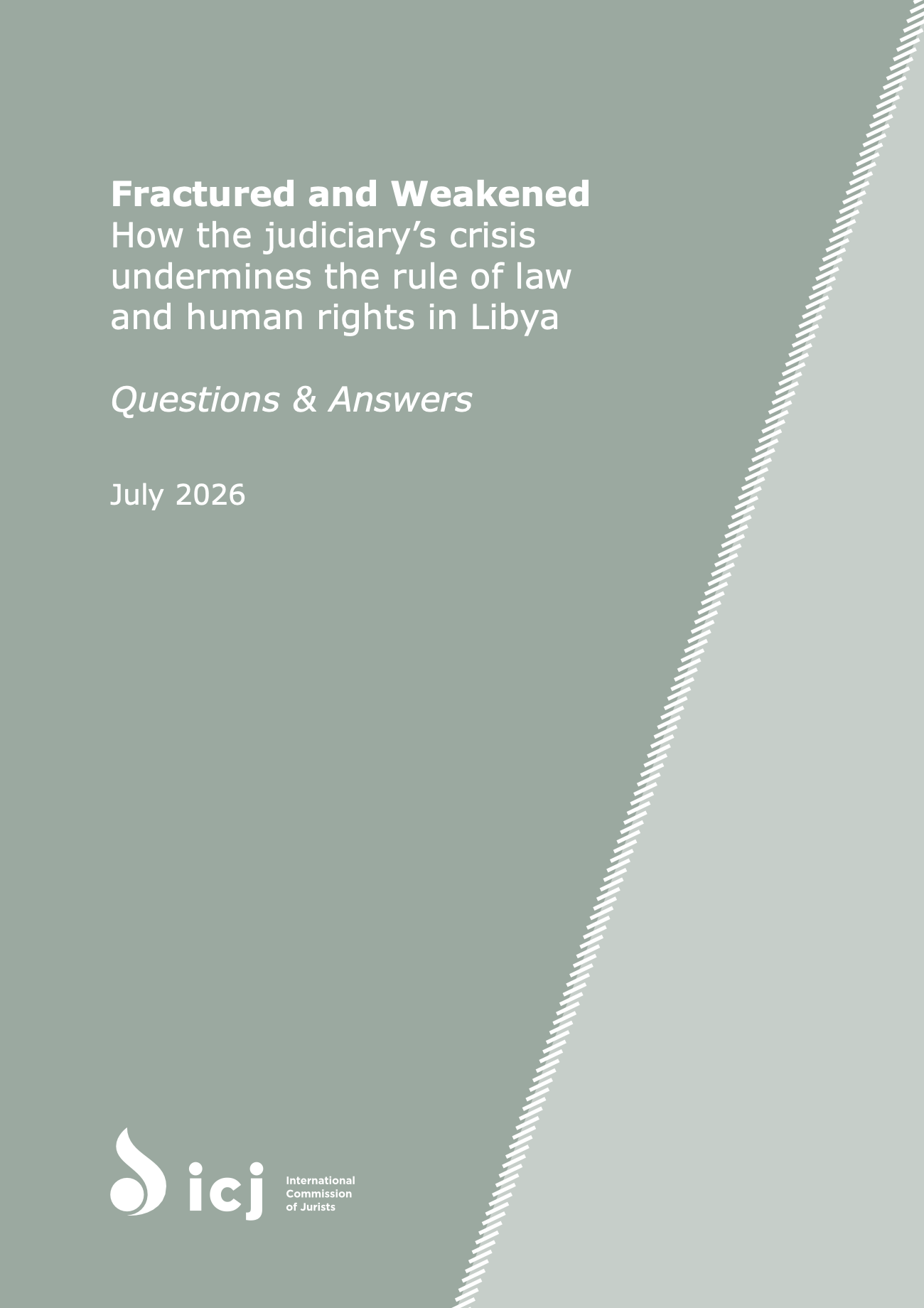
In a new questions-and-answers briefing, the International Commission of Jurists (ICJ) retraces the circumstances that have led to the Libyan judiciary’s acute fragmentation.
.هذا البيان الصحفي متوفر باللغة العربية أيضاً
Since early 2023, Libya’s House of Representatives (HoR) – the legislative body elected in 2014, based in Tobruk, in the East of the country – has adopted a series of laws undermining the unity and independence of Libya’s judiciary. Consequently, there are presently two constitutional judicial bodies competing with one another: the Supreme Court’s Constitutional Chamber in Tripoli, and the Supreme Constitutional Court in Benghazi, in the East of the country, which became operational in December 2025. Each of them has been trying to assert its own, sole and exclusive constitutional jurisdiction in Libya to the detriment of the other by handing down conflicting rulings. As a result, two Supreme Judicial Councils (SJCs) have also been competing over control of the Libyan judiciary, including over the SJC’s own headquarters.
“The HoR’s laws on the SJC and the Supreme Constitutional Court violate Libya’s legal obligations under international law, and create a situation of structural legal uncertainty, if not chaos, where human rights protection in the country is increasingly at risk; where the existing limited checks and balances are further weakened; and where the integrity of any future electoral and constitutional arrangements is in peril”, said Saïd Benarbia, ICJ Middle East and North Africa Programme Director. “The Libyan authorities must safeguard the independence and unity of the Tripoli-based Supreme Court, including its Constitutional Chamber, and of the SJC.”
The Q&A answers the following questions:
- Why are there two constitutional jurisdictions competing with one another in Libya?
- Why are there two Supreme Judicial Councils competing with one another in Libya?
- How does the HoR’s interference with judicial independence undermine Libya’s legal obligations under international human rights law?
- How does the fragmentation of the Libyan judiciary undermine the rule of law?
- How does the fragmentation of the Libyan judiciary undermine human rights protection?
Download
This briefing can be downloaded in English and Arabic.
Contact
Saïd Benarbia, Director, ICJ Middle East and North Africa Programme; t: +41 22 979 3800, e: said.benarbia@icj.org
Nour Al Hajj, Regional Communications & Advocacy Officer, ICJ Middle East and North Africa Programme; e: nour.alhajj@icj.org