Feb 3, 2015 | News
The ICJ condemns yesterday’s decision of the Giza Felonies Court to confirm the death sentences of 183 individuals that had been simultaneously imposed in one mass trial.
The charges include murder, mutilation and attempted murder and relate to an attack on a police station in Kerdasa that took place in August 2013.
According to the ICJ, the trial has involved a litany of violations of fair trial rights, including denying many of the accused the right to legal counsel, denying the right to a public hearing, refusing to allow defence witnesses to testify, prohibiting the cross-examination of prosecution witnesses by defence counsel, and failing to produce credible evidence as to the individual guilt of each accused.
“Once again, Egypt’s judiciary has abdicated its fundamental responsibility to uphold the rule of law and human rights, instead resorting to unfair mass trials and death sentences as a technique to suppress dissent and to crack down on critics of the military and Government,” said Said Benarbia, Director of the ICJ MENA Programme.
“Egypt’s judiciary must act independently, impartially, with integrity and as a check against the Executive’s arbitrary powers and policies, not as a tool to implement them,” he added.
The imposition of death sentences following unfair mass trials constitutes a gross violation of Egypt’s obligations under international human rights law, including those relating to the right to life, the prohibition of torture and other cruel, inhuman or degrading treatment or punishment, and fair trial rights.
The ICJ opposes the use of the death penalty in all circumstances as a violation of the right to life and a form of cruel, inhuman and degrading punishment.
The UN General Assembly has repeatedly, by a large majority, called for a moratorium on its use.
Even those states that retain the death penalty have acknowledged that any imposition of the death penalty through a process that fails to meet the most stringent fair trial standards, inherently violates the right to life.
Contact:
Said Benarbia, ICJ Director of the ICJ Middle East and North Africa Programme, t: 41 22 979 38 17, e: said.benarbia(a)icj.org

Jan 6, 2015 | News
The Pakistan Parliament’s legislation allowing civilians to be tried by military tribunals is a serious blow to human rights and rule of law in the country, the ICJ said today.

Dec 13, 2014 | News
The ICJ condemned decision of the People’s Supreme Court on 12 December 2014 affirming the unfair convictions of human rights defenders Bui Thi Minh Hang, Nguyen Van Minh and Nguyen Thi Thuy Quynh respectively to three, two-and-a half and two years imprisonment.

Nov 19, 2014 | News
Thailand must end immediately the prosecution of civilians in military tribunals and transfer all remaining cases to the civilian courts, said the International Commission of Jurists (ICJ) today.
On 18 November 2014, the Bangkok Military Tribunal convicted a political broadcaster, Khathawut B., of lese majeste under article 112 of the Thai Criminal Code and Article 14 of the Computer Crimes Act, and sentenced him to five years in jail following a plea of guilty. The court barred observers and the public from the proceedings on the ground that they “concerned matters of national security.”
There is no appeal possible under article 61 of the Thai Act for the Organization of the Military Court so long as Thailand remains under Martial Law, which has been in force nationwide since May 22.
“Under international standards, civilians should not be subject to the jurisdiction of military tribunals, particularly where, like in military-ruled Thailand, military tribunals lack the institutional independence from the executive required by international law regarding fair trials. Thus, civilians convicted before such tribunals should have the right to a new trial before a civilian court,” said Wilder Tayler, Secretary General of the ICJ. “This case also highlights another very serious problem with the state of human rights in Thailand: Thailand’s misuse of criminal defamation laws to imprison people exercising their right to freedom of expression.
The National Council for Peace and Order (NCPO) extended the jurisdiction of military tribunals over civilians after it took power by a coup d’etat and imposed Martial Law throughout Thailand. Prior to this, civilians had not been subject to military jurisdiction in Thailand for crimes not directly involving the military for decades, including during the state of emergency in place in southern Thailand since 2004.
Among crimes now within the jurisdiction of military tribunals in Thailand is lese majeste – criminalizing the making of statements that could be construed as defaming or insulting the Thai Monarchy. Such broad restrictions violate the right to freedom of expression guaranteed under article 19 of the International Covenant on Civil and Political Rights (ICCPR), to which Thailand is a state party.
Since the coup, at least 69 civilians have faced prosecution before military tribunals in Thailand on charges ranging from breaching NCPO orders, to planning a terrorist act and lese majeste.
Under article 14 of the ICCPR, everyone has the right to a “fair and public hearing by a competent, independent and impartial tribunal established by law.” The imposition of Martial Law, and the State’s suspension of some of its obligations under the ICCPR, including the right to appeal guaranteed by article 14(5) for cases heard by military tribunals, does not affect the applicability of this provision.
“All prosecutions of civilians before military tribunals must be transferred to civilian courts immediately, if Thailand is to comply with its international obligations,” said Tayler. “There is absolutely no excuse or justification for the use of military tribunals to prosecute civilians in Thailand, and especially not for simply exercising the right to freedom of expression.”
The Draft Principles Governing the Administration of Justice through Military Tribunals, set out principles that apply to state use of military tribunals.
Principle 5 states “Military courts should, in principle, have no jurisdiction to try civilians. In all circumstances, the State shall ensure that civilians accused of a criminal offence of any nature are tried by civilian courts.”
Further, Principle 2 states “Military tribunals must in all circumstances apply standards and procedures internationally recognized as guarantees of a fair trial.” Military tribunals must in all circumstances respect the principles of international law relating to a fair trial, even in times of crisis.
Thailand-military courts-news-press release-2014-THAI (full text, PDF)
Oct 16, 2014 | Advocacy, Analysis briefs, News, Open letters
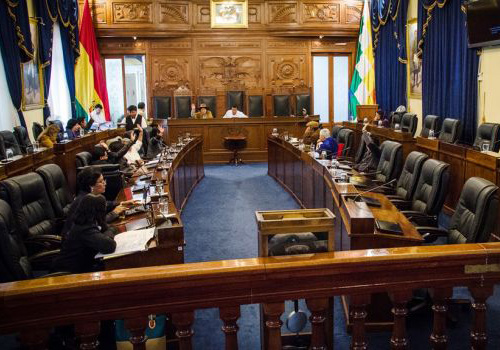
The ICJ condemns the imminent “trial” of Constitutional Court judges by Bolivia’s Senate, in proceedings that could see the judges sent to prison over politicians’ disagreement with a legal ruling.
The proceedings “violate the independence of the judiciary and the right to fair trial,” the Geneva-based organization wrote today in an open letter to all Senators and Deputies of the legislative assembly.
The charges in the trial, scheduled to begin on 21 October, are based entirely on a precautionary ruling by the judges that parts of a new law regulating notaries should not be implemented until the Court has an opportunity to hear a constitutional challenge to the law.
“The spectacle of dozens of politicians pretending to act as an independent and impartial criminal court, threatening to throw constitutional court judges in jail over a difference of opinion as to interpretation of the law, is incompatible with respect for human rights, the separation of powers, and the rule of law,” said Matt Pollard, Head of the Centre for Independence of Judges and Lawyers at the ICJ.
Constitutional Court Judges Soraida Rosario Chanez Chire and Ligia Mónica Velásquez Castaños are to be tried on 21 October, while proceedings against Judge Gualberto Cusi Mamani have reportedly been temporarily suspended for reasons of health. The judges were suspended from duty on 28 July.
An analysis brief published by the ICJ and sent to the legislative members concludes that the proceedings violate Bolivia’s international legal obligations under the American Convention on Human Rights and the International Covenant on Civil and Political Rights.
The brief also cites judgments of the Inter-American Court of Human Rights that found violations of the American Convention as a result of defective parliamentary proceedings for removal of judges in other countries. The proceedings in Bolivia are poised to be even more egregious than the proceedings at issue in the earlier judgments, given the possibility for the Bolivian Senate (photo) to impose a criminal conviction and imprisonment.
“The ICJ urges the Senators and Deputies immediately to cancel the proceedings, to end the judges’ suspension from duty, to refrain from any other form of interference with judicial independence, and to reform judicial discipline and removal procedures to bring them into line with international standards,” said Pollard.
(update as of 21 October: the proceedings were postponed to 4 November after one of the judges collapsed on arrival at the Legislative Assembly and was taken to hospital).
Contacts:
English: Matt Pollard, Head of the Centre for Independence of Judges and Lawyers at the ICJ, t: +41 79 246 54 75; e: matt.pollard(a)icj.org
Spanish: Carlos Ayala, ICJ Commissioner, t: +58 212 952 8448; e: carlos.ayala(a)icj.org
BOLIVIA-Unfair trial of judges-News-Press release-2014-SPA (full text in PDF)
BOLIVIA-unfair trial of judges-Advocacy-Open letter-2014-ENG (full text in PDF)
BOLIVIA-unfair trial of judges-Advocacy-Open letter-2014-SPA (full text in PDF)
BOLIVIA-unfair trial of judges-Advocay-Analysis brief-2014-ENG (full text in PDF)
BOLIVIA-unfair trial of judges-Advocacy-Analysis brief-2014-SPA (full text in PDF)

![Smoke rises after an Israeli air strike on the village of Taybeh in southern Lebanon [Source: Al Jazeera]](https://www.icj.org/wp-content/uploads/2026/03/Screenshot-2026-03-20-at-15.56.24-300x200.png)