Mar 18, 2022 | News
Thai government and justice sector actors must take effective measures to stem the misuse of lawsuits to harass and silence journalists, so-called SLAPP suits, said media workers at a workshop convened by the ICJ on 12 March 2022.

Oct 15, 2021 | News
Russian authorities must immediately withdraw their motion to disbar lawyer Ivan Pavlov and stop their harassment of the lawyer as a result of his professional duties, the International Commission of Jurists (ICJ) said.
Aug 25, 2021 | News
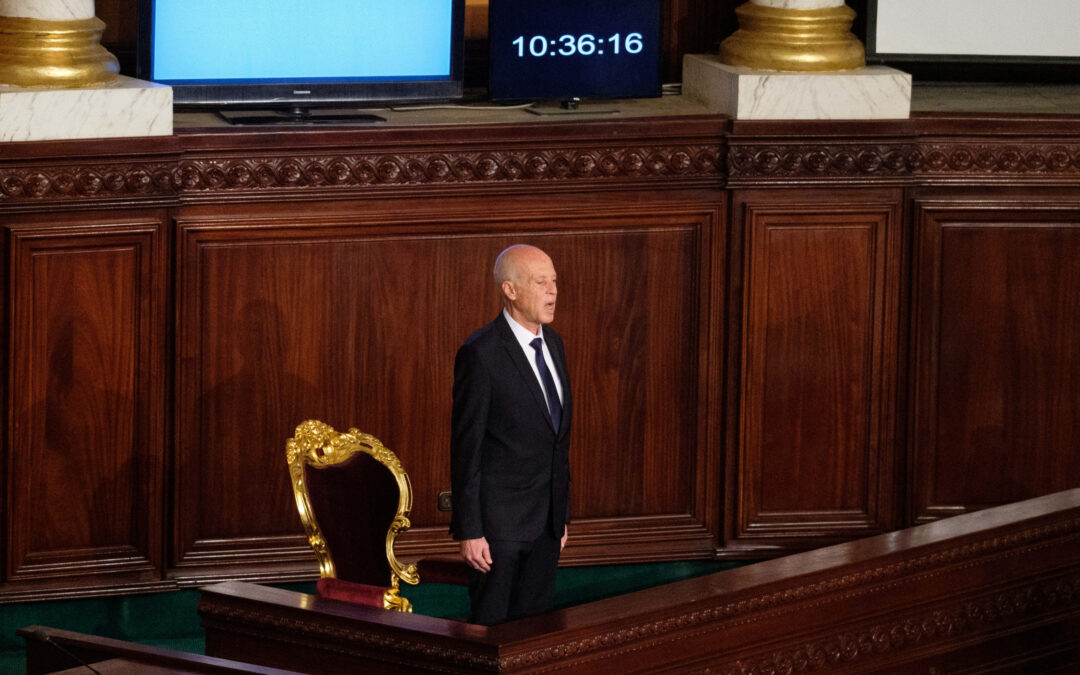
President Kais Saied must immediately revoke his decree renewing the State of Exception and related measures sine die, the International Commission of Jurists said today.

Jun 24, 2021 | News, Uncategorized
Egyptian authorities must immediately quash the convictions of Hanin Hossam and Mawadda Al-Adham and immediately and unconditionally release the two “TikTok girls,” the ICJ said today.
هذا البيان الصحفي متوفر باللغة العربية أيضاً
On 20 June 2021, the Cairo Criminal Court sentenced 20 year-old Hanin Hossam and 23 year-old Mawadda Al-Adham to 10 and six years in prison, respectively, and a fine of 200.000 Egyptian pounds each (12,778 US Dollars), after convicting them on “human trafficking” charges arising from their social media activities.
“Their convictions must be quashed and Hanin Hossam and Mawadda Al-Adham and others imprisoned must be immediately and unconditionally released,” said Said Benarbia, ICJ’s Middle East and North Africa Director.
“The role of the judiciary is to protect and uphold everyone’s right to freedom of expression, not to crack down on its legitimate exercise in the name of some purported and ill-defined moral or social values.”
The two women, known as the “TikTok girls”, were arrested in April 2020 for violating “public morals” and “undermining family values” after publishing videos, including some in which they were shown dancing or signing, on the social media platform TikTok. In July 2020, a Cairo Court convicted and sentenced Hossam and Al-Adham to two years in prison; their conviction was overturned on appeal in January 2021.
However, prosecutors moved swiftly soon after their successful appeal to charge them in another case with “human trafficking”, and “using girls in acts contrary to the principles and values of Egyptian society with the aim of gaining material benefits.” The sentences imposed on 20 June by the Cairo Criminal Court on Hossam and Al-Adham arise from their conviction on those charges.
The charges are based on the 2018 cyber-crimes law, which effectively criminalizes the lawful and legitimate exercise of the right to freedom of expression and association.
“Egypt’s military and government are turning Egypt into an open-air prison in which any and all forms of free expression are crushed,” added Benarbia.
On 12 March 2021, 31 UN Member States delivered a joint declaration at the 46th session of the UN Human Rights Council denouncing the human rights situation in Egypt, including restrictions on freedom of expression.
Contact:
Said Benarbia, Director, ICJ Middle East and North Africa Programme, t: +41-22-979-3817; e: said.benarbia(a)icj.org
Asser Khattab, Research and Communications’ Officer, ICJ Middle East and North Africa Programme, e: asser.khattab(a)icj.org

Nov 2, 2017 | News
The ICJ notes that a number of threats and intimidating statements aimed at members of the judiciary, including the Supreme Court, were made during the election campaign period in Kenya.
Now that the elections ordered by the Supreme Court after nullification of the initial elections in Kenya have been concluded, it is important for Kenyan authorities to reaffirm commitment to separation of powers and guarantee the security of judges and the independence of the judiciary in the country, the ICJ says.
On Monday, 30 October 2017, the Indepedent Electoral Boundaries Commission (IEBC) in Kenya declared President Uhuru Kenyatta as the winner of the October 26 repeat polls.
President Uhuru Kenyatta is widely reported to have been heavily critical of the Supreme Court for annulling the 8 August 2017 presidential election on a “technicality”.
It is also reported that he promised to “fix” the bench if re-elected.
The President is also reported to have said he would deal with Chief Justice Maraga, but did not however define the form of action he would take.
Similar sentiments have been attributed to Deputy President William Ruto. It’s unclear at this stage whether these statements should be dismissed as political rhetoric on the campaign trail or warrant further consideration.
However such utterances and threats on the judiciary by senior government officials may be inferred as an attempt to intimidate or unduly influence the bench.
“These threats coming from the highest authorities hinder the ability of the courts to perform their duties, which are indispensable for the rule of law and fair administration of justice in the country,” said Arnold Tsunga, ICJ’s Africa Regional Programme Director.
“Judges must be able to exercise their duties freely, independently and impartially, or else the rule of law in the country will be eroded, and with it, effective protection of the human rights of the Kenyan people,” he added.
The ICJ recalls that the UN Basic Principles on the Independence of the Judiciary provide that judges must be able to perform their professional duties “without any restrictions, improper influences, inducements, pressures, threats or interferences, direct or indirect, from any quarter or for any reason” and that governments have a responsibility to secure this guarantee.
Article 26 of the African Charter on Human and Peoples Rights also imposes an obligation on Kenya to establish an independent judiciary.
Contact
Arnold Tsunga, Director of ICJ’s Africa Regional Programme, t: +27716405926, e: arnold.tsunga(a)icj.org