Aug 22, 2020 | News
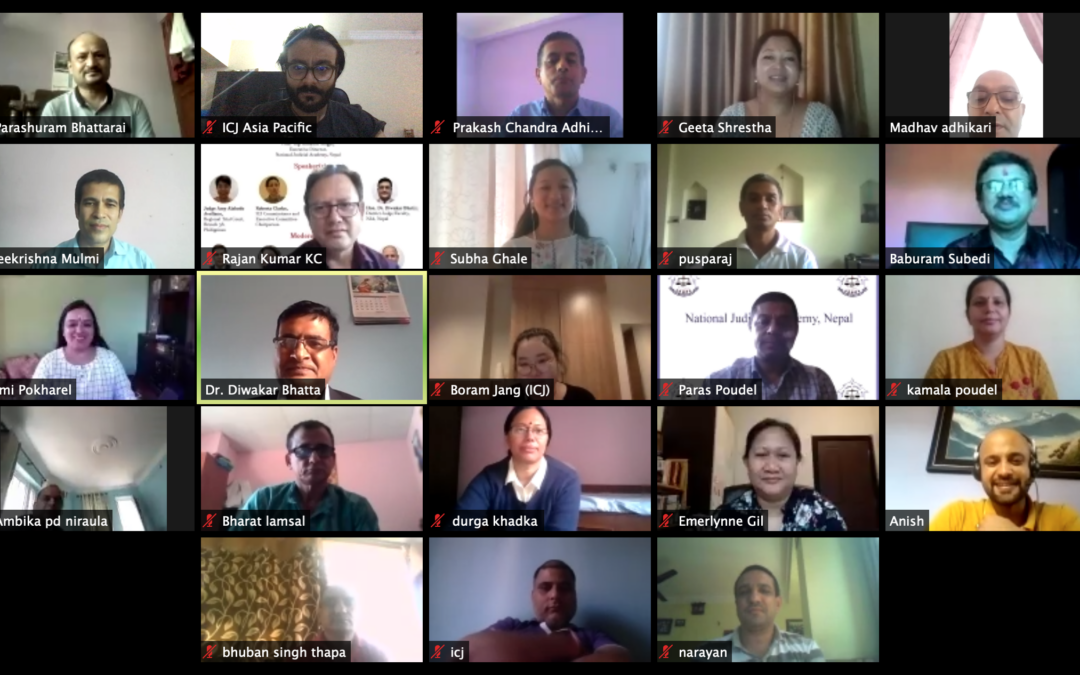
On 15 and 22 August 2020, the ICJ, in collaboration with the National Judicial Academy (NJA) of Nepal, organized the National Judicial Dialogue on the Elimination of Discrimination against Women and Enhancing Women’s Access to Justice.
Due to the exigencies caused by the COVID-19 pandemic, the judicial dialogue was conducted through virtual means.
Fifteen trial court judges from Kathmandu Valley participated in this judicial dialogue with judicial experts from other countries.
Judge Amy Alabado Avellano, a Regional Trial Court judge from the Philippines, engaged with the judges on the application of the Convention on the Elimination of All Forms of Discrimination Against Women (CEDAW) in their judicial decisions. Roberta Clarke, ICJ’s Executive Committee Chairperson and UN Women’s OIC for UN Women’s East and Southern Africa Regional Office, spoke on the right to access to justice under international human rights law.
The second day featured a discussion on specific barriers that women in Nepal face when they access justice. The judges discussed their own role and measures available to the judiciary as an institution to enhance access to justice for women in Nepal. Hon. Justice Sapana Pradhan Malla from the Supreme Court of Nepal and Dr. Diwakar Bhatta from the National Judicial Academy of Nepal led these discussions.
At the Dialogue Emerlynne Gil, ICJ Senior International Legal Adviser, remarked that “judges have a responsibility to uphold the fairness and integrity of the justice system by ensuring that proceedings are conducted in a fashion that does not subordinate the fact-finding process to myth and stereotype.” Honorable Top Bahadur Magar, the Executive Director of the National Judicial Academy, stressed that, “Trial court judges play a pivotal role in debunking myths and gender stereotypes.”
Highlighting the importance of continuing the work towards eliminating gender discriminatory practices among frontline justice actors, even during the COVID-19 pandemic, Emerlynne Gil said. “The COVID-19 pandemic is aggravating existing gender inequalities and women are experiencing more violations of their human rights.”
Contact
Laxmi Pokharel, National Legal Advisor, International Commission of Jurists, t: 977 9851047588, e: laxmi.pokharel(a)icj.org
Jan 18, 2020 | Advocacy, News
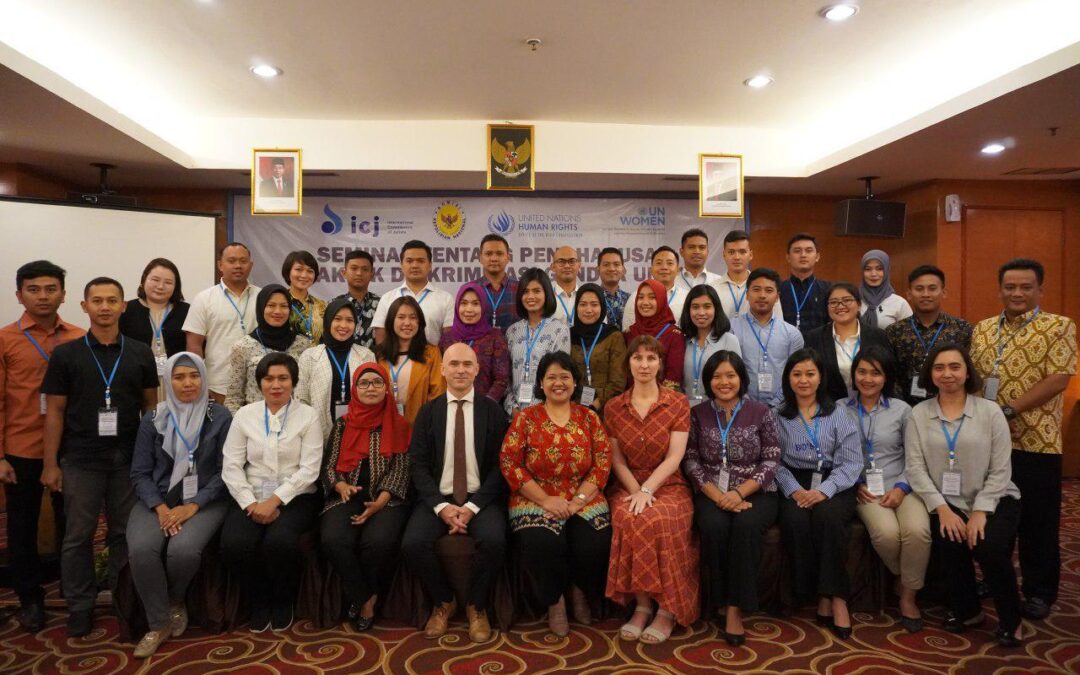
From 16 to 17 January 2020, the ICJ, in collaboration with the National Police Commission (KOMPOLNAS), UN Women, and the Office of the United Nations High Commissioner for Human Rights (OHCHR) organized a Seminar on Eliminating Gender Discriminatory Practices for the Police.
It was held in Bogor, Indonesia and gathered 30 law enforcement officers from Indonesian provinces that are reported to have the highest rate of incidents of violence against women.
Frederick Rawski, ICJ’s Asia and the Pacific Regional Director, stressed to participants that, “Police officers are the first point of contact for women who try to access justice for violations committed against them. It is important therefore for these officers to be well-trained on gender sensitivity and women’s human rights.”
“Only 40 percent of women speak out on violence, and only 10 percent of these report to the police because they are often blamed for the violence they experience or humiliated by those who should protect them,” added Ms. Doreen Buettner, Programme Specialist on Access to Justice of UN Women.
Indonesia is a State Party to the Convention on Elimination of All Forms of Discrimination Against Women (CEDAW), having ratified it on 13 September 1984. It has established a gender mainstreaming mechanism under Presidential Instruction No. 9 of 2000 on Gender Mainstreaming in National Development, which obliges all government representatives and agencies, including the police, to mainstream gender in their work in order to eliminate gender-based discrimination.
Ms. Poengky Indarti, Commissioner from the National Police Commission (KOMPOLNAS), stressed that “Gender-responsive police training should not a one-time thing, we need to institutionalize the training for it to be sustainable.”
At the seminar, the discussions were aimed at strengthening the understanding of the members of police officers on women’s human rights, and the importance of eliminating gender stereotyping in their work to enhance access to justice for women.
Ms. Siti Aminah, Commissioner of the National Commission of Violence Against Women in Indonesia (Komnas Perempuan) and Professor Meg Garvin, Executive Director of the National Crime Victim Law Institute (NCVLI) and Clinical Professor of Law at the Lewis & Clark Law School facilitated discussions on common gender stereotypes in Indonesia and strategies, protocols and good practice relating to all aspects of responses to incidents of violence against women.
Contact
Ruth Panjaitan, National Legal Advisor for Indonesia, International Commission of Jurists, e: ruthstephani.panjaitan(a)icj.org
Resources
To access pictures from the event, click here.
Dec 9, 2019 | Advocacy, News
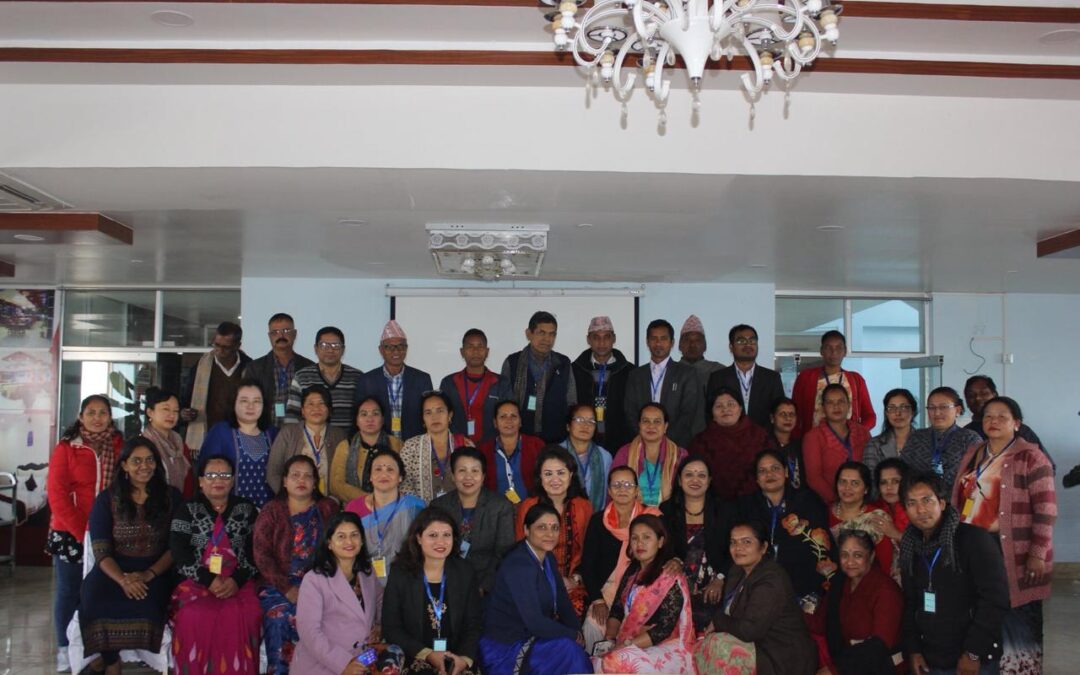
From 7 to 8 December 2019, the ICJ, in collaboration with UN Women, organized the 2019 Workshop of Judicial Committee Members on Eliminating Discriminatory Attitudes Against Women. It was held in Biratnagar, Nepal, and gathered thirty members from judicial committees in Province 1.
Judicial committees were created under Nepal’s Local Governance Operation Act, which was passed in 2017. The law laid out areas of competence of the judicial committees that gives them the potential to significantly impact the lives of women at the community level.
On the first day of the workshop, the discussions were aimed at strengthening the understanding of the members of judicial committees on women’s human rights, and the importance of eliminating gender stereotyping in their work to enhance access to justice for women. On the second day, there were more discussions on the mandate of judicial committees in Nepal and how they can take on the role of promoting and protecting women’s human rights in the country.
As ICJ’s International Legal Adviser, Ms. Boram Jang, pointed out, “Judicial committees are the first points of contact for women in Nepal when they want to access justice.”
It is because of this vital role they hold that the ICJ and UN Women have decided to focus on strengthening the capacity of judicial committee members to better understand the root causes of discriminatory attitudes towards women.
“Women victims and survivors should be able to rely on a justice system free from myths and stereotypes, and on a judicial committee whose impartiality is not compromised by these biased assumptions,” said Boram Jang.
According to Ms. Subha Gale, Programme Analyst of UN Women, “When we deprive women of their ability to access justice, we take away all their rights.”
The keynote speech during the workshop was given by Ms. Bandana Rana, Vice-Chairperson of the Committee on the Elimination of All Forms of Discrimination Against Women (CEDAW Committee). In her speech, she noted how Nepal has moved forward since it adopted its new Constitution, which recognizes the important role women play in the country’s development.
Ms. Bandana Rana also reminded the participants at the workshop how gender stereotypes foster narratives that are harmful for women in society. She said, “If we want to bring change, we must change these narratives. If we want equality among men and women, we must start by teaching our sons – not just our daughters – about equality and non-discrimination.”
Contact
Laxmi Pokharel, National Legal Advisor, International Commission of Jurists, t: +977 9851047588, e: laxmi.pokharel(a)icj.org
Mar 3, 2015 | News
Myanmar’s parliament must reject or extensively revise a series of proposed laws that would entrench already widespread discrimination and risk fuelling further violence against religious minorities, Amnesty International and the ICJ said today.
A package of four laws described as aimed to “protect race and religion” – currently being debated in parliament – include provisions that are deeply discriminatory on religious and gender grounds.
They would force people to seek government approval to convert to a different religion or adopt a new religion and impose a series of discriminatory obligations on non-Buddhist men who marry Buddhist women.
“Myanmar’s parliament must reject these grossly discriminatory laws which should never have been tabled in the first place. They play into harmful stereotypes about women and minorities, in particular Muslims, which are often propagated by extremist nationalist groups,” said Richard Bennett, Amnesty International’s Asia-Pacific Director.
“If these drafts become law, they would not only give the state free rein to further discriminate against women and minorities, but could also ignite further ethnic violence,” he added.
The draft laws have been tabled at a time of a disturbing rise in ethnic and religious tensions, as well as ongoing systematic discrimination against women, in Myanmar.
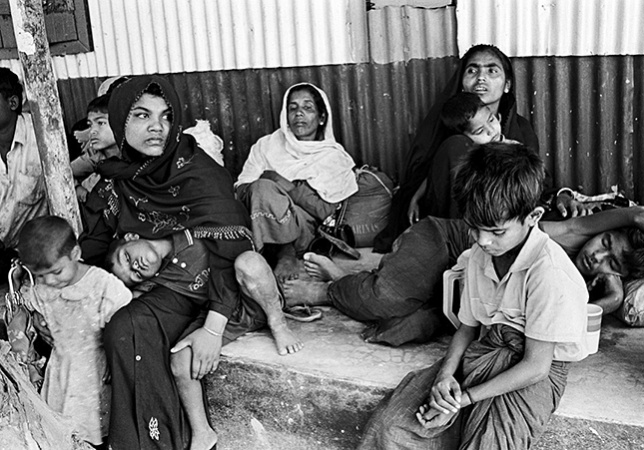
In this context, where minority groups – and in particular the Rohingya (photo) – face severe discrimination in law, policy and practice, the draft laws could be interpreted to target women and specific communities identified on a discriminatory basis.
“The passage of these laws would not only jeopardize the ability of ethnic and religious minorities in Myanmar to exercise their rights, it could be interpreted as signalling government acquiescence, or even assent, to discriminatory actions,” said Sam Zarifi, ICJ’s Asia Director. “The introduction of these discriminatory bills is distracting from the many serious political and economic issues facing Myanmar today.”
Of the four draft laws, two – the Religious Conversion Bill and the Buddhist Women’s Special Marriage Bill – are inherently flawed and should be rejected completely.
The remaining two – the Monogamy Bill and the Population Control Healthcare Bill – need serious revision and the inclusion of adequate safeguards against all forms of discrimination before being considered, let alone adopted.
These bills do not accord with international human rights law and standards, including Myanmar’s legal obligations as a state party to the UN Convention on the Elimination of all Forms of Discrimination against Women and the UN Convention on the Rights of the Child.
Amnesty International and the ICJ have conducted a legal analysis of the four laws and have found that:
- The Religious Conversion Bill stipulates that anyone who wants to convert to a different faith will have to apply through a state-governed body, in clear violation of the right to choose one’s own religion. It would establish local “Registration Boards”, made up of government officials and community members who would “approve” applications for conversion. It is unclear whether and how the bill applies to non-citizens, in particular the Rohingya minority, who are denied citizenship in Myanmar. Given the alarming rise of religious tensions in Myanmar, authorities could abuse this law and further harass minorities
- The Buddhist Women’s Special Marriage Bill explicitly and exclusively targets and regulates the marriage of Buddhist women with men from another religion. It blatantly discriminates on both religious and gender grounds, and feeds into widespread stereotypes that Buddhist women are “vulnerable” and that their non-Buddhist husbands will seek to forcibly convert them. The bill discriminates against Buddhist women as well as against non-Buddhist men who face significantly more burdens than Buddhist men should they marry a Buddhist woman.
- The Population Control Healthcare Bill – ostensibly aimed at improving living standards among poor communities – lacks human rights safeguards. The bill establishes a 36-month “birth spacing” interval for women between child births, though it is unclear whether or how women who violate the law would be punished. The lack of essential safeguards to protect women who have children more frequently potentially creates an environment that could lead to forced reproductive control methods, such as coerced contraception, forced sterilization or abortion.
- The Monogamy Bill introduces new provisions that could constitute arbitrary interference with one’s privacy and family – including by criminalizing extra-marital relations – instead of clarifying or consolidating existing marriage and family laws.
Contact
In Bangkok – Sam Zarifi, ICJ Regional Director for Asia and the Pacific, sam.zarifi(a)icj.org; m +66807819002
In London – Olof Blomqvist, Amnesty International Asia-Pacific Press Officer, olof.blomqvist(a)amnesty.org; t: +44 20 7413 5871, m +44 790 4397 956
An extensive legal analysis of the laws by Amnesty International and the ICJ can be found here:
Myanmar-Reject discriminatory race and religion draft laws-Advocacy-2015-ENG (full text in PDF)
Oct 15, 2014 | News
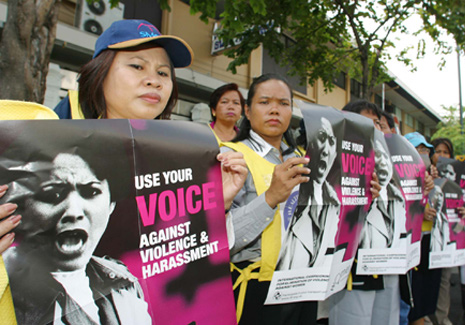
Judges and representatives from judicial institutes from across Southeast Asia are attending a regional workshop to discuss how they can help counter gender-based violence and gender stereotypes.
The workshop, organized by the UN Women Regional Office for Asia and the Pacific, in collaboration with the Office of the Thai Judiciary and the ICJ is held in Bangkok on 15 and 16 October 2014.
This Regional Workshop for Judicial Training Institutions on Good Practices in Promoting Women’s Human Rights Compliant Justice Delivery will focus on using the CEDAW Convention and on eradicating gender stereotypes, especially in cases related to violence against women.
It also aims to improve the progress of the implementation of the CEDAW Convention and strengthen the regional network of judicial training institutions in eight Southeast Asian countries, namely Cambodia, Indonesia, Lao PDR, Myanmar, the Philippines, Thailand, Timor-Leste and Vietnam.
Speakers at the opening session include Hon. Justice Pattarasak Vannasaeng, Secretary-General of the Office of the Thai Judiciary; H.E. Mr. Philip Calvert, Ambassador of Canada for Thailand; Ms. Roberta Clarke, Regional Director of the UN Women Regional Office for Asia and the Pacific; and Sam Zarifi, ICJ’s Regional Director for Asia and the Pacific.
Thailand-Women Judicial training-News-web story-2014-ENG (full text in PDF)