Mar 25, 2015 | Advocacy, Open letters
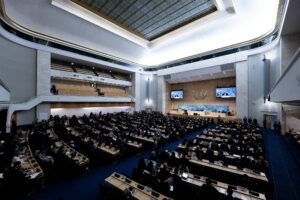
The ICJ today joined other NGOs in an open letter urging States at the UN Human Rights Council not to support a draft resolution on the ‘Effects of Terrorism on the Enjoyment of Human Rights’ in its present form and without substantial amendment.
The letter explains why the draft resolution, presented jointly by Egypt, Jordan, Algeria, Morocco and Saudi Arabia, is significantly unbalanced and suffers from four key and inter-related deficiencies:
First, the draft resolution calls for strengthening of counter-terrorism measures without sufficiently recognising that such laws and measures must be in conformity with international human rights, refugee and humanitarian law and refugee law.
Second, the resolution fails to call on States to ensure that laws and measures on counter-terrorism and national security do not hinder the work and safety of human rights defenders and other civil society actors; and to ensure that such laws and measures clearly identify which offences qualify as terrorist acts by defining transparent and foreseeable criteria.
Third, the text fails to recognise that support for a vibrant and pluralistic civil society and respect for the fundamental rights of freedom of expression, association and assembly are essential to combat extremism, counter terrorism and provide protection, support and justice to victims.
Fourth, while the draft resolution has been presented by the core group as taking a ‘victim-centered’ approach, the text fails to respond to what victims of terrorism have themselves expressed to the Council is needed to respect and fulfill their human rights. To the contrary, the resolution appears to continue the regrettable practice of invoking the suffering victims of terrorism to justify measures that too often are abused to violate human rights, without delivering real justice, remedy, and support to the victims themselves.
In conclusion, the letter urges delegations not to support the draft text without very substantial amendments, and suggests that a preferable approach may be to consider the concerns sought to be addressed in the present text when the Council comes to negotiate its traditional bi-annual resolution on human rights and countering terrorism at its 31st session in March 2016.
The Open Letter is signed jointly by: African Centre for Democracy and Human Rights, Amnesty International, ARTICLE 19, Asian Legal Resource Centre, Cairo Institute for Human Rights Studies, Centro de Estudios Legales y Sociales (CELS), East and Horn of Africa Human Rights Defenders Project, Egyptian Initiative for Personal Rights, FORUM-ASIA, Human Rights House Foundation, Human Rights Watch, International Commission of Jurists, International Federation for Human Rights (FIDH) and International Service for Human Rights.
The full letter may be downloaded in PDF format here: Universal-HRC28-TerrorismHumanRights-Advocacy-OpenLetter-2015-ENG
The draft resolution may be downloaded here: HRC28 Draft Terrorism Human Rights Resolution
Update 26 March 2015: The resolution was adopted, with an oral amendment, by vote of the Council (25 in favour, 16 abstentions, 6 against): Terrorism 2015 vote

Feb 17, 2014 | News
The ICJ today expressed concern at a ruling of the Italian Constitutional Court which denies full accountability of Italian officials in the case of the 2003 unlawful rendition, enforced disappearance and torture of Osama Mustafa Hassan Nasr, also known as Abu Omar.
In a ruling making no mention of the international human rights law obligations of Italy, the Court agreed with the contention of the Italian Government that it may protect from disclosure and use in court what it considers to be “secrets of state” even if to do so would prevent the revelation of the truth about serious crimes and human rights violations and the holding of those responsible to account.
The Court ruled that, under the Italian Constitution and the law on secrets of state, it is the sole prerogative of the President of the Council of Ministers, exercising “a wide discretionary power”, to establish the width of application of the secret of state doctrine.
The Court affirmed that such decisions cannot be questioned by ordinary courts.
A number of Italian and United States intelligence agents, including the former Director of the Italian Military Secret Service, Nicolò Pollari, had been found guilty of criminal offences in connection with the rendition.
The Constitutional Court’s ruling is likely to effectively annul the convictions of the top Italian secret agents involved in the rendition.
“This ruling constitutes a serious blow to the fight against impunity for some of the most serious crimes under international law”, said Massimo Frigo, Legal Adviser for the Europe Programme. “It disregards fundamental pillars of international human rights law, including the right to truth and the duty to investigate, prosecute and ensure accountability for gross violations of human rights”.
“The doctrine of “secret of state” must never be used as a means to cover up responsibility for crimes under international law or gross violations of human rights,” Frigo added. “The United States, which is primarily responsible, deplorably has abdicated its responsibility to meaningfully investigate and hold officials to account for gross human rights violations in its rendition and secret detention programme. Italy, by contrast, had been the only country in which the courts had imposed convictions for the US-led renditions. After this judgment, there is a real risk that the Italian complicity in this crime will never be fully ascertained and accounted for.”
The ICJ is concerned at reports that time limits for the conclusion of criminal proceedings in this case could expire in two months, despite the fact that, under international standards, limitation periods should not be imposed in respect of serious of crimes such as torture and enforced disappearance.
The expiry may foreclose any further investigation or criminal trial on Italian involvement in this rendition, which should occur irrespective the obstacles caused by the secret of state doctrine.
The ICJ is particularly concerned that successive Italian governments since 2007 have either proposed or refused to withdraw government applications before the Constitutional Court affirming that the executive prerogative on secret of state takes precedence over the fight against impunity.
The ICJ considers that the law and practice regarding the “secret of state” must be reformed to be into compliance with Italy’s duty to investigate crimes under international law and gross human rights violations.
While States may protected a limited amount of information when strictly necessary for legitimate national security purposes, they may not do so with respect to information concerning gross violations of human rights.
Background
Hassan Mustafa Osama Nasr, also known as Abu Omar, was been kidnapped in 2003 in the streets of Milan by CIA operatives and subject to rendition to Egypt where he had been subject to enforced disappearance, arbitrary detention and torture.
The case of Abu Omar was one of at least 136 known cases in the rendition and secret detention carried out since 2001 by the United States, with the participation of some 54 other States, which typically involved multiple human rights violations, including torture and ill-treatment, enforced disappearance, and arbitrary detention.
The Constitutional Court judgment effectively reversed the ruling of the Court of Cassation that ordered the reopening of the trial against the former Director of the Italian Military Secret Service, Nicolò Pollari, his deputy, Marci Mancini, and other Italian military secret services operatives for their alleged complicity in the operation.
The Court of Cassation had held that the doctrine of “secret of state”, which barred their conviction, would not apply to them, because the Italian secret services have no authority to conduct such illegal operations and they had therefore effectively acted in private capacity.
Following that judgment, the Court of Appeal convicted, among others, for complicity in the kidnapping Nicolò Pollari to ten years of imprisonment and Marco Mancini to nine years.
The Court of Cassation upheld in absentia the convictions and sentences of 23 US agents involved for the offence of kidnapping.
On 5 April 2013, the President of the Italian Republic, Giorgio Napolitano, granted a pardon for US Colonel Joseph L. Romano III, who had been convicted by Italian courts of the offence of complicity with the US in kidnapping for his role in the rendition of the Milan cleric Abu Omar in 2003.
Contact:
Massimo Frigo, Legal Adviser, ICJ Europe Programme, massimo.frigo(a)icj.org




![Smoke rises after an Israeli air strike on the village of Taybeh in southern Lebanon [Source: Al Jazeera]](https://www.icj.org/wp-content/uploads/2026/03/Screenshot-2026-03-20-at-15.56.24-300x200.png)