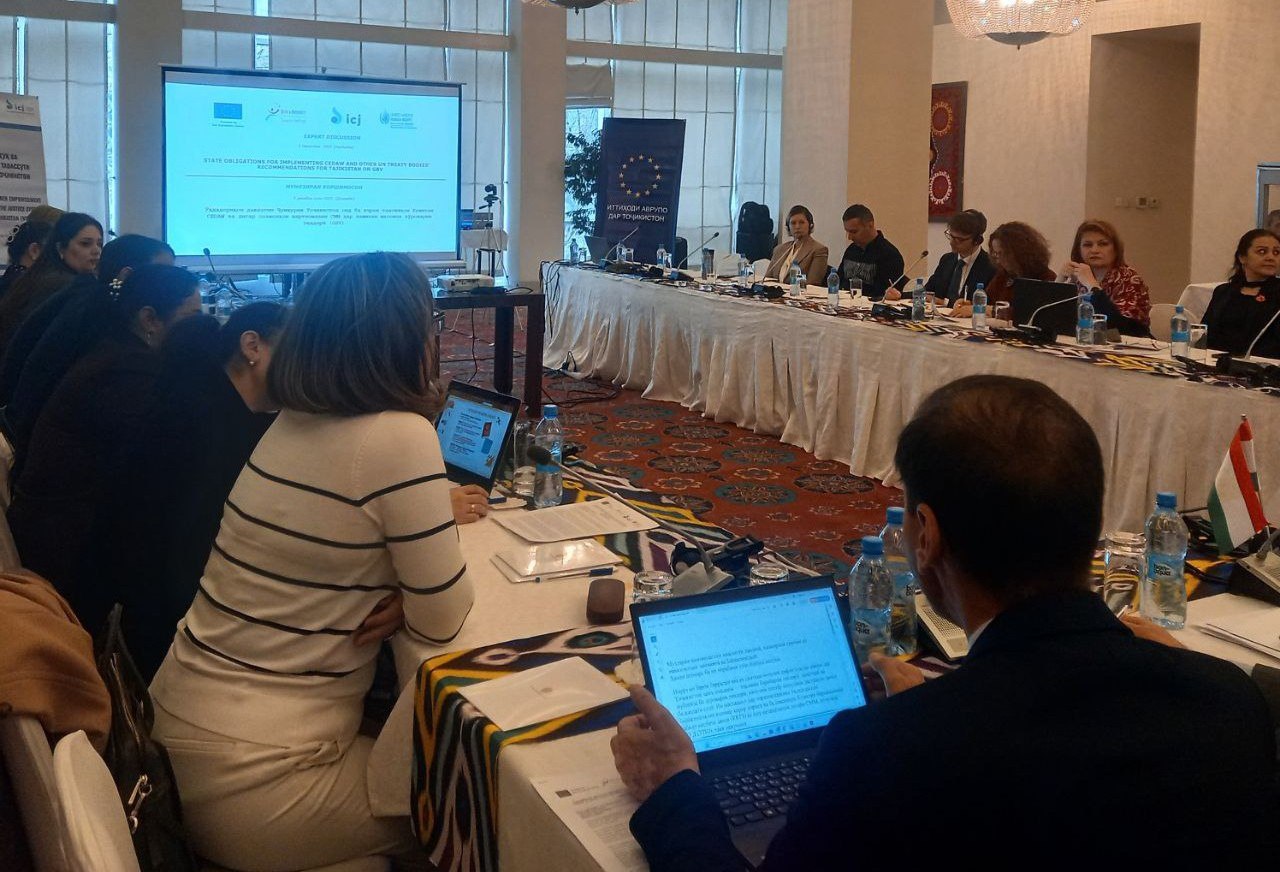
The International Commission of Jurists (ICJ), together with the Office of the United Nations High Commissioner for Human Rights, Regional Office for Central Asia (OHCHR ROCA), and the NGO Right and Prosperity, convened an expert roundtable with representatives of the judiciary, law enforcement bodies, United Nations agencies and civil society to examine Tajikistan’s implementation of its obligations under the Convention on the Elimination of All Forms of Discrimination against Women (CEDAW) and other international human rights treaties in relation to gender-based violence.
The discussion presented key findings of the ICJ mission on access to justice for women and girls in Tajikistan and focused on systemic barriers that continue to impede effective investigation, prosecution and adjudication of gender-based violence cases. Participants examined gaps in criminal and administrative procedures, weak enforcement of protective measures, limited access to legal aid, deficiencies in forensic practice, and the impact of entrenched gender stereotypes on the functioning of the justice system.
Participants discussed how the human rights obligations of Tajikistan require the State to ensure survivor-centred procedures, protect against retraumatisation, guarantee access to justice without placing an undue burden on survivors, and remove discriminatory legal and practical barriers that prevent women and girls from obtaining protection and remedies. They noted that broad reliance on reconciliation, the absence of a specific criminal offence of domestic violence, limited recognition of psychological harm, and insufficient State funding for support services undermine compliance with international human rights law and standards.
“The legal and institutional reforms discussed today are essential to ensure that survivors of gender-based violence can rely on a justice system that protects their dignity, safety and rights,” said Temur Shakirov, ICJ Europe and Central Asia Director. “Implementation of CEDAW is a binding obligation, and sustained efforts by law enforcement bodies, courts, civil society and international institutions are critical to ensuring real progress.”
The ICJ stressed the need to strengthen procedural safeguards, ensure that investigations in all gender-based violence cases are initiated ex officio, expand access to free legal aid, bring forensic practices in line with international obligations, and take concrete measures to enable judges to apply international human rights law in their decisions.
Background:
The roundtable forms part of follow-up to the findings of the ICJ mission on access to justice for women and girls in gender-based violence cases in Tajikistan and to the 2024 Concluding Observations of the CEDAW Committee.
It was organised under the European Union-funded project “Women Empowerment through the Justice System in Tajikistan” (WEMJUST), implemented by the ICJ in cooperation with Tajikistan NGO Right and Prosperity.
The event took place during the international campaign of the 16 Days of Activism against Gender-Based Violence.
Attachments:
Agenda in English Agenda of Expert Discussion In Dushanbe in English
Agenda in Tajik Agenda of Expert Discussion in Dushanbe in Tajik
Agenda in Russian Agenda of Expert Discussion in Dushanbe in Russian