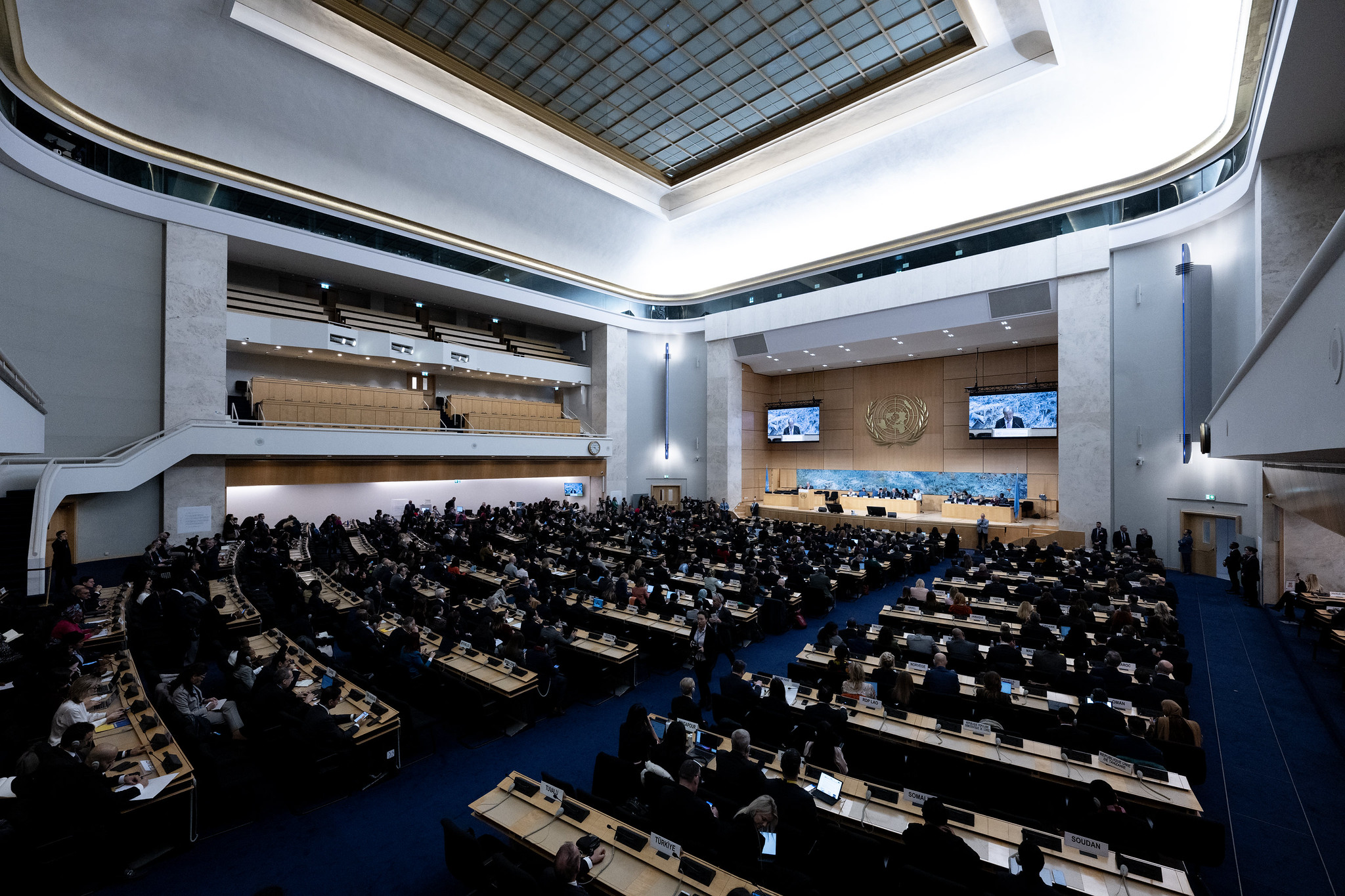
The United Nations is presently grappling with major restructuring likely to involve significant changes, while the process for electing a new Secretary-General is nearing its conclusion. Amidst this instability and uncertainty, the UN’s main human rights body, the Human Rights Council, has concluded its 63rd session, proving once again that it can deliver tangible results, despite the ongoing financial crisis and the geopolitical tensions generated by Member States.
At its session held from 7 September to 7 October, the HRC adopted thirty-seven resolutions, nine of which concerned serious human rights violations in specific countries, namely Afghanistan, Burundi, Central African Republic, Democratic Republic of the Congo, Georgia, Russian Federation, Sudan, Venezuela and Yemen.
For countries experiencing widespread or systematic human rights atrocities, including in situations of armed conflict, justice and effective redress may come years after a conflict or human rights crisis. Yet documenting human rights violations and abuses is fundamental for future accountability and affording victims and survivors the possibility to seek truth, justice and reparation. In that regard, Member States at the Council succeeded in renewing important mandates of investigative and/or monitoring mechanisms. This included a resolution, adopted without opposition, on a mechanism for the appalling situation in Afghanistan, which has experienced disappearance of the rule of law under political arrangements that have stripped away all protection for women. Critical resolutions renewing the monitoring and investigative mandates on the Russian Federation, Sudan and Venezuela were also adopted, although by a vote.
The ICJ particularly welcomes the support across all regions for the resolutions, including for the resolution on Sudan by four African States: The Gambia, Mauritius, Malawi and South Africa. The situation in Sudan is currently one of the most severe humanitarian and human rights crises, marked by the commission of war crimes and crimes against humanity.
The continued establishment and maintenance of robust accountability mechanisms has been a standout achievement. While continuing its work in this area, the Council would do well to prioritize addressing the general and accelerating deterioration of the rule of law globally, amidst the fracturing of human rights multilateralism. There are certainly limits to the powers of the Council alone to tackle this question, yet it is important going forward that the body fully leverages its position to address the interlocking drivers of this decay and its global impacts.
The ICJ also regrets that the HRC has not played a greater preventive role to respond to early warning signs before such major crises can take hold. The ICJ and like-minded partners have in particular been pushing the HRC to tackle the dire human rights and rule of law situations in Libya and Tunisia. On these two situations, the ICJ organized side events with international and national NGO allies.
The work of the HRC on specific situations that seeks to advance accountability for grave human rights violations is fundamental to the Council’s work and is complementary and interrelated with the technical assistance and thematic discussions that also belong to its mandate. The ICJ rejects the positions of certain States, such as the Russian Federation, China, Eritrea, or Cuba, that attempt to place these different functions of the Council in competition and to invoke the objective technical cooperation as a substitute for scrutiny and accountability. This has been the approach by some States towards the deteriorating situation in Yemen, where the prospects for domestic institutions to deliver justice are clearly absent.
At the 63rd session, a concrete salutary contribution that the HRC made to the broader protection and promotion of human rights concerns the role and impact of new and emerging technologies, including digital technologies, on the enjoyment of human rights for all. Particularly noteworthy is the adoption of the first resolution ever focusing on the specific impact of artificial intelligence on the protection and promotion of human rights. Led by Bangladesh and other Member States from the Global South, the resolution insists on the need to ensure that technical capacities are not concentrated in the hands of a few actors, and that AI does not become an additional element that deepens inequalities among States.
The Human Rights Council is a unique space for action when the rest of the system is paralyzed, including by the obstructionism of major world powers. It also remains one of the most accessible bodies to victims, survivors, and civil society members seeking to be heard.
Attacks on international courts and UN experts, and open disregard for international law by powerful States, are not isolated country situations but a global threat to the international legal order. The General Assembly entrusted the Council with preventing human rights violations and responding promptly to situations of human rights crisis. The ICJ calls on Member States to use the tools at the Council’s disposal, including by requesting the Office of the High Commissioner and independent experts to examine and report on this threat, its drivers, and its global impact.