ICJ urges United Nations to remain vigilant in disappeared lawyer case

ICJ urges United Nations to remain vigilant in disappeared lawyer case

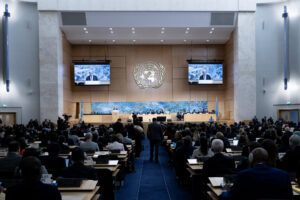
On the fourth anniversary of the disappearance of Thai lawyer Somchai Neelapaichit, the ICJ met with his wife and the UN in Geneva to renew calls for progress in the criminal investigation.

The ICJ told the UN Working Group on Enforced or Involuntary Disappearances (‘UN Working Group’), who are examining the case, that it welcomed the continued investigation by Thailand’s Department of Special Investigations (DSI) to establish the fate of Somchai Neelapaichit, find the body and bring the perpetrators to justice. The ICJ urged the UN Working Group to remain vigilant in the case.

Thailand-ICJ urges United Nations to remain vigilant in disappeared lawyer case-Press releases-2008 (full text, PDF)

ICJ concludes high level mission to the occupied Palestinian Territories and Israel

ICJ concludes high level mission to the occupied Palestinian Territories and Israel

The ICJ today concluded its second high-level mission to Israel and the Occupied Palestinian Territories (OPT).

ICJ Commissioners Professor Pedro Nikken and Professor Rajeev Dhavan led the mission. In the West Bank, they met with senior Palestinian officials, the Chief Justice of the Supreme Court, Mr. Issa Abu Sharar, the Public Prosecutor, Mr. Ahmed Maghni, and representatives of local NGOs and the legal community. They also visited illegal settlements and the wall of separation in the West Bank and Jerusalem. In Israel, the ICJ delegation held meetings with senior governmental officials and the Chief Justice of the Supreme Court of Israel, Ms. Dorit Beinisch

This mission followed the first ICJ mission to Gaza, led by its Secretary-General in December 2007. The first mission met with representatives of the dismissed government of Hamas, senior judges, lawyers, local NGOs and representatives of the legal community. The mission visited refugee camps in Jabaliya, Dir Al Balah, Khan Younes, witnessing the devastating impact of the Israeli siege of Gaza on the humanitarian situation in these camps and the human rights of the civilian population in Gaza.


Palestine-Israel-ICJ Includes a Second High Level Mission to the Occupied Palestinian Territories and Israel-web-2008 (full text, PDF)

La CIJ lamenta vía libre a la pena de muerte

La CIJ lamenta vía libre a la pena de muerte

La reciente sanción por parte del Congreso de Guatemala de una ley que pretende regular el recurso de gracia presidencial en casos de pena de muerte, pone fin a la moratoria de facto que rigió durante los últimos años.

La CIJ lamenta vía libre a la pena de muerte

La CIJ lamenta vía libre a la pena de muerte

La reciente sanción por parte del Congreso de Guatemala de una ley que pretende regular el recurso de gracia presidencial en casos de pena de muerte, pone fin a la moratoria de facto que rigió durante los últimos años.

La CIJ expresa su más honda preocupación frente al retroceso que esta decisión representa e insta al Presidente de la República a vetar la mencionada ley.

“Cuando la tendencia mundial es claramente favorable a la restricción y eliminación de la pena de muerte, el Congreso de Guatemala manifiesta exactamente lo contrario, mediante la sanción de una ley que permite volver a ejecutar condenados”, manifestó Ramón Cadena, Director de la Oficina de la CIJ en Centroamérica . “Nos sumamos a la preocupación expresada por organizaciones locales y la comunidad internacional frente a este grave retroceso”.

El pasado 12 de febrero, el Congreso de Guatemala sancionó el Decreto 6-2008, el cual adolece de graves defectos.

En primer lugar, el decreto no contempla el ente gubernamental ante el cual se debe realizar o presentar la petición para que ésta llegue al Presidente de la República, disposición que afecta el derecho de defensa del condenado.

Por otro lado, el hecho de contemplar en el artículo 8º la figura de denegación tácita o “silencio administrativo” frente a la petición del condenado, tergiversa totalmente la naturaleza del recurso de gracia y viola el artículo 28 de la Constitución Política de la República de Guatemala y el artículo 4.6 del Pacto de San José, que establece que la pena de muerte es inaplicable mientras el ente encargado de conocer y resolver no haya dictado una resolución del recurso.

“La oposición a la pena de muerte constituye uno de nuestros principios rectores y nuestros mayores esfuerzos están dedicados a su completa abolición,” manifestó el Sr. Cadena. “Hacemos un llamado al Presidente Colom para que use su facultad constitucional de vetar la reciente ley del Congreso y sumar así a Guatemala a los países que responden a la criminalidad con políticas públicas de prevención, seguridad y una justicia eficiente.”

Guatemala-death penalty-press release-2008 (full text, PDF)

Translate »