Sep 14, 2017 | Events
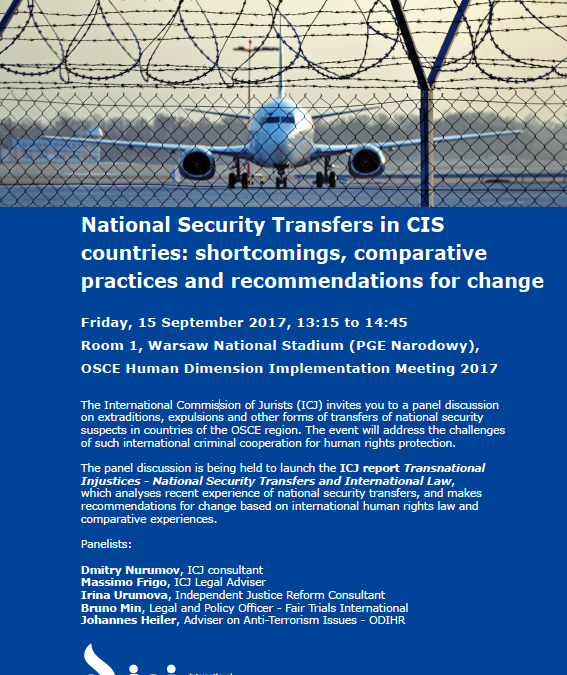
At a side event to the OSCE Human Dimension Implementation Meeting 2017, the ICJ will review the latest developments on extraditions, expulsions and other forms of transfers of national security suspects in countries of the OSCE region.
The event will address the challenges of such international criminal cooperation for human rights protection.
The panel discussion is being held to launch a new ICJ report which analyses recent experience of national security transfers, and makes recommendations for change based on international human rights law and comparative experiences.
The event will take place in Warsaw Friday 15 September at 13:15 – 14:45 at Room no. 1 at the OSCE HDIM 2017.
Panelists:
- Dmitry Nurumov, ICJ consultant
- Massimo Frigo, ICJ Legal Adviser
- Irina Urumova, Independent Justice Reform Consultant
- Bruno Min, Legal and Policy Officer – Fair Trials International
- Johannes Heiler, Adviser on Anti-Terrorism Issues – ODIHR
Working language: English and Russian (simultaneous translation provided)
A flyer for this event is available in PDF format by clicking here.
For more information, contact massimo.frigo(a)icj.org and/or dina.iskaliyeva(a)icj.org
Jul 12, 2017 | News
The ICJ is alarmed at ongoing attacks on the rule of law in Poland.
On 12 July 2017, the Government tabled in Parliament draft bill no. 1727, that, if approved, would automatically dismiss all judges of the Supreme Court and let the Minister of Justice decide which judges are to be reinstated or newly appointed.
“This draft law is a direct blow to the principle of separation of powers, the bedrock of the rule of law,” said Massimo Frigo, Legal Adviser with the ICJ Europe Programme.
“The security of tenure and conditions of service of individual judges are essential to judicial independence,” he added.
Draft bill no. 1727 follows another piece of legislation, recently approved by Parliament, by which the Parliament empowered itself to appoint the majority of the members of the National Council of the Judiciary, the body which selects and governs the judiciary.
That law gives political powers in the Polish legislature and executive, which have increasingly demonstrated deep disregard for human rights and the rule of law, undue influence over the judiciary.
Such deficiencies were also highlighted by the Office for Democratic Institutions and Human Rights of the OSCE in May 2017.
“These series of legislative attacks to the independence of the judiciary in Poland must stop. These actions are inconsistent with the international obligations of Poland to ensure the independence of judges,” said Massimo Frigo.
“The European Union must intervene. A EU Member State that directly undermines the checks and balances of its own legal system threatens the founding values of the EU of the rule of law and respect for human rights,” he added.
Contact
Massimo Frigo, ICJ Legal Adviser, t: +41 22 979 3805 ; e: massimo.frigo(a)icj.org
International standards
Particularly in a context like present day Poland, mass removal of all judges from a court, by another branch of government, without a fair and evidence-based individual process for each judge, is incompatible with international standards such as the UN Basic Principles on the Independence of the Judiciary (See, ICJ Practitioners Guide no 13 on Judicial Accountability, pp. 99-104). The UN Basic Principles affirm, among other things, that:
1. The independence of the judiciary shall be guaranteed by the State and enshrined in the Constitution or the law of the country. It is the duty of all governmental and other institutions to respect and observe the independence of the judiciary.
2. The judiciary shall decide matters before them impartially, on the basis of facts and in accordance with the law, without any restrictions, improper influences, inducements, pressures, threats or interferences, direct or indirect, from any quarter or for any reason.
10. …Any method of judicial selection shall safeguard against judicial appointments for improper motives. …
12. Judges, whether appointed or elected, shall have guaranteed tenure until a mandatory retirement age or the expiry of their term of office, where such exists.
18. Judges shall be subject to suspension or removal only for reasons of incapacity or behaviour that renders them unfit to discharge their duties.
19. All disciplinary, suspension or removal proceedings shall be determined in accordance with established standards of judicial conduct.
20. Decisions in disciplinary, suspension or removal proceedings should be subject to an independent review. This principle may not apply to the decisions of the highest court and those of the legislature in impeachment or similar proceedings.
Similar mass removals with politicization of the procedure for reinstatement and new appointments have been condemned as violations of States’ international human rights obligations by, for instance, the UN Human Rights Committee acting under the International Covenant on Civil and Political Rights, to which Poland is also party (see Busyo, Wongodi, Matubaka et al v. Democratic Republic of the Congo, UN Doc CCPR/C/7878/D/933/2000 (2003), and the Inter-American Court of Human Rights (see e.g. Supreme Court of Justice (Quintana Coelle et al) v. Ecuador, Series C No. 266 (2013) and Constitutional Tribunal (Camba Campos et al) v. Ecuador, Series C No. 268 (2013).
Council of Europe standards, in the form of Recommendation CM/Rec(2010)12 of the Committee of Ministers to member states on judges: independence, efficiency and responsibilities, provide among other things as follows:
26. Councils for the judiciary are independent bodies, established by law or under the constitution, that seek to safeguard the independence of the judiciary and of individual judges and thereby to promote the efficient functioning of the judicial system.
27. Not less than half the members of such councils should be judges chosen by their peers from all levels of the judiciary and with respect for pluralism inside the judiciary.
44. Decisions concerning the selection and career of judges should be based on objective criteria pre-established by law or by the competent authorities. Such decisions should be based on merit, having regard to the qualifications, skills and capacity required to adjudicate cases by applying the law while respecting human dignity.
45. There should be no discrimination against judges or candidates for judicial office on any ground such as sex, race, colour, language, religion, political or other opinion, national or social origin, association with a national minority, property, disability, birth, sexual orientation or other status. A requirement that a judge or a candidate for judicial office must be a national of the state concerned should not be considered discriminatory.
46. The authority taking decisions on the selection and career of judges should be independent of the executive and legislative powers. With a view to guaranteeing its independence, at least half of the members of the authority should be judges chosen by their peers.
47. However, where the constitutional or other legal provisions prescribe that the head of state, the government or the legislative power take decisions concerning the selection and career of judges, an independent and competent authority drawn in substantial part from the judiciary (without prejudice to the rules applicable to councils for the judiciary contained in Chapter IV) should be authorised to make recommendations or express opinions which the relevant appointing authority follows in practice.
48. The membership of the independent authorities referred to in paragraphs 46 and 47 should ensure the widest possible representation. Their procedures should be transparent with reasons for decisions being made available to applicants on request. An unsuccessful candidate should have the right to challenge the decision, or at least the procedure under which the decision was made.
49. Security of tenure and irremovability are key elements of the independence of judges. Accordingly, judges should have guaranteed tenure until a mandatory retirement age, where such exists.
50. The terms of office of judges should be established by law. A permanent appointment should only be terminated in cases of serious breaches of disciplinary or criminal provisions established by law, or where the judge can no longer perform judicial functions. Early retirement should be possible only at the request of the judge concerned or on medical grounds.
69. Disciplinary proceedings may follow where judges fail to carry out their duties in an efficient and proper manner. Such proceedings should be conducted by an independent authority or a court with all the guarantees of a fair trial and provide the judge with the right to challenge the decision and sanction. Disciplinary sanctions should be proportionate.

Jun 29, 2017 | Advocacy, News, Non-legal submissions
The ICJ, together with other 60 national and international human rights organizations urged today the Myanmar authorities, and in particular the Ministry of Transport and Communication and the Parliament, to ensure the repeal of the offence of criminal defamation.
Myanmar-JointStatement-CriminalDefamation-2017-ENG (joint statement in English)
Myanmar-JointStatement-CriminalDefamation-2017-BUR (joint statement in Burmese)
Dec 6, 2016 | Advocacy, News, Non-legal submissions
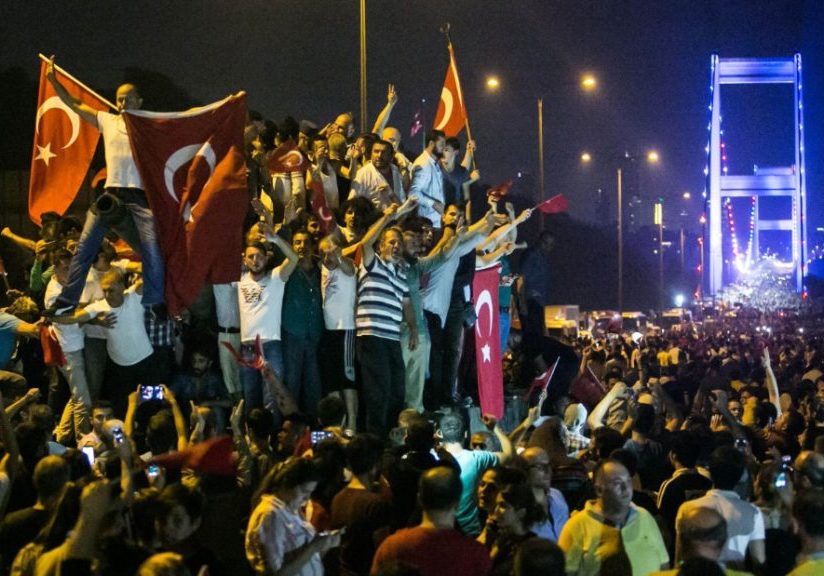
Nearly five months after the failed coup attempt in Turkey, the country remains locked in an acute rule of law crisis. The government must take urgent steps to restore the rule of law, the ICJ said today.
Mass arrests, many of them arbitrary, and credible allegations of the torture and other ill-treatment of detainees, mean that access to legal advice, to a fair trial and to effective judicial remedies are crucial. However, the unprecedented summary and arbitrary purge of the judiciary following the coup, and arrests of judges, prosecutors and lawyers, have significantly weakened the justice system and its capacity to protect against and effectively remedy violations of human rights. The vulnerability of detainees to violations of their human rights has been compounded by unwarranted restrictions on access to lawyers and extended periods of pre-trial detention.
State of Emergency
The ICJ is concerned that the State of Emergency, which involves derogations from Turkey’s international human rights law obligations, has been renewed for a second period of 90 days, until mid-January. Sweeping emergency decrees continue to erode human rights, including rights of fair trial, the right to liberty, and freedoms of expression and association.
The ICJ recalls that in times of crisis, any measures derogating from human rights must be strictly necessary to meet a current threat to the life of the nation. This necessity must be continually re-assessed so that the derogating measures apply for the shortest time possible. Certain human rights, including the right to life, the prohibition of torture or ill-treatment, and the essential elements of arbitrary deprivation of liberty and to a fair trial and the right to an effective remedy can never be restricted even in a state of emergency. The ICJ is concerned that Turkey’s notifications of derogation purport to derogate in general terms from a number of these rights.
Measures taken under the State of Emergency should be rigorously and urgently reviewed to ascertain whether they are permissible under international law and whether they remain necessary and proportionate to any current threat to the life of the nation. Moreover, it must be ensured that non-derogable rights, including the prohibition on torture and other ill-treatment, and the right to a fair trial, are not limited by emergency measures. The ICJ urges the Turkish authorities to lift the State of Emergency and the derogations from its international human rights law obligations at the earliest opportunity.
Independence of the judiciary
The ICJ reiterates its grave concern at mass dismissals of judges and prosecutors, which have a devastating effect on the independence of the judiciary. More than 3,000 judges and prosecutors – approximately one fifth of the judiciary – have been arbitrarily dismissed under emergency decrees, without procedural safeguards and without the right to reasoned decisions.
Judges and prosecutors have been detained in very large numbers. In total, more than 2,000 have been detained, including two judges of the Constitutional Court, 109 members of the Court of Cassation, 41 Members of the Council of State and five members of the High Council for Judges and Prosecutors (HSYK).
Restructuring of the Court of Cassation and the Council of State, under legislation adopted in July, has required the reappointment of all judges of these courts. New judges have been appointed rapidly, through procedures that lack transparency, and in the context of strong executive influence over the appointment process in the HSYK.
The ICJ is also gravely concerned that the independent association of judges, YARSAV, has been shut down, and its President, Murat Arslan, has been arrested.
These measures have eroded the separation of powers in Turkey and have seriously undermined the independence of the judiciary at every level, compromising the courts’ ability to provide fair trials or an effective remedy for violations of human rights. The impact of this situation on the protection of human rights goes beyond what can be justified under the state of emergency. To meet its international human rights obligations, the Turkish government must as a matter of urgency take steps to restore the independence of the judges and of the governing bodies of the judiciary. Procedural safeguards that protect against arbitrariness in criminal, civil and administrative procedures, including in regard to the dismissal of judges, must be reinstated.
Independence of lawyers and access to legal advice
The ICJ is similarly concerned at measures that undermine the independence of the legal profession and the capacity of lawyers to protect human rights. More than 573 lawyers are reported to have been detained in connection with the failed coup since July, and more than 200 have been arrested, and their assets frozen.
Amongst those reported to be arrested are four Presidents of regional bar associations: Orhan Öngöz, President of the Trabzon Bar; Mehmet Cemal Acar, President of the Siirt Bar; İsmail Taştan, President of the Gumushane – Bayburt Regional Bar and Fevzi Kayacan, President of the Konya Bar. The ICJ considers that many of these detentions and arrests are likely to be arbitrary.
These developments have very serious consequences, not only for the rights of lawyers themselves, but also for the right to a fair trial of their clients and the effectiveness of judicial remedies for violations of human rights. They raise concerns that lawyers are being identified with their clients or their clients’ causes, contrary to the Principle 18 of the UN Basic Principles on the Role of Lawyers. The ICJ recalls that under the UN Basic Principles, governments must ensure that lawyers are able to perform all of their professional functions without intimidation, hindrance, harassment or improper interference.
Furthermore, the ICJ is concerned that hundreds of NGOs have been closed under emergency decrees, including a number of lawyers’ associations. Such closures have serious implications for rights of freedom of association and expression, and for the rule of law.
The ICJ calls on the Turkish government to take urgent steps to guarantee the independence of the legal profession, protect lawyers from arbitrary detention or arrest and provide procedural safeguards to ensure the right to fair trial of lawyers under criminal investigation.
Contact:
Roisin Pillay, ICJ Europe Director, at roisin.pillay(a)icj.org or +32 2 734 84 46
Massimo Frigo, ICJ Europe Legal Adviser, at massimo.frigo(a)icj.org or +41 22 979 38 05

Nov 30, 2016 | Advocacy, News, Non-legal submissions
European Union Member States must ensure that a new effort to standardise counterterrorism laws does not undermine fundamental freedoms and the rule of law, a group of international human rights organisations said today.
Amnesty International, the European Network Against Racism (ENAR), European Digital Rights (EDRi), the Fundamental Rights European Experts (FREE) Group, Human Rights Watch (HRW), the International Commission of Jurists (ICJ) and the Open Society Foundations (OSF) are warning that the overly broad language of the new EU Directive on Combating Terrorism could lead to criminalising public protests and other peaceful acts, to the suppression of the exercise of freedom of expression protected under international law, including expression of dissenting political views and to other unjustified limitations on human rights. The directive’s punitive measures also pose the risk of being disproportionately applied and implemented in a manner that discriminates against specific ethnic and religious communities.
The groups call on EU Member States to ensure that implementation of the directive in national law includes additional safeguards to guarantee compliance with regional and international human rights obligations. These safeguards are especially important to ensure that any new laws passed, which will remain in place for years to come, cannot be used abusively by any government, including any that may be tempted to sacrifice human rights and due process in the name of pursuing security.
‘States must effectively address the threat of terrorism. But the EU has rushed to agree a vaguely worded counterterrorism law that endangers fundamental rights and freedoms,’ said Róisín Pillay, Europe Programme Director at the ICJ. ‘Time and again we’ve seen governments adopt abusive counterterrorism laws without assessing their effectiveness, and then implement them in ways that divide and alienate communities. We worry this directive will reinforce this trend and leaves too much leeway for governments to misuse the directive to violate rights.”
The groups also noted that the legislative process for adopting this directive lacked transparency and opportunity for critical debate. There was no impact assessment of the proposal, negotiations moved forward without parliamentary-wide review of the text, and the proposal was rushed through behind closed doors and without any meaningful consultation of civil society.
Despite the inclusion of a general human rights safeguarding clause and repeated caution from our organisations the final text fails to fully protect human rights within the EU:
• The directive repeats the EU’s already overly broad definition of ‘terrorism,’ which permits states to criminalise, as terrorism, public protests or other peaceful acts that they deem ’seriously destabilise the fundamental political, constitutional, economic or social structures of a country or an international organisation.’
• Significantly, the directive requires states to criminalise a series of preparatory acts that may have a minimal or no direct link to a violent act of terrorism, and may never result in one being committed. For example the offences of participating in a terrorist group, travelling or receiving training for terrorist purposed are not adequately defined. Unless these broadly outlined offences are subject to careful drafting and strong safeguards in national law, they are likely to lead to violations of rights, including the right to liberty and freedoms of expression, association, and movement.
• The directive criminalises the public distribution of messages, including messages that ‘glorify’ terrorist acts, if the distribution is intentional and causes a danger that a terrorist offence may be committed. However, such a low threshold likely to lead to abuse if not limited as the UN recommends ‘to incitement that is directly causally responsible for increasing the actual likelihood of an attack’. The directive should have incorporated this language to avoid unjustified interference with freedom of expression.
We welcome the directive’s protection of activities of recognised humanitarian organisations. However we remain concerned that the protection does not expressly extend to all individuals providing medical or other life-saving activities that international humanitarian law (IHL) protects during times of armed conflict.
States should take the directive as an opportunity to reassess their counterterrorism laws, policies and practices and engage with civil society and other stakeholders. We welcome the European Commission’s commitment to formally include civil society organisations in their activities to support transposition of the directive.
Contact:
Roisin Pillay, ICJ Europe Director, at roisin.pillay(a)icj.org or +32 2 734 84 46
eu-press-release-flawed-counterterrorism-directive-2016-eng (download the statement)