Aug 19, 2019 | Advocacy, Cases, Legal submissions
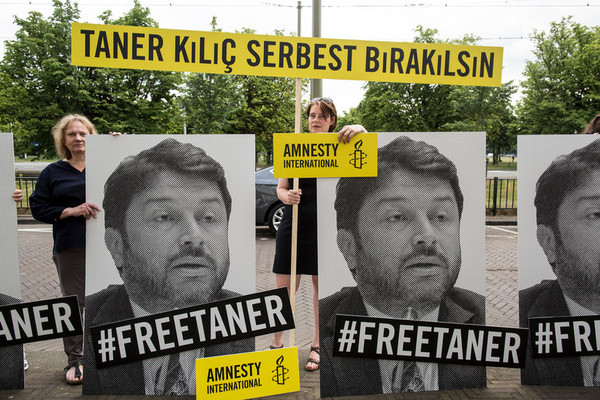
The International Commission of Jurists, the Turkey Human Rights Litigation Support Project and Human Rights Watch have jointly intervened before the European Court of Human Rights in the case of Taner Kiliç, former Chair of the Board of Amnesty International Turkey.
Taner Kiliç is a Turkish human rights defenders. He had been Chair of the Board of Amnesty International Turkey since 2014.
He was arrested on 6 June 2017 on reportedly unsubstantiated charges of “membership of a terrorist organisation” and was released on bail on 15 August 2018 after having spent 14 months in detention.
His case before the European Court of Human Rights challenges the lawfulness of his pre-trial and on remand detention, the violations of his right to judicial review of his detention, and of his freedom of expression and association, considering his arrest linked to his work as leader of a NGO.
As the interveners have written to the Court, this case epitomises some of the most fundamental human rights challenges in Turkey today.
These involve widely documented restrictions on freedom of expression, association, and assembly of human rights defenders (HRDs) and rapidly closing civil society space.
The interveners have submitted observations on:
- the factual context in respect of the situation facing HRDs in Turkey;
- international standards governing obligations towards HRDs of relevance to the Court’s interpretation of the European Convention on Human Rights, including the limits prescribed by Article 18;
- key principles necessary for a rule of law approach to the application of the criminal law, against the legal and practical pattern of excessive resort to criminal law against HRDs in Turkey today.
Turkey-ECtHR-icj&others-Kilic-Advocacy-legal submission-2019-ENG (download the third party intervention)
Photo credit: Amnesty International

Jun 20, 2019 | Advocacy, Cases, Legal submissions, News
The International Commission of Jurists, jointly with Amnesty International and the Turkey Litigation Support Project intervened today before the European Court of Human Rights in the case of a Turkish public servant, Hamit Pişkin, who was dismissed by executive decrees during the State of Emergency.
The case is key with regard to the situation in Turkey now and under the State of Emergency, because it raises significant questions regarding procedural rights in employment proceedings leading to the dismissal of an employee working with or for a State agency on grounds related to national security, including under a State of Emergency, as well as the application of the principles of legality and legal certainty and non-retroactivity as applied to national security, including in counter-terrorism.
During the State of Emergency in Turkey, that lasted two years from 2016 to 2018, almost 130,000 employees in the public sector were dismissed under emergency legislation. Their dismissal however remained in force also after the end of the State of Emergency.
In the submission, the interveners provide the European Court of Human Rights with observations concerning:
- the applicability of the criminal limb of Article 6 of the European Convention on Human Rights (ECHR) to judicial proceedings leading to dismissal of an employee of a public institution;
- the lack of procedural guarantees in the dismissal process necessary to comply with Article 6 of the ECHR, in particular with the presumption of innocence Article 6(2), in such proceedings;
- the application of the principles of legal certainty and non- retroactivity to such decisions (by addressing the problems arising from the application of State of Emergency decrees to events that occurred before the declaration of the State of Emergency).
The full intervention can be downloaded here: Piskin_v_Turkey-ECtHR-TPI-ICJAITLSP-2019-eng

Feb 19, 2019 | Advocacy, Cases, Legal submissions
On 19 of February the ICJ submitted a third party intervention to the European Court of Human Rights in the case of Telek and others v. Turkey.
In its intervention, the ICJ addresses two main questions considering the effectiveness of domestic remedies concerning passport cancellation as a consequence of dismissal under emergency decrees:
- Whether the State of Emergency Commission and/or judicial remedies subsequent to the decision of the Commission might constitute an effective remedy.
- Whether separate remedies for passport cancellation can provide effective relief for the applicants’ claims.
In that respect of mentioned systemic issues the ICJ presents the Court the observations concerning the capacity of the Turkish legal system to provide effective remedies for violations under the European Court of Human Rights, in light of its Convention obligations, in particular obligations under Article 13.
The ICJ submission includes analysis of the Turkish legal system based in part on an ICJ mission to Turkey undertaken in May 2018 that focused on the functioning of the State of Emergency Commission created by Legislative Decree no. 685.
Turkey-icj-Telek&Others-Advocacy-legal submission-2019-ENG (download the intervention in Telek and others v. Turkey).

Jan 25, 2019 | Advocacy, Legal submissions
Today, the ICJ and Lawyers Rights Watch Canada (LRWC) submitted a joint amicus curiae in criminal defamation proceedings against human rights defenders Nan Win and Sutharee Wannasiri for bringing to light alleged labor rights violations at Thammakaset Company Limited.
The defamation charges relate to a 107-second film, produced by the non-governmental organization Fortify Rights, which documents previous defamation complaints brought by Thammakaset against 14 of its former migrant workers from Myanmar.
Nan Win was one of the migrant workers featured in the film. Sutharee Wannasiri, former Human Rights Specialist with Fortify Rights, was charged in connection with making three Twitter posts relating to the film.
The brief aims to clarify the nature and scope of Thailand’s international legal obligations relating to the right to freedom of expression and points out that the imposition of harsh penalties such as imprisonment or large fines on a human rights defender risks having a ‘chilling effect’ on the exercise of freedom of expression, which Thailand is bound to protect pursuant to its international legal obligations.
The preliminary examinations of Nan Win and Sutharee Wannasiri will begin on 4 February and 11 March 2019, respectively.
During the preliminary examination hearing, is the Court will consider the case before it to determine if it is a prima facie case.
The preliminary examination hearing is a mandatory proceeding in matters involving prosecution claims brought by private individuals or entities, such as in the case of Nan Win and Sutharee Wannasiri.
If the preliminary examination finds that the cases are prima facie, the court will admit to trial only the charges relating to the counts deemed prima facie.
If the court finds no prima facie case, it can rule that the charges be dismissed.
Read also:
Thailand: Drop defamation complaints against human rights defenders Nan Win and Sutharee Wannasiri (3 December 2018)
Download:
Thailand-Nan Win Kratik_Amicus-Advocacy-legal submission-2019-ENG (full amicus in PDF, English)
Thailand-Nan Win Kratik_Amicus-Advocacy-legal submission-2019-THA (full amicus in PDF, Thai)
Nov 14, 2018 | Advocacy, Cases, Legal submissions
The ICJ intervened today before the European Court of Human Rights in the cases of a judge and a scholar that were arrested in the wake of the state of emergency in Turkey.
Mr Hakan Baş is a judge who was dismissed and arrested under emergency legislation following the attempted coup of 15 July 2016.
Mr Seyit Ali Ablak is a teacher and was arrested in 2017 also during the state of emergency declared following the attempted coup.
They claim, among others, the violation of their right to a judicial review of detention under articles 5.3 and 5.4 of the European Convention on Human Rights (ECHR).
In this intervention, the ICJ addressed the following issues:
- the international legal and normative framework on the independence of the judiciary and the role of judges, in particular in implementation of obligations under articles 5.3 and 5.4 ECHR;
- the current situation of the independence, governance and administration of the judiciary in Turkey, with particular regard to the Council of Judges and Prosecutors and the role of the peace judges, and their conformity with State obligations under articles 5.3 and 5.4 ECHR. The situation will be assessed with reference to the findings of an ICJ mission undertaken in May 2018 and contained in the mission report Justice Suspended.
Turkey-icj-Bas-Advocacy-legal submission-2018-ENG (download the intervention in Baş v. Turkey)
Turkey-icj-Ablak-Advocacy-legal submission-2018-ENG (download the intervention in Ablak v. Turkey)
Nov 2, 2018 | Advocacy, Cases, Legal submissions
The ICJ intervened today before the European Court of Human Rights in the case of a detained Member of the Turkish Parliament from the HDP party, Ms Burcu Çelik, arrested in 2017 under “terrorism charges”.
In this submission, the ICJ provides the Court with observations concerning the capacity of the Turkish legal system to provide effective remedies for violations under the ECHR with regard to detention, in particular detention of Members of Parliament, in light of its Convention obligations, in particular obligations under Article 5.4.
The ICJ presents its analysis of these aspects of the Turkish legal system based, in part, on information ascertained during a mission to Turkey undertaken in May 2018 and in its report Justice Suspended.
Specifically, the ICJ addresses the question as to whether the remedies of individual application before the Constitutional Court (CC) and under article 141.1 (a) and (d) of the Code of Criminal Procedure (CCP) may be considered as effective in light of the State’s obligations under articles 5.4 and 35.1 ECHR.
Turkey-icj-Celik-Advocacy-legal submission-2018-ENG (download the intervention)