Briefing Papers
The ICJ is publishing a series of briefing papers on the International Law Commission’s Draft Articles, making recommendations for amendment of those articles and the inclusion of additional provisions with a view to bolstering their protective objectives. These papers are structured around the Draft Articles’ provisions. The papers draw and build upon the work of a number of non-government organizations (NGOs), States, experts, and other key stakeholders in advancing the Draft Articles with a view to, ultimately, enacting a long overdue crimes against humanity convention.
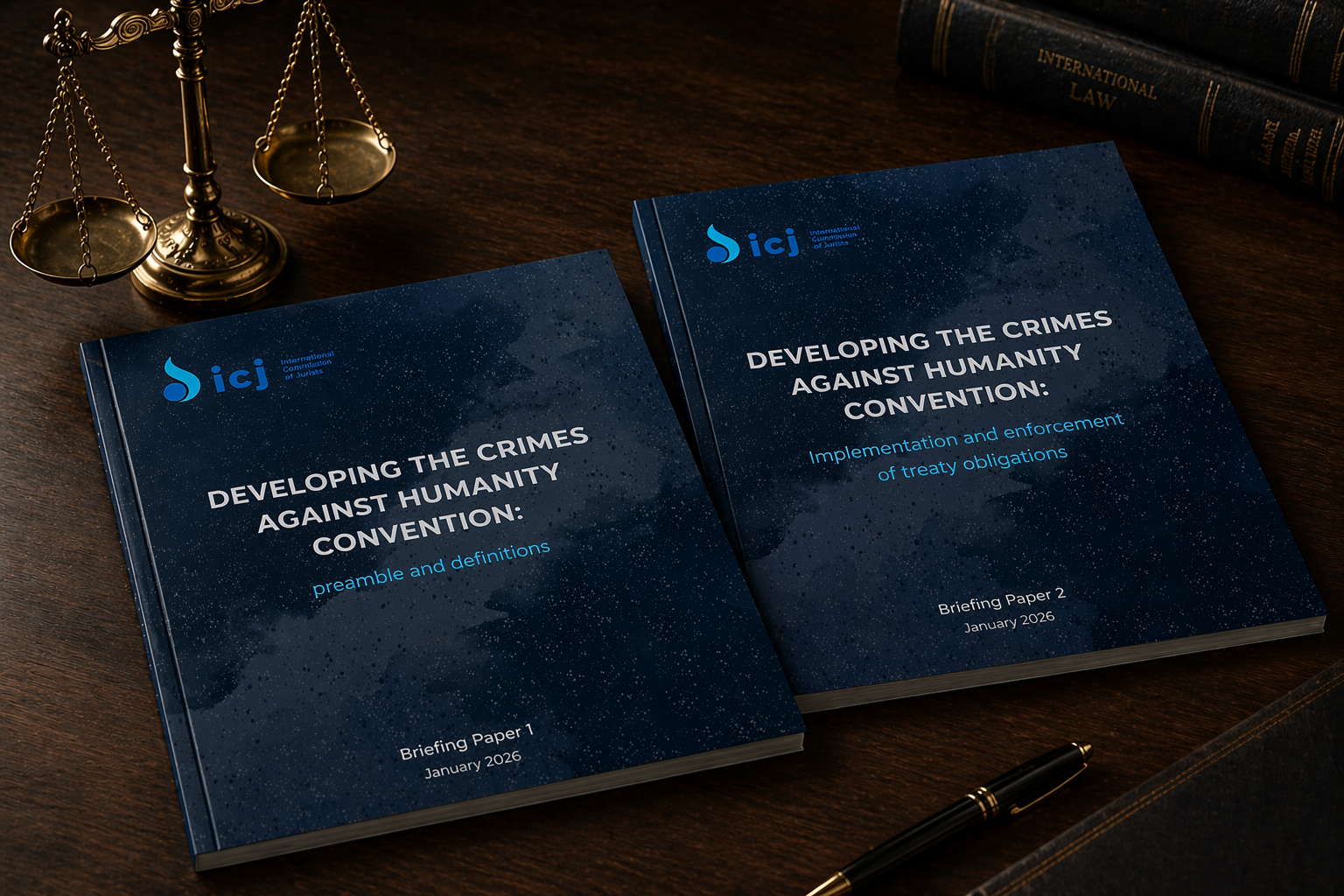
Developing the Crimes Against Humanity Convention: Preamble and Definitions (Briefing Paper 1)
The first briefing paper addresses the preamble of the Draft Articles and the underlying acts of crimes against humanity. Given that a preamble will not only identify the context of the adoption of the Convention and reflect the principles and values that underpin it, and may be highly instrumental in the interpretation of the Convention’s substantive provisions, the ICJ makes a series of recommendations to include additional references and text in the existing preamble. In particular, the ICJ recommends States:
- Include references to all human rights and international humanitarian law treaties and other relevant instruments, as well as customary international law;
- Articulate declaratory principles, including a commitment to accountability, promotion of human rights, and preservation of broad prevention and protection obligations;
- Recognize the gendered and intersectional nature of discrimination and violence underpinning the commission of crimes against humanity, and the related importance of adopting gender-competent, child-competent, and intersectional approaches to accountability;
- Maintain the existing affirmation of the jus cogens character of the prohibition on crimes against humanity;
- Include language acknowledging that the prevention and prohibition of crimes against humanity constitute erga omnes obligations; and
- Replace references to “men, women, and children” with “person/s or people” and include specific references to children when mentioning the rights of victims and witnesses.
A copy of the briefing paper can be downloaded here.
Developing the Crimes Against Humanity Convention: Implementation and Enforcement of Treaty Obligations (Briefing Paper 2)
The second briefing paper addresses the procedural provisions that aim to facilitate implementation and enforcement of the convention, particularly gaps in the text that must be addressed. Among the most critical is the absence of a treaty mechanism for facilitating and monitoring the implementation and enforcement of the Convention. While the Draft Articles articulate obligations to prevent and punish crimes against humanity and, to that end, would establish the obligation for States to fulfil the right of victims and survivors to reparations, they only include a minimal framework for monitoring and enforcement, relying on international cooperation (articles 13 and 14) and inter-State dispute settlement (article 15). By contrast, most modern multilateral treaties in the international criminal law, humanitarian and human rights fields, as well as transnational crime treaties, demonstrate the critical importance of monitoring and enforcement bodies in providing interpretive guidance, coordinating technical assistance and capacity building, facilitating international cooperation, promoting and assessing State compliance, receiving communications and issuing determinations.
This Briefing Paper explores several options for filling this gap. In particular, the paper recommends creating a treaty body with a mandate to:
- Issue interpretive guidance on the provisions of the convention and its application;
- Monitor State compliance through a periodic reporting process.
- Facilitate capacity building, technical assistance, and international coordination and disbursing trust funds for such purposes;
- Receive communications and issue determinations; and
- Conduct inquiries into State compliance.
Additionally, the ICJ made the following recommendations on Draft Articles 3, 4, 6, 7, 10, 13, 14, and 15:
- Draft Article 3, setting out general obligations, should prohibit direct and indirect acts and omissions that constitute crimes against humanity and require States to take all necessary and effective measures to prevent and punish them, as well as to ensure that the existence or threat of armed conflict or a State’s failure to discharge its obligations do not justify conduct constituting crimes against humanity.
- The obligation to prevent crimes against humanity in Draft Article 4 should be strengthened by requiring States to adopt measures, including diplomatic, with respect to territory or persons under not only their jurisdiction but also under their control, direction, or influence. In doing so, States should be required to engage with the competent organs of the UN and monitor, report, and act on risk factors, early warning signs, and the ongoing commission of crimes.
- With respect to the obligation to punish crimes against humanity, Draft Article 6 should be amended to ensure procedural immunities, amnesties, and pardons do not serve as a bar to criminal, civil, or administrative liability. Draft Article 7 should also be amended to ensure the establishment of national jurisdiction against stateless persons habitually resident in a given territory.
- With respect to international jurisdiction, States should be required to refuse extradition under Draft Article 13 where a request is made for the purpose of punishing a person on account of a number of express identities or characteristics, or where the person may be subject to the death penalty. Mutual legal assistance should also be available for the seizure or confiscation of assets under Draft Article 14.
- With respect to the settlement of State-to-State disputes, Draft Article 15 should contain a six-month time period for the duration of negotiations, after which States may seek recourse to the International Court of Justice. The reservation clause in Draft Article 15 should also be removed.
A copy of the briefing paper can be downloaded here.
Developing the Crimes Against Humanity Convention: Ensuring the rights of victims and the accused (Briefing Paper 3)
A third briefing paper (forthcoming) will address the rights of victims and survivors, witnesses and others, and accused persons, including the need for independent judicial mechanisms in the administration of justice.
For further information, see here.