Jul 29, 2021 | Advocacy, Publications
The Government of Pakistan must urgently respond to serious and ongoing persecution of individuals from religious minority groups by State and non-State actors, the International Commission of Jurists (ICJ) said in a new briefing paper released today.
Jun 21, 2021 | Advocacy, News
Victims of sexual and gender-based violence during Nepal’s 10-year-long civil war still face major obstacles to justice, concluded the participants of a virtual consultation on 19 June 2021, on the occasion of the International Day for the Elimination of Sexual Violence in conflict.
The consultation was organized by the International Commission of Jurists (ICJ), in collaboration with the Conflict Victim Women National Network (CVWN), to address “Enhancing Access to Justice for Survivors of Conflict-Related Sexual Violence”. The Nepali version of ICJ Briefing Paper on “Nepal: Transitional Justice Mechanisms with Gender Perspective” was also launched as part of the consultation.
The ICJ consultation with stakeholders highlighted Nepal’s obligation under international law to ensure right to an effective remedy to the victims of sexual and gender-based violence of Nepal’s decade-long armed conflict, which came to a close with a peace accord in 2006.
Around 80 participants, including human rights defenders and conflict victims from different parts of the country attended the consultation. The participants expressed particular concern at lack of attention to gender issues in the context of Nepal’s transitional justice process since its very beginning, and urged that gender considerations be mainstreamed in the transitional justice process.
Ms. Shrijana Shrestha, Chairperson of the CVWN, underscored the lack of government data on victims of conflict-related sexual violence, and denounced the hurdles victims face in seeking justice, due to social and cultural taboos, lack of a support system, and the current statute of limitation to register complaints of sexual violence.
Ms. Mandira Sharma, ICJ Senior Legal Adviser, highlighted that, as a party to various international human rights instruments, Nepal has an obligation to ensure victims’ right to an effective remedy. Further, she expressed concern about the lack of political will since the beginning of the peace process to address the needs of women victims, in particular of victims of conflict-related sexual violence. She emphasized the need to amend the Truth and Reconciliation (TRC) Act in consultation with victims of the armed conflict.
Similarly, Dr. Susan Risal, human rights activists, emphasized the need to develop strong strategies to deal with conflict-related sexual violence in Nepal, taking into consideration the best practices of different countries.
Ms. Laxmi Pokharel, ICJ Legal Adviser, pointed out that the ICJ Briefing paper (“Nepal: Transitional Justice Mechanisms with Gender Perspective”) has analyzed the TRC legislation comprehensively, and can therefore be of use as a powerful advocacy tool for legal reform. She summarized the main findings of the briefing paper and its recommendations, including:
- Amend the TRC Act, through consultative and participatory process, in line with the Supreme Court’s order and Nepal’s international obligations;
- Ensure the participation of women in both Commissions (i.e., the Truth and Reconciliation Commission and the Commission on Investigation of Disappeared Person) at all levels of staffing and in the appointment of Commissioners with a view to ultimately achieving gender parity;
- Provide gender-sensitive training to the Commissioners and staff of the Commissions in order to enhance their ability to address gender issues in their operation;
- Amend the Criminal Code to remove the statutory limitation for filing complaints of rape and other instances of sexual violence;
- Ensure that amnesties and mediation will not be granted to perpetrators of gross human rights violations, including rape and other forms of sexual violence.
During the discussions, the participants highlighted the following major concerns:
- Despite more than six years of its establishment, the Truth and Reconciliation Commission (TRC) and the Commission on Investigation of Disappeared Person (CIDP) have failed to ensure victims’ right to truth, justice, reparation and guarantee of non-repetition;
- There is an urgent need to identify victims of conflict-related sexual violence and provide them with support in order to address their immediate needs;
- The TRC Act needs to be amended in consultation and with the participation of all main stakeholders;
- The existing statute of limitation to file complaints of rape and other forms of sexual violence is a major barrier for victims of conflict-related sexual violence, and must be amended so that victims can access justice.
The event was organized under the ‘Enhancing Access to Justice for Women in Asia and the Pacific’ project funded by the Swedish International Development Cooperation Agency (SIDA). Due to the COVID–19 pandemic, the webinar was conducted virtually via Zoom and broadcasted live on Facebook. The webinar was conducted in Nepali with simultaneous English translation.
Contact
Laxmi Pokharel, ICJ Legal Adviser – Nepal, e: laxmi.pokharel(a)icj.org
Download
Briefing paper on “Nepal: Transitional Justice Mechanisms with Gender Perspective” in English and Nepali.
May 14, 2021 | Advocacy, News, Publications
The ICJ launched a new briefing paper Nepal: Transitional Justice Mechanisms with Gender Perspective in a webinar held on 12 May 2021.
The discussion included the need to give practical effect to Nepal’s obligation under international law to ensure the right to an effective remedy to the victims, including women victims of sexual and gender-based violence during the country’s internal armed conflict (1996 – 2006). Participants focused in particular on the need to ensure that gender issues are incorporated in the transitional justice mechanism.
The Honourable Kalyan Shrestha, former Chief Justice of the Supreme Court of Nepal and ICJ Commissioner, stressed the importance of the role of the Supreme Court of Nepal in establishing landmark jurisprudence on transitional justice.
Justice Shrestha explained how despite the fact that the country had established a progressive Constitution and amended legislation to provide for equality, non-discrimination and access to justice, women victims and survivors of a decade long armed conflict continued to face real barriers to justice. These including short periods of statute of limitations preventing the filing rape and sexual violations cases and lack of support mechanisms for women, which compounded existing economic pressure and social obstacles.
Bandana Rana, Member of the UN Committee on the Elimination of Discrimination against Women (CEDAW), addressed the situation of sexual and gender – based violence against women in Nepal during the armed conflict. She said that Nepal was bound by clear international legal obligations, including under the CEDAW and other treaties. Yet the Nepali government has not taken effective measures to ensure access to justice and the right to an effective remedy to the victims of SGBV during the conflict.
Laxmi Pokharel, ICJ Legal Adviser, summarized the ICJ’s briefing paper on “Nepal: Transitional Justice Mechanisms with Gender Perspective”. The Paper’s major recommendations, to the Government of Nepal, are:
- Amend the Truth and Reconciliation Act (TRC) in line with the Supreme Court’s order and Nepal’s international obligations;
- Ensure participatory, consultative processes while amending the TRC Act;
- Ensure the participation of women at all levels of recruitment, including in the formation of the recommendation committee, in the appointment of Commissioners of both the TRC and the Commission on Investigation of Disappeared Persons (COID) and at all levels of staffing with a view to ultimately achieving gender parity;
- Provide gender-sensitive trainings to the Commissioners and staff of the Commissions in order to enhance their capacity to address gender issues in their operation;
- Take all necessary steps to amend the Criminal Code to remove the statutory limitation for filing incidents of rape and other sexual violence, including in relation to acts committed during the armed conflict, in order to ensure justice for all victims;
- Ensure that amnesties and mediation are not used to replace criminal responsibility for gross violations of human rights, including rape and other sexual violence.
- Incorporate a gender-responsive approach in all aspects of the Commissions’ work, including in the interpretation and application of the mandate of the Commissions, prosecution of perpetrators and reparation to the victims and survivors;
- Incorporate an approach in the Commissions’ work that does not restrict women’s experiences during the armed conflict only to bodily harm suffered, but also takes account of structural gender biases and its consequences during the period of a conflict;
- Design and implement gender-friendly procedures for investigation, including statement taking, victim and witness protection and other activities of the Commissions;
- Design and implement specific reparation policies to address the unique needs of women victims;
- Ensure that the gendered aspects of the armed conflict, including its causes and consequences are incorporated in the final report of the Commissions;
- Take effective measures to ensure the widest possible dissemination of the final report of the Commissions in order to ensure that the wider population is made aware of the truth, most especially in relation to women.
The webinar was jointly organized by ICJ in collaboration with the United Nation’s Office of the High Commissioner for Human Rights (OHCHR) and UN Women. This event was organized under the ‘Enhancing Access to Justice for Women in Asia and the Pacific’ project funded by the Swedish International Development Cooperation Agency (SIDA). Due to the COVID – 19 pandemic the webinar was conducted virtually and live broadcasted on Facebook. It was conducted in English language and simultaneous translation in Nepali language was also available.
Contact
Laxmi Pokharel, ICJ Legal Adviser – Nepal, email: laxmi.pokharel(a)icj.org
Download
Briefing paper on “Nepal: Transitional Justice Mechanisms with Gender Perspective” (full report in PDF)
Mar 16, 2021 | Advocacy
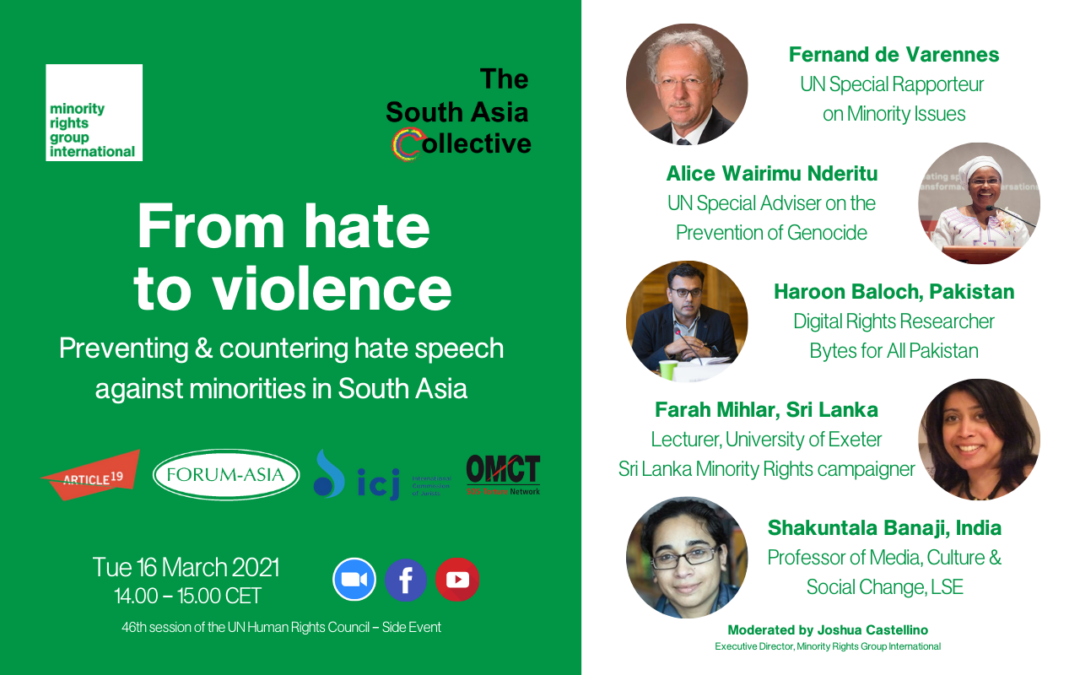
This side event will take place on Tuesday 16 March 2021, from 14:00-15:00 (CET) at the 46th session of the UN Human Rights Council. For registration: https://bit.ly/3llCCMF
Minority Rights Group International and South Asia Collective, along with ICJ, OMCT, Article 19 and FORUM-ASIA, are hosting a side event at 46th session of the Human Rights Council, on hate speech and incitement in South Asia. The aim is to instigate discussion on the causes and consequences of hate speech in South Asia, in the hope of encouraging UN and its agencies to engage better on preventive and early warning actions in the region.
Speakers
- Fernand de Varennes – UN Special Rapporteur on Minority Issues
- Alice Wairimu Nderitu – UN Special Advisor on the Prevention of Genocide
- Haroon Baloch, Pakistan – Digital Rights Researcher, Bytes for All Pakistan
- Farah Mihlar, Srilanka – Lecturer, University of Exeter; Srilanka Minority Rights campaigner
- Shakuntala Banaji, India – Professor of Media, Culture and Social Change at London School of Economics
Moderator
- Joshua Castellino – Executive Director, Minority Rights Group International
Mar 15, 2021 | Advocacy, News
The ICJ and a group of Sri Lankan judges have agreed on the importance of taking effective measures to address discrimination and equal protection in accessing justice in the country.
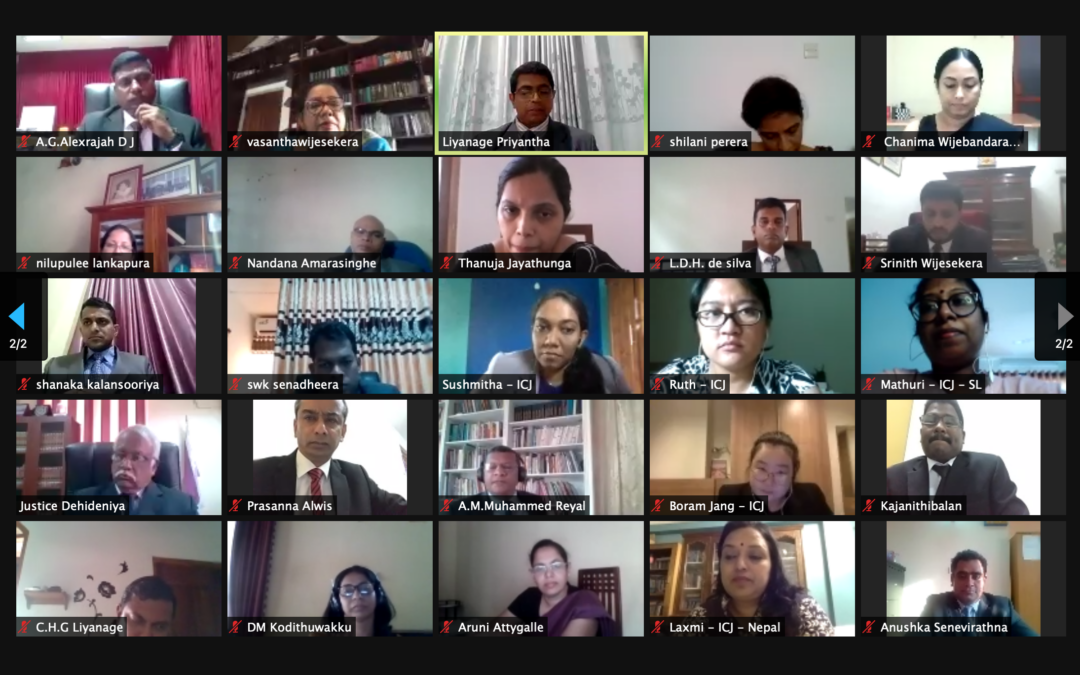
On 6 and 13 March 2021, the ICJ, in collaboration with the Sri Lanka Judges’ Institute (SLJI), organized the National Judicial Dialogue on the Elimination of Discrimination against Women and Enhancing Women’s Access to Justice. This event was organized under the ‘Enhancing Access to Justice for Women in Asia and the Pacific’ project funded by the Swedish International Development Cooperation Agency (SIDA).
Twenty magistrates and District Court judges from around Sri Lanka, with judicial and legal experts from other countries, participated in this judicial dialogue which was conducted virtually due to the COVID-19 pandemic.
The dialogue highlighted how Sri Lankan women continue to face a myriad of challenges including legal, institutional and cultural barriers when accessing justice. Gender biases and discriminatory behaviour prevalent in every aspect of justice delivery needs to be dealt with in order to effectively enhance women’s access to justice.
Boram Jang, ICJ International Legal Advisor remarked that “judiciaries have an important role to play in eliminating gender discrimination in justice delivery as it is a critical component in promoting women’s access to justice. In order to do so, the judges should be equipped with a full understanding of Sri Lanka’s obligations under the CEDAW and other human rights instruments.”
Honorable L. T. B. Dehideniya, Justice of the Supreme Court of Sri Lanka and Executive Director of the SLJI expressed hope that judicial dialogues such as this would “enhance the capacity of participant judges to use the international legal instruments, which Sri Lanka has ratified, in domestic judicial work especially with regard to the elimination of gender inequalities and biases.”
Ms. Bandana Rana, Vice Chair of the CEDAW Committee led a discussion with the judges on the application of the Convention on the Elimination of All Forms of Discrimination Against Women (CEDAW), pointing out that “judges play a pivotal role in identifying the incongruences between existing laws and international human rights standards and ensuring that the full gamut of women’s human rights is retained in line with the CEDAW framework.”
Justice Ayesha. M. Malik, High Court Judge, Lahore, Pakistan affirmed the importance applying the right to access to justice under international human rights law and suggested strategies for reflecting these international standards in judicial decisions.
Attorney Evalyn Ursua addressed on gender stereotypes and biases in justice delivery and engaged the participants on how these could be effectively eliminated. She stated that “the judiciary as a part of the State has the obligation to eliminate gender discrimination.” She encouraged the judges to use the cultural power of law to change language and attitudes surrounding gender discriminatory behaviour and stigma.
The second day featured a discussion on the specific barriers that women in Sri Lanka face when they access justice. Hon. Shiranee Tilakawardane, former Justice of the Supreme Court of Sri Lanka led a discussion on the role and measures available to the judiciary as an institution to enhance access to justice for Sri Lankan women.
Justice Tilakawardane stated that “While theoretically, the Sri Lankan constitution enshrines equality before the law, in reality women continue to feel disadvantaged when they try to access justice” and added “the Sri Lankan judiciary can empower its women only when it understands, acknowledges and addresses the disadvantages they face owing to their gender.” She impressed upon the participant-judges that “ensuring equality is no longer a choice, nor is it merely aspirational, but a pivotal part of judicial ethics.”
The panelists on the second day surveyed the legal, institutional and cultural challenges faced by women at every step of the judicial process. The panel comprised of Prof. Savitri Goonesekere, Emeritus Professor of Law and Former member of the CEDAW Committee, Mrs. Farzana Jameel, P.C, Additional Solicitor General of the Attorney General’s Department and Mrs. Savithri Wijesekara, Executive Director of Women in Need.
Contact
Osama Motiwala, Communications Officer – osama.motiwala@icj.org
Feb 25, 2021 | Advocacy, Non-legal submissions
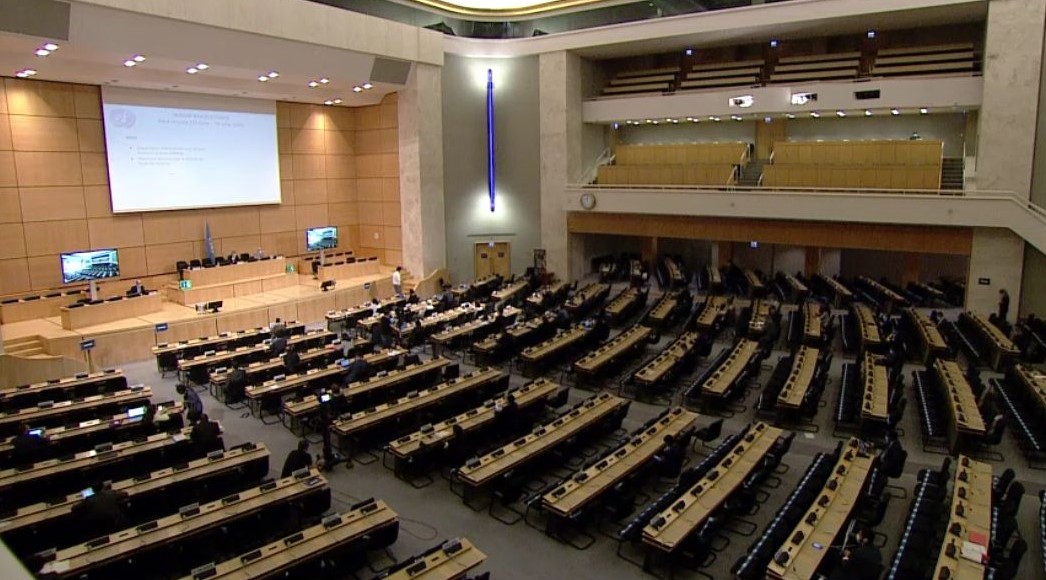
The ICJ today addressed the UN Human Rights Council in the Interactive Dialogue on the Report of the Office of the High Commissioner for Human Rights on Promoting reconciliation, accountability and human rights in Sri Lanka.
The statement reads as follows:
“Madam President,
The ICJ welcomes the comprehensive OHCHR report on Sri Lanka.
We share OHCHR’s observation that domestic initiatives for accountability have repeatedly failed to produce results, ‘more deeply entrenching impunity, and exacerbating victims’ distrust in the system.’ [A/HRC/46/20, pp. 52]
The ICJ has continuously observed that Sri Lanka’s incapacity and unwillingness to pursue accountability for crimes under international law is deep-rooted and longstanding.
The extensive militarization of civilian functions, the reversal of constitutional safeguards, the obstruction of the rare cases of domestic criminal accountability and the deteriorating human rights situation all point to a systemic culture of impunity that will only worsen in the years to come.
Sri Lanka’s failure to establish a hybrid accountability mechanism in the five years since the adoption of Resolution 30/1 demonstrates a complete lack of political will to hold perpetrators accountable. The rights of the victims of human rights violations cannot be ignored any longer.
The ICJ endorses all of OHCHR’s recommendations, particularly the call for international and external accountability processes, whether before the ICC or through the exercise of universal jurisdiction by other States.
We further call for enhanced monitoring and reporting on the ground situation and for the establishment of a mechanism for the collection and preservation of evidence for future prosecution.
Madam High Commissioner, how can OHCHR ensure that the victims’ call for accountability is effectively fulfilled?
I thank you.”
Contact:
Massimo Frigo, ICJ UN Representative, e: massimo.frigo(a)icj.org, t: +41797499949